| ▲ | No more than 100 000 faint satellites should orbit Earth(eso.org) |
| 86 points by Breadmaker 3 hours ago | 121 comments |
| |
|
| ▲ | arjie an hour ago | parent | next [-] |
| These kinds of caps have for years been a dampener on human flourishing. My observation has been that those in stagnation or decline tend to attach themselves to these desires to hold the status quo. Anti-energy, anti-housing, anti-industry and so on because they've reached a local maxima in their ability to live and have chosen to spend their life in leisure. But there is the rest of the world, and if I'm told that the Africans should not have access to high-speed satellite Internet[0] so that the Europeans can use one specific method of looking at the stars, I don't find that convincing. In time, as we expand, space-based observation will become fairly feasible for everyone. And the satellites we have will decay to the Earth should we fail to keep them up there. We will build Earth orbital structures and swarms, and we will build Sun orbital structures and swarms, and we will go to the stars, and it will be better for humanity as a whole. 0: https://www.economist.com/middle-east-and-africa/2026/07/02/... |
| |
| ▲ | Normal_gaussian an hour ago | parent | next [-] | | I think that "Africans should not have access to high-speed satellite Internet" is something you've just made up; the article you link talks about African people turning to Starlink because of local infrastructure issues, and the original article notes that the current satellite count is currently around 14k satellites. 100k is more than enough satellites to provide high-speed satellite internet globally. The article makes mention of specific endeavours, like the night-time mirror satellites, which are particularly disruptive to astronomy, and the general risks of high numbers of satellites. The ability to do Earth based astronomy is something that is of value to all the peoples of Earth, and is mainly funded by the western nations because of their current position as the people with more money. | | |
| ▲ | JumpCrisscross an hour ago | parent | next [-] | | The article doesn’t consider that in a world with a million satellites in orbit, launching space-based telescopes—including into deep space—becomes an order of magnitude cheaper. | | |
| ▲ | onion2k 6 minutes ago | parent | next [-] | | Google says that James Webb telescope cost a total of $10bn. That's not a lot of money in the grand scheme of things. Private citizens could afford to put similar things into space if they chose to. We don't need them to be cheaper. | | |
| ▲ | JumpCrisscross 4 minutes ago | parent [-] | | > James Webb telescope cost a total of $10bn I’d love to see an estimate of what it would cost in a world maintaining a million-satellite fleet. My guess is less than $2bn. |
| |
| ▲ | acdha an hour ago | parent | prev | next [-] | | Does it? My understanding was that it’s less helpful for anything which isn’t in low-earth orbit because the commercial launch engineers are optimizing for the lucrative satellite business, not larger and higher payloads. | | |
| ▲ | JumpCrisscross an hour ago | parent | next [-] | | > commercial launch engineers are optimizing for the lucrative satellite business, not larger and higher payloads Commercial satellites are getting bigger and heavier. Launch that can put big and heavy in LEO can put big and slightly less heavy higher up. Add to that things like in-orbit propellant transfer and there is a good chance astronomy sees a golden age in the coming decades (in countries with space access). I’m not dismissing the problem. Just this analysis as meriting any conclusions. It’s a start. But it’s only part of a full model of how these changes would affect astronomy. | | |
| ▲ | Teever 31 minutes ago | parent [-] | | I get where you're coming from but we haven't really seen any sort of space based telescope designs that take advantage of the Falcon launch paradigm of cheap and reliable launches. Some sort of modular telescope array that could be launched in pieces and self-assemble in orbit. Something that improves in capacity as more pieces are added. Everything seems to have stalled in this field, as if it's just waiting for a Starship which may never come. | | |
| ▲ | JumpCrisscross 27 minutes ago | parent [-] | | > we haven't really seen any sort of space based telescope designs We’re only starting to truly mass manufacture satellites. A world with millions of satellites means one with lots of satellite production and design economies of scale. (Same for all manner of sensors and optics.) > as if it's just waiting for a Starship which may never come Or it may. We’ll know in a couple years. Building a scaling production system for Falcon right now would be silly. And if Starship never works out, we probably don’t see millions of satellites. It’s a fundamentally tied problem, which is why I say the analysis is incomplete. |
|
| |
| ▲ | Tuna-Fish an hour ago | parent | prev [-] | | Larger rockets are inherently more efficient, which is why all the commercial providers are moving towards them. And while yes, most of the providers are targeting primarily for LEO, if you have high payload capacity to LEO you can solve your issue of getting anywhere by packing in a kick stage. And cheap third-party kick stages are available and more are in development. |
| |
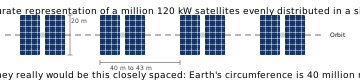
| ▲ | ben_w 21 minutes ago | parent | prev [-] | | Currently writing a draft blog post on all the issues (and non-issues) with these things, it is now long enough (7k words) I'm slightly wondering if it's less "a blog post" and more "one section of a decent sized book on why we can't have nice things". Here's a visual to consider the implications of things you can do with actually one million satellites of the kind of size scale being discussed: https://raw.githubusercontent.com/BenWheatley/blog/refs/head... | | |
| ▲ | JumpCrisscross 17 minutes ago | parent [-] | | > Yes, they really would be this closely spaced: Earth's circumference is 40 million meters Satellites don’t orbit on the ground, which makes the 40m spacing nonsense. And nobody proposes putting a million 120 kW satellites in a single orbit. They really would never be that closely spaced. To approach those densities in a single orbital shell you’d need hundreds of billions of birds in orbit. Spread across all of LEO (and only LEO) we’re talking orders of magnitudes more satellites (like, quadrillions). |
|
| |
| ▲ | rcxdude an hour ago | parent | prev | next [-] | | Not to mention starlink is not a solution for internet for everyone on the planet: it cannot serve everyone in a densely populated area, no matter how many satellites they have in their constellation. It's a useful piece of infrastructure, but it's far from the panacea people seem to think it is. | | |
| ▲ | fc417fc802 22 minutes ago | parent | next [-] | | > it cannot serve everyone in a densely populated area, I also suspect that to be the case but in order to be more objective I wonder. What's the theoretical maximum bandwidth per square meter (or other unit area) that it can deliver? | | | |
| ▲ | IncreasePosts 39 minutes ago | parent | prev [-] | | Ground based infrastructure is much easier to justify in densely populated areas. So, dense areas get ground infra, and the dispersed rural population can get satellite infra |
| |
| ▲ | ck2 31 minutes ago | parent | prev [-] | | note that including dead things in orbit (that we currently have no way to remove) is actually 32,000 not just 14,000 what we need is the investment for "space roombas" that go around bumping things out of orbit that are dead or did not de-orbit properly the problem is all that atmospheric burnup creates a lot of toxic pollution * https://www.bloomberg.com/graphics/2025-space-orbit-satellit... | | |
| ▲ | JumpCrisscross 3 minutes ago | parent [-] | | > we currently have no way to remove Nature takes care of this for us in LEO. I’ve seen no serious plans to put millions of anything anywhere else. |
|
| |
| ▲ | solid_fuel 17 minutes ago | parent | prev | next [-] | | > These kinds of caps have for years been a dampener on human flourishing. I don't think blocking the view of the night sky is necessary for "human flourishing", actually. Your attitude reminds me of the Victorians, who saw their coal-smoke filled skies as a sign of virtuous progress. More reasonable minds prevailed, in the end, and now most people have a more balanced view - with the understanding that progress and industry must be balanced with the ecosystem we live in and depend upon for life. | |
| ▲ | matthewdgreen 35 minutes ago | parent | prev | next [-] | | I didn't understand what these satellites were really like until I visited Zion National Park two weeks ago. Zion is an International Dark Sky park, and so I was really looking forward to seeing the stars. Instead we sat outside and watched dozens and dozens of fast-moving stars zip around on all sorts of trajectories. I'm not saying it ruined the experience (I'm not an astronomer, and it was kind of fun.) But it really brought home how fundamentally we've changed the sky. I also hope we're able to lay enough fiber in developing countries that this many satellites don't need to stay up there forever. | | |
| ▲ | qntmfred 15 minutes ago | parent | next [-] | | for reference https://x.com/Jeremyrand101/status/1981564984154005876 I frequently hang out in my driveway in the early evenings shooting basketball and listening to podcasts. I'll see easily several dozen satellites over the course of the hour or two that I typically stay out there. and I don't even live out in the country or anything. I think mostly people are just not aware (yet?) of how rapidly the number of satellites have grown in the last couple years. | |
| ▲ | phainopepla2 28 minutes ago | parent | prev | next [-] | | I had the same experience visit Mojave National Preserve. It was very distracting while trying to stargaze. I had to stay up late to see the night sky I remember | |
| ▲ | verdverm 30 minutes ago | parent | prev | next [-] | | What time were you there? My understanding is that around dawn/dusk, the angles cause reflection, but for most of the time they are not visible. Also, what about planes? Those also cause similar light streaks. Another understanding I currently hold is that there is already a method for removing these artifacts | |
| ▲ | pfisch 21 minutes ago | parent | prev [-] | | How can anyone see what is happening in Ukraine and not realize the future is not just 1 starlink, but also a Chinese one and a Europe at a minimum. Probably many other countries will make sure to have at least a regional one as well though. | | |
| ▲ | JumpCrisscross 2 minutes ago | parent [-] | | I could absolutely see Europe Greenpeace-nuking its way out of having a LEO constellation while everyone else builds them. |
|
| |
| ▲ | piloto_ciego an hour ago | parent | prev | next [-] | | As a literal leftist by any reasonable metric, the recent trend towards “I wish it was 1995” and “AI is the worst” and “tech sucks now” from people I agree with on many other points frustrates me to no end. “You guys know we could basically live in a Star Trek style utopia if we get this right, right?” “The DATA cenTERS are STEALING the water and breaking Taleckshual ProPerty LERRS!” Like, I thought we were for piracy, and against capital colonizing the space of creative ideas? But I guess what a lot of people were fond of was feeling important. | | |
| ▲ | hack1312 42 minutes ago | parent | next [-] | | “if we get this right” is doing a whole lot of heavy lifting here. | | | |
| ▲ | matthewdgreen 32 minutes ago | parent | prev | next [-] | | Even Star Trek admits that there are horrible events that lie between our world and the utopia. | |
| ▲ | piperswe an hour ago | parent | prev | next [-] | | If politics were trending left I’d agree with you, but as-is the bourgeoisie are the only ones that will get any upside from modern tech. | |
| ▲ | tadfisher 26 minutes ago | parent | prev | next [-] | | In Star Trek canon, humanity figured out how to live in utopia by destroying all existing power structures in a Third World War. What is happening now is we have all our existing structure, and the existing requirement to earn money to live within this structure, and the human creative output we want in our eventual utopia is used to train automata with the express goal to replace humans in those creative endeavors, removing the ability for humans to earn money by being creative themselves. It is not hard to see things from this perspective when a significant portion of writing is becoming obvious slop, and your liberal friends are having a hard time getting hired or landing writing deals or selling artwork. I would feel less important too; I'm already feeling this way when I review a PR with obvious LLM-generated descriptions and comments that reference the prompt. Ideally, feeling important wouldn't be pejorative. Ideally, we'd have a way for artists to have food and shelter and continue to produce art. The hopes that AI will cause this to happen are equivalent to hoping WWIII will come along and wipe out 2/3 of humanity so we can start over with United Earth and warp drives and replicators. | |
| ▲ | SidewaysView 7 minutes ago | parent | prev | next [-] | | God you techbro dorks are so fucking annoying. Kill. All. Trekkies. Now! | |
| ▲ | ben_w 15 minutes ago | parent | prev | next [-] | | Mm. I know a (US) Green party campaigner who is a self-described communist (I forget which variety), who has yet to realise the contradiction between her love of trade unions and support of the environment when it presents itself in support of the famous UK coal miner's strikes. | |
| ▲ | afpx 26 minutes ago | parent | prev | next [-] | | In 1990 I hoped my grandkids would be able to join starfleet. After watching most of the gains go to the worst, I just hope they can escape the borg. | | |
| ▲ | ben_w 10 minutes ago | parent [-] | | I was a kid in the 90s. Kinda surprised we got the (almost) universal translator before we got fusion. |
| |
| ▲ | tsunagatta an hour ago | parent | prev | next [-] | | AI is not going to give us a star trek utopia, AI is an attempt by the bourgeoise to alienate the average person from the capital that has previously always come free with their human life. AI promises a feudalist future where there is no capital that isn't owned by the ruling class. Its power is not democratized, it is concentrated in the hands of those building the data centers. That is why I'm against the data centers. I feel like all leftists should be. | | |
| ▲ | ben_w 4 minutes ago | parent | next [-] | | > AI promises a feudalist future where there is no capital that isn't owned by the ruling class. We may get that, but only if the ruling class want what the Victorians called a "folly": https://en.wikipedia.org/wiki/Folly AI is wildly, wildly divergent in the possible futures it brings. It's really important to influence what happens, but don't limit the potential downside to only as bad as feudalism (neither neo-feudalist nor re-enacted): much worse monsters exist than the typical feudal lord. (Was going to say "among those rulers who needed us alive to fight their wars and grow their food", but then I remembered Cambodia and Pol Pot). | |
| ▲ | JumpCrisscross 41 minutes ago | parent | prev [-] | | > Its power is not democratized, it is concentrated in the hands of those building the data centers. That is why I'm against the data centers If you really believe this (and I’m not saying I don’t, I just don’t have confidence in it), blocking domestic. datacenters doesn’t preserve that labour value. It just ensures whoever builds those datacenters controls production from afar. Like, if AI really replaces human labour, does Africa and Europe having few AI datacenters protect it from America and China? Of course not. Not outside a symbolic level that even then would have to exist with the implied consent of the powers who produce. | | |
| ▲ | tadfisher 24 minutes ago | parent [-] | | Sorry, do Memphis residents get to control xAI's production? I think we're already in this situation. | | |
| ▲ | JumpCrisscross 20 minutes ago | parent [-] | | > we're already in this situation xAI’s datacenters aren’t currently measurably replacing labour. So no, we’re not. If AI becomes economically competitive with broad sections of human labor, those who control it do have the power to replace humans. But banning domestic datacenters doesn’t stop them from existing; it just stops them from existing here. If that precondition arises, that’s just a recipe for domestic deindustrialisation. If you believe AI will replace human labor, blocking datacenters is silly. You want labor (or the public) to build and control them. I’m not convinced AI will replace labor, so I’m not yet at that step. |
|
|
| |
| ▲ | AngryData an hour ago | parent | prev [-] | | The problem is people don't see the near future as a Star Trek utopia, they see it going more towards a dystopian landscape with handfuls of extremely wealthy elite dictating how they can live their life. | | |
| ▲ | brandensilva 25 minutes ago | parent | next [-] | | It's easy to see why people fear AI when our leaders talk of a future where many are jobless and replaced with no solutions to fill in the gaps. AI adoption is a leadership failure more than a tech one right now. If you make people feel empowered with it, it can liberate work-free lives that humanity benefits from. If you use it to destroy people's livelihoods with no options it's not going to survive a revolution. | |
| ▲ | CookieCrisp 42 minutes ago | parent | prev | next [-] | | Which would make sense if they chose strategies that might stop that from happening. Instead the ones I know refuse to even learn what AI can do and refuse to see that they're not going to slow it's adoption down by sealing themselves off. The world was already heading towards a dystopian landscape without AI. So many people on this planet live in a horrific dystopia right now, and here comes along something that might help them. Might give us what we need to stop global warming. I'd rather choose something with a 1% chance of working out than what we had before, 0%. | | |
| ▲ | AngryData 26 minutes ago | parent [-] | | But our top 2 problems are political shenanigans and energy production. And neither are going to be solved by AI, both are made worse with AI. AI is a useful tool, but tools aren't always used to improve lives. |
| |
| ▲ | 39 minutes ago | parent | prev [-] | | [deleted] |
|
| |
| ▲ | gordonhart an hour ago | parent | prev | next [-] | | In related news, earlier this year Chile cancelled plans for a gigawatt-scale solar/wind powered hydrogen production plant nearby the ESO facility in the Atacama desert after light pollution complaints from European scientists. | |
| ▲ | pshirshov an hour ago | parent | prev | next [-] | | > we will build Sun orbital structures and swarms, Another episode of arrogant fantasy in the ponyworld. | |
| ▲ | isatty an hour ago | parent | prev | next [-] | | Well, if you build too many satellites in the swarms, at some point you will lose the ability to see or go to the stars. | |
| ▲ | JBorrow 42 minutes ago | parent | prev | next [-] | | Moving all of astronomy to space based observations is entirely incompatible with the way that instruments are funded, built, and deployed. It is only valid for a set of highly specific and well funded observatories that take decades to get off the ground and can never be updated, improved, or modified to search new scientific directions. Why don’t “we” just build more cell towers? | | |
| ▲ | JumpCrisscross 13 minutes ago | parent [-] | | > Why don’t “we” just build more cell towers? Why is littering our landscape with cell towers and power and fiber lines inherently better than putting this stuff in space? | | |
| |
| ▲ | happytoexplain an hour ago | parent | prev | next [-] | | This is unrealistic, uncharitable, and tribalistic. | |
| ▲ | toasty228 an hour ago | parent | prev | next [-] | | > But there is the rest of the world, and if I'm told that the Africans When the average African live like the average American we'll be truly fucked, probably even before that. We should raise the bottom for sure but we definitely need to cure the degeneracy of the top too Technosolutionism is a cult. We either put the caps on ourself or nature will hard cap us anyways, in a much harsher way. | |
| ▲ | snovv_crash an hour ago | parent | prev | next [-] | | Maybe a fair allocation of sattelites would be proportional to the number of citizens with voting rights in the country. Maybe with some modifier about how impactful that voting can actually be (eg. citizen initiatives vs. just electing representatives from a preselected pool). | | |
| ▲ | JumpCrisscross an hour ago | parent | next [-] | | > a fair allocation Who is doing this allocation? Who is going to tell Pyongyang, Beijing or Moscow they can’t launch anymore? | | |
| ▲ | guelo 44 minutes ago | parent [-] | | If we weren't busy stupidly destroying the institutions for international cooperation, it would be a UN body. | | |
| ▲ | JumpCrisscross 40 minutes ago | parent [-] | | > it would be a UN body No UN body can command a nuclear sovereign. They ultimately continually consent to oversight. | | |
| ▲ | vova_hn2 25 minutes ago | parent [-] | | > No UN body can command a nuclear sovereign. Why not, though? If any country violates their limit, just issue a concern. If they ignore it, upgrade it to a grave concern. Then they will surely have to obey, I mean, it's grave concern we're talking about, what else they could do? |
|
|
| |
| ▲ | JuniperMesos an hour ago | parent | prev | next [-] | | As a California resident I really don't like the idea of a legal framework that encourages more citizen initiatives. They would be used to try to prevent building more housing. | |
| ▲ | rockemsockem an hour ago | parent | prev [-] | | Starlink satellites can provide anyone with Internet. | | |
| |
| ▲ | kibwen 42 minutes ago | parent | prev | next [-] | | > These kinds of caps have for years been a dampener on human flourishing. My observation has been that those in stagnation or decline tend to attach themselves to these desires to hold the status quo. Anti-energy, anti-housing, anti-industry and so on because they've reached a local maxima in their ability to live and have chosen to spend their life in leisure. This kind of attitude has for millenia been a dampener on human flourishing. My observation has been that those without empathy or foresight tend to attach themselves to these initiatives to obliterate our shared human heritage to satisfy their own ridiculous misconception of progress. Anti-intellectual, anti-curious, anti-social and so on because they've reached a local maxima in their ability to give a damn about what it means to live a good life and have chosen to spend their life in self-satisfied ignorance. | |
| ▲ | umpalumpaaa an hour ago | parent | prev | next [-] | | And swarms | |
| ▲ | api 35 minutes ago | parent | prev [-] | | “Anti” is a kind of super-meme that took over discourse in a lot of spheres, especially anywhere near academia, starting in the 1970s. If I had to trace it to one source it would probably be the Club of Rome and Limits to Growth. Paul Erlich would be a close second with The Population Bomb. Here’s a great podcast on the latter: https://www.youtube.com/watch?v=Nn1gieFMuWI This stuff sounds right because obviously you can’t have infinite growth in population or resource use on a finite planet. That means it won’t happen. The question is “how will it not happen?” The answer right now looks like “as people get wealthier they have fewer kids.” There are other possible answers like dematerialization of the economy which is also a thing. Before the 70s this stuff would have been called far right and identified with ideologies like authoritarian eugenics and fascism. The 70s is when a lot of “volkisch” proto-fascist and crypto-fascist ideas got a lefty hippie makeover. The other big one is the idea that “natural” is inherently good. I finally see this stuff getting some challenge from all across the political spectrum, even from the left. In previous decades you only ever saw it get challenged from the right or from what were once called libertarians. |
|
|
| ▲ | nablaxcroissant an hour ago | parent | prev | next [-] |
| I'm not sure how exactly they are making these calculations but I just don't see it. Both Reflect and SpaceX are targeting SSO orbits where they are only reflecting for an hour or two at sunset. That isn't true of Starlink, but that constellation is already up there and if its fine right now, I don't see it getting much worse as the materials on it get refined to be less problematic. More regulations would just have the result of cementing a monopoly for Spacex. |
|
| ▲ | xadhominemx 2 hours ago | parent | prev | next [-] |
| I am a science and astronomy fan, but I am sorry, in this case progress is more important. If we regret our decision, the LEOs will fall out of the sky by themselves in a few years and it will be ok. |
| |
| ▲ | edelbitter an hour ago | parent | next [-] | | Some scientific endeavors can be paused and maybe later relaunched, if funding has not dried up and temporarily-worthless machinery has not been left to rot. But stuff like mitigating the constant threat of big enough objects showing up on a collision course with earth should not be paused until those eye-catchers fall out of the sky. If there is something coming at us that can wipe out more than the stock price of one particularly space-enthusiastic company, we should like to know within a time period appropriate for our current planetary defense capabilities. Which will surely improve, over time - so maybe we can pollute the sky, later. | | |
| ▲ | Legend2440 an hour ago | parent | next [-] | | >the constant threat of big enough objects showing up on a collision course with earth I don't really think this is a serious risk. This is a once-in-a-million-years kind of event. Also, asteroid detection is not seriously affected by satellites. We can easily tell the difference between a moving satellite and a moving asteroid because of their speed. | |
| ▲ | xadhominemx 44 minutes ago | parent | prev [-] | | Is that sort of research unavoidably impaired by a more crowded night sky? Or do we just have to spend more to collect the same quality of data from more or better terrestrial observatories? |
| |
| ▲ | SilverElfin an hour ago | parent | prev | next [-] | | China’s constellations are going to orbits that will take hundreds of years to return to earth and could make launching much harder if there is a collision. As far as I know only SpaceX has satellites in low orbits that frequently need propulsion to push back up, and fall back within 5 years. | |
| ▲ | croes an hour ago | parent | prev [-] | | A few years is a large knowledge gap if an asteroid is on its way to us. Not to mention that’s not how it works. We regret burning so much fossil fuel but those who make huge profits from it prevent as much change as they can. You can bet Amazon and SpaceX will do the same no matter how the rest of us regrets it |
|
|
| ▲ | Legend2440 2 hours ago | parent | prev | next [-] |
| This is a tradeoff we have to make with infrastructure and development in general. How do you balance human needs with pristine nature? Do we put up long-distance power lines and wind farms even though they ruin the views? Do you tear down a forest to put up farmlands and suburbs? Do you build a dam to provide water for irrigation, even though it kills the fish and floods a valley? Satellites are actually easier than most of those tradeoffs, because nothing lives in space and there's no nature to destroy. It only affects us. |
| |
| ▲ | dgellow 5 minutes ago | parent | next [-] | | > How do you balance human needs with pristine nature? How about we set a limit on how many satellites? That’s exactly how to balance | |
| ▲ | croes an hour ago | parent | prev [-] | | They hinder the view on asteroids coming our way. The purpose of most of these satellites is internet access where we already have less limited possibilities with less maintenance costs like constant replacement | | |
| ▲ | Legend2440 an hour ago | parent | next [-] | | No they don't. It's more of an issue for long-exposure galaxies and nebula. And asteroids are an extremely rare threat in the first place. It's literally a once-in-a-million-years kind of event. | | |
| ▲ | croes 22 minutes ago | parent [-] | | Dinosaur killers? Yes. City killers? That size hits more often > Asteroids with a diameter more than 30–50 metres (100–150ft) are large enough to make it through our atmosphere intact, however, and the chance of this happening is estimated to be around once in every 100 years. > The damage from an impact of this size would be wide-ranging, and could wipe out an entire city if they were to impact a heavily populated area. https://www.skyatnightmagazine.com/space-science/chances-ast... | | |
| ▲ | Legend2440 2 minutes ago | parent [-] | | We lack the technology to detect this size of asteroid with enough time to do anything about it. Luckily, the majority of the earth's surface is unpopulated. Most of these rocks hit the ocean or Siberia and cause few or no casualties. The odds of it hitting a major city are quite low. |
|
| |
| ▲ | JumpCrisscross an hour ago | parent | prev [-] | | > They hinder the view on asteroids coming our way Source? |
|
|
|
| ▲ | michelb 2 hours ago | parent | prev | next [-] |
| Worrying for sure. But I doubt the current USA, along with Israel and Russia are going to be bothered about this. Everyone is launching satellites and other gear into orbit for war. |
| |
| ▲ | gordonhart an hour ago | parent | next [-] | | Interesting that your list omits China considering they have firm plans to launch ~41k satellites for government/commercial constellations plus ITU filings for >200k proposed satellites. | |
| ▲ | johnnyApplePRNG an hour ago | parent | prev | next [-] | | They're already itching to throw space-lasers into orbit. [0] I wish I was joking. [0] https://www.jpost.com/defense-and-tech/article-900854 | |
| ▲ | SubiculumCode 2 hours ago | parent | prev [-] | | Or defense. | | |
| ▲ | sylos an hour ago | parent [-] | | Defense is just a polite term for war. | | |
| ▲ | SubiculumCode 25 minutes ago | parent | next [-] | | There is this mistaken idea out there that if the U.S. were to disarm, then other nations would also disarm, and the whole world would live in peace. But history tells us over and over that power abhors a vacuum, and were the U.S. to leave the world, another would take its place, probably Russia or China. If we disarmed, then another nation with arms will inevitably invade the U.S. | |
| ▲ | 32 minutes ago | parent | prev [-] | | [deleted] |
|
|
|
|
| ▲ | upofadown an hour ago | parent | prev | next [-] |
| >SpaceX plans to send one million more satellites into orbit, for space-based data centres, ... I think we should wait to see how the first satellite data centre works out. It seems fairly unlikely that it could be practical. It seems kind of nuts... >Reflect Orbital, a US start-up, aims to launch a constellation of very large mirror-like satellites to provide sunlight at night, with reflected beams that span at least five kilometres on Earth's surface. Straight up nuts with no practical value, even if it did work out. |
| |
| ▲ | ggreer 25 minutes ago | parent [-] | | I can think of several practical uses. It would be very useful immediately after a disaster. Lighting up the night would make search & rescue much more effective. It would also allow for more solar power generation in an area, reducing pollution. Extra light at high latitudes in the winter would reduce seasonal depression. Are they worth the cost/tradeoffs? I don’t know. But there is practical value to lighting up the night. |
|
|
| ▲ | 0-_-0 an hour ago | parent | prev | next [-] |
| If we can launch 1M satellites, how many telescopes can we launch? |
| |
| ▲ | croes an hour ago | parent [-] | | Who is we?
Certainly not amateur astronomers who made important discoveries with their telescopes | | |
| ▲ | monocasa an hour ago | parent [-] | | If the cost to orbit does get low enough as is the assumption in this article, I would be shocked if we didn't start to see amateur space based telescopes. | | |
| ▲ | verdverm 25 minutes ago | parent [-] | | Or services where you can buy some photos, like we have for the telescopes pointed at earth |
|
|
|
|
| ▲ | manoDev an hour ago | parent | prev | next [-] |
| Should it be possible to coordinate orbits to create permanent clear spots on the sky where observatories are? A LEO no flight zone of sorts. |
|
| ▲ | tapland 2 hours ago | parent | prev | next [-] |
| Ugh the part about Munich is depressing. Finding a dark clear sky spot is one of the worlds greatest joys and most awesome experiences. |
|
| ▲ | protortyp an hour ago | parent | prev | next [-] |
| Of course this comes from a European organisation. |
| |
| ▲ | earthnail an hour ago | parent [-] | | I really wanted to downvote this because I hate the constant EU bashing, but I just have to agree. So we can’t see the stars from Munich anymore? Yes, that’s depressing, but we’re not trying to reduce light smog in Munich right now, are we? Because all the buildings that have been build, all the streets and trains, also make it hard to see the stars. More light is one of the things progress has always brought, and eventually we will just have to accept that we started building in the sky, too. We should introduce a global agreement that commercial satellites must fall out of the sky within a few years to reduce debris. It should be an agreeable term since the debris hinders everyone doing business up there. Every nation is going to partially ignore it anyway, for military purposes for example. But that’s a different demand than a cap on the total number of satellites. | | |
| ▲ | ShinyLeftPad 22 minutes ago | parent [-] | | > we’re not trying to reduce light smog in Munich right now, are we we aren't? Bavarian Regulation on Light Pollution, Federal Nature Conservation Act, etc Municipal lighting is regulated with light pollution in mind and allegedly you get fined over bright commercial lights at night |
|
|
|
| ▲ | mrwaffle an hour ago | parent | prev | next [-] |
| For a very imprecise visual, I like the site https://satellite.love |
|
| ▲ | rho138 an hour ago | parent | prev | next [-] |
| It upsets me that an establishment like ESO would grip on the “data centers in space” narrative given the absurd physics constraints. |
|
| ▲ | chhxdjsj an hour ago | parent | prev | next [-] |
| Perhaps we have 100 years to spread consciousness to space before civilisation is devastated by demographic collapse or nuclear war or some horrible virus or islam. 99.9% of species that have existed on earth are already extinct. Climate change happens constantly over long periods. Our CO2 emissions will be background noise on a million year timescale. Time to ignore the whingers and the NIMBYs and colonize the universe. |
|
| ▲ | CodesInChaos an hour ago | parent | prev | next [-] |
| How much CO2 does launching a million satellites produce? Is is significant compared to other sources of CO2? |
| |
| ▲ | verdverm 21 minutes ago | parent [-] | | Compare it to air planes, which are already at a much more significant scale. Accounting for fuel type and combustion efficiency seems relevant. I recall around SpaceX 100th landing, that a day of just transatlantic flights was more than everything SpaceX had done to that point |
|
|
| ▲ | zoilism 2 hours ago | parent | prev | next [-] |
| For the first time in human history, the generations living now have been systematically robbed of their ancestral right to witness the night sky and its jaw-droppingly awe-inspiring magnificence. |
| |
|
| ▲ | tiahura an hour ago | parent | prev | next [-] |
| 99.99% of the world would rather watch a train of Starlink satellites than some star they couldn't see anyway. Not to mention the satellites' other benefits. |
| |
|
| ▲ | next_xibalba 20 minutes ago | parent | prev | next [-] |
| Fortunately, no one owns space, so we don’t have to listen to these decels. |
|
| ▲ | zer0energy 37 minutes ago | parent | prev | next [-] |
| I do not understand why the astronomers feel entitled to determine fair use of the sky. I feel like it's much easier and more reasonable to ask what the telescopes can do to mitigate the problem than to insist that others back off from use of the communal resource. The great observatories are marvels of engineering - a focused effort on technical mitigations to the satellite problem would likely push the problem out for decades into the future. Two possible paths forward:
1. inserting a shutter into the beam path while a satellite is transiting the field of view of the telescope, or
2. (somewhat worse from an SNR perspective) terminating an exposure right before it's corrupted by a transiting satellite and starting a new exposure once the satellite has passed. I for one would much rather see effort put into advancing telescope design than blocking advances of our use of space! |
| |
| ▲ | ShinyLeftPad 34 minutes ago | parent [-] | | maybe for example because thanks to them we have satellites in the first place? I agree with this and I'm not an astronomer btw. | | |
| ▲ | vova_hn2 19 minutes ago | parent [-] | | > thanks to them we have satellites in the first place? What kind of astronomy knowledge is required to launch a satellite? | | |
| ▲ | ShinyLeftPad 14 minutes ago | parent [-] | | idk if I want to list all if it cause it will be very long but let's start with knowing that earth rotates on its axis;) |
|
|
|
|
| ▲ | rcpt 2 hours ago | parent | prev | next [-] |
| Why are they bright? Do they have big lights flashing or is it reflection |
| |
| ▲ | pwg 30 minutes ago | parent | next [-] | | Likely because, in space, reflective items don't heat up as much from sunlight as would a dark, energy absorbing, material. Shedding heat in space is a difficult enough endeavor already without also painting your satellite black so it reflects less light (and thereby absorbs more heat). | |
| ▲ | 0-_-0 2 hours ago | parent | prev [-] | | And what are they reflecting when they are in Earth's shadow? | | |
| ▲ | 43 minutes ago | parent | next [-] | | [deleted] | |
| ▲ | croes an hour ago | parent | prev [-] | | They aren’t in the Earth’s shadow at the start of the night > For the SpaceX satellite mega-constellation, he found that dozens of trails would appear in each image taken two hours into the night with ESO’s Very Large Telescope (VLT) at Paranal Observatory in Chile Not to mention the satellites of Reflect Orbital whose sole purpose is reflecting sun light into night areas |
|
|
|
| ▲ | ChrisArchitect an hour ago | parent | prev | next [-] |
| Title is: One million satellites and mirrors in space pose grave threat to the night sky |
|
| ▲ | riazrizvi an hour ago | parent | prev | next [-] |
| Yes okay, good luck with that. The strategic importance to nations is far too high, it just means astronomy will evolve to a thing where it's done from space. But if you want to be the region where you support these ideas and undermine your own political support for national self-interest then that's your choice. Europe is overrun by these professional class types with nice ideas that are mispriorized. It's like a land of people that behave like pets lacking practical self-sufficiency. |
|
| ▲ | ck2 an hour ago | parent | prev | next [-] |
| too late https://satellitemap.space there are already several starlink competitors and even other countries planning to launch their own 1000-10,000 node networks |
|
| ▲ | holoduke an hour ago | parent | prev | next [-] |
| ah and guess what. only western US / European countries are allowed to have them. The rest are called shadow fleet satellites. |
|
| ▲ | SilverElfin an hour ago | parent | prev | next [-] |
| It’s a public space. No one should be able to just take it over for free. We aren’t being compensated for the pollution of our skies. And also, higher orbits require much longer for debris to fall back and burn up. |
|
| ▲ | Rekindle8090 an hour ago | parent | prev [-] |
| [dead] |