| ▲ | JumpCrisscross 2 hours ago |
| The article doesn’t consider that in a world with a million satellites in orbit, launching space-based telescopes—including into deep space—becomes an order of magnitude cheaper. |
|
| ▲ | acdha 2 hours ago | parent | next [-] |
| Does it? My understanding was that it’s less helpful for anything which isn’t in low-earth orbit because the commercial launch engineers are optimizing for the lucrative satellite business, not larger and higher payloads. |
| |
| ▲ | JumpCrisscross 2 hours ago | parent | next [-] | | > commercial launch engineers are optimizing for the lucrative satellite business, not larger and higher payloads Commercial satellites are getting bigger and heavier. Launch that can put big and heavy in LEO can put big and slightly less heavy higher up. Add to that things like in-orbit propellant transfer and there is a good chance astronomy sees a golden age in the coming decades (in countries with space access). I’m not dismissing the problem. Just this analysis as meriting any conclusions. It’s a start. But it’s only part of a full model of how these changes would affect astronomy. | | |
| ▲ | Teever an hour ago | parent [-] | | I get where you're coming from but we haven't really seen any sort of space based telescope designs that take advantage of the Falcon launch paradigm of cheap and reliable launches. Some sort of modular telescope array that could be launched in pieces and self-assemble in orbit. Something that improves in capacity as more pieces are added. Everything seems to have stalled in this field, as if it's just waiting for a Starship which may never come. | | |
| ▲ | JumpCrisscross an hour ago | parent [-] | | > we haven't really seen any sort of space based telescope designs We’re only starting to truly mass manufacture satellites. A world with millions of satellites means one with lots of satellite production and design economies of scale. (Same for all manner of sensors and optics.) > as if it's just waiting for a Starship which may never come Or it may. We’ll know in a couple years. Building a scaling production system for Falcon right now would be silly. And if Starship never works out, we probably don’t see millions of satellites. It’s a fundamentally tied problem, which is why I say the analysis is incomplete. |
|
| |
| ▲ | Tuna-Fish 2 hours ago | parent | prev [-] | | Larger rockets are inherently more efficient, which is why all the commercial providers are moving towards them. And while yes, most of the providers are targeting primarily for LEO, if you have high payload capacity to LEO you can solve your issue of getting anywhere by packing in a kick stage. And cheap third-party kick stages are available and more are in development. |
|
|
| ▲ | onion2k an hour ago | parent | prev | next [-] |
| Google says that James Webb telescope cost a total of $10bn. That's not a lot of money in the grand scheme of things. Private citizens could afford to put similar things into space if they chose to. We don't need them to be cheaper. |
| |
| ▲ | JumpCrisscross an hour ago | parent [-] | | > James Webb telescope cost a total of $10bn I’d love to see an estimate of what a JWST-class telescope would cost to design, build and launch in a world maintaining a million-satellite fleet. My guess is less than $2bn. | | |
| ▲ | HPsquared an hour ago | parent [-] | | A big part of the complexity of JWST was the way everything had to fold and fit into a small launch vehicle. With larger vehicles (e.g. Starship) the JWST mirror could have been built in one piece, which is much simpler. The whole thing was engineered to the max to fit within tight constraints, which is very expensive. | | |
| ▲ | JumpCrisscross 40 minutes ago | parent [-] | | > With larger vehicles (e.g. Starship) the JWST mirror could have been built in one piece, which is much simpler Not just the complexity of design, but also cost and complexity of cryo-vacuum testing hundreds of deployment mechanisms any one of whose failure critcially endangers the project. The mirror could also be conventionally manufactured versus requiring gold-plated beryllium [1]. [1] https://en.wikipedia.org/wiki/Optical_Telescope_Element |
|
|
|
|
| ▲ | ben_w an hour ago | parent | prev [-] |
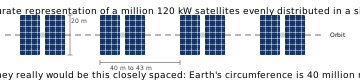
| Currently writing a draft blog post on all the issues (and non-issues) with these things, it is now long enough (7k words) I'm slightly wondering if it's less "a blog post" and more "one section of a decent sized book on why we can't have nice things". Here's a visual to consider the implications of things you can do with actually one million satellites of the kind of size scale being discussed: https://raw.githubusercontent.com/BenWheatley/blog/refs/head... |
| |
| ▲ | JumpCrisscross an hour ago | parent [-] | | > Yes, they really would be this closely spaced: Earth's circumference is 40 million meters Satellites don’t orbit on the ground, which makes the 40m spacing nonsense. And nobody proposes putting a million 120 kW satellites in a single orbit. They really would never be that closely spaced. To approach those densities in a single orbital shell you’d need hundreds of billions of birds in orbit. Spread across all of LEO (and only LEO) we’re talking orders of magnitudes more satellites (like, quadrillions). | | |
| ▲ | ben_w 4 minutes ago | parent | next [-] | | > Satellites don’t orbit on the ground, which makes the 40m spacing nonsense. Hence why the horizontal scale bar says "40 m to 43 m": Going to 500 km doesn't add much to the orbit's circumference. > And nobody proposes putting a million 120 kW satellites in a single orbit. One of my tentative conclusions is that it would be an improvement if they did. It's in my blog post because I'm considering all possible arrangements of ways to do this. Current list: • Spread them out by altitude while still keeping them in sun-synchronous low earth orbit like SpaceX plan
• Put them all of them in a single sun-synchronous low earth orbit so none of them can hit each other
• Spread them out like Starlink currently is
• Have swarms, where each group has many satellites significantly closer to each other than the usual safety separation, like Google's Project Suncatcher
• Have fewer, bigger satellites, like Starcloud
> To approach those densities in a single orbital shell you’d need hundreds of billions of birds in orbit. Spread across all of LEO (and only LEO) we’re talking orders of magnitudes more satellites (like, quadrillions).Matters less than I expected when I started writing. How much so depends on what I end up adding by treating gaps in "full" (up to the safety margin) orbits as the thing of interest and seeing if someone's done a version of this on spherical geometry: https://math.stackexchange.com/questions/270937/how-can-you-... | |
| ▲ | HPsquared 38 minutes ago | parent | prev [-] | | Can all orbits be completely filled at once, though? They'll intersect at some point (I had originally said poles but that's only polar orbits..) ... I suppose you have phase, altitude and inclination (and eccentricity which adds another couple of variables). But they do intersect, don't they? | | |
| ▲ | JumpCrisscross 28 minutes ago | parent [-] | | > Can all orbits be completely filled at once, though? They’ll intersect Correct. I wasn’t proposing a realistic configuration. Just showing why OP’s visual doesn’t work for the numbers it gives. (It 1D space fills. I expand that to 2 and 3D.) Millions of satellites is currently accepted as the maximum carrying capacity of LEO before collisions becomes a PITA. |
|
|
|