Remix.run Logo
ben_w an hour ago

Currently writing a draft blog post on all the issues (and non-issues) with these things, it is now long enough (7k words) I'm slightly wondering if it's less "a blog post" and more "one section of a decent sized book on why we can't have nice things".

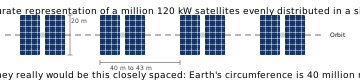
Here's a visual to consider the implications of things you can do with actually one million satellites of the kind of size scale being discussed:

https://raw.githubusercontent.com/BenWheatley/blog/refs/head...

JumpCrisscross an hour ago | parent [-]

> Yes, they really would be this closely spaced: Earth's circumference is 40 million meters

Satellites don’t orbit on the ground, which makes the 40m spacing nonsense. And nobody proposes putting a million 120 kW satellites in a single orbit.

They really would never be that closely spaced. To approach those densities in a single orbital shell you’d need hundreds of billions of birds in orbit. Spread across all of LEO (and only LEO) we’re talking orders of magnitudes more satellites (like, quadrillions).

ben_w 2 minutes ago | parent | next [-]

> Satellites don’t orbit on the ground, which makes the 40m spacing nonsense.

Hence why the horizontal scale bar says "40 m to 43 m": Going to 500 km doesn't add much to the orbit's circumference.

> And nobody proposes putting a million 120 kW satellites in a single orbit.

One of my tentative conclusions is that it would be an improvement if they did.

It's in my blog post because I'm considering all possible arrangements of ways to do this. Current list:

  • Spread them out by altitude while still keeping them in sun-synchronous low earth orbit like SpaceX plan
  • Put them all of them in a single sun-synchronous low earth orbit so none of them can hit each other
  • Spread them out like Starlink currently is
  • Have swarms, where each group has many satellites significantly closer to each other than the usual safety separation, like Google's Project Suncatcher
  • Have fewer, bigger satellites, like Starcloud
> To approach those densities in a single orbital shell you’d need hundreds of billions of birds in orbit. Spread across all of LEO (and only LEO) we’re talking orders of magnitudes more satellites (like, quadrillions).

Matters less than I expected when I started writing. How much so depends on what I end up adding by treating gaps in "full" (up to the safety margin) orbits as the thing of interest and seeing if someone's done a version of this on spherical geometry: https://math.stackexchange.com/questions/270937/how-can-you-...

HPsquared 36 minutes ago | parent | prev [-]

Can all orbits be completely filled at once, though? They'll intersect at some point (I had originally said poles but that's only polar orbits..) ... I suppose you have phase, altitude and inclination (and eccentricity which adds another couple of variables). But they do intersect, don't they?

JumpCrisscross 26 minutes ago | parent [-]

> Can all orbits be completely filled at once, though? They’ll intersect

Correct. I wasn’t proposing a realistic configuration. Just showing why OP’s visual doesn’t work for the numbers it gives. (It 1D space fills. I expand that to 2 and 3D.)

Millions of satellites is currently accepted as the maximum carrying capacity of LEO before collisions becomes a PITA.