| ▲ | Economics of Orbital vs. Terrestrial Data Centers(andrewmccalip.com) |
| 176 points by flinner 21 hours ago | 243 comments |
| |
|
| ▲ | jofer 19 hours ago | parent | next [-] |
| What really worries me is that I keep hearing "cooling is cheap and easy in space!" in a lot of these conversations, and it couldn't be farther from the truth. Cooling is _really_ hard and can't use efficient (i.e. advection-based air or water cooling) approaches and are limited to dramatically less efficient radiative cooling. It doesn't matter that space is cold because cooling is damned hard in a vacuum. The article makes this point, but it's relatively far in and I felt it was worth making again. With that said, my employer now appears to be in this business, so I guess if there's money there, we can build the satellites. (Note: opinions my own) I just don't see how it makes sense from a practical technical perspective. Space is a much harder place to run datacenters. |
| |
| ▲ | yabones 19 hours ago | parent | next [-] | | Yeah, I don't see a way to get around the fact that space is a fabulous insulator. That's precisely how expensive insulated drink containers work so well. If it was just about cooling and power availability, you'd think people would be running giant solar+compute barges in international waters, but nobody is doing that. Even the "seasteading" guys from last decade. These proposals, if serious, are just to avoid planning permission and land ownership difficulties. If unserious, it's simply to get attention. And we're talking about it, aren't we? | | |
| ▲ | eldenring 12 hours ago | parent | next [-] | | You should read the linked article, they talk about it there. You radiate the heat into space which takes less surface area than the solar panels and you can just have them back to back. In general I don't understand this line of thinking. This would be such a basic problem to miss, so my first instinct would be to just look up what solution other people propose. It is very easy to find this online. | | |
| ▲ | mkesper 10 hours ago | parent | next [-] | | Please have a look at how real stations like ISS handle the problem and do not trust in should-work science fiction. It's hard. https://en.wikipedia.org/wiki/International_Space_Station#Po... | | |
| ▲ | jcattle 9 hours ago | parent [-] | | Taking a system which was conceptualized about a quarter of a century ago and serves much different needs than what a datacenter in space needs (e.g. very strict thermal band, compared to acceptable temperature range from 20 to 80 degrees) isn't ideal. The physics is quite simple and you can definitely make it work out. The Stefan Boltzman law works in your favor the higher you can push your temperatures. If anything a orbital datacenter could be a slightly easier case. Ideally it will be in an orbit which always sees the sun. Most other satellites need to be in the earth shadow from time to time making heaters as well radiators necessary. | | |
| ▲ | uplifter 9 hours ago | parent [-] | | These data centers are solar powered, right? So if they are absorbing 100% of the energy on their sun side, by default they'll be able to heat up as much as an object left in the sun, which I assume isn't very hot compared to what they are taking in. How do they crank their temperature up so as to get the Stefan Boltzmann law working in their favor? I suppose one could get some sub part of the whole satellite to a higher temperature so as to radiate heat efficiently, but that would itself take power, the power required to concentrate heat which naturally/thermodynamically prefers to stay spread out. How much power does that take? I have no idea. | | |
| ▲ | TheOtherHobbes 6 hours ago | parent [-] | | σ is such a small number in Stefan-Boltzman that it makes no difference at all until your radiators get hot enough to start melting. You not only need absolute huge radiators for a space data centre, you need an active cooling/pumping system to make sure the heat is evenly distributed across them. I'm fairly sure no one has built a kilometer-sized fridge radiator before, especially not in space. You can't just stick some big metal fins on a box and call it a day. | | |
| ▲ | torginus 2 hours ago | parent [-] | | Out of curiosity, I plugged in the numbers - I have solar at home, and a 2 m2 panel makes about 500w - i assume the one in orbit will be a bit more efficient without atmosphere and a bit more fancy, making it generate 750w. If we run the radiators at 80C (a reasonable temp for silicon), that's about 350K, assuming the outside is 0K which makes the radiator be able to radiate away about 1500W, so roughly double. Depending on what percentage of time we spend in sunlight (depends on orbit, but the number's between 50%-100%, with a 66% a good estimate for LEO), we can reduce the radiator surface area by that amount. So a LEO satellite in a decaying orbit (designed to crash back onto the Earth after 3 years, or one GPU generation) could work technically with 33% of the solar panel area dedicated to cooling. Realistically, I'd say solar panels are so cheap, that it'd make more sense to create a huge solar park in Africa and accept the much lower efficiency (33% of LEO assuming 8 hours of sunlight, with a 66% efficiency of LEO), as the rest of the infrastructure is insanely more trivial. But it's fun to think about these things. | | |
| ▲ | jdhwosnhw an hour ago | parent | next [-] | | This argument assumes that you only need to radiate away the energy that the solar actively turns into electricity, but you also need to dissipate all the excess heat that wasn’t converted. The solar bolometric flux at the earth is 1300 w/m2, or 2600 for 2 sq m. That works out to an efficiency of ~20% for your home solar, and your assumed value of 750 w yields an efficiency of ~30%, which is reasonable for space-rated solar. But assuming an overall albedo of ~5% that means that you were only accounting for a third of the total energy that needs to be radiated. Put another way, 2 sq m intercepts 2600 w of solar power but only radiates ~1700 w at 350 k, which means it needs to be run at a higher temperature of nearly 125 celsius to achieve equilibrium. | |
| ▲ | uplifter 27 minutes ago | parent | prev | next [-] | | >Depending on what percentage of time we spend in sunlight (depends on orbit, but the number's between 50%-100%, with a 66% a good estimate for LEO), we can reduce the radiator surface area by that amount. You need enough radiators for peak capacity, not just for the average. It's analogous to how you can't put a smaller heat sink on your home PC just because you only run it 66% of the time. | |
| ▲ | yetihehe an hour ago | parent | prev | next [-] | | > 2 m2 panel makes about 500w It receives around 2.5kW[0] of energy (in orbit), of which it converts 500W to electric energy, some small amount is reflected and the rest ends up as heat, so use 1kW/m^2 as your input value. > If we run the radiators at 80C (a reasonable temp for silicon), that's about 350K, assuming the outside is 0K which makes the radiator be able to radiate away about 1500W, so roughly double. 1500W for 2m^2 is less than 2000kW, so your panel will heat up. [0] https://www.sciencedirect.com/topics/engineering/solar-radia... | |
| ▲ | two_handfuls 2 hours ago | parent | prev [-] | | Yes it's fun. One small note, for the outside temp you can use 3K, the cosmic microwave background radiation temperature. Not that it would meaningfully change your conclusion. |
|
|
|
|
| |
| ▲ | wongarsu 8 hours ago | parent | prev [-] | | It's definitely a solvable problem. But it is a major cost factor that is commonly handwaved away. It also restricts the size of each individual satellite: moving electricity through wires is much easier than pumping cooling fluid to radiators, so radiators are harder to scale. Not a big deal at ISS scale, but some proposals had square kilometers of solar arrays per satellite | | |
| ▲ | jofer 3 hours ago | parent [-] | | That exactly. It's not that it's impossible. It's that it's heavy to efficiently transport heat to the radiators or requires a lot of tiny sats, which have their with problems. |
|
| |
| ▲ | kristianbrigman 2 hours ago | parent | prev [-] | | But heat = energy, right? So maybe we don’t really want to radiate it, but redirect it back into the system in a usable way and reduce how much we need to take in? (From the sun etc) |
| |
| ▲ | PeterHolzwarth 12 hours ago | parent | prev | next [-] | | "space is cold" I've always enjoyed thinking about this. Temperature is a characteristic of matter. There is vanishingly little matter in space. Due to that, one could perhaps say that space, in a way of looking at it, has no temperature. This helps give some insight into what you mention of the difficulties in dealing with heat in space - radiative cooling is all you get. I once read that, while the image we have in our mind of being ejected out of an airlock from a space station in orbit around Earth results in instant ice-cube, the reality is that, due to our distance from the sun, that situation - ignoring the lack of oxygen etc that would kill you - is such that we would in fact die from heat exhaustion: our bodies would be unable to radiate enough heat vs what we would receive from the sun. In contrast, were one to experience the same unceremonious orbital defenestration around Mars, the distance from the sun is sufficient that we would die from hypothermia (ceteris paribus, of course). | | |
| ▲ | DoctorOetker 2 hours ago | parent | next [-] | | Assuming merely attitude control, sure only radiative cooling is available, but its very easy to design for arbitrary cooling rates assuming any given operating temperature: Budget the solar panel area as a function of the maximum computational load. The rest of the satellite must be within the shade of the solar panel, so it basically only sees cold space, so we need a convex body shape, to insure that every surface of the satellite (ignoring the solar panels) is radiatively cooling over its full hemisphere. So pretend the sun is "below", the solar panels are facing down, then select an extra point above the solar panel base to form a pyramid. The area of the slanted top sides of the pyramid are the cooling surfaces, no matter how close or far above the solar panels we place this apex point, the sides will never see the sun because they are shielded by the solar panel base. Given a target operating temperature, each unit surface area (emissivity 1) will radiate at a specific rate, and we can choose the total cooling rate by making the pyramid arbitrarily long and sharp, thus increasing the cooling area. We can set the satellite temperature to be arbitrarily low. Forget the armchair "autodidact" computer nerds for a minute | | |
| ▲ | yetihehe an hour ago | parent [-] | | > The rest of the satellite must be within the shade of the solar panel, Problem is with solar panels themselves. When you get 1.3kW of energy per square meter and use 325w of that for electricity (25% efficiency) that means you have to get rid of almost 1kW of energy for each meter of your panel. You can do it radiatively with back surface of panels, but your panels might reach equilibrium at over 120°C, which means they stop actually producing energy. If you want to do it purely radiatively, you would need to increase temperature of some surface pointing away from sun to much more than 120°C and pump heat from your panels with some heatpump. |
| |
| ▲ | pfdietz 2 hours ago | parent | prev | next [-] | | Temperature is a property of systems in thermal equilibrium. One such system is blackbody radiation, basically a gas of photons that is in thermal equilibrium. The universe is filled with such a bath of radiation, so it makes sense to say the temperature of space is the temperature of this bath. Of course, in galaxies, or even more so near stars, there's additional radiation that is not in thermal equilibrium. | |
| ▲ | teeray 4 hours ago | parent | prev | next [-] | | > Temperature is a characteristic of matter. There is vanishingly little matter in space. Due to that, one could perhaps say that space, in a way of looking at it, has no temperature. Temperature: NaN °C | |
| ▲ | zeofig 12 hours ago | parent | prev | next [-] | | A perfect vacuum might have no temperature, but space is not a perfect vacuum, and has a well-defined temperature. More insight would be found in thinking about what temperature precisely means, and the difference between it and heat capacity. | | |
| ▲ | margalabargala an hour ago | parent | next [-] | | I think the better argument to be made here is "space has a temperature, and in the thermosphere the temperature can get up to thousands of degrees. Space near Earth is not cold." | |
| ▲ | bee_rider 4 hours ago | parent | prev [-] | | I think your second sentence is what they were referencing. Space has a temperature. But because the matter is so sparse and there’s so little thermal mass to carry heat around as a result, we don’t have an intuitive grasp on what the temperature numbers mean. |
| |
| ▲ | fulafel 2 hours ago | parent | prev [-] | | Related: what color is space? | | |
| |
| ▲ | vessenes 9 hours ago | parent | prev | next [-] | | Jusssst had this conversation two nights ago with a smart drunk friend. To his credit when I asked "what's heat?" and he said "molecules moving fast" and I said "how many molecules are there in space to bump against?" He immediately got it. I'm always curious what ideas someone that isn't familiar with a problem space comes up with for solutions, so I canvased him for thoughts -- nothing novel, unfortunately, but if we get another 100 million people thinking about it, who knows what we'll come up with? | | |
| ▲ | BobaFloutist an hour ago | parent [-] | | I got really annoyed when I first realized that heat and sound (and kinetic energy) are both "molecules moving," because they behave so dramatically differently on a human scale. And yes, obviously they aren't moving in the same way, but it's still kind of weird to think about. |
| |
| ▲ | fanf2 15 hours ago | parent | prev | next [-] | | This article assumes that no extra mass is needed for cooling, i.e. that cooling is free. The list of model assumptions includes: • No additional mass for liquid cooling loop infrastructure; likely needed but not included • Thermal: only solar array area used as radiator; no dedicated radiator mass assumed | | |
| ▲ | Yizahi 7 hours ago | parent | next [-] | | Author also forgot batteries for the solar shade transition period and then additional solar panels to charge these batteries during the solar "day" period. then insulation for batteries. Then power converters and pumps for radiators and additional radiators to cool the cooling infrastructure. Overall not a great model. But on the other hand, even an amateur can use this model and imagine that additional parts and costs are missing, so if it's showing a bad outlook even in the favorable/cheating conditions for space DCs, then they are even dumber idea if all costs would be factored in fully. Unfortunately many serious journalists can't even do that mental assumption. :( | | |
| ▲ | torginus 2 hours ago | parent [-] | | I'd say int makes much more sense to just shut off in the sunshade. The advantage of orbital solar, comes not so much from the lack of atmosphere, but the fact that depending on your orbit, you can be in sunlight for 60-100% of the time. | | |
| ▲ | Yizahi an hour ago | parent [-] | | That proposal I've seen a few times too, basically put up a constellation up there, linked with laser comms and then transfer data to the illuminated sats in a loop. That sounds possible, but I have doubts. First of all if we take 400 km orbit, the "online" time would be something like 50 minutes. We need to boot up the system fully, run comm apps, locate a peer satellite and download data from it (which needs to be prepared in a portable form), write it locally and start calculations, then by the end of the 50 min repeat. All these operations are slow, especially boot time of the servers (which could be optimized of course). It would be great if some expert could tell us if it is feasible or not. |
|
| |
| ▲ | davedx 9 hours ago | parent | prev [-] | | Yeah that's just flat out wrong then: you can't use the solar array as a radiator. | | |
| ▲ | jcattle 9 hours ago | parent [-] | | Of course you can. You can use everything as a radiator. Unless you have something which is literally 0 Kelvin everything radiates. See here for all the great ways of getting rid of thermal energy in space: https://www.nasa.gov/smallsat-institute/sst-soa/thermal-cont... | | |
| ▲ | notahacker 8 hours ago | parent | next [-] | | You can use everything as a radiator, but you can't use everything as a radiator sufficiently efficient to cool hot chips to safe operating temperature, particularly not if that thing is a thin panel intentionally oriented to capture the sun's rays to convert them to energy. Sure, you can absolutely build a radiator in the shade of the panels (it's the most logical place), but it's going to involve extra mass. | | |
| ▲ | dsr_ 2 hours ago | parent [-] | | You also want to orient those radiators at 90 degrees to the power panels, so that they don't send 50% of their radiation right back to the power panels. |
| |
| ▲ | oivey 3 hours ago | parent | prev [-] | | You can rivet people onto the outside of the ISS to radiate heat, too, but it may be detrimental to the overall system. |
|
|
| |
| ▲ | pavon 19 hours ago | parent | prev | next [-] | | Cooling isn't anymore difficult than power generation. For example, on the ISS solar panels generate up to 75 W/m², while the EATCS radiators can dissipate about 150 W/m². Solar panels have improved more than cooling technology since ISS was deployed, but the two are still on the same order of magnitude. | | |
| ▲ | Nevermark 12 hours ago | parent [-] | | So just 13.3 million sq. meters of solar panels, and 6.67 million sq. meters of cooling panels for 1 GW. Or a 3.651 km squared and 2.581 km squared butterfly sattelite. I don't think your cooling area measures account for the complications introduced by scale. Heat dissipation isn't going to efficiently work its way across surfaces at that scale passively. Dissipation will scale very sub-linearly, so we need much more area, and there will need to be active fluid exchangers operating at speed spanning kilometers of real estate, to get dissipation/area anywhere back near linear/area again. Liquid cooling and pumps, unlike solar, are meaningfully talked about in terms of volume. The cascade of volume, mass, complexity and increased power up-scaling flows back to infernal launch volume logistics. Many more ships and launches. Cooling is going to be orders of magnitude more trouble than power. How are these ideas getting any respect? I could see this at lunar poles. Solar panels in permanent sunlight, with compute in direct surface contact or cover, in permanent deep cold shadow. Cooling becomes an afterthought. Passive liquid filled cooling mats, with surface magnifying fins, embedded in icy regolith, angled for passive heat-gradient fluid cycling. Or drill two adjacent holes, for a simple deep cooling loop. Very little support structure. No orbital mechanics or right-of-way maneuvers to negotiate. Scales up with local proximity. A single expansion/upgrade/repair trip can service an entire growing operation at one time, in a comfortable stable g-field. | | |
| ▲ | pfdietz 2 hours ago | parent | next [-] | | Solar panels can in principle be made very thin, since there are semiconductors (like CdTe) where the absorption length of a photon is < 1 micron. Shielding against solar wind particles doesn't need much thickness (also < 1 micron). So maybe if we had such PV, we could make huge gossamer-thin arrays that don't have much mass, then use the power from these arrays to pump waste heat up to higher temperature so the radiators could be smaller. The enabling technology here would be those very low mass PV arrays. These would also be very useful for solar-electric spacecraft, driving ion or plasma engines. | |
| ▲ | krisoft 5 hours ago | parent | prev | next [-] | | > active fluid exchangers operating at speed spanning kilometers of real estate, to get dissipation/area anywhere back near linear/area again Could the compute be distributed instead? Instead of gathering all the power into a central location to power the GPUs there, stick the GPUs on the back of the solar panels as modules? That way even if you need active fluid exchanger it doesn’t have to span kilometers just meters. I guess that would increase the cost of networking between the modules. Not sure if that would be prohibitive or not. | | | |
| ▲ | jaywee 4 hours ago | parent | prev | next [-] | | Well, divide et impera. Fairly straightforward for AI inference (not training):
The existing Starlink constellation: 3491 V1 sats × 22.68 m² = 79176 m² 5856 V2-mini sats × 104.96 m² = 614 646 m² Total: 0.7 km² of PERC Mono cells with 23% efficiency. At around 313W/m² we get 217MW. But half the orbit it's in shade, so only ~100MW. The planned Starship-launched V2 constellation (40k V3 sats, 256.94 m²) comes out at 10 km², ~1.5GW. So it's not like these ideas are "out there". | |
| ▲ | withinboredom 5 hours ago | parent | prev [-] | | Lets not forget that you have to launch that liquid up as well. Liquids are heavy, compared to their volume. Not to mention your entire 'datacenter' goes poof if one of these loops gets frozen, explodes from catching some sunlight, or whatever. This is pretty normal stuff, but not at this scale that would be required. |
|
| |
| ▲ | wmf 19 hours ago | parent | prev | next [-] | | None of it is easy but neither is cooling impossible as many people are saying. | | |
| ▲ | cmgbhm 19 hours ago | parent | next [-] | | Doing like an 8xh200 server (https://docs.nvidia.com/dgx/dgxh100-user-guide/introduction-...) is 10.2kW. Let’s say you need 50m^2 solar panels to run it, then just a ton of surface area to dissipate. I’d love to be proven wrong but space data centers just seem like large 2d impact targets. | | |
| ▲ | wmf 18 hours ago | parent | next [-] | | Yeah, you need 50m^2 of solar panels and 50m^2 of radiators. I don't see why one is that much more difficult than the other. | | |
| ▲ | Yizahi 6 hours ago | parent | next [-] | | You need 50sqm of solar panels just for a tiny 8RU server. You also forgot any overhead for networking, control etc. but let's even ignore those. Next at the 400km orbit you spend 40% of the time in shade, so you need an insulated battery to provide 5kWh. This would add 100-200kg of weight to a server weighing 130kg on its own. Then you need to dissipate all that heat and yes, 50sqm of radiators should deal with the 10kW device. We also need to charge our batteries for the shade period, so we need 100sqm of solar panels. And we also need to cool the cooling infrastructure - pumps, power converters, which wasn't included in the power budget initially. So now we have arrived to a revised solution: a puny 8RU server at 130 kg, requires 100sqm and 1000 kg of solar panels, then 50-75 sqm of the heat radiators at 1000-1500 kg, then 100-200 kg of batteries and then the housing for all that stuff plus station keeping engines and propellant, motors to rotate all panels, pumps, etc. I guess at least 500kg is needed, maybe a bit less. So now we have a 3 ton satellite, which costs to launch around 10 million dollars at an optimistic 3000/kg on F9. And that's not counting cost to manufacture the satellite and the server own cost. I think the proposal is quite absurd with modern tech and costs. | | |
| ▲ | withinboredom 5 hours ago | parent [-] | | Don't forget to budget power to run the coolant heaters and prevent them from freezing in the shade. |
| |
| ▲ | rekenaut 13 hours ago | parent | prev [-] | | Especially if with the radiators you can just roll out as rolls of aluminum foil, which is very light and very cheap. | | |
| ▲ | viraptor 11 hours ago | parent [-] | | Only on a short distance. To effectively radiate a significant amount of heat, you need to actually deliver the heat to the distant parts of the radiator first. That normally requires active pumping which needs extra energy. So now you need to unfold sonar panels + aluminium + pipes (+ maybe extra pumps) | | |
| ▲ | notahacker 7 hours ago | parent [-] | | Orbital assembly of a fluid piping system in space is a pretty colossal problem too (as well as miles of pipes and connections being a massive single point failure for your system). Dispersing the GPUs might be more practical, but it's not exactly optimal for high performance computation... | | |
| ▲ | coffeebeqn 5 hours ago | parent [-] | | It’s a fun problem to think about but even if all the problems were solved we would have very quickly deprecating hardware in orbit that’s impossible to service or upgrade |
|
|
|
| |
| ▲ | moralestapia 3 hours ago | parent | prev [-] | | >large 2d impact targets I bet you a million dollars cash that you would not be able to reach them. |
| |
| ▲ | mjhay 19 hours ago | parent | prev [-] | | There’s a big difference between “impossible” (it isn’t) and “practical” (it isn’t). | | |
| ▲ | dzhiurgis 17 hours ago | parent [-] | | What happened to "do things that don't scale"? | | |
| ▲ | WJW 8 hours ago | parent [-] | | Maybe you should re-read the "do things that don't scale" article. It is about doing things manually until you figure out what you should automate, and only then do you automate it. It's not about doing unscalable things forever. Unless you have a plan to change the laws of physics, space will always be a good insulator compared to what we have here on Earth. | | |
| ▲ | dzhiurgis 8 hours ago | parent [-] | | Ok fair enough. No need to rewrite anything. Radiators are 30% heavier per watt than solar panels. This is far from impossible. |
|
|
|
| |
| ▲ | noosphr 10 hours ago | parent | prev | next [-] | | Space hardware needs to be fundamentally different from surface hardware. I don't mean it in the usual radiation hardenrining etc, but in using computing substrates that run over 1000c and never shut down. T^4 cooling means that you have a hell of a time keeping things cool, but keeping hot things from melting completely is much easier. | | |
| ▲ | baq 7 hours ago | parent [-] | | if you have a compute substrate at 1300K you don't have a cooling problem - you have an everything else problem | | |
| ▲ | noosphr 6 hours ago | parent [-] | | There are very high temperature transistors. We don't use them on earth because we expect humans to be near computers and keeping anything extremely hot is a waste of energy. But an autonomous space data center has no reason to be kept even remotely human habitable. | | |
| ▲ | TheOtherHobbes 5 hours ago | parent [-] | | The transistors are experimental, and no one is building high-performance chips out of them. You can't just scale current silicon nodes to some other substrate. Even if you could, there's a huge difference between managing the temperature of a single transistor, managing temps on a wafer, and managing temps in a block of servers running close to the melting point of copper. |
|
|
| |
| ▲ | IncreasePosts 2 hours ago | parent | prev | next [-] | | Who says that? Every conversation I've seen is despite how many serious organizations with talented people, the "uhhh how do you cool it?" Is brought up immediately | |
| ▲ | moralestapia 3 hours ago | parent | prev | next [-] | | Maybe hang out with different people? Everyone I talked to (and everyone on this forums) knows cooling is hard in space. It is always the number one comment on every news piece that is featured here talking about "AI in space". | |
| ▲ | davedx 9 hours ago | parent | prev | next [-] | | I think the point is, yes, cooling is a significant engineering challenge in space; but having easy access to abundant energy (solar) and not needing to navigate difficult politically charged permitting processes makes it worthwhile. It's a big set of trade offs, and to only focus on "cooling being very hard in space" is kind of missing the point of why these companies want to do this. Compute is severely power-constrained everywhere except China, and space based datacenters is a way to get around that. | | |
| ▲ | TheOtherHobbes 5 hours ago | parent [-] | | Of course you can build these things if you really want to. But there is no universe in which it's possible to build them economically. Not even close. The numbers are simply ridiculous. And that's not even accounting for the fact that getting even one of these things into orbit is an absolutely huge R&D project that will take years - by which time technology and requirements will have moved on. | | |
| ▲ | JoeAltmaier 5 hours ago | parent [-] | | Lift costs dropping geometrically. Cost and weight of solar decreasing similarly. The trend makes space-based centers nearly inevitable. Reminds me of "Those darn cars! Everybody knows that trains and horses are the way to travel." | | |
| ▲ | Yizahi 4 hours ago | parent [-] | | Lift costs are not quite dropping like that lately. Starship is not yet production ready (and you need to fully pack it with payloads, to achieve those numbers). What we saw is cutting off most of the artificial margins of the old launches and arriving to some economic equilibrium with sane margins. Regardless of the launch price the space based stuff will be much more expensive than planet based, the only question if it will be optimistically "only" x10 times more expensive, or pessimistically x100 times more expensive. I don't get this "inevitable" conclusion. What is even a purpose of the space datacenter in the first place? What would justify paying an order of magnitude more than conventional competitors? Especially if the server in question in question is a dumb number cruncher like a stack of GPUs? I may understand putting some black NSA data up there or drug cartel accounting backup, but to multiply some LLM numbers you really have zero need of extraterritorial lawless DC. There is no business incentive for that. |
|
|
| |
| ▲ | jmyeet 12 hours ago | parent | prev | next [-] | | I've done some reading on how they cool JWST. It's fascinating and was a massive engineering challenge. Some of thos einstruments need to be cooled to near absolute zero, so much so that it uses liquid helium as a coolant in parts. Now JWST is at near L2 but it is still in sunlight. It's solar-powered. There are a series of radiating layer to keep heat away from sensitive instruments. Then there's the solar panels themselves. Obviously an orbital data center wouldn't need some extreme cooling but the key takeaway from me is that the solar panels themselves would shield much of the satellite from direct sunlight, by design. Absent any external heating, there's only heating from computer chips. Any body in space will radiate away heat. You can make some more effective than others by increasing surface area per unit mass (I assume). Someone else mentioned thermoses as evidence of insulation. There's some truth to that but interestingly most of the heat lost from a thermos is from the same IR radiation that would be emitted by a satellite. | | |
| ▲ | Turskarama 11 hours ago | parent [-] | | The computer chips used for AI generate significantly more heat than the chips on the JWST. The JWST in total weighs 6.5 tons and uses a mere 2kw of power, which is the same as 3 H100 GPUs under load, each of which will weight what, 1kg? So in terms of power density you're looking at about 3 orders of magnitude difference. Heating and cooling is going to be a significant part of the total weight. |
| |
| ▲ | renewiltord 19 hours ago | parent | prev | next [-] | | For some decades now I’ve heard the debunk many times more than the bunk. The real urban myth appears to be any appreciable fraction of people believe the myth. | |
| ▲ | terminalshort 18 hours ago | parent | prev [-] | | But space isn't actually cold, or at least not space near Earth. It's about 10 C. And that's only about a 10 C less than room temperature, so a human habitable structure in near earth space won't radiate very much heat. But heat radiated is O(Tobject^4 - Tbackground^4), and a computer can operate up to around 90C (I think) so that is actually a very big difference here. Back of the envelope, a data center at 90C will radiate about 10x the heat that a space station at 20C will. With the massive caveat that I don't know what the constant is here, it could actually be easy to keep a datacenter cool even though it is hard to keep a space station cool. | | |
| ▲ | uplifter 9 hours ago | parent | next [-] | | It's actually only about 3x. As you intimated, the radiated heat Energy output of an object is described by the Stefan-Boltzmann Law, which is E = [Object Temp ]^4 * [Stefan-Boltzmann Constant] However, Temp must be in units of an absolute temperature scale, typically Kelvin. So the relative heat output of a 90C vs 20C objects will be (translating to K): 383^4 / 293^4 = 2.919x Plugging in the constant (5.67 * 10^-8 W/(m^2*K^4)) The actual values for heat radiation energy output for objects at 90C and 20C objects is 1220 W/m^2 and 417 W/m^2 The incidence of solar flux must also be taken into account, and satellites at LEO and not in the shade will have one side bathing in 1361 W/m^2 of sunlight, which will be absorbed by the satellite with some fractional efficiency -- the article estimates 0.92 -- and that will also need to be dissipated. The computer's waste heat needs to be shed, for reference[0] a G200 generates up to 700W, but the computer is presumably powered by the incident solar radiation hitting the satellite, so we don't need to add its energy separately, we can just model the satellite as needing to shed 1361 W/m^2 * 0.92 = 1252 W/m^2 for each square meter of its surface facing the sun. We've already established that objects at 20C and 90C only radiate 1220 W/m^2 and 417 W/m^2, respectively, so to radiate 1252 W per square meter coming in from the sun facing side we'll need 1252/1220 = 1.026 times that area of shaded radiator maintained at a uniform 90C. If we wanted the radiator to run cooler, at 20C, we'd need 2.919x as much as at 90C, or 3.078 square meters of shaded radiator for every square meter of sun facing material. [0] Nvidia G200 specifications: https://www.nvidia.com/en-us/data-center/h200/ | | |
| ▲ | terminalshort 3 hours ago | parent | next [-] | | You forgot about the background. The background temp at Earths distance from the sun is around 283K. Room temperature is around 293K, and a computer can operate at 363K. So for an object at 283K the radiation will be (293^4 - 283^4) = , and a computer will be (363^4 - 283^4) (293^4 - 283^4) = 9.55e8 (363^4 - 283^4) = 1.09e10 So about 10x I have no problem with your other numbers which I left out as I was just making a very rough estimate. | |
| ▲ | merman 6 hours ago | parent | prev [-] | | You use arbitrary temps to prove at some temps it’s not as efficient. Ok? What about at the actual temps it will be operating in? We’re talking about space here. Why use 20 degC as the temperature for space? | | |
| ▲ | icegreentea2 4 hours ago | parent [-] | | He didn't use 20C as the temperature of space. He used the OP's example of comparing the radiative cooling effectiveness of a heat SOURCE at 90C (chosen to characterize a data center environment) and 20C (chosen to characterize the ISS/human habitable space craft). |
|
| |
| ▲ | modeless 14 hours ago | parent | prev | next [-] | | The temperature that you raise to the fourth power is not Celsius, it's Kelvin. Otherwise things at -200 C would radiate more heat than things at 100 C. Also the temperature of space is ~3 K (cosmic microwave background), not 10 C. | | |
| ▲ | ithkuil 9 hours ago | parent | next [-] | | There is a large region of the upper atmosphere called the thermosphere where there is still a little bit of air. The pressure is extremely low but the few molecules that are there are bombarded by intense radiation and thus reach pretty high temperatures, even 2000 C! But since there are so few such molecules in any cubic meter, there isn't much energy in them. So if you put an object in such a rarefied atmosphere. It wouldn't get heated up by it despite such a gas formally having such a temperature. The gas would be cooled down upon contact with the body and the body would be heated up by a negligible amount | | |
| ▲ | modeless 44 minutes ago | parent [-] | | These satellites will certainly be above the themosphere. The temperature of the sparse molecules in space is not relevant for cooling because there are too few of them. We're talking about radiative cooling here. |
| |
| ▲ | terminalshort 10 hours ago | parent | prev [-] | | Yeah, if you forget about the giant fucking star nearby | | |
| ▲ | modeless 2 hours ago | parent [-] | | The Sun is also not 10 C. Luckily you have solar arrays which shade your radiators from it, so you can ignore the direct light from it when calculating radiator efficiency. The actual concern in LEO is radiation from the Earth itself. |
|
| |
| ▲ | ithkuil 10 hours ago | parent | prev [-] | | Pressure matters |
|
|
|
| ▲ | zozbot234 19 hours ago | parent | prev | next [-] |
| Will these space-based data centers run on rad-hard silicon (which is dog slow compared to anything on Earth) or just silently accept wrong results, hardware lockups and permanent failure due to the harsh space environment? Will they cool that hardware with special über-expensive high-temperature Peltiers that heat the radiators up to visible incandescence so that the heat can be shed with any efficiency? There's zillions of those issues. The whole idea is just bonkers. |
| |
| ▲ | eldenring 12 hours ago | parent | next [-] | | Google did a study with their TPU v6 > For ML accelerators to be effective in space, they must withstand the environment of low-Earth orbit. We tested Trillium, Google’s v6e Cloud TPU, in a 67MeV proton beam to test for impact from total ionizing dose (TID) and single event effects (SEEs).
>
> The results were promising. While the High Bandwidth Memory (HBM) subsystems were the most sensitive component, they only began showing irregularities after a cumulative dose of 2 krad(Si) — nearly three times the expected (shielded) five year mission dose of 750 rad(Si). No hard failures were attributable to TID up to the maximum tested dose of 15 krad(Si) on a single chip, indicating that Trillium TPUs are surprisingly radiation-hard for space applications. | |
| ▲ | kragen 18 hours ago | parent | prev | next [-] | | At Satellogic, we famously flew mostly just regular cellphone parts on orbit. We did have higher rates of various kinds of failures than is usual on Earth, but hardware failure can generally be masked by software redundancy. | | |
| ▲ | klysm 14 hours ago | parent [-] | | RAM corruption is not cheap to protect against | | |
| ▲ | kragen 12 hours ago | parent | next [-] | | You need parity, which is cheap, or lockstep duplexing, which isn't. Or, you know, sometimes you can just restart malfunctioning processes and repair corrupted filesystems while you run the failed tasks again on another node. | |
| ▲ | Onavo 13 hours ago | parent | prev [-] | | At today's prices perhaps, but pre ChatGPT you just have to run more of it + more error correction. Not great for the power budget but not anything significant in the grand scheme of things. |
|
| |
| ▲ | Symmetry 4 hours ago | parent | prev | next [-] | | It's very important in this case to specify which orbit the satellite is going to be in. If you're in LEO like the international space station you spend all day inside the Van Allen Belt protected from all those charged particles that the sun is pumping out. You're still lacking the atmosphere's protection from cosmic rays but that's not a huge dosage. If you go out to MEO then suddenly you're outside that protective magnetic shield and you have to deal with charged particles smashing into you and you want a large mass of water or wax shielding if you don't have radiation tolerant electronics. SSO, a low earth orbit whose plane is perpendicular to the direction of the sun so it gets constant sunlight, is harsher than normal LEO orbits because it passes over the poles where the protection from the Earth's magnetic field is weakest, but it's still a lot better than higher orbits. This is probably where you want a datacenter to get constant sunlight and as much protection as possible. | |
| ▲ | wmf 19 hours ago | parent | prev | next [-] | | rad-hard silicon ... or just silently accept wrong results, hardware lockups and permanent failure Somehow I don't think those are the only options. AFAIK Starlink is using a lot of non-rad-hard silicon already. | | |
| ▲ | danpalmer 18 hours ago | parent | next [-] | | Starlink is however operating at ~500km where radiation is less of a concern, but where the lifetime of a satellite is only 2-3 years. The unit economics of orbital GPUs suggest that we'll need to run them for much longer than that. This is actually one of the few good points of orbital data centers, normally older hardware is cycled out because it's not economic to run anymore due to power efficiency improvements, but if your power is "free" and you've already got sufficient solar power onboard for the compute, you can just keep running old compute as long as you can keep the satellite up there. | | |
| ▲ | wmf 18 hours ago | parent [-] | | I think they last 2-3 years after they run out of argon fuel, so more like 7-8 years total. It looks like some Starlinks from Nov 2019 are still operational. | | |
| ▲ | danpalmer 15 hours ago | parent | next [-] | | My understanding was that anything at ~500km needed readjustments every few months in order to not come down. Much less than 2-3 years. I'd be interested to know what the average lifespan or failure rate of Starlink has been. That's good that some are still up there 6+ years later, but I know many aren't. I'm not sure how many of those ran out of fuel, had hardware failures, or were simply obsolete, but an AFR would be interesting to see. | | |
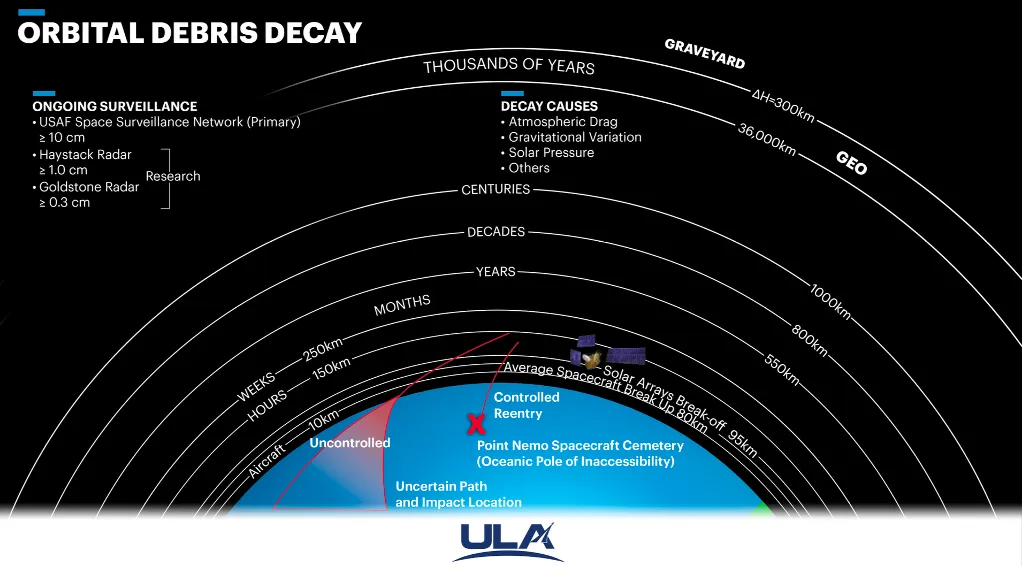
| ▲ | jaywee 4 hours ago | parent | next [-] | | Quite helpful infographics from ULA:
https://blog.ulalaunch.com/hubfs/orbital%20debris.jpeg | |
| ▲ | verzali 8 hours ago | parent | prev [-] | | The atmosphere is still thick enough to drag you down at 500km. You would last typically last a few years before burning up - the rate of fall is pretty low at 500km. But you do need fuel to do collision avoidance manoeuvres and for attitude control (otherwise your panels will no longer face the Sun and your antennas will not face the ground). |
| |
| ▲ | perihelions 16 hours ago | parent | prev [-] | | Or in theory, indefinitely, https://news.ycombinator.com/item?id=16527007 ("First firing of air-breathing electric thruster (esa.int)" (2018)) |
|
| |
| ▲ | johnsmith1840 19 hours ago | parent | prev | next [-] | | My understanding is non rad hardened method get around this by basically doubling or some multiple of repeating calculations and chexking data often. Random errors will occur you just need to be checking fast enough to fix and update that bad bit flip. I am sure there's all sorts of fun algorithms in this space but I am under the impression there is SOME tax to doing this. What is the tax? Is it 10% ir 60% I have no idea would love to know! | | |
| ▲ | marcosdumay 14 hours ago | parent | next [-] | | Why make a GW datacenter on the ground if you can make two and pay to launch them into space? | |
| ▲ | danpalmer 18 hours ago | parent | prev [-] | | There's more than that, it's possible to get permanent hardware damage from radiation at smaller (modern standard) process sizes. | | |
| ▲ | johnsmith1840 18 hours ago | parent [-] | | I didn't think about that, so yeah, basically space based compute centers are just hype on top of hype. |
|
| |
| ▲ | notahacker 19 hours ago | parent | prev | next [-] | | Your other options of fault tolerance typically achieved by doing everything at least twice and being willing to reboot (and accepting attrition from total ionizing radiation) or lots of shielding are fine for building functioning space hardware but suboptimal for building datacentre business models... | |
| ▲ | enderfusion 13 hours ago | parent | prev | next [-] | | The radiation effects on the silicon solar cells is often underestimated, it's not just the GPUs! | |
| ▲ | tekno45 15 hours ago | parent | prev [-] | | they throw those satellites to a fiery doom on a regular cadence. |
| |
| ▲ | recursivecaveat 11 hours ago | parent | prev | next [-] | | Say what you will about the data centers in space idea (I think it's transparently stupid), but ML is generally resistant to random undirected noise. It's almost a requirement by definition that a machine which takes pictures and accurately outputs the probability that they are pelicans has to be pretty robust to nigh-infinite amounts of minor variation. That's part of the reason all the super low precision stuff works. It's only in the control logic or maybe the absolute precise chokepoints of computation where flips are dangerous, so most of them are harmless. | |
| ▲ | Fomite 17 hours ago | parent | prev | next [-] | | The LLMs they hope to have in those data centers already silently accept wrong results. | |
| ▲ | JumpCrisscross 19 hours ago | parent | prev | next [-] | | At this scale could you do shielding? | | |
| ▲ | mjhay 19 hours ago | parent | next [-] | | Orbital data centers are impractical for a lot of reasons (to put it mildly) but radiation shielding isn’t one of them. Proportionally less shielding is needed as one scales up, due to lower surface/volume ratios. | |
| ▲ | inejge 13 hours ago | parent | prev | next [-] | | There are ways in which shielding in space can do harm: really energetic particles get trapped and produce a shower of daughter particles and rays over a greater area. So you'd need even more shielding. Or you accept that such things will happen and use rad-hard parts, redundancy etc. When you have the whole atmosphere above, it's much less of a concern. Besides, that's even more mass to be lofted. Pushing the economics further into the ludicrous end. | |
| ▲ | ted_dunning 19 hours ago | parent | prev [-] | | Sure. At the cost of lofting that shielding from the ground and taking the economics from 500x to 2000x crazy. |
| |
| ▲ | rsynnott 11 hours ago | parent | prev | next [-] | | > or just silently accept wrong results Silently wrong results are very fashionable these days, you know. Deterministic results are very 2010s. | |
| ▲ | turtletontine 15 hours ago | parent | prev [-] | | > Will… I think “won’t”. I could be wrong of course, but I imagine efforts to put servers into orbit will die before anything is launched. It’s just a bad idea. Maybe a few grifters will make bank taking suckers’ money before it becomes common knowledge that this is stupid, but I will be genuinely surprised if real servers with GPUs are launched. I don’t mean to be facetious here. But saying “will” is treating it as inevitable that this will happen, which is how the grifters win. |
|
|
| ▲ | daemonologist 18 hours ago | parent | prev | next [-] |
| > This is all to say that the current discourse is increasingly bothering me due to the lack of rigor; people are using back-of-the-envelope math, doing a terrible job of it, and only confirming whatever conclusion they already want. Calculating radiation and the cost of goods is not difficult. Run the numbers. > References: Gemini, Gemini, ChatGPT, ChatGPT, Gemini, ChatGPT, Gemini, ChatGPT, Grok, Gemini (There are sub-references from these services in the GitHub.) I think, if you're going to make statements like this - especially from a position of expertise, you should be personally verifying the numbers and citing their sources directly. What good is asking the reader to trust an AI on your behalf? They should trust you. (To be clear, I suspect the conclusions drawn are still correct.) |
| |
| ▲ | sigmar 13 hours ago | parent [-] | | >This isn't about talent. It's about integration... Vertical integration isn't a nice-to-have. It's the whole ballgame. I'm going to assume there's tons of logical errors and oversights in the math, considering the author couldn't even be bothered to write the text of the post himself. |
|
|
| ▲ | Ataraxic 19 hours ago | parent | prev | next [-] |
| Scott Manley had a video about this last year. https://www.youtube.com/watch?v=d-YcVLq98Ew The short of it is that cooling is likely the biggest problem, given you will need to pump the heat to the backside and radiate it away, and the amount of mass you will need to dedicate to cooling works against deployments and increases the cost per unit significantly. Not to mention, the idea of these huge deployments runs into potential space debris issues. Whenever one of these ventures actually manages to launch a proof of concept, I think we'll be able to quickly discern if there is actually a near-future here. |
|
| ▲ | mojosam 4 hours ago | parent | prev | next [-] |
| > That "why" is almost missing from the public conversation. People jump straight to hardware and hand-wave the business case, as if the economics are self-evident. They aren't. But then he never answers that fundamental question, and jumps straight to the hardware and power and cost? What problems are orbital data centers trying to solve? What optimizations are they intended to deliver? Are these optimizations beneficial to everyone who uses a data centers, or just operators or users of orbiting satellite constellations? > But the knock-on effects are why this keeps pulling at people. If you can industrialize power and operations in orbit at meaningful scale, you're not just running GPUs. You're building a new kind of infrastructure that makes it easier for humans to keep spreading out. Compute is just one of the first excuses to pay for the scaffolding. This seems to be the closest we get to a “Why”, but it doesn’t make much sense. A constellation of 40,000 satellites with GPUs “infrastructure that makes it easier for humans to keep spreading out”? How? > The target I care about is simple: can you make space-based, commodity compute cost-competitive with the cheapest terrestrial alternative? That's the whole claim. … Can you deliver useful watts and reject the waste heat at a price that beats a boring Crusoe-style tilt-wall datacenter tied into a 200–500 MW substation? Isn’t the answer clearly “No”? The default settings of his model — which I assume he considers optimal — tell us that power for orbital data enters will cost 3.5X terrestrial ones. And that only SpaceX has the vertical integration to do even attempt to do this. So again, where is the competitive advantage? Also, I don’t understand why he’s including satellite construction and launch costs for a 40,000 satellite constellations in his analysis, if he’s assuming SpaceX as he claims. Wouldn’t SpaceX simply implement these compute capabilities in the next gen of Starlink, so which would reduce costs significantly. > It might not be rational. But it might be physically possible. But isn’t that precisely what everyone has been saying? I don’t think the question has been whether orbital data centers are possible, it’s been whether they are rational. And that centers foremost h the unanswered question, Why is this a good idea? |
| |
| ▲ | arijun 2 hours ago | parent [-] | | > But then he never answers that fundamental question The fundamental question is “is it economically viable”, and the answer from his model is “not really” > A constellation of 40,000 satellites with GPUs “infrastructure that makes it easier for humans to keep spreading out”? I think he’s claiming industrializing larger and more economical power generation in space, as well as the means to put it up there, would make it easier to transition to a theoretical space economy > But isn’t that precisely what everyone has been saying? From the article, he claims that people handwave the economics, so at least the people he has interacted with haven’t been saying that. |
|
|
| ▲ | thatjoeoverthr 7 hours ago | parent | prev | next [-] |
| The analyses here miss the economic realities of building datacenters. "Just use land", "just use nuclear", "just use water". All of this is contested. A system of lawsuits and regulations turns negative externalities (even ones you aren't convinced of!) into costs you can weigh against. So, like hydrogen vs. RP-1, it's not enough to pick a handful of physical performance metrics. It has to win holistically. If you can produce any kind of economically productive compute node and add it to (for example) the Starlink network, and launch on a reusable vehicle, you carry on installing them as fast as you can build them. So, the move is to turn the problem of contested land use into a manufacturing problem. This is not so easy to pin down on a spreadsheet, and will be decided at the level of the business unit. If SpaceX can put a GPU/TPU on the grid more economically than the other guy, then it doesn't matter if they have ammonia in the pipes instead of water. Grab your popcorn. |
| |
| ▲ | baq 7 hours ago | parent [-] | | The article makes pretty much exactly this point somewhere in the middle. > the list of organizations positioned to even try that is basically one. Maaaaybe Blue Origin can join once they get a constellation going. |
|
|
| ▲ | anonymousiam 13 hours ago | parent | prev | next [-] |
| This is an interesting analysis, and I like the sliders that let you instantly show the impacts of system trades. The one glaring hole that I see is the challenge of moving the data to/from the datacenter while it's on orbit. Bandwidth to/from space isn't free. FCC/ITU licenses are required, transmitters/receiviers/modems/DSP/antennas all add to SWAP (size, weight, and power). Ground-stations are needed to move the data up/down, but those have recently become a commodity too. Still, they're not free. (see: https://aws.amazon.com/ground-station) There is also the added latency between earth-based users and space-based datacenters, which may be a deal breaker for some applications. Another issue I don't see covered are the significant differences between space-based hardware and terrestrial hardware. The space stuff needs to be radiation tolerant, and that usually makes it a lot slower and a lot more expensive than the terrestrial stuff, all other things being equal. In the end, space-based datacenters are highly impractical even if you assume that Starship can put anything into orbit very cheaply. |
| |
| ▲ | DoctorOetker 2 hours ago | parent [-] | | The most chased workload will inevitably be cryptographic research, proofs of mathematical statements are hard to find the proof for, but tend to be short and easy to verify once a putative proof is presented. Just send the proofs back to earth. |
|
|
| ▲ | uplifter 8 hours ago | parent | prev | next [-] |
| Here's some math on how affordable that abundant LEO solar energy is: First you have to pay energy to get to LEO A Starship Launch costs[0] 51.75 TJ of energy in terms of its methane fuel. It will be able to take a payload of 150 tonnes or 331,000 pounds[1]. How many computers is that? One online estimate says a computer weights 80 lbs or 35 kg. So 150000 kg / 35 kg/computer = approximately 4285 computers that we can launch into orbit per Starship. 51.75TJ / 4285 computers = approximately 12.08 GJ per computer to place it in orbit. Let's say each computer is a H200 and consumes 700 watts continuously. How long would it need to run in orbit before it used as much energy for computation as it took to launch it? 12.08 GJ / 700 W = 12,080,000,000 J / 700 J/s = approximately 17,257,143 seconds. Or about 6.5 months to break even on energy. That sounds pretty good, except my estimate for the weight of each compute unit and associated power system & cooling etc. are probably underestimates by one or two orders of magnitude. In which case you'd be looking at 5 to 50 years to break even on energy, by which time the chips are obsolete and need to be replaced anyway. [0] https://space.stackexchange.com/questions/66480/how-much-ene...
[1] https://en.wikipedia.org/wiki/SpaceX_Starship#Description |
| |
| ▲ | verzali 8 hours ago | parent [-] | | You are just launching computers, with no propulsion, no attitude control, no solar panels, no radio/laser systems, no radiators. So all of that will take mass away from the computing power. A starlink satellite already weighs about 1000kg, and that really is just the supporting infrastructure you need before you start adding computers... So yes, 10-100x extra is probably reasonable. |
|
|
| ▲ | cdf 10 hours ago | parent | prev | next [-] |
| Does anybody actually work with H100s and the like? Their failure rate is so high, I dont understand why anybody will even consider it feasible to put the machines in orbit or even the sea. By my ballpark estimate, if you have 800 H100s, after 6 months, about 100 would be overheating or throttling, and a few will disappear and one or two will crash the machine with load. |
| |
| ▲ | titzer 3 hours ago | parent [-] | | > Does anybody actually work with H100s and the like? They don't. The expectation the cloud develops in people is that magic computers just appear. They're living at a virtualized layer where all the nitty gritty of real machines going down and needing to be serviced all the time is handled by unseen minions (sorry SREs and DC staff) and cluster management and provisioning software. The reality is that datacenters in space is mind-boggling stupid, just from the infeasibility of maintenance alone. |
|
|
| ▲ | modeless 19 hours ago | parent | prev | next [-] |
| I love the sliders, but note that the numbers on this site literally came from ChatGPT, so there is plenty of room for disagreement. Seems like according to this analysis it all hinges on launch cost and satellite cost. This site's default for Starship launch cost is $500/kg, but SpaceX is targeting much lower than that, more like $100/kg and eventually optimistically $10/kg (the slider doesn't even go that low). At $100/kg (and assuming all the other assumptions made on the site hold) then you break even on cost vs. terrestrial if you can make the satellites for $7/watt (excluding GPUs, as the whole analysis does). |
| |
| ▲ | bediger4000 19 hours ago | parent [-] | | Aerospace industry has a long history of missing lower cost/kg to orbit. I'm extremely suspicious of $500/kg, which is about a third of today's cost. | | |
| ▲ | modeless 19 hours ago | parent [-] | | OTOH SpaceX has a pretty good history of undercutting the industry on cost. If Starship full reusability works I would be very surprised if it only lowered launch costs by a factor of three. Of course it's not guaranteed to work, but clearly SpaceX's orbital datacenter plans are predicated on Starship working. | | |
| ▲ | ted_dunning 19 hours ago | parent [-] | | SpaceX has never met any milestone that Elon has ever set. | | |
| ▲ | modeless 19 hours ago | parent | next [-] | | OTOH they have achieved many things that experienced people said were impossible or would never make financial sense. | | |
| ▲ | DonHopkins 15 hours ago | parent [-] | | OTOH they have a huge batshit crazy fanbase of boot lickers who are so gullible they'll believe and parrot anything Elon says. | | |
| ▲ | matheusmoreira 14 hours ago | parent [-] | | SpaceX created reusable rockets that can fly back to the launch platforms and land gracefully. Hard to blame people for becoming fans. Before them stuff like this only existed in kerbal and sci-fi. | | |
| ▲ | exmadscientist 11 hours ago | parent [-] | | Becoming a fan of someone or something is great! Accepting everything they then do, forever, even when it's obviously nonsense, is what gets you called a "huge batshit crazy fanbase of boot lickers". This "idea" is great party conversation. It's probably doing a great job of shoving around the Overton window, too (perhaps the real goal here?). It's, uh, not realistic, and anyone who is seriously "all in" on it (you're allowed to consider it and to dream, that's not the same as being all in) is not worth taking seriously no matter how much of the oxygen in the room they're using up. |
|
|
| |
| ▲ | rockemsockem 11 hours ago | parent | prev | next [-] | | Never on time, but always eventually. | |
| ▲ | baq 7 hours ago | parent | prev [-] | | ...on time. the first booster landing after delivering a payload to orbit was quite something and made a serious stir in the industry. |
|
|
|
|
|
| ▲ | lifeisstillgood 10 hours ago | parent | prev | next [-] |
| I am struggling with a why for this (other than “huh cool, that will get investors”). All the jurisdiction and regulation arguments and the “we could get the costs down” seem to meet the objection of “for the same investment we could do just as well or better on the ground”. The one that does not is the physics of the whole thing. I struggle to work out how exactly but being slightly time dilated compared to the ground does not seem like a win, but being able to gather data from opposite sides of the planet slightly faster than cables does seem like a potential win. Most stock exchanges make a significant chunk of their revenues renting out data space, so it seems a possibility. But either way it seems very niche. |
|
| ▲ | 1970-01-01 2 hours ago | parent | prev | next [-] |
| Hilarious how they could easily validate this by PoC. Even putting a small RasPi cluster in orbit. Do that and make a profit. Then ask for money. |
|
| ▲ | enderfusion 13 hours ago | parent | prev | next [-] |
| OP here. Happy to answer any questions, appreciate the boost. |
|
| ▲ | xnx 19 hours ago | parent | prev | next [-] |
| François Chollet https://x.com/fchollet/status/1999982683708150014 : "Datacenters in space" make for a catchy narrative and an interesting demo, but the math simply doesn't work. When considering factors like launch cost, maintenance complexity, and the cost of high-bandwidth communications (latency included), there is no realistic set of economic and engineering assumptions under which orbiting datacenters become cost-competitive with simply building conventional nuclear-powered (or renewable energy-powered) datacenters on the ground. In fact we're off by 50-100x. Dramatic launch cost reductions still won't make it work. And of course if you invest a lot in specific lines of tech to make it work you then have to consider that the same can also be invested in better ground-based nuclear, bringing the cost of power down for everyone. |
| |
| ▲ | wmf 19 hours ago | parent [-] | | So the guy who shows his work says 3.4x and the guy who doesn't says 50-100x. | | |
|
|
| ▲ | Teknomadix 4 hours ago | parent | prev | next [-] |
| Very doable with Photonic compute in orbit:
Way less waste heat (huge when you can only radiate it away), lower power draw per FLOP (smaller solar arrays), and photons don't give a damn about cosmic radiation causing bit flips. |
|
| ▲ | brotchie 19 hours ago | parent | prev | next [-] |
| Did a similar back-of-the-napkin and got 5x $ / MW of orbital vs. terrestrial. This article's analysis is ~3.4x. I do wonder, at what factor of orbital to terrestrial cost factor it becomes worthwhile. The greater the terrestrial lead time, red tape, permitting, regulations on Earth, the higher the orbital-to-terrestrial factor that's acceptable. A lights-out automated production line pumping out GPU satellites into a daily Starship launch feels "cleaner" from an end-to-end automation perspective vs years long land acquisition, planning and environment approvals, construction. More expensive, for sure, but feels way more copy-paste the factory, "linearly scalable" than physical construction. |
| |
| ▲ | notahacker 18 hours ago | parent | next [-] | | It becomes worthwhile if its actually cheaper (probably significantly cheaper given R&D and risk), or if you're processing data which originates in space and the data transfer or latency is an issue You can set up plant manufacturing chips in shipping containers and sending them to wherever energy/land is cheapest and regulation most suitable, without having to seek the FCCs approval to get launch approved and your data back... | |
| ▲ | nick486 11 hours ago | parent | prev [-] | | people use aws despite it being 2x-10x the cost of self hosting. cost isnt everything. |
|
|
| ▲ | thenthenthen 3 hours ago | parent | prev | next [-] |
| The 'Satellite Size' slider does not seem to impact the cost, also not in relation to changing the other settings? |
|
| ▲ | rswail 12 hours ago | parent | prev | next [-] |
| Aside from the economics, the question is why do it in orbit vs on land (or sea)? What are the regulatory/legal gains? Lack of jurisdiction means open slather? What are the national security gains? Redundancy and resiliency by each satellite being a "micro-compute" connected by high speed laser links? So more resilient to attack? Why do it at all? |
| |
| ▲ | ygouzerh an hour ago | parent | next [-] | | I think the only reason is for legal purpose. If data is downloaded illegally from space, stored in space and model trained on it... it will be a mess juridically if someone complain. Same for model inference, it will be hard for a government to put controls on the model output. | |
| ▲ | eldenring 12 hours ago | parent | prev [-] | | I think the main draw is its elegance. You have very efficient power from the sun, put that directly into your compute, radiate it out. Energy is ~free, no heavy infrastructure required, just a closed circuit for computing. | | |
| ▲ | rswail 9 hours ago | parent | next [-] | | Elegance compared to a PV/Storage facility built next door to a data centre? It doesn't make sense right now, and won't for at least 5-10 years. By which time, this current round of hype will have burned up ~$1T if it doesn't fall apart from the current internal contradictions and lack of market/customers/uses. We're still on the uphill ride of the Gartner hype cycle, not even at the "Peak of Inflated Expectations" yet. | |
| ▲ | KeplerBoy 6 hours ago | parent | prev [-] | | We also have very efficient power from the sun here on earth. I don't get how that is an argument. |
|
|
|
| ▲ | zkmon 11 hours ago | parent | prev | next [-] |
| Economics for who? The builder of the data center and plethora of all contractors and sub-contractors would see great economics though. Even the sponsor/owner of the data center might see economics work out, if you consider the reputational gain (why did we land on Moon? what's the economics?), experience gained and considering the burn of someone else's money. The money of mega companies that go into this kind of "monuments" is not exactly theirs. |
| |
|
| ▲ | faidit 5 hours ago | parent | prev | next [-] |
| Terrestrial may be cheaper but it can be burned down by peasant mobs. To become an immortal god you must remove all meat-based legacy threats. |
|
| ▲ | sc68cal 19 hours ago | parent | prev | next [-] |
| When Starcloud put together that whitepaper the first thing I looked at was the launch costs[1]. It references a $5M cost to launch, which right away made absolutely no sense to me. Just a cursory search shows launch costs are around $50M per launch, if not more. It's great that this site drills down even further to demonstrate that there is absolutely no point at which the launch costs ever make this economical or viable, so I really don't understand what people are doing. Especially because this site was harping for years about the cost of launches and putting things in to orbit, the whole reason why SpaceX got started and has grown as it has. As soon as that became an inconvenient number, we now just make things up (Just pretend that launch costs are 10% of what they actually are to get people to invest?). [1]: https://starcloudinc.github.io/wp.pdf |
| |
| ▲ | jaywee 4 hours ago | parent | next [-] | | Don't confuse launch _price_ with launch _cost_. It's been estimated the internal F9 launch costs are around $15M-$20M. The $5M is a marginal cost-target for fully reusable Starship. | |
| ▲ | JumpCrisscross 19 hours ago | parent | prev [-] | | > Just a cursory search shows launch costs are around $50M per launch I think datacentres in space are predicated on Starship bringing launch costs down. Way down. | | |
| ▲ | indolering 15 hours ago | parent [-] | | Spinlaunch is also promising drastically reduced cost per launch. The payload size for their first launcher is pretty small and they appear to be struggling to get the kinetic launcher online. | | |
| ▲ | jiggawatts 12 hours ago | parent [-] | | Spinlaunch is an outright scam. Their main product is taxing people for inadequate knowledge of basic physics. And engineering. Also… common sense. |
|
|
|
|
| ▲ | zokier 20 hours ago | parent | prev | next [-] |
| tbh this feels lot like people throwing Drake equation around. You put in whatever random numbers together and you can get any result you want. |
| |
| ▲ | SyzygyRhythm 19 hours ago | parent | next [-] | | We know the upper bound for most of those numbers. SpaceX already achieves internal marginal launch costs of ~$1000/kg, for instance. We know their rough costs per satellite. In contrast, we know little to nothing about the inputs to the Drake equation. The numbers don't quite work out in favor of orbital datacenters at the current values. But we can tell from analyses like this what has to change to get there. | | | |
| ▲ | BonoboIO 19 hours ago | parent | prev [-] | | The cooling and density challenges of datacenters here on earth are not trivial , but in space this is multiple magnitudes more difficult. These numbers are just random bullsh*t numbers. And what problems do orbital datacenters solve?
They still need uplink, so not libertarian we can do what we want, you have no jurisdiction here thing. This is just a sci-fi idea that is theoretically possible and is riding the ai bubble for users and investors that don’t know better. |
|
|
| ▲ | JumpCrisscross 19 hours ago | parent | prev | next [-] |
| I’d love to see these variables fitted to learning curves. That would give you a forecast for when, if learning continues as predicted, the economics could be competitive. (If it doesn’t, you need a new paradigm first.) |
|
| ▲ | nixonpjoshua 19 hours ago | parent | prev | next [-] |
| I am reminded of how space exploration has come largely before deep ocean exploration, seems like a human bias. Putting data centers under water makes way way more sense than into space. |
| |
| ▲ | eichin 15 hours ago | parent | next [-] | | https://en.wikipedia.org/wiki/Project_Natick shut down in 2024 (though apparently it hadn't been in the water since 2020.) It seems like it basically worked, but it wasn't clear that the cooling advantage was all that big relative to the hassle of having them in a difficult-to-maintain environment. | |
| ▲ | JumpCrisscross 19 hours ago | parent | prev | next [-] | | > Putting data centers under water makes way way more sense than into space You need permits underwater. You don’t in space. | | |
| ▲ | notahacker 19 hours ago | parent [-] | | The FCC regulates satellites launched from or communicating with the US, including stuff which extends beyond spectrum licensing like mandatory 5 year deorbiting capability for newly launched LEO satellites. Europe, China and India are not regulation-free utopias either. You've actually got more option to jurisdiction-shop with underwater data, but I'm not convinced that's the major issue with building datacentres anyway. Ultimately there are latency and minimise data-transfer arguments for doing certain types of data processing on local machines in space, but the generalised compute and model-training argument only works if the unit economics stack up as sufficiently good to cover the risk and R&D, and they're not obviously favourable compared with cold place on earth with clear skies and access to cold water even assuming launch costs become minimal. (It's slightly amusing to see how much some advocates of that other controversial futurist vision of spaced-based solar power - whose chances of success equally depend on low launch costs - viscerally hate the latest wave of datacentres-in-space hype...) | | |
| ▲ | JumpCrisscross 18 hours ago | parent [-] | | > FCC regulates satellites launched from or communicating with the US FCC is easier to deal with than multiple layers of environmental, planning, power, and water concerns at the local, state and federal levels. > they're not obviously favourable compared with cold place on earth with clear skies and access to cold water There are fewer of those places that can be developed than there is space. The bottleneck to space is launch. The bottleneck on the ground is power. I don’t think anyone thinks the math works right now. But as OP showed, it’s surprisingly proximate in a way SBSP is not. | | |
| ▲ | notahacker 18 hours ago | parent [-] | | > FCC is easier to deal with than multiple layers of environmental, planning, power, and water concerns at the local, state and federal levels. If you get fed up of multiple layers of concerns and US specific bureaucracy, you simply move to a different country where a single authority is desperate to not only remove hurdles but might even give subsidies to someone that wants to employ lots of people to put up solar panels and give them a bit of surplus power and hot water. Chips and solar panels fit as easily in shipping containers as they do in spacecraft. The FCC actually has to handle the concerns of entities more concerned by the environmental impact of your megaconstellation because it's a 1km^2 wide missile travelling at 17,500 mph which much of the rest of the space industry is expected to expend propellant to evade where orbits intersect, which is a bit more concerning than 5km^2 of slightly less green fields and some question marks about water abstraction, and there aren't other authorities you can turn to. (Space is underregulated in terms of not having any practical traffic management beyond launch and spectrum licensing, but that's more risk rather than dream libertarian business opportunity; the FCC can still kibosh your project, you just won't get anyone clearing debris out your way) Technically there is more space in space than Earth, but once you start factoring that convenient orbits for earth data transfer involve carving a high speed path which intersects with other spacecraft also moving at high speed and not all with as much control as they'd like it starts to look a lot less capacious. The Earth not about to run out of coastal regions with unbuilt land any time soon. (SBSP has its own similar issues, of course) |
|
|
| |
| ▲ | dzhiurgis 17 hours ago | parent | prev [-] | | Yeah try tell average eco joe you are planning to warm up oceans by 0.00000001% of what sun does already. (I agree right now it probably makes sense, but decades and centuries away we probably don't want to warm up earth anymore. If anything space datacenters could provide shade for earth lol.) |
|
|
| ▲ | TrainedMonkey 19 hours ago | parent | prev | next [-] |
| AFAIK compute heavy datacenter in space don't work. But if you already have a vast fleet of laser connected LEO satellites throwing some efficient SSDs into them can make a lot of sense. A large portion of the traffic is fairly static, e.g. video based content or even model weights. Caching that will save you ground to space side of the transmission. This will let you put more user beams on satellites and use less ground stations. |
|
| ▲ | boddu 13 hours ago | parent | prev | next [-] |
| Really interesting article. Curious to see the ChatGPT link attached But when I click on it, I get this error. Failed to load shared conversation. Request is not allowed. Please try again later. (403, 9aebe525df75165e-BLR) |
|
| ▲ | kibwen 3 hours ago | parent | prev | next [-] |
| This is AI slop in a pretty dress. It's fascinating that space-based datacenters are such a catastrophically bad investment that even limp apologia like this can, at best, argue that maybe it's not quite as bad as you think, as long as you still manage to ignore half the costs because you're a loser who delegated your thinking to a chatbot. |
|
| ▲ | CobrastanJorji 20 hours ago | parent | prev | next [-] |
| This is very well done! I love including all the sliders so that we can play with the (reasonable looking) assumptions the author has made. Like the author, I share their surprise that the result did not come out even more in favor of terrestrial GPUs. |
|
| ▲ | carlosseru 7 hours ago | parent | prev | next [-] |
| it would only make sense if land availability for DCs is 0 or truly expensive… Someone might be foreseeing an scenario like that? Are satellite launchers behind this hype? |
|
| ▲ | Gazoche 8 hours ago | parent | prev | next [-] |
| For someone who is "increasingly bothered by the lack of rigor in the current discourse", the author sure has no qualms about using LLM outputs as primary sources. This is an immediate red flag that discredits the entire article. |
|
| ▲ | octaane 13 hours ago | parent | prev | next [-] |
| The only benefit as I perceive it re: orbital data center hardware is regulatory avoidance. Think...DDOS machines that can't be shut off; or financial hosting services for unsavory individuals. However, it's very expensive by all metrics (including those talked about in the article), and frankly, these satellites are sitting ducks for the hunter killer satellites the various space powers have, if they actually wanted to do something about these hypothtical data centers and the problems they would cause. |
|
| ▲ | Glyptodon 20 hours ago | parent | prev | next [-] |
| I guess I'd assume that the premise driving this would be that there will eventually be enough business in space that it's necessary for space-centric use, and that terrestrial use is just a fringe benefit or loss leader or something. But oddly this doesn't seem to be how the concept is typically framed. My second level curiosity is how much cheaper/competitive it'd be if we had space elevators. |
| |
| ▲ | xgulfie 19 hours ago | parent | next [-] | | Space elevators are pretend, you may as well ask if it would be cheaper if we had dilithium crystals | |
| ▲ | KineticLensman 19 hours ago | parent | prev [-] | | space-elevators require various types of unobtanium and have their own logistics challenges not to mention failure modes that involve spattering fast moving debris round the entire equator | | |
| ▲ | Glyptodon 2 hours ago | parent [-] | | Obviously I don't expect one next Tuesday. I just think it'd be interesting to see how it alters the picture. |
|
|
|
| ▲ | Terr_ 18 hours ago | parent | prev | next [-] |
| I sometimes wonder if there are people out there who just read too much Neuromancer, and they think they can construct their own Tessier-Ashpool orbital dynasty. I suppose there are several other Oligarchs In Space stories and movies since then, but if the point of the space station is to host AI, that narrows it down a bit. Or perhaps it's performative, designed to spook gullible politicians into changing laws to "keep" businesses that were never actually going to go somewhere else anyway. |
|
| ▲ | TitaRusell 5 hours ago | parent | prev | next [-] |
| Right now all my favourite pirate sites are based in Russia but moving them to extrateritorial space would be genius! Americans couldn't shoot at it in fear of igniting a space war with China. |
|
| ▲ | Gazoche 5 hours ago | parent | prev | next [-] |
| Cons of orbital data centers: - Ludicrously expensive to setup - Need radiation-hardened silicon - Ludicrously expensive maintenance requiring highly specialized operators (a.k.a astronauts) - High risk of losing the entire equipment to a rocket failure (not infrequent even for modern launch vehicles) - Supplying enough electrical power would be extremely difficult - Cooling would be extremely difficult - Geosynchronous orbits have at least 200ms of communication latency - Lower orbits means the data center would not stay in place and require complicated tracking antennae and/or a communication mesh a la Starlink, again increasing latency and complexity Pros of orbital data centers: - ?????? ...why are we doing this again? |
|
| ▲ | patrick4urcloud 12 hours ago | parent | prev | next [-] |
| so the conclusion is orbital datacenter is a very bad idea ? |
|
| ▲ | cess11 9 hours ago | parent | prev | next [-] |
| One of the main reasons for putting "compute" and "storage" in space is that it is out of reach for the general public and would allow for more stability in exceptionally intense tyranny. It is much easier to blow things up on land than in space, and the 'negative externalities' simpler to make assumptions about. The value of this to the people who would be in charge of this "compute" and "storage" is likely much larger than the difference in energy cost. |
|
| ▲ | d_silin 20 hours ago | parent | prev | next [-] |
| As an expert in this field, I can assure that cost is not the most important factor. Demand is. |
| |
| ▲ | CobrastanJorji 20 hours ago | parent | next [-] | | But if cost of the space GPUs is higher then the land GPUs, why would demand matter? Is there limited land? Are space GPUs better for some reason, like perhaps they can't be regulated as easily or because our AGI overlords will be less vulnerable to mobs with pitchforks? | |
| ▲ | ikiris 20 hours ago | parent | prev [-] | | Demand for what? A sealab like head in the sand view of lack of data regulation requirements? | | |
| ▲ | d_silin 20 hours ago | parent [-] | | specific software applications you can run in space that you can't run on Earth or can't run cheaper on Earth. | | |
| ▲ | echoangle 20 hours ago | parent | next [-] | | What’s software that would benefit from running in space? The only thing I can imagine is processing of data generated in space so you need less downlink or can reduce latency, everything else can be calculated wherever you want, no? | | |
| ▲ | ikiris 18 hours ago | parent | next [-] | | I think the point the original guy is hand wavingly getting at is the point of something like this is to avoid the possibility of say a FBI raid or Nuremburgish trials for a vast AI surveillance processing facility hub for other down looking satellites if they were to lose their newly acquired power, or similar technocratic ramblings / ideas like it would survive the end of society. Its like that scene at the end of Real Genius, "Maybe somebody already has a use for it, one for which it's perfectly designed." Lets look at the facts: Impossible to raid, not under any direct legal jurisdiction, high bandwidth line of sight communications options to satellite feed points that would be difficult to tap outside of other orbital actors, Power feed that is untethered to any planetary grid or at risk of terrestrial actors, etc. | | |
| ▲ | echoangle 18 hours ago | parent | next [-] | | That’s not how it works. Your state is responsible for your activities in space, so if you annoy other countries enough, your own country will regulate you. If they don’t, you could have just built the same thing on the ground in this country. | |
| ▲ | fch42 10 hours ago | parent | prev [-] | | Impossible to raid ? It's definitely much easier and much much cheaper to send a single rocket there blowing the assembled rather large target into still sizeable chucks of orbital debris than it is to deploy and assemble the thing there in the first place. And there are a few terrestrial actors rather capable of this. More than there are who could make it happen under whatever optimistic assumptions anyway. In itself, a structure of this size in orbit is an efficient catcher of micrometeorites and orbital debris. Over "non-eternal" timeframes you don't even need a bad actor with good rockets. Nevermind that in such a case, the eventual fate of these sizeable chunks of orbital debris is to become rods of god ... just without particular steerability. It'd be a sight. |
| |
| ▲ | d_silin 20 hours ago | parent | prev [-] | | ...you have to pay me a lot for the answer to this question. |
| |
| ▲ | hirsin 14 hours ago | parent | prev | next [-] | | At this point I'm going to assume that anyone pushing datacenters in space wants to host child pornography. That's the only realistic workload that ticks all the boxes for orbital datacenters. | | |
| ▲ | ViscountPenguin 14 hours ago | parent [-] | | I don't think it would "solve" little any of the legal issues with Child Pornography (not if the owner lived on earth, at least), but it would make a great and politically convenient target for space to earth weaponry. | | |
| ▲ | hirsin 13 hours ago | parent [-] | | Oh, fully agreed. Orbital datacenters don't solve many to any engineering problems either, so I figure its adherents are as much into legal problem solving as they are engineering problem solving. |
|
| |
| ▲ | ikiris 19 hours ago | parent | prev | next [-] | | Don't be coy, please indicate the math that works differently in silicon in a zero g environment if its not some regulation dodge. | | |
| ▲ | d_silin 18 hours ago | parent [-] | | People in comments figured out half the answer already, the remaining half is left as an exercise for audience. |
| |
| ▲ | hooverd 20 hours ago | parent | prev [-] | | such as? | | |
| ▲ | mlhpdx 20 hours ago | parent [-] | | Unregulated casinos? | | |
| ▲ | compiler-guy 19 hours ago | parent | next [-] | | Unregulated casinos don't need this kind of compute. Most could be run on a decent raspberry pi or two. At any rate, one basic communication's satellite worth of compute would be more than enough. No need for TPUs. | | | |
| ▲ | xgulfie 20 hours ago | parent | prev [-] | | Human trafficking ring? |
|
|
|
|
|
|
| ▲ | metalman 6 hours ago | parent | prev | next [-] |
| the cost of having very fast up/down syncrounous data/compute,comunications to any random spot on the planet, at any time, in a very hard to interupt or detect manner, is, what it is and can not be compared to anything else |
|
| ▲ | mrinterweb 19 hours ago | parent | prev | next [-] |
| I realize terrestrial data centers have environmental risks, but are the risks greater for an orbital data center? I would think space debris, solar flares, or a bad actor satellite with a laser could do a lot of damage. Good luck repairing the orbital data center. |
| |
| ▲ | wmf 19 hours ago | parent [-] | | Now imagine that the risks aren't being evaluated objectively. Imagine if the risks of terrestrial data centers have been exaggerated 100x. |
|
|
| ▲ | alexc05 3 hours ago | parent | prev | next [-] |
| do it on mars then... that would have the added benefit of heating the planet so we could live on it. It seems so obvious if you think about it. Someone transfer eleventy trillion dollars to Elon Musk so we can get started. |
|
| ▲ | waterTanuki 19 hours ago | parent | prev | next [-] |
| I'm not really interested in the problems that can come with orbital compute. We've seen them listed ad nauseam. Have we seen any benefits to orbital computing by launching a cluster of raspberry pis to LEO? Surely this isn't an impossible task to test out on a smaller scale? |
| |
| ▲ | deddy 12 hours ago | parent [-] | | There isn’t really much benefit to having compute on orbit unless you’re working on VERY specific applications that have such tight latency requirements where you need to process the data immediately as it comes out of the sensor. In which case you just implement the algorithms in ASICs or FPGAs anyways. There have been NVIDIA Jetsons or better on orbit since at least 2021 and that had no meaningful impact on any actual meaningful compute workloads beyond proof of concept demos. |
|
|
| ▲ | DesiLurker 16 hours ago | parent | prev | next [-] |
| this does not makes sense from dollars pov to me, I ran a back of napkin session with claude & gemini on this and the short of it is you need a magical weightless radiator for cooling and even then it wont work because the launch costs need to be sub $100 before this can be feasible. this does not even factors the 5y amortization and LEO orbit drag correction. It then occurred to me that they (all major AI companies) know all of these facts but still pushing for it so there must be another reason. Then I recalled the offhand statement from the openAI lady about govt backstop for infra, which was strongly opposed by public and AI czar. this might be be a backdoor way of injecting that backstop capital in terms of subsidies now for results in 5 years or so. and needless to say after pilot programs those will fail spectacularly. |
|
| ▲ | bgwalter 19 hours ago | parent | prev | next [-] |
| I have no idea what this Grok assisted article is trying to say. But the data-center-in-space hype is irrational. It hand-waves cooling and bit flip errors. It does not explain why we need chat bots in space (we don't need them on earth either). It is a nice talking point for the U.S. Saudi Investment Forum. The Saudis apparently buy anything: https://xcancel.com/elonmusk/status/2000603814249079165#m |
|
| ▲ | HardCodedBias 20 hours ago | parent | prev | next [-] |
| I suspect that this orbital data centers isn't entirely about dollars (No doubt dollars are important). I suspect it is about the regulatory environment. The regulatory environment on data centers is moving quickly. Data centers used to be considered a small portion of the economy and thus benign and not worth extorting/controlling. This seems to be changing, rapidly. Given that data centers only exchange information with their consumers they are a natural candidate for using orbit as a way to escape regulators. Further, people are likely betting that regulators will take considerable time to adjust since space is multinational. |
| |
| ▲ | GMoromisato 20 hours ago | parent | next [-] | | True, but businesses don't care about regulations except where it costs them money. Also, remember that time is money, so any regulatory delays cost real money to a business. My point is that you can actually reduce it all to dollars. And I believe that the cost of orbital data centers will come down due to technological advances, while the cost of regulation will only go up, because of local and global opposition. | | |
| ▲ | HardCodedBias 19 hours ago | parent [-] | | "My point is that you can actually reduce it all to dollars." I'm not sure. A couple of points: 1) The regulatory landscape is enormous. It is unknown from which angle regulators will "slow you down." 2) As I mentioned the regulatory frameworks in this area are evolving very quickly. It is unknown what the regulations will be in 1, 2, 5 years and how that will impact your business. | | |
| ▲ | mmooss 19 hours ago | parent [-] | | > The regulatory landscape is enormous. It is unknown from which angle regulators will "slow you down." That's not true for people experienced in the particular industry. Others can find a lawyer that will give them a good picture. |
|
| |
| ▲ | ok_dad 19 hours ago | parent | prev | next [-] | | Interestingly, the humans running the "unregulated space datacenter" are still on Earth, subject to Earth's laws. | |
| ▲ | markus_zhang 19 hours ago | parent | prev | next [-] | | I think it is also about security. It is impossible for ordinary people to break into such a data center. It’s a bit like the cyberpunk future when the ultra riches live in moon bases or undersea bases and ordinary people fight for resources in a ruined earth. | |
| ▲ | klysm 20 hours ago | parent | prev [-] | | How on earth does that justify the astronomic expense difference? | | |
| ▲ | guywithahat 19 hours ago | parent [-] | | Well the argument some of these companies are making is that it would be cheaper over 10 years (some things like power can be cheaper in space, and you can get it from solar nearly 24h a day). It seems likely to me (as it does many other people) that it won't be cheaper, but if it's the same price or mildly more expensive there might be a regulatory incentive to train a ML model in space instead of a place like the EU |
|
|
|
| ▲ | GMoromisato 20 hours ago | parent | prev | next [-] |
| > ...we should be actively goading more billionaires into spending on irrational, high-variance projects that might actually advance civilization. I feel genuine secondhand embarrassment watching people torch their fortunes on yachts and status cosplay. No one cares about your Loro Piana. I 100% agree with this. There are ~2,600 billionaires in the world and we should encourage all of them to spend their money. Even buying a superyacht is a benefit to the economy. But the best billionaires, like Bill Gates and Elon Musk, are actually trying to advance the tech tree. We are honestly lucky that Musk is wired funny. Any normal human being would retire and hang out on the beach with supermodels after all the abuse he has taken. But he takes it all as a personal challenge and doubles down. That is both his worst quality and his best. |
| |
| ▲ | mmooss 19 hours ago | parent | next [-] | | > Any normal human being would retire and hang out on the beach with supermodels after all the abuse he has taken. First, he seeks and creates conflict. He isn't 'taking' abuse, except in the sense that he is reaching out and grasping at it. Everyone in that position takes lots of abuse. If they built their own fortune, they generally don't retire to the beach or they would have long ago. | | |
| ▲ | GMoromisato 18 hours ago | parent [-] | | I will agree that if he hadn't aligned himself with Trump/MAGA he would have a much lower profile. But I think we'd be better off if taking a political position did not automatically piss off half the country. I think a lot of competent but normal people refuse the get involved in politics because of how toxic it is. I wish Musk had stayed out of politics, but I'm glad he hasn't given up on Tesla/SpaceX just because of the enemies he's made. I think any normal person would have. | | |
| ▲ | mmooss 18 hours ago | parent [-] | | > if he hadn't aligned himself with Trump/MAGA he would have a much lower profile He's been possibly the world's leading troll since long before his MAGA phase. Let's be serious. |
|
| |
| ▲ | narrator 14 hours ago | parent | prev | next [-] | | You should read F.A Hayek's essay on The Paradox of Savings [1]. Creation of capital like factories, education creating new specialists, or new processes lowers the cost of production and leads to real economic progress. Excessive spending without capital creation does nothing except keeping factors of production wastefully employed when they could be put to other uses and always ends in inflation. [1] https://mises.org/mises-daily/hayek-paradox-saving | |
| ▲ | nickff 19 hours ago | parent | prev | next [-] | | >”we should encourage all of them to spend their money. Even buying a superyacht is a benefit to the economy.” You’re falling victim to the ‘broken windows fallacy’ here; money which is invested is actually more productive in improving medium and long term economic productivity than ‘consumption’ goods. Even ‘retained’ money (under one’s mattress) is not net-negative, as it increases the value of its circulating counterparts. | | |
| ▲ | GMoromisato 16 hours ago | parent [-] | | Scenario A: Someone breaks a window and the homeowner buys a replacement. Scenario B: A homeowner adds a new window to their home. Scenario C: A homeowner buys an online-course to learn how to make windows and then adds one to their home. Scenario A has approximately no benefit to the economy. The homeowner is no better off (same number of windows) but had to spend money. The window maker might be better off, but only to the same extent that the homeowner is worse off. I totally agree that Scenario A is not a benefit to the economy. That's the "broken window fallacy". But Scenario B is definitely better for the economy. The homeowner has decided that having a new window is better than having the money. So the homeowner is better off. The window maker is also better off because they get the money. This is what happens when a billionaire buys a yacht. Scenario C is the best. The homeowner has a new skill, which they can use to add more windows to their house or maybe their neighbors' houses. Over time, the amount of money spent on window-making will decrease, but the number of windows will stay constant or increase. That's a net benefit. And the online-course creator still made money. This is what Musk is doing. He is developing new technologies that enable new capabilities and/or make existing things cheaper (e.g., electric cars, access to space, rural internet connectivity). There is also Scenario D: The homeowner doesn't buy a new window but just keeps his money under his mattress. This is clearly the worst for the economy. Hording money like that means that there is less money circulating and lowered economic activity. The window maker is worse off, and even the homeowner is worse off if they would like to have a new window. Billionaires who don't spend their money are the real danger, not the ones who tweet too much. Investing their money is slightly better in that it makes the price of borrowing cheaper. But that only helps up to a point. Someone has to spend money or else there's no point in being able to borrow some. So I wish more billionaires were following Scenario C. | | |
| ▲ | jaccola 14 hours ago | parent [-] | | In your original comment, it sounded like you would encourage billionaires to buy yachts, solely "for the good of the economy". Scenario D: A homeowner adds 10 window to their home because the populous think he is stingy and will send him to the guillotine if he does not start spending his money on new windows! Scenario D provides no benefit to society. If the billionaire does want the yacht, then no encouragement is needed. |
|
| |
| ▲ | markus_zhang 19 hours ago | parent | prev | next [-] | | Any normal human being may hang out with models for a while but I guess they will promote their own ideas very soon. $$$ brings power. | |
| ▲ | piskov 19 hours ago | parent | prev | next [-] | | I am still waiting for someone to fund some open-source github projects instead of some new library or museum in their name. | | |
| ▲ | GMoromisato 18 hours ago | parent [-] | | Yes, absolutely! I think this will happen as more billionaires come from the tech world. |
| |
| ▲ | m_fayer 19 hours ago | parent | prev | next [-] | | Your description of Elmo applies to several other billionaires who have somehow avoided quixotic hyper-destructive rampages through American politics. I’m all for wired funny, but not when it comes with this much carnage. | | |
| ▲ | SauntSolaire 19 hours ago | parent [-] | | I'm not sure who the whole 'Elmo' thing is for -- more than anything I cringe at the person saying it, rather than thinking less of Elon or whatever the hope is. Like 'drumpf', or the whole small hands thing, it just comes across like a redditism that escaped confinement. Is the hope that Elon or fans of his read it and get offended? I doubt they care much, and I fail to see the point of it. | | |
| ▲ | m_fayer 9 hours ago | parent [-] | | I use it to indicate my derision, and that I refuse to take this person seriously. That's the point. How the reader reacts is beside the point, to me. Diminishing names used for delegitimization are not something reddit invented. Calling George W. Bush "dubya", Barack Obama "barry", or Richard Nixon "look it up" are all great examples of a time-honored tradition. Hope I cleared that up for you. |
|
| |
| ▲ | bgwalter 19 hours ago | parent | prev | next [-] | | He plans to IPO SpaceX and xAI, so this space data center fantasy benefits both: https://finance.yahoo.com/news/musks-net-worth-hits-600-2022... He is a walking billboard. | |
| ▲ | waterTanuki 19 hours ago | parent | prev [-] | | Elmo already cancelled out any progress made by buying a social media platform and getting the most anti-science anti-NASA admin in history elected. He's done a net negative on the world at this point, even if the scale is vastly larger than most people. |
|
|
| ▲ | Schlagbohrer 6 hours ago | parent | prev | next [-] |
| For someone engaging in a lot of fun, sci fi utopian thinking, he still falls prey to libertarian thought: "I'll go one step further and say the quiet part out loud: we should be actively goading more billionaires into spending on irrational, high-variance projects that might actually advance civilization. I feel genuine secondhand embarrassment watching people torch their fortunes on yachts and status cosplay. No one cares about your Loro Piana. If you've built an empire, the best possible use of it is to burn its capital like a torch and light up a corner of the future. Fund the ugly middle. Pay for the iteration loops. Build the cathedrals. This is how we advance civilization." That can be done easily (and has been done many times in the past! And in the present, elsewhere in the world outside the US!) by TAXING the billionaires and using that money for government funded research programs such as DARPA, NSF, national space programs that are actually ambitious and risk taking and held to timelines. Americans need to get over this idea that billionaires are gods that we must pray to and instead see them as just normal citizens who need to be taxed way more. |
|
| ▲ | piskov 19 hours ago | parent | prev [-] |
| There was already an article of how this thing is just ain’t gonna happen: https://taranis.ie/datacenters-in-space-are-a-terrible-horri... — If I were to guess, my first bet would be grand PR damage control for all the Mexicans, Irish, and what have you as in “don’t worry, we’ll soon be in space and out of your backyard” (no, they won’t). https://www.nytimes.com/2025/10/20/technology/ai-data-center... |