| ▲ | Eight Bits of Trust; eMudhra's CA keys cracked in milliseconds(scotthelme.co.uk) |
| 600 points by hkc 7 hours ago | 260 comments |
| |
|
| ▲ | jasonjayr 5 hours ago | parent | next [-] |
| > It's fortunate that the steps required here aren't particularly complicated for the devices you can update, and the advice essentially boils down to 'update them'. The problem is the devices you can't update or update easily. > Update everything that ships a CA bundle: your OS ca-certificates package, certifi, Node, Homebrew, and rebuild your container images once the base images pick up the change. > Devices you can't update are the hard part. Routers, printers, TVs, appliances with frozen firmware will trust these certificates until expiry, which is July 2039... Quick -- we need to MITM all the smart TVs so they can be jailbroken in one fell swoop! |
| |
| ▲ | __MatrixMan__ 4 hours ago | parent | next [-] | | Devices that are smart enough to talk to the internet but not smart enough to let the user install their own certs should not exist. | | |
| ▲ | tonyhart7 3 hours ago | parent [-] | | "let the user install their own certs should not exist" are you sure that this is not opening to more attack vector ????? | | |
| ▲ | LtWorf 3 hours ago | parent | next [-] | | Users aren't supposed to be considered an attack vector. I don't care what the advertisers think. | | |
| ▲ | axus 3 hours ago | parent | next [-] | | The infected devices on the LAN are an attack vector, though. | | |
| ▲ | mapontosevenths 2 hours ago | parent [-] | | If I want my IOT garbage to be infected that's between me and my local botherder. The vendor loses the right to decide how my things are used the minute they take my money. |
| |
| ▲ | antonvs 2 hours ago | parent | prev [-] | | Users are attack vectors in one of the more commonly successful attacks: social engineering. | | |
| ▲ | ruszki 15 minutes ago | parent | next [-] | | Yes, however, this causes people who know what they do suffer because of people who don't. My question is whether this affects innovation, because the same thing at different places definitely does, and we actively fight against this exactly to help innovation. | |
| ▲ | gus_massa 26 minutes ago | parent | prev [-] | | Like: To verify you are human, clik on the two ducks and install this new certificate. Bonus points if it's during a fake job interview. |
|
| |
| ▲ | tempfile 3 hours ago | parent | prev [-] | | Which is better - two attack vectors that can be mitigated by an expert, or one attack vector that can't be mitigated by anyone? |
|
| |
| ▲ | happyPersonR 16 minutes ago | parent | prev | next [-] | | If you just take them offline you can do this without having to rush. Just change your WiFi password, don’t give them the new one and don’t update them lol. | | |
| ▲ | junon 5 minutes ago | parent [-] | | You can't hardly use the TVs then. I've seen TVs that don't let you use the HDMI port without it being connected if you have a streaming dongle connected. Hopefully that practice has mostly died off now (Samsung used to do this on some models, iirc), but it's still a risk and only kicks the can down the road a bit. |
| |
| ▲ | ezoe 4 hours ago | parent | prev | next [-] | | These devices are already very weak and many of them even do non-TLS updates with no signing check anyway. If it has been so weak already, it can't be weaker. | | |
| ▲ | Sayrus 4 hours ago | parent [-] | | Not always true. I have IoT devices where a valid certificate is useful because the original host doesn't exist anymore and the certificate isn't pinned. Flashing the devices require direct UART/USB access which may involve soldering, if it even exists. This leak is gold for those because these devices will never get an updated CRL. |
| |
| ▲ | Scott_Helme_ 3 hours ago | parent | prev | next [-] | | Just imagine how much stuff you're going to be able to MiTM now!! | |
| ▲ | justincormack 5 hours ago | parent | prev | next [-] | | Some of them seem to do some cert pinning | |
| ▲ | mschuster91 5 hours ago | parent | prev [-] | | > > Devices you can't update are the hard part. Routers, printers, TVs, appliances with frozen firmware will trust these certificates until expiry, which is July 2039... The interesting question is, how many of these devices will have the compromised CA root certificate in place? Oh and another thing is problematic, many a Java app ships with its own keystore.jks if it needs to trust some privately hosted endpoint, and that keystore.jks may or may not contain the compromised CA root certificate... updating the OS will not catch this kind of stuff. | | |
| ▲ | cromka an hour ago | parent [-] | | > how many of these devices will have the compromised CA root certificate in place? I have two Google devices at home and both are compromised still. If Google can't handle pushing out a quick cert chain update, then I truly doubt other manufacturers can. | | |
|
|
|
| ▲ | john_strinlai 3 hours ago | parent | prev | next [-] |
| new email from wayne, who is the original reporter: "I've had more than a few emails asking on how this was discovered. The simple answer is: https://github.com/google/paranoid_crypto Yeah, out of the box. CCADB was intended to be a quick corpus test before looking at subscriber certificates... I've done a far more thorough check of all existing CCADB certificates, thankfully no more hits. Most of my time has been spent going over the basics that everyone assumed someone else had already done - a critical mistake to ever make near security. So unless someone has significantly more computational resources or access to more cryptanalysis research the low-hanging fruit has been caught so far." https://groups.google.com/a/mozilla.org/g/dev-security-polic... |
| |
| ▲ | TheJoeMan 2 hours ago | parent | next [-] | | I must say, if I was writing a password cracker, I probably would not think to actually start at "1". | | | |
| ▲ | renhanxue 3 hours ago | parent | prev | next [-] | | > https://github.com/google/paranoid_crypto This repository was archived by the owner on Aug 19, 2026. It is now read-only. I guess now that we've checked, nobody will ever make a mistake like this again so we don't need this anymore? :) | | |
| ▲ | wildzzz 2 hours ago | parent | next [-] | | Archive is a nice solution in between just letting it rot on the vine forever and deleting it. Leaving it open doesn't immediately signal to users that the codebase is no longer in development, youd have to check when the last commit was. And even then, that doesn't tell you much. Is this so simple of an app that there's really nothing to patch or upgrade for long periods? A python script that converts some legacy file format into an open one might effectively be complete, there's nothing left to add or fix and there's no real threat vector to exploit. Or is this a cutting edge app that someone committed daily for years but now hasn't moved in a year. The one thing I don't like about archive is the inability to add new issues. If I encounter a new issue, I don't necessarily want to fork it and track the new issue myself. I don't want to take responsibility for the code, I just want to let people know so someone else can fix it if they care. | |
| ▲ | Aurornis 3 hours ago | parent | prev | next [-] | | Archived means it’s still available but signals that it won’t be developed. Last commit was 2 years ago anyway. | |
| ▲ | fortran77 3 hours ago | parent | prev [-] | | You can still use a read-only archive. |
| |
| ▲ | commandersaki 2 hours ago | parent | prev | next [-] | | I'm guessing this is the code: https://github.com/google/paranoid_crypto/blob/main/paranoid... | |
| ▲ | Scott_Helme_ 3 hours ago | parent | prev [-] | | I have to be honest, that hasn't stopped me from trying! |
|
|
| ▲ | jlmorton 7 hours ago | parent | prev | next [-] |
| In retrospect, having 100 trusted certificate authorities might have been excessive. |
| |
| ▲ | londons_explore 12 minutes ago | parent | next [-] | | Certificate transparency requirements effectively take the power away from certificate authorities. They instead place the burden on individual webmasters again to actually verify that nobody has been falsely issuing for their domains. There are also some new vulnerabilities about CT logs who might be malicious. | |
| ▲ | tclancy 6 hours ago | parent | prev | next [-] | | In retrospect, not having a tiny competency check may have been an oversight. | |
| ▲ | Scott_Helme_ 3 hours ago | parent | prev | next [-] | | That really depends how you define "trusted certificate authorities". If you're talking about root certs then it's almost 350 currently trusted by at least one major operator. If you include intermediates, you're talking more than 3,600! | |
| ▲ | m3kw9 3 hours ago | parent | prev | next [-] | | How are they trusted if they can just generate any key they like in their back room? | | |
| ▲ | swores 3 hours ago | parent | next [-] | | "Trusted" means how people treated them, it doesn't mean the extent to which they deserved trust. | | | |
| ▲ | RALaBarge an hour ago | parent | prev | next [-] | | There are chains of trust which are established for SSL certs, centered around the idea that if we can believe Mozilla et al. that the server responding is who they claim they are. Up until now, that is good enough to establish the trust needed to accept the 2 keys in the connection are connected, and then a secure connection could be established to the host server. Mozilla et al. could claim trust for Microsoft and then MS would be an intermediary for Mozilla. There is a long history of sketchy intermediaries like GoDaddy and others that root certificate providers like Mozilla would block at times due to abuse. This leads to users, usually ones that are not that technically savvy, seeing 'insecure' warnings on a page that actually offers HTTP. ..but since the root servers no longer accept them as trusted, everything that GoDaddy supported, and every intermediary (child) cert which they approved would no longer be trusted and you would see a non-secure warning. | |
| ▲ | bigfishrunning 3 hours ago | parent | prev [-] | | That's the thing about trust -- in order to get into the root key store for windows, chrome, linux, etc they were trusted not to do that. they violated that trust. |
| |
| ▲ | otabdeveloper4 6 hours ago | parent | prev | next [-] | | Correct, we only need zero. | | |
| ▲ | sebzim4500 5 hours ago | parent [-] | | Interesting, what would be the alternative? I mean specifically for the use case of the browser warning the user if there is a MITM between them and e.g. their bank. | | |
| ▲ | __MatrixMan__ 3 hours ago | parent | next [-] | | Stop validating names, start signing content. Scan a QR code when you open the bank account, add it to the keys you trust as authorities on financial things. When your browser runs accross data tagged "financial" it checks the trusted keys in that domain and renders it only if it was signed by a key that is trusted in that domain (the domains prevent your bank from abusing that trust by causing you to see political ads or some such). If you ever see something that you suspect is malicious, you untrust whichever key signed it and take it up with whoever asked you to trust their key. If you verify it's malicious, gossip the bad keys to your friends so they can distrust also. | | |
| ▲ | diarrhea 3 hours ago | parent | next [-] | | That solves integrity but not confidentiality. It does not protect against MITM. | |
| ▲ | lokar 36 minutes ago | parent | prev | next [-] | | So, have each domain run its own root CA (scoped to the domain), and have users trust them one at a time when they have cause to interact with them? | |
| ▲ | chrisjj 3 hours ago | parent | prev [-] | | > When your browser runs accross data tagged "financial" it checks the trusted keys 'Cos no scammer would ever be so sneaky as to leave off the tag... /s > it up with whoever asked you to trust their key 'Cos no scammer would ever pretend to be that person... /s |
| |
| ▲ | rocqua 2 hours ago | parent | prev | next [-] | | In practice we have Certificate Transparency Logs that let us check whether a CA has issued a certificate for a domain you control without you asking them to. This really reduces how much we need to trust the CAs, because we can detect any untrustworthy actions after the fact. Now detecting after it happened is too late. But it does mean that mistakes or malicious actions are much more expensive to a CA. In practice this has really reduced the risk, especially to those whom aren't interesting enough to burn a valuable capacity on. Which is the vast majority of people. Though perhaps if you count TLS traffic weighted by importance that count is different. | |
| ▲ | josephg 5 hours ago | parent | prev | next [-] | | Make dns secure and put certs / public keys in dns. Control over dns already gives you the right to get tls certs. It should just be connected directly. We don’t need CAs. | | |
| ▲ | three14 4 hours ago | parent | next [-] | | tptacek argues that DNSSEC is too flawed to actually do this: https://sockpuppet.org/blog/2015/01/15/against-dnssec/ | | |
| ▲ | josephg 3 hours ago | parent | next [-] | | He's right. DNSSEC is a mess, and we should fix that. We should fix that whether or not we delete CAs because CAs rely on DNS to verify that you own your domain. If DNS isn't secure, neither are CAs. In the long run, fixing bugs is almost always better than working around them. DNSSEC is a bug. So are CAs. We can and should fix both. | | |
| ▲ | chimeracoder 2 hours ago | parent [-] | | His argument is that DNSSEC is fundamentally broken, and you can't fix it via incremental improvements. He is not arguing that DNS security cannot or should not be improved; in fact, he explicitly states the exact opposite. | | |
| ▲ | tptacek 39 minutes ago | parent [-] | | I don't have an objection to doing a different DNS security system, and in fact I like DoH a lot. You can do DoH all the way back from authority servers if you like, and that addresses domain validation without boiling the ocean with 1990s cryptography the way DNSSEC tries to do. |
|
| |
| ▲ | GoblinSlayer 2 hours ago | parent | prev | next [-] | | ECDSA was added to DNSSEC 3 years before that blog post in april 2012 (rfc6605). | | |
| ▲ | tptacek 39 minutes ago | parent [-] | | And then for the next 10 years APNIC wrote posts about how actually using ECDSA broke resolvers. |
| |
| ▲ | ranger_danger 4 hours ago | parent | prev [-] | | I have seen their comments across this site for a very long time. Unfortunately I do not respect or put any stock in what they say, because of how unbelievably rude and dogmatic they are, and always have been. "As a rule, strong feelings about issues do not emerge from deep understanding." | | |
| ▲ | icedchai 3 hours ago | parent [-] | | Fortunately, you can investigate this stuff for yourself and develop your own opinion. IMHO, DNSSEC doesn't actually "secure" much of anything. It can be disabled trivially by anyone operating a resolver. As I mentioned elsewhere, none of the major sites (FAANG) use it. What does that tell you? | | |
| ▲ | ranger_danger 2 hours ago | parent [-] | | Yes I'm not saying DNSSEC is or isn't good. I think a multi-layered approach would be best for redundancy. |
|
|
| |
| ▲ | shiandow 5 hours ago | parent | prev | next [-] | | Making DNS secure is not trivial though. In a way that's just moving the problem. | | |
| ▲ | josephg 3 hours ago | parent | next [-] | | A secure DNS is valuable whether or not we get rid of CAs, since CAs rely on DNS queries to verify domain ownership. And if we have a secure DNS, then CAs are completely redundant. I'd much rather trust a handful of domain registrars than a handful of domain registrars, plus 100 random questionably competent organisations all over the world. Especially when any one of them can generate keys for every domain on the planet. | | |
| ▲ | darkwater 3 hours ago | parent [-] | | It seems a nice thing to have indeed, but domain registrars have already a history to cede control and bend to $GOVERNMENT. We have countries already trying to MiTM all their citizens by mandating CAs injection in every device under their jurisdiction, what would be the defense against this threat in a world where registrars hold the keys to TLS encryption for the web on the TLDs they own as root?
I'm not that expert in this field so I really would like to learn if it's possible. | | |
| ▲ | shiandow an hour ago | parent [-] | | Not that it isn't an interesting question but what's preventing them now? You can get a certificate for any domain you control. It is just really obvious if you abuse that power. Which shouldn't really change with DNSSEC I think. |
|
| |
| ▲ | vesinisa 5 hours ago | parent | prev [-] | | Isn't this what DNSSEC solves? | | |
| ▲ | muvlon 5 hours ago | parent | next [-] | | DNSSEC deployment has been anything but trivial. This APNIC post from 2024 estimated that about 1% of DNS queries were being validated via DNSSEC: https://blog.apnic.net/2024/05/28/calling-time-on-dnssec/. That's more than 25 years after the IETF first standardized DNSSEC. | | | |
| ▲ | shiandow 4 hours ago | parent | prev [-] | | It should, though it achieves that goal by a chain of certificates not unlike CAs just tied to DNS. Like I said, it essentially just moves the problem. Which might still be better, if only because it limits the surface area. |
|
| |
| ▲ | braiamp 5 hours ago | parent | prev | next [-] | | That still requires trust stores to be distributed to the clients and some clients don't need that baggage on the dns. Also, dns is by default insecure, dnssec is a configuration nightmare | | |
| ▲ | otabdeveloper4 5 hours ago | parent [-] | | > That still requires trust stores to be distributed to the clients There's no such thing as a "trust store" in practice. To be "trusted" you just need to demonstrate you have control over a DNS TXT record, and we don't need a special "store" or intermediary for that. Certificate authorities are an artifact of a bygone time and an entirely different model of internet infrastructure. | | |
| ▲ | woodruffw 4 hours ago | parent [-] | | The trust store refers to the collection of parties that ultimately verify the signed claim of your control over a domain, which might have taken the form of a DNS TXT challenge (or any other number of challenges). You still need it, because there would otherwise be a basic circularity when determining whether to trust a connection. (Moving the PKI into DNS does not remove it, it just moves it around.) | | |
| ▲ | josephg 3 hours ago | parent [-] | | > (Moving the PKI into DNS does not remove it, it just moves it around.) Better in DNS though. You could have certs mirror the structure of DNS. Install a single root signing key for the top level DNS registry on client devices. Then you can query that to find out the signing keys for .com, .net, .au, etc. And continue from there. One big problem with the CA system is that any CA - even the most incompetent - can sign certificates for any domain. If trust was moved to DNS, there would only be a single organisation that could forge certificates for any given domain. Using 7 as a private key? What a joke. The CAs aren't worthy of trust. We already have to trust the domain name registrars anyway, since CAs query them to figure out if you own a domain before signing a certificate. In total, removing CAs would not only simplify the system. But it would allow scoped signatures. And we'd end up needing to trust far fewer actors to have a secure internet. | | |
| ▲ | itintheory an hour ago | parent | next [-] | | > One big problem with the CA system is that any CA - even the most incompetent - can sign certificates for any domain. Is this not what CAA records were intended to solve? It seems like in practice they're only used by CAs to decide if they can sign a cert for a given domain, but it seems like a client could use it to determine if a server cert was from the correct CA. | |
| ▲ | woodruffw 3 hours ago | parent | prev [-] | | Why would I trust my domain registrar to maintain PKI? They don’t seem inherently better suited for it, and in various ways are more susceptible to meddling for e.g. ccTLDs. I think the idea that CAs are uniquely incompetent is probably incorrect. |
|
|
|
| |
| ▲ | asksomeoneelse 5 hours ago | parent | prev [-] | | But how do you make DNS secure without CAs? | | |
| |
| ▲ | lukewarm707 5 hours ago | parent | prev | next [-] | | For me the complexity of anything connected to public internet is now over what I can secure. I genuinely can't say I secured a PC, when it needs to phone home for a configuration at this point. We are most likely over the line for needing to airgap a personal PC. | |
| ▲ | Ohentis 4 hours ago | parent | prev | next [-] | | I quite like how i2p does it. Public keys are part of addresses, human readable names are user defined and shared but static. | |
| ▲ | embedding-shape 5 hours ago | parent | prev [-] | | The first time you go to the bank, you do the "trust exchange" (maybe scanning a QR? People sure love that) that verifies future connections, similar to how you acquire digital certificates today when you deal with the government online and similar. Edit: > Every time you access your bank on different devices normalizes it so that visiting a typo domain would show the dialog and many would just click through. Show the dialog? What dialog? There is no dialogues here, you cannot login to the bank unless you've verified the connection. You do it with your phone, then you can propagate the trust from there to other devices if needed. | | |
| ▲ | bluehatbrit 5 hours ago | parent | next [-] | | Not all banks have physical locations, not everyone has the ability to get to the ones which do. You can't walk back from the existing expectation and ease of use we have today. It's just not going to happen, people will opt for the current path because it's easy and seems good enough to them. Most normal people don't even know this whole thing is going on. They don't know the difference between http and https other than "it's secure". If we want to improve on this, it has to come with the current level of ease of use at a minimum. | | |
| ▲ | monsieurbanana 4 hours ago | parent | next [-] | | > If we want to improve on this, it has to come with the current level of ease of use at a minimum. OR it has to be a situation catastrophic enough. I don't think this one is, but it's hard to be optimistic for the future | |
| ▲ | __MatrixMan__ 3 hours ago | parent | prev | next [-] | | Presumably you had some reason to trust the bank in the first place. Maybe a recommendation from somebody you know? Get the key from them. The current level of ease is not being achieved securely. If it's not possible to do so, we should walk it back. | |
| ▲ | chrisjj 2 hours ago | parent | prev [-] | | > If we want to improve on this, it has to come with the current level of ease of use at a minimum. We need to recognise that is impossible. Making getting into a bank account easier for the owner does so for everyone else too. And also makes it easier for the bank to ditch the secure fallback - a building. And ask why vendor-indepedent trust shops aren't sprouting in every locale. Answer: same security problems. We are well and truly doomed to living in a scammers' paradise. | | |
| ▲ | venzaspa 2 hours ago | parent [-] | | But my bank has no physical buildings whatsoever? And also, how is my bank supposed to safely generate and distribute a key that we can exchange securely if an organisations who's primary purpose to generate these keys couldn't even manage to do so. I have plenty of other services I use too. Suddenly my phone company, doctors, supermarket has to create and distribute keys for me to go around collecting so that I can securely talk to them and we have to do this in a way that stops anyone from swapping those keys out before they get to me. I mean the current system isn't perfect, but it's a Utopia compared to that. |
|
| |
| ▲ | bee_rider 2 hours ago | parent | prev | next [-] | | That could be kind of interesting. It does seem to lean on the physical bank-front being trustworthy (no evil clerks). If we’re meeting physically to set up connections, we could even use something like a one-time-pad, and be information-theoretically secure. How many bits does your bank really need to send you securely anyway? | |
| ▲ | whywhywhywhy 5 hours ago | parent | prev | next [-] | | Every time you access your bank on different devices normalizes it so that visiting a typo domain would show the dialog and many would just click through. | |
| ▲ | u8080 3 hours ago | parent | prev [-] | | Like...TOTP or FIDO2? |
|
|
| |
| ▲ | BirAdam 6 hours ago | parent | prev [-] | | or, perhaps you need more so that one being stupid doesn't effect so much. | | |
| ▲ | epanchin 5 hours ago | parent | next [-] | | Each CA is like a padlock locked in series with other padlocks. The weakest padlock is the only one that matters. | | |
| ▲ | akerl_ 4 hours ago | parent [-] | | In a world with CT logs and CAA records, is that actually the case? | | |
| ▲ | zbentley 3 hours ago | parent [-] | | Yes, because as we are seeing with this incident, plenty of things don’t check CT logs (and thus can still be hacked if CT isn’t published for bad certs), and CAA records are fundamentally advisory. | | |
| ▲ | akerl_ 2 hours ago | parent [-] | | You said "yes" but then answered "no"? Like it seems your disagreement is that you're pointing out there are systems today that trust WebPKI CAs but don't validate CT/SCTs. I'd agree that that's an issue and I want those systems to join the world where CT exists. As I said, in a world with CAA records and CT logs, this isn't an issue. If your CA wants to be in root trust stores, you have to put your certs in CT logs. CAA records are "advisory" in the sense that we mandate that root-trusted CAs obey CAA records and that they write cert issuance to CT logs, so a trusted CA that violates CAA records has to tell on itself in a very detectable way. | | |
| ▲ | Scott_Helme_ an hour ago | parent | next [-] | | I'm just not sure that I can see a world where all devices that rely on TLS/PKI are capable of CT SCT validation. Look at the issues we have around stale root stores still happening when we have validity periods of literally decades. Some of these clients out there simply won't ever be able to keep their trusted log store updated. Refs:
Part 1: https://scotthelme.co.uk/impending-doom-root-ca-expiring-leg...
Part 2: https://scotthelme.co.uk/complexities-chain-building-ca-infr...
Part 3: https://scotthelme.co.uk/cross-signing-alternate-trust-paths...
Part 4: https://scotthelme.co.uk/building-certificate-chains/ There's also the Let's Encrypt root migration that was postponed due to legacy devices: https://scotthelme.co.uk/lets-encrypt-postpone-isrg-root-tra... | | |
| ▲ | akerl_ an hour ago | parent [-] | | Similarly to vaccines, part of the magic is that you don't need "all", you just need "most". Right now CT support is rough for things outside of browsers; it's a pretty fair bet that if you pick up a command line tool or library, it is not checking SCTs, and that makes those workflows vulnerable. If we flipped that, and the average command line tool or library did validate by default, it would dramatically alter the risk calculus for attackers. | | |
| ▲ | Scott_Helme_ an hour ago | parent [-] | | For a scenario like this it doesn't help a given client what % of the ecosystem does SCT validation or not, all that matters is whether that client does it. I agree that more SCT validation across the ecosystem reduces the value of a mis-issued certificate to an attacker, but a lot of value still remains. If 90% of clients did SCT validation, an attacker can still succeed against the 10% that don't, there's no herd immunity. |
|
| |
| ▲ | lelandbatey 44 minutes ago | parent | prev [-] | | You said: > In a world [where] CT logs and CAA records [exist] And we are in that world. CT logs and CAA records exist. They are around. What you are implying you said is: > In a world with CT logs and CAA records [and everyone/everything reads and validates them] We are not in that world, and we probably won't enter that world for the next 15 to 20 years because we are also in a world where folks expect networked devices to be able to communicate (mostly) securely without constantly communicating with a centralized set of clearinghouses arbitrating "what is secure". As we are discovering, our flawed systems may need broader rethinking, especially if we want secure communication (with all the epistemological ball of yarn that comes with it) without constant total centralization, which seems to be the approach-of-least-resistance lately. |
|
|
|
| |
| ▲ | caaqil 5 hours ago | parent | prev [-] | | > perhaps you need more so that one being stupid doesn't effect so much. So you create more surface area for vulnerability? We might already be at or close to the sweet spot. Security is hard. | | |
| ▲ | Gabrys1 4 hours ago | parent [-] | | I would assume that the client would need to validate the certs against more than 1 trust path (for the comment to make sense) |
|
|
|
|
| ▲ | irusensei 3 hours ago | parent | prev | next [-] |
| Okay hear me out. People are complaining about unpatcheable IOT device and thats indeed concerning. But can’t we use the bad keys to generate seemingly value certificates that can be used to jailbreak these devices? EDIT: seems its already happening? https://x.com/otomir23/status/2112697830687047918 |
| |
| ▲ | Scott_Helme_ 3 hours ago | parent | next [-] | | Yeah this is absolutely possible, and while they are a few good opportunities like this, it also means that someone else can decrypt all of your traffic in the same way. | |
| ▲ | reisse 3 hours ago | parent | prev [-] | | Yeah, it's happening in the wild already. Seen more cases like that. | | |
| ▲ | cromka 3 hours ago | parent [-] | | I really hope someone manages to root the Google Home speakers. Been waiting for ages to be able to repurpose them for Home Assistant integration! EDIT: just whipped up a quick hacking session with DeepSeek and, indeed, Google hasn't updated the cert chain yet on these devices, I am sniffing everything with MITM! Let's see if I can put that to use and gain root. At the very least, a mock endpoint server is possible now for use with Home Assistant. |
|
|
|
| ▲ | amluto 2 hours ago | parent | prev | next [-] |
| For all that DNSSEC is crap, DANE would at least mean that a domain is only vulnerable to failures of the authorities relevant to the domain. Meanwhile there are two less invasive changes that really ought to happen: 1. A clean way for things like curl and Python to start checking CT logs like Chrome does. 2. Name constraints. It’s long past time for the CAs of the world to have name constraints enforced. A CA that is not appropriate to use for .com should not work for .com. A CA that is not appropriate to use for .ae should not work for .ae. And the CA/B Forum should should requiring that all newly approved roots and all newly signed intermediates have appropriate name constraints. |
| |
| ▲ | Scott_Helme_ an hour ago | parent | next [-] | | 1. They could do this now, the implementation exists publicly, but I think it would be better at the OS level like upki for revocation: https://discourse.ubuntu.com/t/addressing-linuxs-missing-pki... 2. I don't think such constraints would really work. My company might have 4 domains on different TLDs and then end up needing to use 4 different CAs. Geography doesn't really apply on the Internet. | |
| ▲ | alphager 42 minutes ago | parent | prev [-] | | 1 already exists. You don't check the ctlogs; the ctlogs as their signed timestamp to the certificates. All you need to verify that a certificate has been published is to verify the timestamp signatures. |
|
|
| ▲ | WalterGR 7 hours ago | parent | prev | next [-] |
| Related: https://news.ycombinator.com/item?id=50166579 “eMudhra intermediate CA compromise” |
947 points | 19 hours ago | 408 comments |
|
| ▲ | bombcar 7 hours ago | parent | prev | next [-] |
| Of COURSE it's easy to crack, 4 isn't even prime! |
| |
| ▲ | DavidSJ 6 hours ago | parent | next [-] | | In their defense, they were probably targeting the Mersenne prime 2^2 - 1 and just made a typo. | | |
| ▲ | throw0101a 6 hours ago | parent [-] | | > In their defense, they were probably targeting the Mersenne prime 2^2 - 1 and just made a typo. There are two hard problems in computer science: naming things, cache invalidation, and off-by-one errors. | | |
| |
| ▲ | wolfi1 6 hours ago | parent | prev | next [-] | | ok, it's joke. but for those who don't get it: elliptic curves don't need primes | |
| ▲ | joshuat 7 hours ago | parent | prev | next [-] | | It’s really impressive no one caught their three previous private key values | | | |
| ▲ | chompychop 5 hours ago | parent | prev | next [-] | | They should have gone with 57. Everyone knows it's prime. | | |
| ▲ | bee_rider 2 hours ago | parent | next [-] | | I wonder if anyone wants to over-analyze this joke to come up with the best candidates for the number? 57 falls too easily to the quick divisibility by 3 trick, IMO. (I realize over-analyzing jokes always makes them unfunny but we can pick the best number here and nobody has to know). | | |
| ▲ | samatman 31 minutes ago | parent [-] | | Me! I'm in! Most-nearly-prime number under 100 is.... 91. 13 x 7. You've either memorized that or you're going to have fun deciding it's not prime. And if you did times tables up to 13, congratulations, you're special. |
| |
| ▲ | kachnuv_ocasek 5 hours ago | parent | prev [-] | | Alex? You're alive after all? |
| |
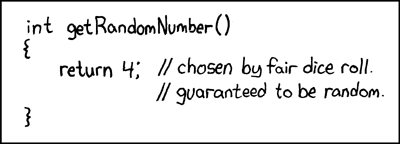
| ▲ | delibes 6 hours ago | parent | prev | next [-] | | https://xkcd.com/221/ | | |
| ▲ | lta 5 hours ago | parent [-] | | It's been a while since this one popped up.
It's surprising how many of those doodles are surviving the test if times, in the midst unexpected ways |
| |
| ▲ | ohuf 2 hours ago | parent | prev | next [-] | | it doesn't have to be and it actually never is: this isn't RSA, it's an elliptic curve algorithm. if you'd have read the article, you'd have understood this | |
| ▲ | Zeetah 3 hours ago | parent | prev | next [-] | | The number 4 is very famous. https://xkcd.com/221/ | |
| ▲ | walrus01 6 hours ago | parent | prev [-] | | Hey, that's the same combination I have on my luggage! | | |
| ▲ | wowczarek 4 hours ago | parent [-] | | Good job the Earth doesn't have an air shield protected by this byte or we'd be Skroob'd. |
|
|
|
| ▲ | seanalltogether 3 hours ago | parent | prev | next [-] |
| Quick question for the crypto experts. I thought that the goal of a true random number generator was that all values between 0 and MAXCOUNT are equally likely, and therefore all private keys between those values are equally likely. Is this not true? If people are going to attempt to brute force your key, don't you want the floor to start at 0? If the floor is higher, won't the brute force start higher too? |
| |
| ▲ | CSMastermind 3 hours ago | parent | next [-] | | It's not that 4 isn't a valid seed (though insanely unlikely) it's that once I know your values weren't picked randomly because I guessed one of them I can easily figure out the others. In this case one cert gets defeated and you go the odds of that number being that low are 2^-384. Essentially impossible if it were randomly selected. It's much more likely you didn't choose that at random so I start guessing a bunch of other low numbers for your other certificates and find them quickly. | | |
| ▲ | nomel an hour ago | parent [-] | | > Essentially impossible if it were randomly selected. You would say the same of any seed I gave you. You've just artificially assigned this number with some sort of emotional importance. | | |
| ▲ | Quinner an hour ago | parent | next [-] | | If you cherry-pick that statement in isolation you're technically correct. But in practice the whole comment you're replying to is actually correct, in this case if you saw the number four, one would be correct in concluding that's unlikely and searching other low digit numbers, the proof of that is that it happened here. | |
| ▲ | eatkd an hour ago | parent | prev [-] | | They had multiple keys and 7 of the keys were numbers less than 256. | | |
|
| |
| ▲ | wakamoleguy 3 hours ago | parent | prev | next [-] | | Imagine you have a 3 digit PIN code. That’s 1,000 options to brute force. If you remove 000-009 as “too weak”, you still have 99% of the search space available. These numbers scale favorably as the private key size gets bigger. In short, raising the floor doesn’t really hurt the search space meaningfully. | | |
| ▲ | kstrauser an hour ago | parent [-] | | It also acts as a test case. "Hey seed-generator, give me a random number between 0 and a gazillion." "Does 4 sound good?" "No, it sounds like you're obviously broken." In theory, all values would be equally random. In practice, some results are exceedingly more likely to occur when something's wrong with the algorithm. While any given outcome of flipping a coin randomly N times is equally likely, if that series looks like [heads, heads, heads, heads, ...], then there's probably something other than pure random affecting the output. |
| |
| ▲ | betterunix2 2 hours ago | parent | prev | next [-] | | Yes, what matters is the size of the range, not the bounds on the range. Also keep in mind that in some cases private keys are not uniformly sampled from a range of integers; for example RSA keys, which are sampled from prime numbers. More generally, it is common to sample a bit string and use that as a seed for a PRG, from which the private key is generated. So in that case the range is [0, 2^k] and what matters is the quality of the randomness. Unfortunately high-quality randomness is not always available, especially for embedded devices and rack-mounted "appliances." | |
| ▲ | adzm 3 hours ago | parent | prev | next [-] | | You are technically correct, the best kind of correct! Though I have a feeling we'll never see a 384-bit CSRNG generate 352 0-bits in a row in this Universe's lifetime. That said, a sanity check on the value somewhere in the code would indeed have prevented this. | |
| ▲ | himinlomax 3 hours ago | parent | prev [-] | | IIRC in RSA the key, a prime number, is selected between 2^(bits-1) and 2^bits, or iow it always starts with a 1₂. |
|
|
| ▲ | Ambroos 3 hours ago | parent | prev | next [-] |
| My oven (which has a camera and WiFi, don't ask, it's a great oven otherwise and doesn't exist without WiFi) received a software update this morning. I can't help but wonder if it's related. |
| |
|
| ▲ | tclancy 6 hours ago | parent | prev | next [-] |
| I will say, there’s something almost reassuring when something goes boom that badly and the story is really silly. It’s like [horrific human-caused disaster] but it’s because of a Three Stooges episode. |
| |
| ▲ | skinfaxi 4 hours ago | parent [-] | | The more cynical among us think that is part of it. Remember when Bush Jr. became a bumbling idiot for a few years? |
|
|
| ▲ | supernes 6 hours ago | parent | prev | next [-] |
| Two more things to note about impact assessment: Flatpak uses the selected runtime's baked-in trust store (I think), so any apps may be susceptible even if you update the system package. Containers also don't inherit the host's trust store and use the one from the base image. |
|
| ▲ | geye1234 an hour ago | parent | prev | next [-] |
| For those running Ubuntu, the following page tells you what to do. It's two commands: https://ubuntu.com/blog/emudhra-ca-compromise-fixes-availabl... |
|
| ▲ | charles_f 3 hours ago | parent | prev | next [-] |
| I reckon that was an attempt to fend off the enemy. "Everyone expects us to set 196 bits of entropy, but you know what they won't expect? A single byte!" |
|
| ▲ | throwitaway222 39 minutes ago | parent | prev | next [-] |
| Predicting more LAN devices come pre-installed with a variety of private VPN options and an option to route all traffic from specific devices through that. |
|
| ▲ | tniemi 6 hours ago | parent | prev | next [-] |
| Someone used the Dilbert random number generator.
https://www.random.org/analysis/ |
| |
|
| ▲ | nmeofthestate 5 hours ago | parent | prev | next [-] |
| I wonder how someone stumbled upon this - maybe leaked by someone inside eMudhra? Since there's nothing to indicate that the private key was all zeroes and one non-zero lsbyte, and presumably nobody would try to brute-force a private key. |
| |
| ▲ | cvwright 4 hours ago | parent | next [-] | | I suspect that they read the article last Friday about Claude finding the origin of the ECDSA constants. That was only a few hours before Google received the vulnerability report. The two cases are very similar. The only difference is that the weak randomness was harmless in the earlier story, and here it’s devastating. | |
| ▲ | hnfong 5 hours ago | parent | prev | next [-] | | Of the thousands of people bored with a swarm of AI agents, is it not plausible that somebody would just say "hey, let's do a vibe check to see whether any CAs are trivially crackable"? | |
| ▲ | consp 5 hours ago | parent | prev | next [-] | | > and presumably nobody would try to brute-force a private key. Why not? There are examples of RNGs providing very poor entropy which might be a reason to check it (looking at you Sony). | | |
| ▲ | nmeofthestate 5 hours ago | parent [-] | | Just seems weird for anyone to focus on trying to crack private keys starting with absurd 8-bit values that "nobody would use for a private key", let alone bother to do it at all, given the search space. | | |
| ▲ | consp 5 hours ago | parent | next [-] | | I would not expect anyone to be on the lookout continuously, but like the researcher doing a "yolo" and trying. There are enough people out there that it is likely to happen at least once in a while. Or for instance someone looking for a firmware exploit in a downstream device. | |
| ▲ | smaudet 3 hours ago | parent | prev [-] | | And here you learn why security is often just theater (not saying a proper elliptic key is theater)... It took less than a second to factor this key. Why not attempt, say, to factor every CA, with a budget of less than a minute each? The reward/risk ratio is skewed so heavily in favor of trying, the only reason not to is this idea that it is "impossible". It's clearly not, hence, the theater. Your locks don't have to work, they often only have to look like they work... |
|
| |
| ▲ | jhalstead 3 hours ago | parent | prev [-] | | This question seems to be answered in another comment now: https://news.ycombinator.com/item?id=50180284 |
|
|
| ▲ | positive-spite 7 hours ago | parent | prev | next [-] |
| That's some criminal negligence right there. 8 bits is crazytalk! |
| |
| ▲ | joshuat 7 hours ago | parent | next [-] | | “4” hey chatgbg what is a “private key” | | |
| ▲ | Agentlien 6 hours ago | parent | next [-] | | As someone from Gothenburg, Sweden (often referred to as gbg) I shall answer: A private key is a tiny number you don't need to share publicly because it is easy enough to guess. | |
| ▲ | Hamuko 6 hours ago | parent | prev [-] | | Maybe they were counting on the fact that usually the right answer to “I’m thinking of a number between 1 and 10” is “7”. |
| |
| ▲ | bombcar 5 hours ago | parent | prev [-] | | Isn't 4 simply 2 bits? Silly 2-bit outfit. Maybe it's 3 bits. | | |
| ▲ | patrickthebold 5 hours ago | parent [-] | | I think the way that the bits are counted is based on the pool from which the number was randomly drawn. So it's possible they had 256 bits of entropy but got really unlucky. | | |
| ▲ | thesz 2 hours ago | parent [-] | | Their other keys are also in 0..255 range. This is definitely not "really unlucky." I guess they used (x `mod` 256) instead of (x `mod` (2^256)). |
|
|
|
|
| ▲ | mnx 5 hours ago | parent | prev | next [-] |
| I made test.key4.lol if you want to quickly check if your device/browser is vulnerable still. |
|
| ▲ | childintime 3 hours ago | parent | prev | next [-] |
| 1. So there was no certification of the certifiers? 2. This is stupidity that rises to the level of being malicious. There is no excuse, this was a fraud. Their business was literally to promise security and.. make a profit. Nothing was ever delivered. |
| |
| ▲ | greengreengrass 3 hours ago | parent | next [-] | | > promise security and.. make a profit Some would argue the inherent moral hazard makes these opposing outcomes that cannot be achieved simultaneously. | | |
| ▲ | missinglugnut an hour ago | parent [-] | | The company had a valuation of about $500million USD (converted from INR) before the incident. Now it's likely worthless, because of an incident that could have been prevented by hiring one competent person. Moral hazard describes situations where an entity is incentivized to take undue risk. With an upside of saving a single Indian endineers salary and a downside of destroying the entire company, it's safe to say the market wasn't incentivizing this. They were just stupid. |
| |
| ▲ | badgersnake 3 hours ago | parent | prev [-] | | Like a web-of-trust model? |
|
|
| ▲ | Qision 7 hours ago | parent | prev | next [-] |
| It feels like they chose the private keys by hand. |
| |
| ▲ | PalmPilotProMax 7 hours ago | parent | next [-] | | Artisanal cryptography. Hand-picked private keys salted with organically sourced nonces. | | | |
| ▲ | muvlon 6 hours ago | parent | prev | next [-] | | My bet is on one of - A sequence number being accidentally used as the private key or - The private key being generated securely but then accidentally truncated to 8 bits (e.g. writing a single char into a zeroed buffer when you should've memcpy'd from a char*). The sequence number idea is supported by the fact that two of the G3B private keys are consecutive numbers. I ran a quick Monte Carlo simulation and if I got it right, sampling 8 keys from [0,255] uniformly at random (as in the truncation scenario), you'd expect them to contain 2 consecutive numbers only about 18% of the time. | | |
| ▲ | account42 6 hours ago | parent | next [-] | | All the numbers also have digits going from left to right on a keyboard. I think the manual "random" input theory is plausible. | | |
| ▲ | muvlon 5 hours ago | parent [-] | | Oh wow, that is even more damning. Only 146 out of the possible 256 keys have this property. You only have about a 1% chance to get that 8 times in a row (A little more than 1% if sampling with replacement and a little less if sampling without. You'd expect them to at least not use the exact same key twice but at this point???). |
| |
| ▲ | Avamander 5 hours ago | parent | prev [-] | | Some error code being used? FIPS mode gone wrong? |
| |
| ▲ | gquere 4 hours ago | parent | prev | next [-] | | There's a beginning of an explanation in the mozilla bugrepor thttps://bugzilla.mozilla.org/show_bug.cgi?id=2083449 | | |
| ▲ | mminer237 3 hours ago | parent [-] | | Thanks. The relevant quote: > We have done some preliminary assessment, there appears to be a flaw in the KGC script that was used on that specific day to create these ECC issuers. As for these ECC keys, our review of the KGC, assessment of the code and view of HSM keys so far indicate that a) a set of original ECC keys were created onboard as expected b) an approved deviation to our usual KGC to test a wrap/unwrap was introduced as these keys were meant for export for this instance c) a flaw in the code resulted in the second pair of keys being created onboard which were weaker d) these second pair of weaker keys were used by mistake to create the csr (because the key labels were similar) and signed by our root e) the CSR from these weaker keys were also sent over to Sectigo for cross signing (we verified the files sent over to Sectigo) | | |
| ▲ | benmmurphy 2 hours ago | parent [-] | | `a flaw in the code resulted in the second pair of keys being created onboard which were weaker` that sounds like the HSM is capable of generating keys in a range that is smaller than [1..group_order). such a feature makes no sense at all. or is this some kind of weird thing where people want to generate weak keys for 'testing' and HSM vendors have added such a strange feature. its actually satisfying to see someone get burned by this because such a feature should never exist and this is the reason why. if the HSM can generate keys in a smaller range (especially some arbitrary small range) then you are putting a lot of trust in the operators of the HSM. hopefully there are good audit logs and people actually check the audit logs every time keys are generated to make sure the keys being generated aren't from a special range. |
|
| |
| ▲ | walrus01 6 hours ago | parent | prev | next [-] | | A long time ago one time pads used to be chosen by hand by women picking numbered lottery balls out of a spherical tumbling machine on a table. | |
| ▲ | Fabricio20 6 hours ago | parent | prev [-] | | The fact that there are more than the "4" one, and all the low numbers are below 384 (384 being the bits for private key) makes me think whoever was creating these thought "Oh a random number between 1-384" let me choose... 4! (156, 230, 115, 56, 66, 237, 155)... https://xkcd.com/221/ |
|
|
| ▲ | kyleomalley 4 hours ago | parent | prev | next [-] |
| Question: what about the other trusted roots? Has anyone tested them? I’ve tested most of them (from historical archives) and have automated testing any new CA certificates that show up in CT. I’m calling the check “luggage code entropy” (1 byte). It was a mistake to trust so many root CAs and misapply the same level of trust where clearly it is impossible to independently verify and most of the accountability is smoke and mirrors. We need to be asking “why” here, the stated reason needs to be much more than “because webtrust audit” and “we recorded the entire operational process for key material handling on YouTube with this open source implementation of key ceremony tooling and have underwritten the strength of the private key with a few $mm dollars, to be paid out to the rest of the roots for the shared reputational damage to the entire ecosystem should we fuck up (intentional or otherwise). |
|
| ▲ | jesuswasjew 3 hours ago | parent | prev | next [-] |
| This does not look like blunder; more like espionage. The bigger guys are throwing emudra under the bus. |
| |
| ▲ | bstsb 3 hours ago | parent [-] | | “espionage” would involve a private key shared with the three-letter agencies, not a key anyone could crack in seconds | | |
| ▲ | jesuswasjew 2 hours ago | parent [-] | | anyone = themselves. The key ceremony is supposed to be nuke launch level secure. That 4 pass many eyes. |
|
|
|
| ▲ | TazeTSchnitzel 7 hours ago | parent | prev | next [-] |
| Could HN start feeding submissions through Pangram so us human readers don't have to suffer with reading the nauseating AI-prose? |
| |
| ▲ | swiftcoder 6 hours ago | parent | next [-] | | Count yourself lucky - compared to Claude's prose, this is fairly readable. | |
| ▲ | jadamson 6 hours ago | parent | prev [-] | | It reads fine to me. If it is AI, I'd like to know which one so I can use it too. | | |
| ▲ | stratos123 6 hours ago | parent | next [-] | | It reads okay to me too, yet Pangram says it's mixed - the "What a private key actually is" section is AI, so is 'Why "it cannot be contained"' and some others. | |
| ▲ | TazeTSchnitzel 6 hours ago | parent | prev | next [-] | | I think it's a hybrid text. The section about how elliptic curve keys work is particularly aggravating. Unfortunately it's also the only section that gave me new information. | |
| ▲ | karel-3d 5 hours ago | parent | prev [-] | | It has parts that are human written and parts that are generated. I couldn't tell at first, but now seeing it in Pangram, it's kind of clear. | | |
|
|
|
| ▲ | maeln 7 hours ago | parent | prev | next [-] |
| eMudhra explanation : https://bugzilla.mozilla.org/show_bug.cgi?id=2083449#c11 Kind of hard to understand how a bug would have generated a second pair of key so bad, and how would human would have ended up using them. Never attribute to malice what can be attributed to stupidity, but sometimes you wonder. |
| |
| ▲ | amoss 4 hours ago | parent | next [-] | | Given the usefulness of this to anybody who knew about it between the ceremony and now - assume malice. | |
| ▲ | dist-epoch 6 hours ago | parent | prev | next [-] | | And an equal amount of stupidity in the whole ecosystem, apparently there are no "unit-tests" for trivial failure modes, like 8 bits of entropy, before adding a CA to the trusted list. What next, googling the public key finds a 2 year old pastebin with the private key? | | |
| ▲ | silvestrov 6 hours ago | parent [-] | | Even just a human glancing at the private key should do it. Don't they even test script changes on a staging server? How could there be such a script error in production that was not caught in testing/staging? This sounds very like a fundamental organization error, not an innocent whoopsie. It should lead to a permanent ban of the organization. | | |
| ▲ | karel-3d 5 hours ago | parent [-] | | Well humans should NOT glance at private keys! That is the whole point of HSMs! | | |
| ▲ | consp 5 hours ago | parent | next [-] | | I'm still flabergasted the HSM allowed this key to be generated. Then again, I've worked with HSMs, there are always many mistakes in the firmware, usually less severe though. | | |
| ▲ | karel-3d 5 hours ago | parent [-] | | It seems there was some issue with the ceremony with some wrapping/unwrapping scripts. They explicitly said they wanted to export the keys from the HSM; the keys were intended for USA/Europe (for sovereignty reasons) but were never actually used. It seems the HSM itself worked, their ceremony around wrapping/unwrapping didn't. | | |
| ▲ | consp 4 hours ago | parent [-] | | Makes more sense. I'm sure the Utimaco's used (haven't worked with one) also allow all slots to contain the same name or keys with the same name and the device always selecting the first one if you only provide the name and not the slot ID or token identifier. Don't ask how I found out the hard way. | | |
|
| |
| ▲ | silvestrov 4 hours ago | parent | prev [-] | | But eMudhra wanted to (was required to) export the keys. So using an HSM in the first place is a security theater. Or that this HSM isn't really an HSM since it allows for export of the private key. The trusted enclave in a MacBook is more secure than this HSM. | | |
| ▲ | karel-3d 3 hours ago | parent | next [-] | | There is something called "wrapping/unwrapping" - you encrypt the key, move it to the other HSM, and it unwraps it. So what moves around is encrypted. I don't know enough about HSMs to tell you if it's done using symetric or asymetric crypto, but no the key should not move around in the plaintext. The write-up from eMudhra mentions something about wrapping/unwrapping ceremony failing. | |
| ▲ | xvector 3 hours ago | parent | prev [-] | | Most HSMs used by CAs are pretty trash tbh. |
|
|
|
| |
| ▲ | sobkas 6 hours ago | parent | prev [-] | | Any sufficiently advanced malice is indistinguishable from stupidity. | | |
| ▲ | RetroTechie 4 hours ago | parent | next [-] | | The reverse is also true: Any sufficiently advanced stupidity is indistinguishable from malice. | |
| ▲ | SAI_Peregrinus 4 hours ago | parent | prev [-] | | Never assume stupidity for what can adequately be explained by profitable malice. Never assume unprofitable malice for what can adequately be explained by stupidity. |
|
|
|
| ▲ | megous 3 hours ago | parent | prev | next [-] |
| Well, so what now? It's not like I have these in my system CA store, they're just intermediaries cross-signed by sectigo. |
| |
| ▲ | akdev1l 3 hours ago | parent [-] | | You can add the intermediate CA to your block list, presumably the distros will do this | | |
| ▲ | megous 2 hours ago | parent [-] | | Looks like archlinux already did. After update my fake st*pe.com cert no longer verifies. Ufff. | | |
|
|
|
| ▲ | yoyohello13 2 hours ago | parent | prev | next [-] |
| I love how this article explains multiplication... very carefully. |
|
| ▲ | Gabrys1 4 hours ago | parent | prev | next [-] |
| This has a big upside: I can now MITM any Android app / IOT device without any suspicious set up on the device? (given it'll run on the unupdated OS and that cert revocation is not ON). |
| |
| ▲ | eob 4 hours ago | parent [-] | | With the speed of vibe coding.. I'd expect the "Reverse Engineer Anything" folks to come out with a "Man in the Middle Anything" app by lunch |
|
|
| ▲ | eviks 5 hours ago | parent | prev | next [-] |
| > recovered all of them from their public certificates on my laptop just now, and it took less than a second. Why wasn't this second spend by the parties accepting those certificates as valid before they were accepted? |
| |
|
| ▲ | jesuswasjew 3 hours ago | parent | prev | next [-] |
| My izzat is down right now. |
|
| ▲ | hypfer 6 hours ago | parent | prev | next [-] |
| This is not a good write-up. Yesterday's discussion did contain better data, less self-Promotion and actually asked why it happened, instead of just saying "number small". |
|
| ▲ | russfink 2 hours ago | parent | prev | next [-] |
| > One of eMudhra's certificate authority private keys is the number 4. https://imgs.xkcd.com/comics/random_number.png |
|
| ▲ | dbcooper 6 hours ago | parent | prev | next [-] |
| All the numbers were under 384. Surely they couldn't have ... |
| |
|
| ▲ | bandrami 4 hours ago | parent | prev | next [-] |
| Shakti de. This should be firm-ending for them but I fear it won't be. |
|
| ▲ | ligarota 4 hours ago | parent | prev | next [-] |
| Man in the middle just for the love of the game |
|
| ▲ | koolba 6 hours ago | parent | prev | next [-] |
| What the chances there’s another CA key out there with something like unix time as the key? |
| |
| ▲ | ls65536 4 hours ago | parent [-] | | Another place to search for private key candidates would be the outputs of various common PRNGs when they have been seeded with a timestamp (for all timestamps in, say, the past 20 years). These would look like nice random values (unlike the ones that were recently compromised), but they would be trivial to generate by anyone who knows the initial inputs (PRNG algorithm, seed, maybe starting byte position, etc.). |
|
|
| ▲ | joelkoen 5 hours ago | parent | prev | next [-] |
| Someone else has published usable .key files here: https://github.com/Fluepke/emudrahahahahaha |
|
| ▲ | dist-epoch 6 hours ago | parent | prev | next [-] |
| > and no TLS certificates chaining to these CAs ever showed up in CT Why are browsers trusting CAs which issued zero certificates since their creation 1 year ago? |
| |
| ▲ | skywhopper 6 hours ago | parent [-] | | These are intermediate roots, signed by trusted root certs, so the trust from your OS or browser is implicit to the roots it trusts. | | |
| ▲ | akino_germany 5 hours ago | parent [-] | | Yes, but there was no TLS cert issued that had these intermediate certs in its chain of trust at all anywhere. So why are they a CA if they don't issue any certs? | | |
|
|
|
| ▲ | siwatanejo 7 hours ago | parent | prev | next [-] |
| https://xkcd.com/221/ |
| |
|
| ▲ | sylware 5 hours ago | parent | prev | next [-] |
| The CA concept itself is flawed, unless normal users were able to cherry pick the CA they do trust, dream. And even with that, they must keep in mind that many authorities and/or mafias have very probably rogue certificates for browser invisible man-in-the-middle. |
| |
| ▲ | Scott_Helme_ 3 hours ago | parent | next [-] | | It's an interesting idea, but how would a user make that decision on who to trust? As in, what 'things' could we look at to make that call? | |
| ▲ | gquere 4 hours ago | parent | prev [-] | | Doesn't ACME+CT solve this threat? |
|
|
| ▲ | AlexITC 5 hours ago | parent | prev | next [-] |
| Another very unfortunate even next to the php, fun times we are living in. |
|
| ▲ | naabozaurus 7 hours ago | parent | prev | next [-] |
| hey, at least it was easy to remember... |
| |
|
| ▲ | m3kw9 3 hours ago | parent | prev | next [-] |
| This has to be a backdoor planted by hackers, mess with the key gen, say is all good. Must be known since issuance. |
|
| ▲ | sscaryterry 6 hours ago | parent | prev [-] |
| I wouldn't be surprised if we learn in the near future, that this was deliberate. |
| |
| ▲ | edent 6 hours ago | parent | next [-] | | I'm not so sure. If you wanted to be deliberate, you'd choose a plausible value that you could control. No one is going to suspect `98761316832165974216498789746` is anything other than random. But `000000000000000123` looks suspicious. | | |
| ▲ | K0balt 4 hours ago | parent | next [-] | | But that would be obviously intentional. Much more plausible deniability with 0x4. | |
| ▲ | sscaryterry 6 hours ago | parent | prev [-] | | Why are many of them, suspicious? | | |
| ▲ | kenniskrag 5 hours ago | parent | next [-] | | The probability of getting a 0 is the same for every digit. However, in my opinion, the probability of getting a number that starts with two zeros is 1/10 * 1/10, and the probability of getting a number that starts with the same two digits is 10 * 1/10 * 1/10. But the probability to receive one number or the other are the same. | |
| ▲ | matsemann 5 hours ago | parent | prev [-] | | By random chance you probably wouldn't get that many zeros. Of course, one could say it's just as random as any other string, but.. | | |
| ▲ | sscaryterry 5 hours ago | parent [-] | | Not a mathematician, but I'm sure the probability of them all being below 384 is going to be in the order of 0.000000001% if not less :) | | |
| ▲ | betterunix2 2 hours ago | parent | next [-] | | Sure, if they were actually sampling 384 bits. Sounds like they sampled a lot less than that; maybe someone though "384 bits" meant "in the range [0, 383]" or whatever. | |
| ▲ | kenniskrag 5 hours ago | parent | prev [-] | | 10 times the amount of digits is the possible number space. smaller than 384 means 384 numbers (including 0) divided by the amount of possible numbers (see above) imho | | |
|
|
|
| |
| ▲ | hannob 6 hours ago | parent | prev | next [-] | | Makes no sense. If it was deliberate, one would use keys that only the person abusing it has. Not keys everyone can guess if they get a hint. | | |
| ▲ | bombcar 5 hours ago | parent [-] | | Deliberate deniability - if you leak a real key, it's pretty obvious you leaked a real key. Here, you didn't leak anything, you just fucked up. |
| |
| ▲ | yoavm 6 hours ago | parent | prev | next [-] | | Why would it be? | | |
| ▲ | sscaryterry 6 hours ago | parent [-] | | Do I honestly need to enumerate what you can do if you have the keys for a CA? | | |
| ▲ | swiftcoder 6 hours ago | parent [-] | | Yeah, but if you are the one issuing the CA's private key, you already, by definition, have the keys to that CA. You don't need to make stupid keys in that scenario | | |
| ▲ | sscaryterry 5 hours ago | parent [-] | | In case it wasn't obvious. The NSA and many other organisation would find this extremely useful. | | |
| ▲ | yoavm 5 hours ago | parent [-] | | But it doesn't make sense. Sure they'd find it extremely useful to have the key, but it doesn't need to be a weak key for it to be useful. If anything, it makes it less useful to them. If I'm going to ask you or force you to share your password with me, there's no reason I'd ask you to set the password to 4. We might as well agree that the password would be D#!(s9fj0jalk!4af095SF42 , and it's much more likely our collaboration will continue working for years. "Never attribute to malice that which is adequately explained by stupidity" | | |
|
|
|
| |
| ▲ | betterunix2 2 hours ago | parent | prev | next [-] | | I would be shocked if this was anything other than a bug. A CA already has the power to issue MITM certificates, so what reason would a CA have to deliberately generate bad keys? In all likelihood it is code that reads 1 byte from /dev/random, or reads 32 bytes but writes it into a 1 byte array, or something to that effect. | |
| ▲ | skywhopper 6 hours ago | parent | prev [-] | | Sounds more like extremely sloppy procedures. Which depressingly I doubt are unusual among CAs. | | |
| ▲ | sscaryterry 5 hours ago | parent [-] | | As far as I know, to become a CA, with the requirements and ceremonies involved, this type of mistake must never happen. Assuming malice instead of ignorance is reasonable here. The entire premise of a CA, is trust. | | |
| ▲ | woodruffw 4 hours ago | parent [-] | | There are a lot of CAs that are essentially grandfathered into root programs (and there’s no “one” root program, every OS and verifier gets to choose their own inclusion policies). They might need to jump through hoops to stay in any given program, but being there in the first place is not a strong indicator of quality. |
|
|
|