| ▲ | Europe's new climate in seven charts(bbc.com) |
| 141 points by saikatsg 9 hours ago | 219 comments |
| |
|
| ▲ | Natfan 8 hours ago | parent | next [-] |
| to me, these heatwaves feel like the start of the end of human existence |
| |
| ▲ | A_D_E_P_T 7 hours ago | parent | next [-] | | Nah. It's really as simple as this: Southern climates are moving north. (In the northern hemisphere.) If you want a vision of the future, consider a New England that looks more like the Southeast. There will be winners and losers. As climate zones move toward the poles, weather patterns and agricultural viability will shift with them. This will eventually turn current breadbaskets into deserts while warming up northern/southern regions for longer growing seasons. Various regions will cross ecological thresholds, causing sudden, dramatic shifts in local climates. For example, a warmer Earth could bring monsoon rains back to the Sahara and Arabian deserts, turning them green once again. In general, a warmer world is a wetter world due to increased oceanic evaporation. Sea levels will gradually begin rising, but perhaps at a rate of 1-2" per year. It takes a lot of heat to melt glaciers. Human existence is not in doubt on account of the climate alone -- our prehistoric forebears had a lot worse to deal with -- but there could be mass population movements and alterations in how agriculture is handled globally. Current political structures are not up to this challenge. | | |
| ▲ | defrost 7 hours ago | parent | next [-] | | That's how it starts, sure. Give that state you described another 50 odd years again and things can get worse - the land based glaciers are already greatly reduced, almost gone. The bulky polar ice is retreating a little - but the warming sea surface is the thing, it'll carry warm water and melt more and more ice. Now it's fun and games for predicting what comes next - the insulation in the atmosphere is still increasing and the same amount of trapped energy that now goes to turning a mass of ice to a mass of water (at much the same temperature) will now turn to raising that same mass of water from near 0 C to about 60 C (roughly IIRC) - speeding up ice melts. There's also the increasing amounts of water and methane in the atmosphere that come along with rising temperatures, these are much much better insulators that measly old CO2 and will serve to trap ever more energy from the sun. Geophysically that's how this all goes in the absence of any serious reduction of insulation in the atmosphere. | |
| ▲ | mike_hock 7 hours ago | parent | prev | next [-] | | Climate change itself is not gonna endanger humans as a species, but secondary effects might. Such as wars resulting from dramatic shifts in the value of territories and wars over resources. | | |
| ▲ | A_D_E_P_T 7 hours ago | parent [-] | | War won't end human existence. If there's one thing you can learn from the recent wars in Iran and Ukraine, it's that conventional air-bombing has acquired a terrible cost:efficacy ratio that cannot be sustained, that drones have leveled the playing field on the ground, and that attackers generally appear to lack the stomach for mass mobilization and mass casualties in war. Again, there'll be winners and losers. Some in fortresses; others in famines and droughts. It is, of course, imperative that we do what we can do now to mitigate this. But the continuation of the human species is, I am sure, not in doubt. Our ancestors in prehistoric times have, assuredly, gone through FAR worse, including real population bottlenecks. | | |
| ▲ | adrianN 7 hours ago | parent | next [-] | | War definitely can end technological civilization. Bootstrapping it again will be quite difficult as a lot of the easily accessible natural resources are already depleted. | | |
| ▲ | A_D_E_P_T 7 hours ago | parent [-] | | > Bootstrapping it again will be quite difficult as a lot of the easily accessible natural resources are already depleted. That's a myth, but let's assume it isn't. I'm thinking it sounds like a job for you. Okay, here's what you've gotta do. Buy some titanium slabs. Etch onto them, in simple and decipherable language (there's a technical way to approach this, I can explain later,) the secrets of solar panels, how to refine scrap metal, the basics of modern materials science, and so forth. Include the secrets of nuclear power, germ theory, semiconductors, DNA, important mathematical and physical formulae, and whatever else you feel like they ought to know. Warn them against the once-low-hanging fruit of fossil fuel; tell them that hydrocarbons ought to be used as chemical building blocks, solely. Bury the slabs in a seismically stable vault, and leave clues to its existence at various geographic landmarks. That's it, you've saved technological civilization in 50,000AD. | | |
| ▲ | adrianN 5 hours ago | parent [-] | | Any high technology has incredibly long dependency chains. I think you seriously underestimate the difficulty of bootstrapping, say, WW2 level tech from irradiated wastelands after major nuclear exchanges. | | |
| ▲ | A_D_E_P_T 4 hours ago | parent [-] | | "Irradiated wastelands" -- surely you realize that Hiroshima and Nagasaki are large cities today? Harmful radiation usually doesn't stay harmful for very long. In any case, I don't share your low opinion of future humans. They'll be as capable as we are; maybe far more capable. You also over-estimate and over-weight how destructive nuclear exchanges really are, the readiness state of the world's nuclear arsenals, and the willingness of their possessors to lash out at effectively unaligned countries like Argentina, Chile, Austria, Morocco, Fiji, and I could go on all day. | | |
| ▲ | nmeagent 5 minutes ago | parent [-] | | > surely you realize that Hiroshima and Nagasaki are large cities today? I don't think you understand the massive difference in scale between detonating a couple of atom bombs vs. thousands of thermonuclear devices, each with at least an order of magnitude (~16 kt vs hundreds) more destructive power. Nevermind the vast fallout dispersal that would blanket the northern hemisphere at least, as well as the ridiculous amounts of soot in the atmosphere from the resulting firestorms that would, to put it mildly, be a bit of a setback for agricultural yields for a damn long time. You might be okay in those unaligned places, sure, bit if you're in roughly half of the world you're pretty much effed. |
|
|
|
| |
| ▲ | Dumblydorr 7 hours ago | parent | prev | next [-] | | You seem to forget about hydrogen bombs. War can 100% end everything. | |
| ▲ | iso1631 7 hours ago | parent | prev [-] | | Depends if that war turns nuclear. Perhaps a few million will survive with sustinance living in areas like patagonia, new zealand, global population of nomadic tribes around the same level as pre-agricutural civilisation - say about 10k years ago |
|
| |
| ▲ | Aachen 7 hours ago | parent | prev | next [-] | | > our prehistoric forebears had a lot worse to deal with Do you mean in terms of climate change? I know some temperatures were different but this was much more gradual afaik, which is no problem for anyone with two feet and a sense of where to go, but they were much more dependent on the ecosystem which struggles to keep up with the speed of today's changes From what I hear, what we're causing is unprecedented for humans. Not dinosaur meteorite level of course (it's not an overnight change) but an ecosystem extinction event is nevertheless going on (https://en.wikipedia.org/wiki/Holocene_extinction) I agree with the broader point that we'll survive and the question is more about the amount of suffering we inflict on ourselves and other animals along the way. Just curious if any old human (or even any great ape from the 'homo' genus) did experience worse | | |
| ▲ | A_D_E_P_T 7 hours ago | parent [-] | | Prehistoric climate change was sometimes much more sudden than anything we've experienced. See e.g.: https://en.wikipedia.org/wiki/Younger_Dryas There are others. | | |
| ▲ | Tarsul 4 hours ago | parent | next [-] | | The present has accepted this challenge. As Wiki states: "The scientific consensus is that severe AMOC weakening explains the climatic effects of the Younger Dryas." And with the news about AMOC weakening today, we could as well be off to quicker temperature swings (particularly in Europe) than we've seen the last decades that might well challenge the Younger Dryas. | |
| ▲ | Aachen 6 hours ago | parent | prev [-] | | "in the tropics, the cooling was spread out over several centuries" but "2–6 °C in Europe and up to 10 °C in Greenland, in a few decades. Cooling in Greenland was particularly rapid, taking place over just 3 years or less" That's indeed a lot more extreme in a shorter amount of time, at least regionally. Feel like I should have known that! Thanks |
|
| |
| ▲ | illiac786 6 hours ago | parent | prev | next [-] | | Let’s say the end of our civilization and going back to middle age or something like that. | | |
| ▲ | spwa4 6 hours ago | parent [-] | | The middle ages were in the middle of something called "the little ice age" which was entirely different and, obviously, mostly had the opposite effect. The most dramatic story about that is what happened to the settling of Greenland (more than once). Basically during a cold spell the city was gradually abandoned, with sometimes the last few people literally freezing to death when their fuel ran out. | | |
| ▲ | illiac786 5 hours ago | parent [-] | | I think you missed my point. What’s coming will obviously not be the middle age, that’s in the past. It will still be bad. |
|
| |
| ▲ | intended 7 hours ago | parent | prev | next [-] | | This is… one way to look at the death of billions, the end of nations, and the collapse of society due to the ensuing refugee crises. Not to forget, we are dependent on the food web. These changes mean species will be wiped out, fishing stocks will crash, and invasive will spread. Since you are likely in the developed world, tropical temps in Europe would mean refurbishment of houses. People won’t remember things like the lakes freezing over or ice skating. | | |
| ▲ | bob001 5 hours ago | parent | next [-] | | > collapse of society due to the ensuing refugee crises Society won't collapse. Humans will do amazingly evil things to survive. The British were happy to starved millions of Indians to death until the country gained independence. All to support the British empire. We live in an era of basically unprecedented niceness in the history of humanity. Even the great empires of the past oppressed and killed multitudes more through slavery or serfdom or constant expansionist wars or other such means. > refurbishment of houses Perfect work for refugees to do at gun point. Billions may die but society will go on with a somewhat lower regard for life and a larger amount of nationalism. Arguably what we consider western society will collapse but that's only existed for under a century. In some ways that is more depressing than society simply collapsing. We will leave behind a rotting zombified corpse of our society to future generations. | | |
| ▲ | intended 2 hours ago | parent [-] | | > Billions may die but society will go on with a somewhat lower regard for life and a larger amount of nationalism. Arguably what we consider western society will collapse but that's only existed for under a century. It is easy to write provocative things when we do not let ourselves bear the weight of their implication. This is horror being outlined. In earnest conversation, these are sombre and sobering implications, not frivolous or minor things. This is a sea of humans, extending from one end of the horizon to the other, hungry, lost, frightened, confused, sad and angry. It is the loss of culture, history and fascinating things that one cherishes. |
| |
| ▲ | usrnm 7 hours ago | parent | prev | next [-] | | Even anatomically modern humans have gone through similar events several times in the history of our species, let alone our ancestors. Climate change itself will not be the end of humanity, but it may be the end of the current civilisation. | | |
| ▲ | spwa4 6 hours ago | parent [-] | | There are several highly problematic areas, but they are local (very, very big, but local, not remotely close to covering the whole of human civilization). | | |
| ▲ | intended 5 hours ago | parent [-] | | I am curious how humanity is not affected as a whole by climate change. You already said these are massive geographic issues. Yet these different, large, geographic problems are of a size that doesn’t end up having even a remote effect on human civilization? How? Is there some geography which is not impacted at all? A geography where a massive portion of human civilization is situated? |
|
| |
| ▲ | iso1631 7 hours ago | parent | prev [-] | | > the collapse of society due to the ensuing refugee crises This is what worries me. At some point more northern facing countries will decide enough is enough and start mass genocide of any population attempting to flee. Europe will be ok with just killing a few hundred million trying to flee in boats, and the eastern frontier is securable, especially with drones, but even with conscripts. Hell Ukraine has done a solid job on its own against an organised army on its doorstep. America will act as a buffer for Canada and will have no problem with wiping out refugees. Argentina will be interesting but it's too small and isolated to matter globally. The big global risk is that India and Pakistan have nukes and will be trying to flee into China and central Asia. Setting aside refugees, far bigger risk for Europe isn't reurbishment of housing, it's tropical diseases in the south, it's the collapse of food security, and the general collapse of society as the economy falls over. | | |
| ▲ | intended 5 hours ago | parent [-] | | I agree. I find it very difficult to maintain an even tone and address statements that posit climate change positive effects on society. There are so many incredibly bad things about climate change it boggles the mind. I try and believe people are burying their heads in the sand to avoid the pain of reckoning with the end of everything they hold dear. This ends up with punches being pulled. |
|
| |
| ▲ | b112 7 hours ago | parent | prev [-] | | One thing. "Longer growing season" is not predicated upon temperature. Length of the day, sunlight, is a hard requirement for some plants. And the further north you go, the less the sun gets up over rhe horizon, even at noon. So extending the time before frost, won't help many plants reach maturity. The days will be shorter, and when the sun comes up there is barely any light anyhow. Raw "daylight hours" are meaningless here, when the sun only gets barely over the norizon. One month of June light is like 6 months of December light in much of Canada. |
| |
| ▲ | inigyou 8 hours ago | parent | prev | next [-] | | People one or two generations before you felt that about the cold war. | | |
| ▲ | notrealyme123 7 hours ago | parent | next [-] | | I think thats the wrong level of abstraction. The cold war ended, but clima change will not end. | | |
| ▲ | Aachen 7 hours ago | parent | next [-] | | Of course it will. There is a finite amount of fossil fuels and it'll become uneconomical to use before those are fully exhausted. Give it some more years (say, a few hundred) after the last car fleet and power plant switched away and the climate will have triggered any tipping points it's going to tip. Then the animals that haven't adapted will soon have finished going extinct, the ocean finished warming up with its lag effect, and climate change is finished changing After that it's 'over' no? The world map is redrawn (many countries' shapes will look different), people that needed to move have moved or got killed (quite possibly by territorial humans refusing to let them onto livable land), but it'll settle into a new normal eventually | | |
| ▲ | notrealyme123 6 hours ago | parent | next [-] | | That's the correct level of pedantic answer my comment deserves. Everything is true. Clima change will stop, how much of humanity or human society survives is open, but yes it will stop. | |
| ▲ | InsideOutSanta 6 hours ago | parent | prev [-] | | I think they meant "end before the near-extinction of humanity", but yes, it eventually will reach another steady state one way or another. |
| |
| ▲ | epgui 7 hours ago | parent | prev | next [-] | | The word abstraction does not mean the same thing as the words analogy or comparison. | | |
| ▲ | notrealyme123 6 hours ago | parent [-] | | Yes absolutely. They are different things . I am using "level of abstraction" in a sense to find a useful amount of details to drop or keep, which in turn makes an analogy/comparison possible. | | |
| ▲ | Tadpole9181 3 hours ago | parent [-] | | Wow, you have the patience of a saint. It seems you have almost nobody actually engaging in discussion and instead trying to nitpick and play word games. | | |
| ▲ | notrealyme123 2 hours ago | parent [-] | | Hahaha ouch - and thank you. I think this particular topic is not about being right, but about revealing wild claims as what they are. Answering to nitpicking and word plays is just fun along the way. |
|
|
| |
| ▲ | underdeserver 7 hours ago | parent | prev | next [-] | | It can change, if we get to net negative emissions. Not probable but possible. | | |
| ▲ | adrianN 7 hours ago | parent | next [-] | | It will just take at least three or four generations to get back to 90's climate, provided we don't trigger any irreversible tipping points, like the melting of the permafrost, in which case the climate is messed up for millennia. | | |
| ▲ | blooalien 2 hours ago | parent [-] | | The melting of the permafrost is already underway and it's not looking good for any hope of it slowing down, and that's only one (of many) irreversible tipping point we're facing right now. But hey, it'll be fine because it's all just "fake news" anyhow. (I wish that were actually true about it not being real, but it's crystal clear to anyone with an IQ higher than a houseplant that the scientists were right all along and we really should have started acting on all this stuff decades ago.) :( |
| |
| ▲ | phreeza 7 hours ago | parent | prev [-] | | Or solar geoengineering? Which is scary but becoming more likely it seems. |
| |
| ▲ | xienze 7 hours ago | parent | prev | next [-] | | > The cold war ended You wouldn't know it based on how everyone talks about Russia pulling the strings of just about every election (and being a moment away from conquering Europe while simultaneously being too incompetent to beat Ukraine). | | |
| ▲ | swiftcoder 2 hours ago | parent | next [-] | | > and being a moment away from conquering Europe while simultaneously being too incompetent to beat Ukraine TBF, I don't think anyone has seriously espoused this fear since the war in Ukraine bogged down. It's become very clear that NATO folks overestimated Russia's conventional military capability - and along with the Russians, underestimated how rapidly drone warfare was evolving. The cold-war era risk still facing us is more that one of the unhinged megalomaniacs currently in power in Moscow/Washington decides to press the big red button and end it all | |
| ▲ | Paradigma11 6 hours ago | parent | prev | next [-] | | An animal is most dangerous when deeply wounded. | |
| ▲ | genericacct 7 hours ago | parent | prev | next [-] | | Let me remind you that launching nuclear weapons close to your border is an issue, launching them half a continent away not so much. | |
| ▲ | DFHippie 7 hours ago | parent | prev [-] | | Russia is great at stuff that can be automated cheaply like influence campaigns. They're not so great at physical hardware and logistics and so forth. Not everyone is good at everything. Messing with elections by fooling the most volatile and eager to be fooled is not a genius move. |
| |
| ▲ | iso1631 7 hours ago | parent | prev [-] | | Nuclear winter may cancel it out. |
| |
| ▲ | IneffablePigeon 7 hours ago | parent | prev | next [-] | | The conditions leading to the Cold War were reversible, this crisis is becoming very much less so. Despite what the carbon capture techno optimists say. | | |
| ▲ | sfn42 6 hours ago | parent | next [-] | | If you actually look at the numbers of carbon capture its entirely obvious that it can't work. It's honestly strange to me that they even waste money on it, personally I think it's a distraction - "look we're working on a fix, now let us just pump up the rest of this oil in the mean time and we'll definitely fix it later". In order to just offset our current emissions, we would need around a million carbon capture facilities equivalent to the largest one we currently have. For comparison, the number of power plants in the entire world is a few tens of thousands. So we'd need maybe like 50 times as many capture plants as we currently have power plants. Like it's not even in the neighbourhood of realistic, it's just completely infeasible and I am sure engineers know that. You basically need to suck the whole atmosphere through facilities, and there's a lot of atmosphere. | |
| ▲ | joe_mamba 7 hours ago | parent | prev [-] | | >The conditions leading to the Cold War were reversible, this crisis is becoming very much less so. During the covid start lockdowns when everyone was forced to WFH and nobody was driving to work for a couple of weeks, we saw a massive decrease in CO2 and emissions. So it can be reversed, we just don't want to because we gotta keep the GDP hamster wheel moving | | |
| ▲ | rsynnott 7 hours ago | parent [-] | | We did not see a massive decrease. We saw a short-lived drop to levels normal in the mid tens. It is barely a blip on the graph. WFH won’t save us, unfortunately. | | |
| ▲ | joe_mamba 7 hours ago | parent [-] | | My bad, I was only talking about the readings in my city, not the whole planet. I assumed it would scale to the whole planet in that period. | | |
| ▲ | rsynnott 6 hours ago | parent [-] | | Ah. I’d consider _city-level_ readings an absolutely useless metric here, because, particularly if it’s a city with a large commuter hinterland, a lot of people were simply not present in the city, but still existed out there somewhere, running their heating/cooling/etc. Daytime populations of large cities generally dropped during the covid wfh period, so yeah, no shit CO2 emissions dropped; people were off emitting CO2 elsewhere. |
|
|
|
| |
| ▲ | TheOtherHobbes 7 hours ago | parent | prev | next [-] | | The cold war never heated up. Even if we stopped using fossil fuels tomorrow, it will take millennia for the climate to return to normal. | | |
| ▲ | tasuki 6 hours ago | parent | next [-] | | > it will take millennia for the climate to return to normal No. There is no such thing as "normal" climate. It's ever changing. We're just making the change a whole lot faster. | |
| ▲ | xienze 7 hours ago | parent | prev [-] | | Won't the climate change naturally even in the absence of fossil fuels? Like it has during all of history? What's "normal" is based on a small slice of human history, which itself is a small slice of the planet's history. | | |
| ▲ | sfn42 6 hours ago | parent | next [-] | | Your question betrays the fact that you simply don't understand the scale of what's happening. Imagine a line chart. It displays average global temperature over millions of years. It goes up a little, it goes down a little, it fluctuates over time. That's the natural change. It occurs over thousands and millions of years. Looking at the last few decades on that chart, you'll see a wall. It's going almost straight up compared to the rest that just meanders lazily. You can see a few other similar peaks on the chart many millions of years in the past, they generally correspond with things like apocalyptic meteorite impacts etc. And even then the change occurs much more slowly than what we're seeing now. It's honestly insane to me that we're watching the world end and half of people are like "but are we sure this isn't normal?" Yes we're sure. We double checked. Just look at any "global average temperature" chart and try to predict where it's going. This isn't the stock market it won't just randomly start doing something else. The movement we're seeing is directly correlated to our ghg emissions, and there's a lag - the effects of current emissions won't be fully seen until up to two decades from now. So even if we stopped right now it would continue warming for decades. Warming also releases more GHGs. As poles and permafrost thaws, enormous amounts of methane are released that was previously trapped, further accelerating warming and acting as a positive feedback loop on top of our steadily rising emissions. In short were fucked, we know it, and anyone who doesn't know is not paying attention. | |
| ▲ | DFHippie 7 hours ago | parent | prev [-] | | It isn't the fact of change but the rate of change which is anomalous. |
|
| |
| ▲ | freetonik 7 hours ago | parent | prev | next [-] | | Well, they had a point, and we've got pretty close to that outcome. It didn't happen, thus today we're able to discuss the fact that it didn't happen. | |
| ▲ | iso1631 7 hours ago | parent | prev [-] | | There's a lot of worry about the future, and has been since world-ending threats became apparent However while apocalypse scenarios (Nuclear war, asteroid impact, AI powered biological warfare) are low likelihood, extreme impact, climate change is extreme likelihood and high impact, not just the immediate effect on places like Europe, Canada etc, but also from the conflicts that climate change will drive, which in turn may escalate to those extreme impact nuclear wars. On a 5x5 matrix, grand extinction events would be a 5 for effect but a 1 for likelihood, putting them in a "medium-high" category Climate change is a 3-4 on effect but a 4-5 o likelihood, putting them in a "very-high" risk category | | |
| ▲ | graemep 7 hours ago | parent [-] | | Space weather that would bring down our systems is not such low likelihood. I am not convinced nuclear war or biological warfare are as unlikely as you think. We have historically had narrow escapes from nuclear war. | | |
| ▲ | pyrale 7 hours ago | parent | next [-] | | Let's just say that, if we're talking likelihood, climate change is the "we've already smashed the button and are now debating whether we should get in the vault" category. | |
| ▲ | hyperbovine 7 hours ago | parent | prev [-] | | Climate change also greatly increases the chance of a huge global conflict breaking out. | | |
| ▲ | graemep 7 hours ago | parent [-] | | It might raise the chance of some conflicts (e.g. over Antarctica or Russia's border) and some land grabs, but I cannot see it leading to a world war. | | |
| ▲ | water-data-dude 3 hours ago | parent | next [-] | | India and Pakistan are both reliant on the Indus River for their agriculture. The Indus has its source in glaciers in the Himalayas. As those glaciers disappear, the Indus will deliver less water, and deliver it much less reliably (melting ice and snow provides a nice steady flow, runoff less so). So: you have two nuclear powers who are both relying on the same diminishing resource to feed their people. Do you not see how that could cause....tension? | | |
| ▲ | graemep 28 minutes ago | parent [-] | | Yes, but that would be a regional, not global conflict. There are already tensions over it and plenty of other tensions between India and Pakistan. the comment I replied to claimed it would cause a "huge global conflict" - i.e. world war. Serious as a war between India and Pakistan would be I would not characterise it in the same way as, say, an all out war between the US and China. |
| |
| ▲ | swiftcoder 7 hours ago | parent | prev [-] | | That largely depends on to what degree food production collapses in newly-tropical regions. A whole bunch of staple agricultural production isn't going to survive widespread drought and heatwaves, and everyone dependent on those food sources is going to end up very hungry, and taking a hard look at cooler neighbouring regions... |
|
|
|
|
| |
| ▲ | ricardo81 7 hours ago | parent | prev | next [-] | | The prophecies always were about water stress and food security. How that plays out, I don't know. If it's anything like the recent energy spikes it means burdening future generations of wealthy countries with subsidised amenities while others go without. | | |
| ▲ | est31 7 hours ago | parent | next [-] | | There is a lot of desertification of farmland going on, including in the USA. It gets abstracted away for richer countries as they can outbid the poorer countries for food. In developed economies, most of a particular piece of food's price is not the costs that go to the farmer, but costs that come later in the process, so that cost increasing is also felt less. Heatwaves on the other hand affect the western countries directly. | |
| ▲ | newsclues 7 hours ago | parent | prev [-] | | When food and water become scare, conflicts arise. | | |
| ▲ | ricardo81 6 hours ago | parent [-] | | yes, essentially. But gets hidden behind wealthier countries tucking away the debt. |
|
| |
| ▲ | khurs 7 hours ago | parent | prev | next [-] | | Relax, it's just the start of more Air Con sales in Europe. | | |
| ▲ | mike_hock 7 hours ago | parent [-] | | Buy aircon stocks now! | | |
| ▲ | gh2k 7 hours ago | parent [-] | | uk here. I've been trying to by a portable AC unit for a couple of weeks and every single retailer is sold out nationwide. | | |
| ▲ | Aachen 6 hours ago | parent [-] | | Don't get the portable ones. I made the mistake in 2019 and the thing is abysmally loud, barely gets the temperature 2 degrees lower in a single room, uses twice as much electricity as the rest of the household combined, and you still can't work from the heat and noise. That's with a window replaced by an insulating panel with a round cut-out for the hose, not a cracked window like you see most people needing to do. I've compared about two dozen units in a spreadsheet and this one was clearly the best buy, so I don't think it's just my unit I totally recommend airco but only the split units that actually provide relief. Still a lot of energy but I feel differently about that consumption when it's not mostly wasted The mobile ones are nice to aim at you though, I'll give them that much. For the effect they give, you might nearly just as well run it outside (anywhere in the shade) and aim it at you. Then the noise also doesn't reflect off the walls so that's more bearable, too Btw the split units, as a bonus, can usually also heat the room(s) they're in. The UK has quite a lot of (planned) wind power year round, so reducing gas consumption will also cut back on the fuels that are causing this | | |
| ▲ | khurs an hour ago | parent [-] | | A lot of people are renting in UK now, so they will need permission to install a perm one? |
|
|
|
| |
| ▲ | xienze 7 hours ago | parent | prev | next [-] | | Serious question, are you doing a simple extrapolation and assuming in 10 years Europe is going to have 60C heatwaves or something? | | |
| ▲ | lefra 7 hours ago | parent | next [-] | | The french government (more pro-business than pro-ecology, but not climate deniers) is seriously planning for how to manage 55C heatwaves around the half of the century. Because climate scientists agree that's what's coming (except for extreme, immediate reduction of fossil fuel burning). | |
| ▲ | Natfan 7 hours ago | parent | prev | next [-] | | no, im running on the assumption that the heat will stay at around 35C but get progressively longer, for months at a time countries that have developed around ~20C heat will not be able to cope. many people will die. | |
| ▲ | pillefitz 7 hours ago | parent | prev [-] | | This doesn't sound like a serious question | | |
| ▲ | xienze 7 hours ago | parent [-] | | It does when people start talking about a heatwave as being the "start of the end of human existence." It strongly implies that these trends will wipe out humanity in very short order. Perhaps even within the lifetimes of people in this thread. What I find most amusing is people somehow think climate change will end humanity faster than what's _actually_ on track to do so, and quickly: people having children well below replacement levels. | | |
| ▲ | swiftcoder 7 hours ago | parent | next [-] | | > people having children well below replacement levels You do realise that the global population is still increasing? While birthrates are falling, we aren't even predicted to hit the peak for another half-century. Even pessimistic estimates put it in the 2200s before we fall back to current population levels. Which is ~100 years longer than current estimates give us before the effects of climate change starts taking a bite out of the world population | | |
| ▲ | intended 7 hours ago | parent [-] | | I too am curious as to why that is the feature they are concerned about. As I recall there was a UN survey that found financial security was the most common reason for adults across the globe to choose not having children. Income levels are highly dependent on the degree of stability and monthly expenses that households can expect. | | |
| ▲ | swiftcoder 3 hours ago | parent [-] | | It's probably also worth mentioning that nobody predicts birthrates to fall indefinitely - the human race isn't just going to die out because multi-child families are less common. Instead we expect that as affluence becomes more evenly distributed, the whole thing will stabilise at a lower population (and ideally one that leads to less competition for natural resources) Outside of "great replacement" types who are worried about the continued supply of purebred aryans, I'm not really sure why anyone would be concerned by this | | |
| ▲ | intended 3 hours ago | parent [-] | | > Outside of "great replacement" types. That is what stood out to me as well, but I could be doing them a disservice. |
|
|
| |
| ▲ | inigyou 7 hours ago | parent | prev [-] | | Both are temporary. Hopefully the reduction in population leads to a more sustainable humanity that changes the climate less. BTW both of these have been predicted since the 80s. |
|
|
| |
| ▲ | pjmlp 7 hours ago | parent | prev | next [-] | | If we don't nuke ourselves first. | | |
| ▲ | abroszka33 7 hours ago | parent [-] | | Yeah, that seems like our only realistic solution to the climate crisis. | | |
| ▲ | pjmlp 6 hours ago | parent [-] | | We were somehow on the good path after covid, then world leaders decided killing each other folks was more relevant goal, followed by making big tech bros even more rich with AI centers. Meanwhile paperstraws, and glued bottle caps, are supposed to save the planet. |
|
| |
| ▲ | yde_java 8 hours ago | parent | prev [-] | | Research past heat waves in Europe. Did your grand parents felt the same as you? | | |
| ▲ | pyrale 7 hours ago | parent | next [-] | | Yeah it's true, Europe has had heat waves in the past. For instance, in 1540. Also 1779. And also 1906, 1947, 1964, 1976, 2003, 2006, 2015, 2017, 2018, 2019, 2020, 2022, 2023, 2024, and 2025. Frequency? Do I look like a statistician to you?! | | | |
| ▲ | realusername 7 hours ago | parent | prev | next [-] | | Well, this month has been the absolute record temperatures so we can't say what they would think since they never experienced that | |
| ▲ | iso1631 7 hours ago | parent | prev | next [-] | | 1960 to 1979 had 6 years where UK temperatures went over 30C in June 1980 to 1999 had 6 years 2000 to 2019 had 13 years 2020 to 2026 has had 6 years so far, and we're only 35% of the way through The longest period of time from 1960 to 2000 where june temperatures went higher than 30 was two years, reaching 30 in 1975 and 36 in 1976. 2021 was the only June in the last 10 years where temperatures didn't reach that 1975 record. | | |
| ▲ | graemep 7 hours ago | parent | next [-] | | So even if it goes above 30 every single remaining year it will still be 9 vs 13 in the previous decade? | | |
| ▲ | onraglanroad 6 hours ago | parent | next [-] | | These are 20 year periods, not decades. How did you think there were 13 years in the previous decade? It would be 18 vs 13 if every year up to 2039 went over 30C. | |
| ▲ | rsynnott 6 hours ago | parent | prev | next [-] | | They’ve rendered that in a rather confusing way. 13 incidents is for _two_ decades, not one. | |
| ▲ | NekkoDroid 6 hours ago | parent | prev [-] | | The time frames they are looking at are 2 decade intervals, not 1 decade |
| |
| ▲ | xienze 7 hours ago | parent | prev [-] | | Why do you choose 1975/30C as your cutoff point for "record heat" when it should be 1976/36C? Clearly 30C isn't unheard of, even in the past. |
| |
| ▲ | bloqs 7 hours ago | parent | prev | next [-] | | It's a good question, in terms of progression of climate change | |
| ▲ | Yokolos 7 hours ago | parent | prev | next [-] | | Why don't you research past heat waves? We're literally setting new heat records nearly every year. This year the heat record in Germany went from 39 degrees to 42. We're even setting night time heat records because of how bad it is. I don't understand the impulse to ignore what we're experiencing right now. What do you gain by sticking your head in the sand? | | |
| ▲ | yde_java 7 hours ago | parent [-] | | Ask your grandparents about "Die große Dürre 1947" in Germany. Near entirely dried-up rivers and reservoirs, lakes three meters below normal, roughly half a million cattle emergency-slaughtered in Bavaria, hydroelectric shutdowns forcing power rationing, and forest fires along the Bavarian–Austrian border.
Sure we have an all time high now, but currently there's still too much water as one could stick their head into the soil of the Elbe and Rhine. | | |
| ▲ | abroszka33 7 hours ago | parent [-] | | That used to be once in a lifetime event. Now we have temperatures like that two or three times every decade and soon it's going to be a normal summer temperature. |
|
| |
| ▲ | maipen 7 hours ago | parent | prev | next [-] | | Every year people complain about the cold, heat and allergies. Even if they live 200 years, it would always be the same. People get use to it, it goes away, cycle repeats. Nobody remembers exactly unless they had a near death experience. | |
| ▲ | freetonik 7 hours ago | parent | prev | next [-] | | Why does it matter how humans _felt_? | |
| ▲ | watwut 6 hours ago | parent | prev [-] | | > Did your grand parents felt the same as you? They remember a lot more snow and talk about how summers were not that hot. And like, they are otherwise into half of right wing conspiracy theories. |
|
|
|
| ▲ | makapuf 7 hours ago | parent | prev | next [-] |
| What strikes me is the relative sharp change. CO2 has been rising since, what 250 years ? However real effects of global warming seems to be felt since, like 10 years old ? |
| |
| ▲ | Sharlin 7 hours ago | parent | next [-] | | That’s very characteristic of highly nonlinear systems, and weather/climate is the textbook nonlinear system. | |
| ▲ | inigyou 7 hours ago | parent | prev | next [-] | | The year-to-year fluctuations are much stronger than the overall trend. We notice only the record-breaking years and then we feel like the change occurred in the past year. | | | |
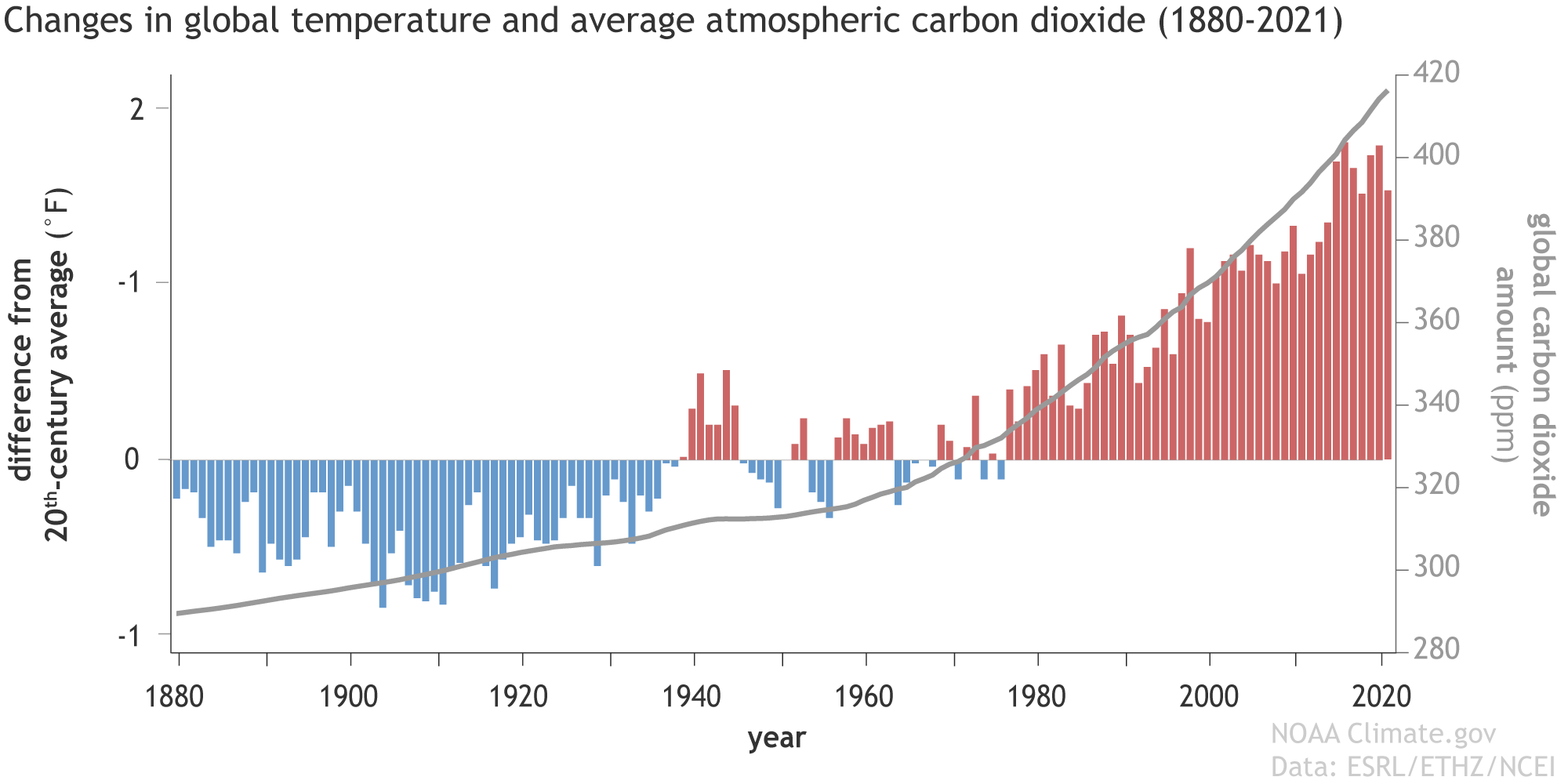
| ▲ | Certhas 7 hours ago | parent | prev | next [-] | | https://www.climate.gov/sites/default/files/2022-10/global_t... CO2 and temperature track quite well. However, climate sensitivity actually says the relationship is not linear but logarithmic. Doubling CO2 increases temperature by 2-3 degrees. The thing is, in the last decade or two we have firmly moved into the regime where we are out of the natural variability. If you get a 30 degree summer every five years instead of every ten that might be a very clear signal for warming, but is not as notable. If every summer is 30 degree and sometimes you get 40 you really feel the new climate normal. | |
| ▲ | pyrale 7 hours ago | parent | prev | next [-] | | > CO2 has been rising since, what 250 years It has been rising exponentially. > However real effects of global warming seems to be felt since, like 10 years old ? Look up glacier timelapses. More vulnerable ecosystems have visibly reflected climate change for far longer than 10 years now. | |
| ▲ | marginalia_nu 7 hours ago | parent | prev | next [-] | | Atmospheric CO2 has been accelerating. We increased atmospheric CO2 by as much the last 25 years as we did the preceding century. | |
| ▲ | Dumblydorr 7 hours ago | parent | prev | next [-] | | Keep in mind total emissions grew much much faster in our lifetime (let’s say 1980-2026) than in the prior 200 years, which was before most of the recent huge growth in Chinese and Indian emissions. Also the ocean and arctic were absorbing the majority of the heat. The arctics been going through these heat waves for 10 years, its white albedo decreasing and potentially permafrost melting making more effective emissions now. We must act. Stop eating beef. Stop taking trips if possible. Vote for those who care about climate, not bugaboos like immigration. We have real problems like climate, and jump-scare tribal problems like immigrants and foreigners, which are actually good for a nation. Saying this just having emerged from a heat dome, New England forest is not built for feels like 105F. Many living things in my own backyard are now heavily stressed by climate. We. Must. Act. | | |
| ▲ | inigyou 7 hours ago | parent | next [-] | | What action will you take to ensure next year it's only 85F? | | |
| ▲ | Dumblydorr 7 hours ago | parent | next [-] | | You can’t. All you can do is realize every trip you take and every bite of beef is yet another drop in the bucket. Every vote for a denialist is probably worth 100s of burgers too, sad to say. You must choose if your hedonism outweighs the good of our biosphere now and in future. The billions of unborn humans. The trillions of innocent life forms that might go extinct. That blue bird or cardinal in the yard with no AC. The coral reefs decimated. The poor humans suffering tremendously. We have a choice to slightly reduce these things. Most people choose hedonism. | | |
| ▲ | inigyou 7 hours ago | parent [-] | | There are some actions people can take that create massively outsized consequences. The CEOs of oil companies take many of these. |
| |
| ▲ | swiftcoder 7 hours ago | parent | prev | next [-] | | > What action will you take to ensure next year it's only 85F? The time to take that particular action was 20 or 30 years ago. We're not in a position to do a damn thing about next year's heat waves, or the year after that... What we're talking about now is taking actions that may prevent much larger heat waves 20 years from now | | |
| ▲ | inigyou 7 hours ago | parent [-] | | What actions will you take to ensure the summer of 2050 isn't 200F? | | |
| ▲ | swiftcoder 6 hours ago | parent [-] | | Solar + heat pumps, electric vehicle (I'd rather use public transit, but I live in the wilderness), eating locally-grown seasonal fruits and vegetables, etc. I walk this walk, bud, but at the same time, whatever I do is completely irrelevant if we don't get off our collective asses and force the governments and corporations to do their part. |
|
| |
| ▲ | abroszka33 3 hours ago | parent | prev [-] | | Absolutely nothing. In fact I'm trying to enjoy the things I can while it lasts. |
| |
| ▲ | baggy_trough 7 hours ago | parent | prev | next [-] | | You aren't going to "stop eating beef" your way out of this. Addressing climate change requires technical solutions that result in clean energy that is cheaper than carbon emitting sources (in reality, not just due to regulations). | | |
| ▲ | hdgvhicv 4 hours ago | parent [-] | | Solar is far cheaper than other forms, despite he US subsidising fossil fuels and taxing solar | | |
| ▲ | baggy_trough 4 hours ago | parent [-] | | Excellent news, then all we have to do is let peoples' desire to save money take care of the problem! |
|
| |
| ▲ | bamboozled 6 hours ago | parent | prev [-] | | “Stop eating beef.” Nah we need to stop burning fossil fuels dude. | | |
| ▲ | swiftcoder 6 hours ago | parent [-] | | I mean, we do also need to eat less beef. Its not going to fix things on its own, but it is part of multi-solving our way through this crisis |
|
| |
| ▲ | sometimelurker 4 hours ago | parent | prev [-] | | > CO2 has been rising it rises faster now because we have more co2-emitters today than we did 20 years ago. source: economy has grown. idc if this sounds rude, but honestly you shoulve guessed this |
|
|
| ▲ | Havoc 7 hours ago | parent | prev | next [-] |
| Yeah London was genuinely rough. Everything is built for cold not heat |
| |
| ▲ | graemep 7 hours ago | parent [-] | | A lot of older building worked a lot better. The downstairs of my Victorian terraced house in Cheshire stayed cool throughout the heatwave. A friend's far older house with very thick walls is extremely good at maintaining comfortable temperature in the summer. |
|
|
| ▲ | Luc 7 hours ago | parent | prev | next [-] |
| It's a damn shame that the EU's plan to reduce our already low emissions (<6% globally) to zero by 2050, at great cost to our collective wealth, will result in a reduction in global warming of less than 0.02 C (1). That is if industry doesn't just move to India, China, Indonesia, etc. (1) Based on the IPCC rule of thumb of 0.45 C increase per 1000 GtCO2 emissions, see e.g. https://www.cambridge.org/core/books/climate-change-2021-the... |
|
| ▲ | yread 6 hours ago | parent | prev | next [-] |
| Not that it invalidates the article but the previous record for Czech republic was 40.4 not 39 degrees (see VIII/August below) https://www.chmi.cz/namerena-data/historicka-data/historicke... |
| |
|
| ▲ | k__ 7 hours ago | parent | prev | next [-] |
| "Europe's rapid warming is partly the result of [...] a drop in the number of tiny polluting particles in the air. This means that less of the Sun's energy is reflected back into space, leaving more energy to heat the Earth's surface." Hmmm... |
| |
| ▲ | rsynnott 7 hours ago | parent | next [-] | | This is a fairly well-known phenomenon, and sometimes comes up in geoengineering discussions. It’s dangerous ground; thing about fine particulate matter is you generally don’t want to breathe it. | | |
| ▲ | swiftcoder 7 hours ago | parent [-] | | Ideally we would want a fine particulate that stays high in the atmosphere, and doesn't come down where we need to breathe | | |
| |
| ▲ | dofm 7 hours ago | parent | prev | next [-] | | This is now quite well-studied because we have had two periods in our own lifetimes (OK I guess maybe not in the lifetimes of some HN readers!), where we have cut air pollution radically almost overnight. 9/11 and the COVID pandemic transport shutdown. In both cases, the pan evaporation rate went up; in the case of 9/11 it went up very noticeably in a short period of time. Essentially: clean air == less "global dimming". Whether any really recent changes like the increasingly successful rollout of electric cars is yet having an effect, I don't know. | | |
| ▲ | Wacari 4 hours ago | parent [-] | | Yeah, another example is when the Internation Maritime Organization reduced the legal sulfur content limit in shipping fuel. This reduced SO2 emissions by about 80%, which improved human health, but also caused an increase in short-term atmospheric warming. |
| |
| ▲ | dwroberts 7 hours ago | parent | prev | next [-] | | The full quote is > Europe's rapid warming is partly the result of the melting of bright snow and ice, and a drop in the number of tiny polluting particles in the air. That first one is kind of important and it seems intentionally misleading to omit it | |
| ▲ | mike_hock 7 hours ago | parent | prev [-] | | Revs the coal-rolling truck's engine. "Once and for all." "But ..." Revs the engine again. "ONCE AND FOR ALL!" |
|
|
| ▲ | jmyeet 7 hours ago | parent | prev | next [-] |
| It's hard to compare a shift in a probability distribution because people will hang on to outliers. We hear this every winter: "all I hear about is Global Warming but look at this record snow". But I do believe the empirical evidence for all this has gone well beyond statistical significance. The Wire is one of my all-time favorite shows in part because it's a story of institutional failure at every level. The police, the ports, the media, the schools and the city government. That's really what's going on here. Utility companies (in the US at least) prefer fossil fuels because they're more profitable. The wealthy prefer fossil fuels because a mine or an oil well is and always has been a massive wealth concentrator. Build a solar farm and it... just produces electricity. There are far fewer profit opportunities so it doesn't happen. So fossil fuel companies have money to throw at politicians to enshrine their rent-seeking behavior. But most depressing is how many ordinary people buy into this system with some hand-waving about "jobs" even though renewables will be strictly better in basically every way at this point. Spain could become the energy powerhouse of Europe here. It's one of the most southernmost European countries and has plentiful sunshine. Additionally it has a lot of otherwise degraded land. According to Google, 200,000+ square kilometers. You build endless solar farms and UHVDC transmission lines across the continent and you could massively diminish the dependence on natural gas. All the tech for all of this already exists. It can be added incrementally. There's no 20+ year construction cycle like there is for any nuclear project. As an added benefit, this would likely help regenerate the soil as China has done. It's worth adding that the privatization era of the 1980s and 1990s was a massive problem. Every utility in Europe should be nationalized. It's easier to subsidize energy shocks when you own the companies that are profiting from them. |
| |
| ▲ | graemep 7 hours ago | parent [-] | | > The wealthy prefer fossil fuels because a mine or an oil well is and always has been a massive wealth concentrator. lots of wealthy people are anti-fossil fuel. > Build a solar farm and it... just produces electricity. it needs land. It increases the value of land. Wealthy people own lots of land. The main objections for switching to wind and solar are variability in output and the cost of building all the new stuff. > Spain could become the energy powerhouse of Europe here. It's one of the most southernmost European countries and has plentiful sunshine. Fine if you are Spanish. Not so good if you are from the north of Europe or somewhere with less spare land. > It's worth adding that the privatization era of the 1980s and 1990s was a massive problem. Every utility in Europe should be nationalized. It's easier to subsidize energy shocks when you own the companies that are profiting from them. I think it would have the opposite effect. Its tempting to sustain the profits when you get them. I wonder whether the British government would be so keen on moving away from fossil fuels if it still owned BP? | | |
| ▲ | jmyeet 6 hours ago | parent [-] | | > lots of wealthy people are anti-fossil fuel. They're really not. Or it's just perfrmative environmentalism. Because they continue to support to politicians and the system that maintains the status quo. > Fine if you are Spanish. Please read the whole paragraph. Transmitting power, which is what UHVDC lines are for and something China builds to transmit power thousands of kilometers from the Western half of the country to the Eastern half where everybody lives, exists [1]. Standard transmission lines lose 4-10%/1000km. UHVDC loses 1-3%/1000km. Europe loves importing electricity. It's the key to greenwashing. Why not build solar where it's most efficient and import that instead? > I wonder whether the British government would be so keen on moving away from fossil fuels if it still owned BP? The UK has spent hudnreds of billions of pounds subsidizing electricity that goes straight into the pockets of the shareholders of natural gas companies and private utilities. Is that better? [1]: https://www.youtube.com/watch?v=Y9OcsvNZeB0 | | |
| ▲ | graemep 3 hours ago | parent [-] | | > They're really not. Or it's just perfrmative environmentalism. Because they continue to support to politicians and the system that maintains the status quo. There are a lot of wealthy people spending serious money on lobbying against fossil fuels: https://spectator.com/article/revealed-the-shady-funding-of-... > Europe loves importing electricity. It's the key to greenwashing Yes, its also a potential problem transmitting . > The UK has spent hudnreds of billions of pounds subsidizing electricity that goes straight into the pockets of the shareholders of natural gas companies and private utilities. It has spent a lot of money subsidising wind power. The UK has hugely cut its CO2 emissions. https://ourworldindata.org/profile/co2/united-kingdom | | |
| ▲ | jmyeet 2 hours ago | parent [-] | | Oh... I understand now. You're right wing and quoting a right-wing dish rag like the Spectator to play into a conspiracy that "dark money" is pushing some "net zero" agenda, somehow at the expense of the UK. Got it. According to one study, the UK's investments in wind power have saved consumers 100 billion pounds since 2010 [1] all while spending 16-20 billion pounds a year on subsiizing natural gas [2] plus more on an emergency energy bill in 2020-2022. [1]: https://www.ucl.ac.uk/news/2025/oct/analysis-wind-power-has-... [2]: https://www.globaljustice.org.uk/news/uk-government-subsidis... | | |
| ▲ | graemep 36 minutes ago | parent [-] | | Your first link (the credible one) says "This massive expansion of UK offshore wind is partly due to UK government subsidies." so it proves me right. The other one is a campaign group who say there are subsidies but fail to name a single specific one. Insulting people who come up with facts that do not suit your case does not prove anything, and there are guidelines on HN about personal attacks and assuming bad faith. Saying "Spectator bad" does not disprove anything it says either. Believing publications that take a line you agree with and disbelieving those that disagree with you is not a great way of learning facts. | | |
| ▲ | jmyeet 18 minutes ago | parent [-] | | > The other one is a campaign group who say there are subsidies but fail to name a single specific one. It seems deliberately obtuse to try and deny there are significant energy (and thus natural gas) subsidies in the UK. Ok, try the Office of Budget Responsibility [1]: > By the time of our November 2022 forecast, the Government announced a series of additional measures to support households and business, which increased our forecast of the total cost of energy support in 2022-23 to £67.1 billion (2.7 per cent of GDP). > Insulting people who come up with facts So you're not right wing? Cry-bullying about "personal attacks" for using an accurate political label correctly isn't helping your defense. Pushing a conspiracy theory that a cabal of dark money is pushign renewable power and using The Spectator as a source is the UK equivalent of quoting Sean Hannity. [1]: https://obr.uk/box/the-cost-of-the-governments-energy-suppor... |
|
|
|
|
|
|
|
| ▲ | thewhitetulip 7 hours ago | parent | prev | next [-] |
| Why is it that aggressive climate action is not taken still? |
| |
| ▲ | water-data-dude 3 hours ago | parent | next [-] | | In the US it's been turned into a culture war thing, because ignoring the problem benefits some already wealthy people who think they'll either be insulated by their wealth or they'll dead before it's time to face the consequences | |
| ▲ | makapuf 7 hours ago | parent | prev | next [-] | | Sure those heatwaves are murderous, but I think the earlier they come, the earlier real action is taken. The worst could be a very slow response. | | |
| ▲ | thewhitetulip 7 hours ago | parent [-] | | They are early. I saw an old prediction for EU temparature The 2050 temp they had predicted was less than the current heat wave |
| |
| ▲ | sometimelurker 4 hours ago | parent | prev | next [-] | | coordination problems. everyone (mostpeople) wants action to be taken, but it requires coordination | |
| ▲ | mike_hock 7 hours ago | parent | prev | next [-] | | Tragedy of the commons. | |
| ▲ | inigyou 7 hours ago | parent | prev | next [-] | | What action would be taken by who? | | |
| ▲ | IshKebab 7 hours ago | parent [-] | | There are literally hundreds of actions that could be (or in some cases have been) taken. I think the vast majority need to be taken by the government. Individuals mainly need to to support and demand these actions from the government, and punch climate change deniers in the face. E.g. 1. Stick to their plan to ban ICE car sales by 2030. 2. Unban on-shore wind power (Labour did this! Not that anyone noticed...) 3. Mandate solar panels and heat pumps for new houses. 4. Mandate bike lanes for new roads (blows my mind that this isn't a policy). 5. Take distribution into account when paying energy suppliers, so we aren't paying for a load of wind power in Scotland that we can't use (I believe this is being considered). 6. Upgrade the grid so we can get power from Scotland (I think this is in progress). 7. Make car charging infrastructure sane. No apps! Fines for broken chargers. More chargers along motorways. Street-side charging. 8. Stop freezing fuel duty. 9. Mandate OpenTherm (or similar) on boilers and thermostats. 10. Create an open, mandatory standard for remote adjustment of power consumption of things like air conditioners, freezers, car chargers and so on, that must be supported and can be used by power companies to optimise grid usage. Some large buildings do this but 99.99% of things that could do it don't. 11. Offer government backed loans for solar power. There are private companies that do it but they're seen as quite sketchy (e.g. if you sell your house...) so uptake is low. 12. Give office employees a right to work from home one day a week where it's possible (similar to how you have a right to change your hours). 13. Ban patio heaters. 14. Ban especially inefficient cars (e.g. less than 20 mpg). 15. Fix the railways... They are working on this tbf. | | |
| ▲ | inigyou 7 hours ago | parent [-] | | Then I think the answer to your question is that the government is corrupt and paid off by oil companies and other interests to not do these things. So they will not happen. | | |
| ▲ | IshKebab 6 hours ago | parent [-] | | Wasn't my question, but no I don't think that's the reason. It's that ordinary people do not actually care about it that much. Plenty of people are still climate change deniers (yes even in the middle of an unprecedented heatwave in the UK which is relatively liberal). Even the people that have brains are ostensibly do care about climate change... when push comes to shove and you try to increase petrol prices to the level that represents their true cost, or try to erect a wind turbine near them... They'll say "erm actually never mind". Actually it doesn't even need to be a wind turbine. There are many PV solar projects in the UK that get attacked by NIMBYs. Literally just solar panels in fields. The most low impact construction ever. How could people possibly object to that, you ask? There are a variety of bullshit reasons they come up with e.g. 1. Extra lorry traffic during construction (a one-time minor inconvenience). 2. The applicants hadn't done a survey on how putting poles in the ground in the middle of a field might affect the habitats of newts, or some bollocks like that. 3. There's too much solar power already. I shit you not. https://www.bbc.co.uk/news/articles/cd0vyv7rejlo |
|
|
| |
| ▲ | titzer 7 hours ago | parent | prev | next [-] | | Because rich people want more money. They keep saying it's for the good of humanity and some useful idiots keep repeating that. A more balanced tax policy, regulation of financial markets, incentives to renewals, stopping investment in fossil fuels, increasing energy efficiency, and rewilding could all help, but we won't do a lick of it, because every single one of those things goes against the billionaires who own the political class. | | |
| ▲ | argentinian 7 hours ago | parent | next [-] | | Voters also don't care much. You might say that rich people and politicians have more responsibility because they have more power for making changes, but politicians are chosen by voters, and wealth doesn't make people more ethical | | |
| ▲ | thewhitetulip 7 hours ago | parent [-] | | So I've thought about this a lot. All the news orgs are owned by oligarchs and that's why even on this thread using green energy is equal to going back to stone age When China India and now Phillipines and rest of South Asia is installing record number of solar and wind | | |
| ▲ | argentinian 7 hours ago | parent [-] | | What do you think about the concept of "externalities", making producers of excessive contaminating gases pay for it because they are harming the planet? | | |
|
| |
| ▲ | makapuf 7 hours ago | parent | prev [-] | | I'm 100% behind it, but would regulation of financial markets and balanced tax policy do for global warming ? Sure heavy regulation of industries and fossil fuels usage but financial markets, im not sure. | | |
| ▲ | inigyou 7 hours ago | parent [-] | | Financial markets are the reason nobody has top-down control, because the market has control. I don't remember where I read that where employees in companies think AI is stupid but their manager wants them to, the manager also thinks AI is stupid but the CEO wants them to, the CEO also thinks AI is stupid but the board wants them to, the board thinks AI is stupid but investors want them to, and when they interview some investors, they don't give a shit about AI, why would they. Nobody is steering the ship. It's just drifting aimlessly in random self-perpetuating cycles. That's because financial markets are steering the ship but they don have any brains. If we put humans in charge of the ship again, we might be able to actually steer it and then we could steer it away from the iceberg that is climate change before we hit that iceberg. | | |
| ▲ | argentinian 7 hours ago | parent [-] | | What would you suggest that humans could do to steer it away from climate change? | | |
| ▲ | inigyou 7 hours ago | parent [-] | | Stop burning fossil fuels? It's pretty easy actually, if you were god-emperor of the world you could structure it in a way where very few fossil fuels have to be burnt. But nobody is god-emperor of the world, nobody is even god-emperor of most countries or even most large companies, people are barely president of most countries or large companies and that's the problem. | | |
| ▲ | argentinian 7 hours ago | parent [-] | | So we need a benign world emperor. And there's the risk of an evil world emperor. | | |
| ▲ | inigyou 7 hours ago | parent [-] | | We could start by letting companies have emperors, instead of letting the financial market be the emperor of almost every company. How's Valve Software doing? | | |
| ▲ | argentinian 7 hours ago | parent [-] | | The financial market is an expression of the incentives of investors. I think that markets are not the problem, instead the problem is that pollution is free, companies and governments can pollute or Earth without paying externalities. Blaming markets is completely missing the mark. |
|
|
|
|
|
|
| |
| ▲ | throw_m239339 7 hours ago | parent | prev | next [-] | | > Why is it that aggressive climate action is not taken still? We can't even have global peace around the world, some people are still starving daily despite the fact that there is plenty of food to feed everybody on the planet, and slavery is still a thing, who's going to do what climate action exactly? | | |
| ▲ | thewhitetulip 7 hours ago | parent [-] | | Europe and the world in general obviously. 1000 people doed in France due to the heat wave. Ignoring heat wave deaths, Hormuz crisis has shown us that oil cam be blockaded but the panels and windmills installed on our rooftops can't be blockaded Even Cuba is setting up solar plants with the help of China. Philippines is the highest importer of solar panels since Hormuz was blocked. Rest of South Asia is quickly following | | |
| ▲ | throw_m239339 21 minutes ago | parent [-] | | > Europe and the world in general obviously. 1000 people doed in France due to the heat wave. Way more died during the heat wave in France in 2003. What did France do? Nothing substantial, because nobody is willing to bear the cost of substantial policies to fight climate change. |
|
| |
| ▲ | dismalaf 7 hours ago | parent | prev [-] | | Do you really think Russia, China, India or developing countries are going to stop using fossil fuels if we stop? If the west de-industrializes then our enemies will destroy us... Russia's literally invading Europe right now (albeit poorly). | | |
| ▲ | feydaykyn 6 hours ago | parent | next [-] | | Check current renewal deployment figures, China is actually at the forefront, and India is taking the "right" path. https://www.youtube.com/watch?v=F1MGJUaxQPk | | |
| ▲ | dismalaf 5 hours ago | parent [-] | | Both are still increasing their total fossil fuel usage significantly. Even if they're deploying renewables at a high rate. Both are also increasing coal usage. Total and cumulative numbers are all that matter for global warming. https://ourworldindata.org/fossil-fuels https://ourworldindata.org/grapher/coal-production-by-countr... | | |
| ▲ | feydaykyn 20 minutes ago | parent [-] | | Thank you for the source, it's very interesting. I am a bit lost though: the first global graphic shows a depressing increase of fossil fuel consumption, but the detailed graphics after either show a stagnation or a decrease (must be centered on electricity generation I guess). The global picture seems very positive, reaching a plateau is a great achievement! Let's meet in 2026 to hopefully confirm this trend |
|
| |
| ▲ | Hikikomori 6 hours ago | parent | prev | next [-] | | Yeah they will, its literally cheaper now. | |
| ▲ | thewhitetulip 7 hours ago | parent | prev [-] | | China and India are installing crazy amounts of solar. I don't know much about Russia. India is doing industrialisation via solar. Massive solar arrays on top of factories and warehouses. How the heck is installing solar panels to generate green electricity de-industrilaize?! Also India is building worlds largest solar park of 30GW |
|
|
|
| ▲ | metalman 6 hours ago | parent | prev | next [-] |
| Unfortunately, the headline, like ALL of the rest for decades, is woefully conservative and fails to address the real situation, and more probmilmaticaly the failure modes of intense climate change.
The current (daily) charts and maps as all in record teritory, with changes so extream as to suggest that there could be unmanageable conditions in our imediate future. https://www.ospo.noaa.gov/products/ocean/sst/contour/ https://nsidc.org/sea-ice-today https://climatereanalyzer.org/clim/seaice_daily/ edit: The charts shown in the article, show
the institutional insanity, by greying out Ireland, speaking of "europe", but showing only data for England. |
|
| ▲ | graemep 7 hours ago | parent | prev | next [-] |
| Why such short term graphs? One of them only goes back 1991, and the longest term only goes back to 1946. |
| |
| ▲ | rsynnott 6 hours ago | parent | next [-] | | I’d assume lack of quality high resolution data. Weather stations all over the place, with records preserved indefinitely, is a relatively recent phenomenon. | |
| ▲ | realo 7 hours ago | parent | prev [-] | | Yes... why!! Let's go back... ah, I see mile-high glaciers over London. Global warming did occur in the past as well. | | |
| ▲ | graemep 7 hours ago | parent [-] | | How is that a reason to exclude it from the graph? Surely including it in the charts would strengthen the case for regarding it as a long term problem? Excluding it subtly suggests that global warming is a short term phenomenon. | | |
|
|
|
| ▲ | IshKebab 7 hours ago | parent | prev | next [-] |
| And yet there are still climate change deniers here. Look at any BBC article about this where they enable comments and about a quarter of the upvotes are for denier comments. Absolutely insane. |
|
| ▲ | kubb 7 hours ago | parent | prev | next [-] |
| Let's keep going. I almost have enough for _. |
|
| ▲ | nemo44x 7 hours ago | parent | prev | next [-] |
| Time to get AC in homes. Especially in the Uk Where homes are generally terraced/attached, small, and decently insulated. The costs to operate wouldn’t be too painful. Secondly, much of Western Europe (except Norway) needs to figure out how to bring energy costs way down. It’s so expensive compared to the USA and Canada and people take home significantly less money. |
|
| ▲ | BrandoElFollito 6 hours ago | parent | prev | next [-] |
| I don't get the chart with the tropical nights. It is not as if there was a heat dome that is specifically sitting on the cities. It is more because the cities are so bad in heat control that they get tropical night via inertia. |
|
| ▲ | bob001 7 hours ago | parent | prev | next [-] |
| And yet many Europeans will still argue that ACs are evil and they shouldn't have them despite an estimated 175k heat related deaths per year. Although maybe this heat wave will change some minds. |
| |
| ▲ | rsynnott 6 hours ago | parent | next [-] | | Are the anti-AC zealots in the room right now? Lived in Europe all my life, never seen this, in the past 40 years. I think it’s more an American fantasy than anything else. Historically, aircon in Northern Europe was pointless except for large office blocks, so was rarely installed. It’s been common in much of Southern Europe for a while. I think it’s still a _fairly_ hard sell in much of Northern Europe; you might be talking about a few days a year when it’s actually required, which will discourage people from putting it in. Thought about it myself when I was WFH during covid, but in Ireland in particular it really is just a few days a year, at worst. | | |
| ▲ | bob001 5 hours ago | parent [-] | | > Are the anti-AC zealots in the room right now? The first response to my post was one. Last post that touched on this a couple weeks ago had a number of them as well. |
| |
| ▲ | skrebbel 7 hours ago | parent | prev | next [-] | | Is this a strawman? It might be my bubble, but I see a lot more people complaining about anti-AC warriors than actual anti-AC warriors. Do you have an example? I mean it also doesn't make much sense anymore does it? You turn the AC on when the sun is out and theres an energy surplus. We got AC last year, and solar panels at the same time, so the AC climate impact is zero. All reactions from neighbours etc were either neutral or positive. (This is in the Netherlands, which frowned upon aircos until very recently) | |
| ▲ | Sharlin 7 hours ago | parent | prev | next [-] | | Always fun, having to fight a problem caused by X by doing more X. At least there’s the silver lining that solar production and the need for AC go hand in hand. | | |
| ▲ | stavros 7 hours ago | parent | next [-] | | The problem wasn't caused by air conditioning, it was caused by burning fossil fuels. Perhaps we could find a way to have air conditioning without burning fossil fuels? | | |
| ▲ | Sharlin 5 hours ago | parent [-] | | Obviously. But as of now, AC means burning carbon (~50% of Europe's electricity production). Demand for even more electricity may accelerate the transition, hopefully, but right now the projection is that all the extra capacity and much more will be taken by data centers and consumer electricity bills are going to double or triple. Hopefully that will never actually happen but who knows. Obviously consuming even more should never be the solution to problems caused by overconsumption. We should be figuring out ways to keep electricity use in check rather than consuming more and more, but that's a fact that people would rather not accept. | | |
| ▲ | skrebbel 2 hours ago | parent [-] | | > But as of now, AC means burning carbon Source? Where I live (NL) the electricity prices are very low on the days/times you’d need AC because of all the solar power generated then. I think you gotta back up your claim that 50% of electricity consumed by ACs comes from burning carbon. It strikes me as very counterintuitive (or dated) |
|
| |
| ▲ | bob001 7 hours ago | parent | prev [-] | | Yes, all that CO2 generated by nuclear power plants and renewable energy is terrible. But I guess if enough people die then Europe's carbon emissions will also go down so it's a win! And thank you for proving my point. | | |
| ▲ | Sharlin 7 hours ago | parent [-] | | ~50% share (in some countries much higher) fossil-based electricity is still 50% fossil-based electricity. | | |
| ▲ | bob001 6 hours ago | parent | next [-] | | That tends to happen when you spend a couple decades shutting down the non-fossil fuel energy sources. Germany used to be 30% nuclear up to 2005 so well past climate change is real times. Now it's around 1%. | | | |
| ▲ | stavros 7 hours ago | parent | prev [-] | | Then don't do that. |
|
|
| |
| ▲ | swiftcoder 6 hours ago | parent | prev [-] | | > And yet many Europeans will still argue that ACs are evil I have literally never met this straw man European (and I live here). Heat pumps are going in all over Europe at a rate of knots, and solar adoption rates in southern Europe mean that using those heat pumps to cool down in summer will be basically free |
|
|
| ▲ | petesergeant 7 hours ago | parent | prev | next [-] |
| If you’re wondering who to blame, as little as ten years ago: “Republican Senate environment chief uses snowball as prop in climate rant”[0] It’s an interesting plot twist in Termination Shock, where the popularist right shifts overnight from “it’s fake” to “real, but the liberals/globalists/experts betrayed us by doing nothing useful”. A reframe from environmentalism into grievance politics, which is already becoming real in France[1]. 0: https://www.theguardian.com/us-news/2015/feb/26/senate-james... 1: https://www.bbc.com/news/articles/c4gyqldl3p5o |
| |
| ▲ | bob001 7 hours ago | parent | next [-] | | It's not a fully invalid view in Europe to an outsider's eye. There is a world where nuclear power and ACs were built to prepare Europe for this without increasing global warming. That world was blocked by environmentalists. Now it's no ACs and russian natural gas imports anyways. | | | |
| ▲ | stinkbeetle 7 hours ago | parent | prev [-] | | USA is around 18th country in CO2 emissions per capita, and has reduced emissions per capita around as much as the combined EU since 2000, or a little more. Can't see how some random politician is "to blame", that's pretty absurd claim, and not supported by the claimed evidence. | | |
| ▲ | fulafel 3 hours ago | parent | next [-] | | The others above USA are tiny countries. USA is at 14, Saudi Arabia at 20, EU at 5, China at 9. The reductions in absolute tonnage for USA are big because there's a lot of low hanging fruit left. And it's partly a petrostate. | |
| ▲ | defrost 7 hours ago | parent | prev [-] | | And the consumption habits of the USA are responsible for how many more tonnes of CO2 emissions that are not onshore within the USA ? The USA was far and away the very worst global source for a very long time, that only changed by offshoring the processing and manufacture that feeds US consumption. | | |
| ▲ | stinkbeetle 7 hours ago | parent [-] | | > And the consumption habits of the USA are responsible for how many more tonnes of CO2 emissions that are not onshore within the USA ? Probably quite a few thanks to globalist politicians among all major political parties to offshore production to countries with fewer regulations and much higher emissions intensity of production. But it would not be the highest emissions per capita. Much the same as the EU. The handwringing and self-flagellation still does not suffice for actual evidence for blaming one idiot politician in one country performing a political stunt. You clowns think this is a Captain Planet cartoon where there's a few evil moustache twirling dudes setting out to wreck the environment and you just need to defeat them and everyone around the world joins hands and its smooth sailing for the rest of eternity. You must be forever bewildered about the state of the world and shocked at the news of completely normal and foreseeable things happening, like energy being very valuable, and people wanting to buy things cheaply. I can assure you if Mr. Snowball here had never been born, there would be absolutely no difference to the current situation. If the North American landmass did not exist at all, fossil fuel use would still be causing the same kind of global carbon pollution. > The USA was far and away the very worst global source for a very long time, that only changed by offshoring the processing and manufacture that feeds US consumption. Petrostates have been much worse by emissions per capita. |
|
|
|
|
| ▲ | bilsbie 7 hours ago | parent | prev | next [-] |
| I’ve been hearing this every summer. It kind of feels like these countries rediscover summer every year. |
| |
| ▲ | gh2k 7 hours ago | parent | next [-] | | yes. every summer the records are broken again because it was warmer than the previous one. That's why the news repeats. | |
| ▲ | jplrssn 7 hours ago | parent | prev [-] | | > It kind of feels like these countries rediscover summer every year. The graphs in the article somewhat disprove that. | | |
|
|
| ▲ | comrade1234 7 hours ago | parent | prev [-] |
| Don't worry. The AMOC is already collapsing. I live in Zurich, about the same latitude as the north tip of Maine. Winters here are pleasant - you have to go to the mountains to get snow. Once the Atlantic current that keeps Europe warm collapses maybe the glaciers can start growing again. |