| ▲ | 10111001 5 hours ago |
| > Our findings suggest that 90% of American working hours are spent on tasks with little or no coverage from existing benchmarks. This makes it very hard to know how good AI models are at the work Americans actually do. > ... > But even after controlling for AI-exposure, O*NET tasks from occupations with larger wage bills are significantly overrepresented among benchmark prompts: So, in short: they want AI to take the good jobs. AI is not coming for jobs with tasks like "gather and empty trash" or "service, clean, or supply restrooms," or "mix water and detergents or acids in containers to prepare cleaning solutions according to specifications." We software engineers and lawyers would be smart to start retraining (and adjusting our living standards) now! And this points to one of the ways AI will help improve society and living standards for all: we'll have cleaner, better-maintained bathrooms, as labor one wasted on engaging intellectual tasks is redirected towards menial, low-pay tasks that still need a human touch. Reason to be optimistic, amirite? |
|
| ▲ | huijzer 4 hours ago | parent | next [-] |
| > We software engineers and lawyers would be smart to start retraining (and adjusting our living standards) now! As someone who recently switched from data scientist to electrician, starting the day can be pretty tough because you have to get physically moving and uncomfortable, but I feel way better at the end of the workday than after an office job. Most of the time, the work is pretty uncomfortable, but somehow it's a lot of fun. |
| |
| ▲ | fierycatnet 3 hours ago | parent | next [-] | | I've done it with Local 60. I didn't last long. The work is legit heavy and hours are crazy. I lasted 4 months before I figured it is not for me. 6 am safety meetings and talk about injuries or someone getting decapitated was not a good motivator either. | | |
| ▲ | pton_xd 3 hours ago | parent | next [-] | | You weren't kidding, one of the first things that popped up when I searched Local 60 was the regional chapter talking about their Death Benefits! | | |
| ▲ | Loquebantur an hour ago | parent [-] | | It's easy to insulate a robot. The difficulty with human abilities in vision, locomotion and particularly coordination and manipulation is due to their arithmetic complexity being high. Modern deep learning solves that, LLMs provide the "interface" for planned action. From the outside, this process of "solving" perhaps looks like "robots stumble around haplessly". But it's just the same as with mathematicians in the intellectual realm: when the level of ability surpasses that of humans, it appears as a "sudden event" to outsiders, having occurred far faster than anticipated. There are no "safe havens". | | |
| ▲ | lazide 37 minutes ago | parent [-] | | The reality is that humans are far cheaper than robots in most real world situations. The only real exceptions so far are heavily controlled environments like factories. Where robots ‘win’ is following orders with no regard to self preservation or long term survival. Ponder that for a bit, and it’s consequences get a bit scary. |
|
| |
| ▲ | harvey9 3 hours ago | parent | prev | next [-] | | Back when I worked shifts I had a colleague who looked like he had 'flu after a set of early starts. The safety brief is supposed to motivate you to work safely so maybe they need to work on how they present it. I saw a couple of colleagues injured in my old job (EMS) but only seen a member of the public decapitated. | |
| ▲ | dver 2 hours ago | parent | prev [-] | | Arc Flash training will get your attention. |
| |
| ▲ | inoffensivename 4 hours ago | parent | prev | next [-] | | I was a software engineer at a FAANG, now an airline pilot. I feel a bigger sense of satisfaction with my job now, because at least at the end of the day I helped people get to where they needed to go. The work is was doing in big tech was pretty far from anything that would help people in any tangible way. The money isn't as good but the office view is way better. I'm glad to see very poor coverage for transportation jobs on the AI benchmarks. May that continue until I'm done flying, at least AI probably won't ruin that for me any time soon. | | |
| ▲ | jcmontx 3 hours ago | parent | next [-] | | How much money did you spend in getting all of the hours + licenses? | |
| ▲ | caaqil 3 hours ago | parent | prev | next [-] | | > I'm glad to see very poor coverage for transportation jobs on the AI benchmarks. May that continue until I'm done flying, at least AI probably won't ruin that for me any time soon. No offense but pilots are probably at peak automation since their job has mostly been reduced to being a glorified AutoPilot system babysitters mainly needed for regulatory hedging. The ground transportation is still fair game though. | | |
| ▲ | jazzyjackson 2 hours ago | parent | next [-] | | Being responsible for knowing what to do when autopilot fails has pretty good job security actually. The job might be babysitting, but no one wants to be in a flying tube without a captain that can at least let us know when we’re all going to die | | |
| ▲ | caaqil an hour ago | parent [-] | | > no one wants to be in a flying tube without a captain that can at least let us know when we’re all going to die I'm not sure how the news being delivered by a carbon-based pilot would help with the dying part but I guess hospice care exists for a reason. |
| |
| ▲ | dghlsakjg an hour ago | parent | prev | next [-] | | You’ve never been in a cockpit while a plane has been flying have you? | |
| ▲ | weaksauce 3 hours ago | parent | prev | next [-] | | do you actually understand how modern airplanes work in practice or is this just based off the fact that an airplane can land by itself? | |
| ▲ | jpalawaga 3 hours ago | parent | prev [-] | | is there a reason to think swe won't become the same? llm pilot, accountability guy, and has enough skill to manually pilot in extraneous situations. | | |
| ▲ | azornathogron 30 minutes ago | parent [-] | | Pilots can do that because they go through a ton of training and they deliberately do things to maintain their manual flying skills, including regularly taking manual control outside emergencies when the autopilot could fly perfectly well. And when a pilot takes control "for practice" there's no reduction in productivity for the airline compared to if the pilot is sitting in the seat with the autopilot engaged. How can software engineers maintain a healthy "manual programming" skill set?
What employer would be willing to pay for so much wasted time for their software engineers to do deliberate training courses, or willing to accept the productivity loss from their engineers occasionally working manually for practice, when working manually is so much slower? |
|
| |
| ▲ | da02 2 hours ago | parent | prev [-] | | You made the right choice. You will outlast OpenAi and Anthropic. They sell hallucinations and best guesses. The future can't be built on that. A good pilot who cares about safety and details, that can't be replaced with an LLM. |
| |
| ▲ | lnsru an hour ago | parent | prev | next [-] | | Hello fellow electrician, I was previously electrical engineer :-) I enjoy healthy weight loss while not sitting continuously in the office. | |
| ▲ | atlasunshrugged 4 hours ago | parent | prev | next [-] | | How did you make the switch? Did you go back to school or do some sort of apprenticeship? | | |
| ▲ | huijzer 3 hours ago | parent [-] | | I have done multiple studies and they were always technical, so the company took a shot and hired me and would train me on the job. So far it's going well. They say I'm picking up stuff quickly and I occasionally help the head engineers with problems on their computers. This would probably be the same for most programmers. Reading drawings, connecting electrical circuits, and doing troubleshooting is surprisingly similar to programming. | | |
| ▲ | vvzz 40 minutes ago | parent | next [-] | | I mean, from my perspective as an engineer, electricians’ work is just extremely primitive. I do not mean this as a disrespect - its hard and important work, but its on order of magnitude simpler mentally. Of course many software "engineers" are nothing more than plumbers/electricians with data and that cohort is being quickly pushed out by AI. And our industry in general has conflated technicians and engineers which makes this worse. But fundamentally, engineers job is to model the problem from the first principles and then apply that model to whatever problem. Technicians operate within the model, so I postulate anyone considering themselves an engineer is fundamentally a more capable electrician, plumber, carpenter, whatever than any master tradesperson. I'm not speaking as someone that changed an outlet once and thinks they are now an "electrician". I have two decades of extensive property maintenance experience. I do everything myself and since my state does not allow pulling permits without licensure, I hold myself to commercial standards minimally. So EMT, MC, trapezes and gutters, no romex crap. Similarly, I will likely outsolder and outthread at least the current generation of "plumbers" that only know how to press things. What I'm saying is extremely evident in any electricians' forum where its obvious that electricians just do not understand why is NEC written certain way. Then there' usually some "oracle" on said forums "deciphering" what the code is, despite it all being a pretty basic and coherent spec. | |
| ▲ | atlasunshrugged 3 hours ago | parent | prev [-] | | Very cool! Best of luck on the transition | | |
|
| |
| ▲ | ww520 4 hours ago | parent | prev [-] | | OT. What’s the going rate for adding a new circuit from the panel? Let’s say the circuit ended with an external outlet outside of the garage and to an outlet inside the garage. | | |
| ▲ | knollimar 3 hours ago | parent | next [-] | | Depends heavily on how hard it is to get through the wall. Also adding a new circuit to a panel is different than extending one from inside | | |
| ▲ | ww520 an hour ago | parent [-] | | Just stacco on wood frame. It’s adding a new circuit from the panel; might need to add a circuit breaker for the circuit. The wire can go through crawl space or over in attic. |
| |
| ▲ | huijzer 3 hours ago | parent | prev | next [-] | | I'm in ship construction (industrial) | |
| ▲ | toomuchtodo 4 hours ago | parent | prev | next [-] | | $80-140/hr, depending on market (residential electrical work). | |
| ▲ | quickthrowman 3 hours ago | parent | prev | next [-] | | For one exterior GFCI receptacle in a bell box with a weatherproof in-use cover and one GFCI receptacle in a plastic box with 50’ of 14/2 NM-B cable, I would charge you $650. I don’t do the work myself. | |
| ▲ | ThrowawayTestr 4 hours ago | parent | prev [-] | | If you run the wire yourself would only be a couple hours of labor | | |
| ▲ | kakacik 3 hours ago | parent [-] | | Insurances love this trick so much they will refuse to pay anything in case it even indirectly caused any event. At least get it verified by professional, lowering financial gain of such approach a bit |
|
|
|
|
| ▲ | solyin 2 hours ago | parent | prev | next [-] |
| > AI is not coming for jobs with tasks like "gather and empty trash" or "service, clean, or supply restrooms," or "mix water and detergents or acids in containers to prepare cleaning solutions according to specifications." Yes it is. YC has a company working on picking strawberries, even. Hardware takes longer than software, but if you think the robots aren't coming, you're not paying attention. The only question is how long will they take to reach the general public? There are test runs already in automotive factories and elsewhere, and yeah, they're slow and don't work very well, for now, but there's a lot of money going into making them better. And then where will we be? |
| |
| ▲ | z0r 2 hours ago | parent | next [-] | | Automated harvesting machines for fruits is not an accomplishment of AI. Companies have been building machines to do that long before the advent of AI. Robotic manufacturing is nothing new. Back in 2012 I genuinely thought the self-driving car was going to put truck drivers out of work and reshape the economy on a timescale of less than a decade. This turned out to be a technofantasy. I think AI is going to play out the same way. AI is not a panacea for work, and the economic bubble forming around it is going to collapse with devastating consequences before we begin to see adoption of the underlying technologies for real ROI spread widely beyond the software industry. | | |
| ▲ | Loquebantur 2 hours ago | parent | next [-] | | "Robotic" isn't new, human-level ability in manipulation is. The same goes for self-driving cars. It's a exponential, hockey-stick curve that at some point crosses the level of human ability. There is nothing "linear" about it and your suggestion of parallels to former experience is wildly misguided. People fail to notice, most jobs are less complicated than math and programming. The "obstacles" there are of the kind of "we always did it this way", but that's no real "moat"? The bubble regarding the big AI firms may well collapse, but the assumption, that was somehow improving the situation is far-fetched. People automated out of a job will either compete with those in other jobs or be dependent on support. Either way, salaries will fall across the board and prices rise. At an ever accelerating pace. | | |
| ▲ | z0r an hour ago | parent | next [-] | | Prices can't rise while salaries fall in a functioning economy. Humans will continue to be cheaper for many physical applications. Your suggestions of the inevitable exponential curve for the improvement and application of these technologies is wildly misguided. | |
| ▲ | techpression 34 minutes ago | parent | prev [-] | | You can't have falling salaries and rising prices for a very long time before society collapses. It would have domino effects to the point of anarchy, people lose their jobs and banks become landlords, but the houses are worth nothing so banks collapse, with it goes the stock exchanges. Now there's no financial system in place at all, and all you're left with is strawberry picking robots and some tech billionaires living on their islands with their robot pets and flying cars. Now if all these resources were instead put into actually improving things, then we'd be far better of, unfortunately, for all the intelligence the people behind these things possess, they seem to be stuck in the "lets do the same but faster" mindset. |
| |
| ▲ | elevaet an hour ago | parent | prev | next [-] | | I made the same mistake in my thinking wrt truck drivers. I've learned a lesson to be more skeptical about these things. So far I see that my own work as a programmer has changed radically, and it is far more productive. I still have a lot of work, but I really don't know how this will play out. | |
| ▲ | pixl97 2 hours ago | parent | prev [-] | | Eh, this is partially incorrect. All the 'easy' to automate things have been automated already. A lot of things that were not automated is because there are small bits of problematic things that made it not worth while or the loss slightly too high. AI vision systems solve a lot of this. |
| |
| ▲ | uludag an hour ago | parent | prev | next [-] | | My understanding is that all of these endeavors involve scale and are very different from a drop-in replacement humanoid robot. Like with the particular examples you sited, cleaning restrooms can have a huge number of "edge cases" which nothing short of a robot with human-like capabilities could handle. If expenditures on AI is as huge as it is, with the financials being as shaky as they are, despite AI seeming to be very effective for very high paying jobs, I can't immagine the capex and shaky financials for replacing menial labor en mass. Like immagine all the chips, metals, compute needed as well as the maintenance, depreciation, vandalism, etc. | |
| ▲ | Beached 2 hours ago | parent | prev | next [-] | | While they are slow and dont work well, their cost / output is already on human parity. The Figure 3 test runs are proving that humanoid robots are already good enough for isolated repetitive tasks (factory work). | |
| ▲ | jmyeet 2 hours ago | parent | prev [-] | | AI isn't a technical problem. It's an economic one. There's nothing inherently wrong with automating away certain jobs, particularly if they're dirty, dangerous or repetitive. And I include agriculture in this. The problem is how we as a society handle that. Do we let AI specifically and automation in general to make a handful of people more wealthy? Or do we share those benefits so people have to work less? In short, it's an income and wealth distribution question. Sadly, I think we're automation will mean minting trillionaires while the fabric of society unravels around us. |
|
|
| ▲ | patcon 4 hours ago | parent | prev | next [-] |
| I'll take you up on that attempt to find a silver lining: Previously privileged people having a hard time is maybe a good recipe for class solidarity, which is maybe something we could use in society. Maybe it will be good for us... collectively, if not individually. Class mobility is good mostly because new money rising turns the soil of society -- a partial inversion of roles and positions, bringing [social] networks-on-high in greater contact with networks-down-low. An upper class moving down is in strange ways perhaps good for the "soil" of culture as well. It just has worse branding as a not-very-uplifting story. But it's better than rich-get-richer and poor-get-poorer, which is what's been happening a lot lately. EDIT: But also, I suspect I would be "fuck-you angry' at reading this comment if I had a family depending on me. |
| |
| ▲ | dclowd9901 3 hours ago | parent | next [-] | | This is a gleaming silver lining view. Blindingly so. The largest customers of the trades class are the white collar class. The largest customers of service industries are the white collar class. It _will_ be "the rich get poorer and the poor get poorer". This is a hollowing out and redistributing up of wealth, plain and simple. It's the reason AI company leaders are so adamant about framing it as a post-singularity utopia with UBI. They have no answer other than "you're all going to be jobless, better figure that out." Worse yet, they see it merely as a policy problem, rather than a problem they're responsible for. It _is_ a policy problem, no doubt, but the angry mobs won't be coming for policy. | | |
| ▲ | scruple 3 hours ago | parent [-] | | And the top 10% of earners pay something like 70% of the tax receipts. Cratering that tax base is going to wipe out social programs and payrolls back and forth across the entire country. | | |
| ▲ | kakacik 3 hours ago | parent [-] | | Not a concerns for folks working on it, its the-others-problem all the way down, or simply human greed |
|
| |
| ▲ | 10111001 3 hours ago | parent | prev | next [-] | | > Class mobility is good mostly because new money rising turns the soil of society -- a partial inversion of roles and positions, bringing [social] networks-on-high in greater contact with networks-down-low. An upper class moving down is in strange ways perhaps good for the "soil" of culture as well. It just has worse branding as a not-very-uplifting story. But it's better than rich-get-richer and poor-get-poorer, which is what's been happening a lot lately. I think you're confused. The true upper class isn't going anywhere, those are the people so rich they don't need to work (and if they do "work," it's tending their empire). They'll keep getting richer. The "downward mobility" you're talking about the upper middle class and middle class. People who need to work, but can live comfortably on their wages. This is really about flattening the working class into its poorer levels (and kicking away the ladders the people in those levels could use to lead a more comfortable life, no more getting a college degree and graduating from the factory floor to the office). It's about increasing inequality and creating an unbridgeable chasm between the poor and rich. | | |
| ▲ | topaz0 2 hours ago | parent [-] | | The truly rich need the masses to be complacent about their wealth to be able to hold it. They work very hard to demotivate the masses, and succeed largely because the professional class are happy to play along in exchange for prosperity. Solidarity between the professional class and the poor would do a lot to undermine the conditions that let them keep their wealth. | | |
| ▲ | 10111001 2 hours ago | parent | next [-] | | > The truly rich need the masses to be complacent about their wealth to be able to hold it. They work very hard to demotivate the masses, and succeed largely because the professional class are happy to play along in exchange for prosperity. Solidarity between the professional class and the poor would do a lot to undermine the conditions that let them keep their wealth. Are you talking about violent revolution? Some disorganized thoughts: 1. The professional classes are so unused to violence, they'll probably undermine the chances of violent revolution (e.g. reflexively supporting gun control, seeing such voilence through the lens "school shootings" and other crime, and being likely to report it, etc.). 2. The professional class is losing a lot of its economic power. The time for solidarity and non-violent action way 5 years ago, but the "happy to play along" professionals (e.g. libertarian software engineers) botched their best opportunities. From here on out it will be harder. 3. As all of this is happening, technology is helping to undermining the ability of the masses to do anything about it: IRL community declining, people getting mesmerized and isolated by social media, AI-enabled surveillance, AI-enabled astroturfing and propaganda, autonomous AI weapons, etc. 4. Even if what you say is true, the clock is ticking. Wait a generation and the "former professional class" will be gone as a distinct thing, and their kids will join an undifferentiated mass of poor who have normalized and internalized their circumstances, as they have no first-hand experience of better times. | |
| ▲ | jimbokun 2 hours ago | parent | prev [-] | | > The truly rich need the masses to be complacent about their wealth to be able to hold it No they just need killer robots to shoot anyone who gets uppity. |
|
| |
| ▲ | falsemyrmidon 3 hours ago | parent | prev | next [-] | | Hollowing out the middle class (and yes I consider software engineers to be mostly upper middle class, most of them need to continue working for someone else) is not a good thing. What makes you think any of this is creating upward class mobility instead of just increasing wealth concentration? | | |
| ▲ | code_biologist 3 hours ago | parent [-] | | Indeed, the changes around socialization and community formation during the last 30 years perfectly discourage meaningful class solidarity. Everybody will continue scrolling angry content while the middle class hollowing out proceeds. |
| |
| ▲ | jimbokun 2 hours ago | parent | prev | next [-] | | This would be downwards only class mobility. Not very helpful if you don't also have people moving in the opposite direction. | |
| ▲ | rattlesnakedave 3 hours ago | parent | prev | next [-] | | [flagged] | |
| ▲ | ecshafer 3 hours ago | parent | prev [-] | | Your argument is that a lot of people, who worked very hard, losing their jobs would be a good thing actually, because maybe we can have a violent communist revolution where we can all be poor together. At least millions will starve in the resulting civil war, then millions more in the resulting communist rule. You also have this hilarious talk of "privilege" with this weird assumption that all of the white collar workers of course come from great privilege (perhaps telling on yourself and letting your guilt come out), despite many of us having grown up poor, are from poor areas, and worked our way out. | | |
| ▲ | weakfish 3 hours ago | parent | next [-] | | I think you’re assuming the poster genuinely agrees with what they posted, whereas this quote seems to point towards a more devil’s advocate view: > I'll take you up on that attempt to find a silver lining: | |
| ▲ | advael 3 hours ago | parent | prev [-] | | IDK do we still consider china - a country that currently has a fairly enormous middle class - to be communist? For that matter, do we view the current american economy to be a free market? (It's certainly "capitalist" in the strict academic sense of the word, wherein capital invested is the means by which ownership is ascertained, but that's generally not what people mean colloquially, so I find that using that term mostly bogs people down in semantics) Furthermore, why do you believe that the only possible outcome of class solidarity is violent revolution? Why do you believe that any revolution would inevitably settle on, presumably, a specifically soviet model of government and economic policy? I find that most american adults, even ones who otherwise seem intelligent, seem to have this picture of economic and power relations that just kind of sounds like a half-remembered bad cartoon of a cold war that ended before I was born. | | |
| ▲ | TFNA an hour ago | parent [-] | | Whatever China's regime is now, it is the expression of a population with a much more collectivist spirit than the West, a population that overall (i.e. a small dissident minority aside) is willing to submit to the Party in the name of social stability. The West is a lot more individualist, and a revolution under those circumstances is likely to be much messier. The point is that it probably wouldn't neatly land on a specific model, Soviet or not, but would first involve immense turmoil and infighting like revolutions usually do, and after that it still probably would never reach the effectiveness of China's post-Mao model. |
|
|
|
|
| ▲ | fasterik 3 hours ago | parent | prev | next [-] |
| I think you're concluding too much and too little from this statistic at the same time. Just because current AI systems can't automate manual labor doesn't mean that's not coming with a future generation of robotics and ML models. And just because AI performs well on a benchmark doesn't mean it's "taking the jobs". You still need humans to decide what's important to work on and to do the high-level system design and engineering. You might need fewer human employees at one company to do the same amount of work, but this creates an enormous opportunity for teams to do more and for more people to start companies. The lump of labor fallacy needs to go away. https://en.wikipedia.org/wiki/Lump_of_labour_fallacy |
| |
| ▲ | autoexec 3 hours ago | parent | next [-] | | > And although you might need fewer human employees at one company to do the same amount of work with AI, this creates an enormous opportunity for small teams to start new companies and invent new technologies. Yes, I'm sure all the wage slaves who are suddenly forced out of the labor market that was barely allowing them to scrape by paycheck to paycheck will suddenly start creating new businesses and become investors in new technology and not just become homeless leading to a massive increase in diseases/crimes of despair. If (and it's a massive if) what passes for AI these days gets good enough to replace any substantial number of workers it will be a disaster. | |
| ▲ | strken 42 minutes ago | parent | prev | next [-] | | If the number of job openings go up, but at the same time the average job opening has worse pay and conditions, I don't see the connection to the lump of labour fallacy. As far as I know, that's how the lump of labour fallacy actually works! There's an equilibrium between supply and demand for labour such that workers are (more or less) choosing the best jobs they can find. There's infinite demand for labour, but not at any price, so demand destruction of the best jobs can still happen. There will be infinitely more jobs, but they won't be as good as the ones that were destroyed. Of course, demand creation for really good jobs can also happen. What the GP is saying is that they believe demand destruction will outpace demand creation for really good jobs and everyone will be forced into less desirable jobs. I don't see how this is inconsistent with the lump of labour fallacy. | |
| ▲ | NorthSouthNorth 2 hours ago | parent | prev | next [-] | | My current experience is that we're all just producing more output. Client doesn't pay us more, we don't work more, we aren't hiring more. We simply produce more work with a team that's remained the same size. Some of the projects we've done would have required 4-6 additional people, but realistically, pre-ai, we would just not do the project or we would do it over a period 3-4x longer. There's just so much to do. | |
| ▲ | Madmallard 3 hours ago | parent | prev | next [-] | | Nothing to do with that Company stock value goes up when they lay off staff. Next quarter shareholder maximization is the goal. AI and layoffs is the strategy to get there. | |
| ▲ | eli_gottlieb 3 hours ago | parent | prev [-] | | Lump of Labor is a fallacy, but a lot of bosses, upper management, and investors wish it was true. |
|
|
| ▲ | robotresearcher 4 hours ago | parent | prev | next [-] |
| > So, in short: they want AI to take the good jobs No, we are currently unable to do most tasks that require physical manipulation, independent of what anyone wants. |
| |
| ▲ | airstrike 4 hours ago | parent | next [-] | | If by "currently" you mean "for the foreseeable future", then sure. | | |
| ▲ | jebarker 4 hours ago | parent [-] | | Are you suggesting this is isn’t currently true in the conventional use of the word? |
| |
| ▲ | Forgeties79 4 hours ago | parent | prev [-] | | Guarantee you it’s more feasible with the insane investment we have been seeing than dc’s in space are. |
|
|
| ▲ | jpadkins 4 hours ago | parent | prev | next [-] |
| different side of the same coin: Of course smart companies are going to automate the most profitable tasks first, they seek profits! However, the benefit for society is also the greatest. As long as competition holds, the reduced costs in these tasks will represent the greatest savings for consumers. Tech has been creating disinflation for decades for consumers. AI may accelerate that (it hasn't so far). |
| |
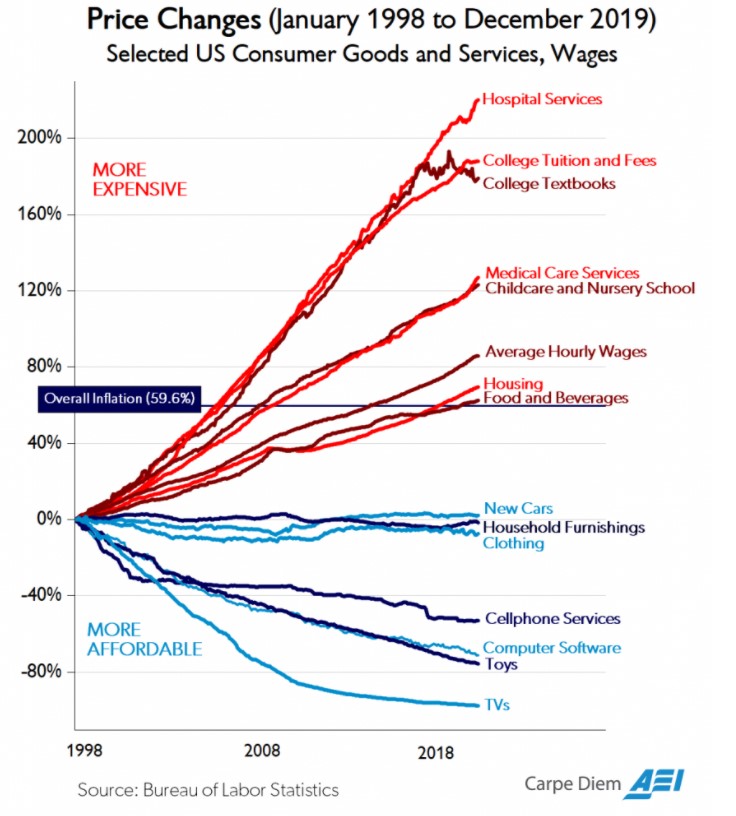
| ▲ | isgb 4 hours ago | parent | next [-] | | Oh yeah I definitely expect savings to be passed to consumers, like with all the tax cuts and deregulation we’ve been doing for decades. The only “disinflation” consumers have experienced is devaluation of products through obsolescence as newer, often more expensive alternatives enter the market. | | |
| ▲ | saulpw 4 hours ago | parent [-] | | I'm pretty cynical about the outcomes of capitalism in general. But I can buy a new 10TB HD for $300. Or a gigabit internet connection for $100/mo. Think back 10 or 20 years. How is this not a radical price-per-bit decrease for consumers? | | |
| ▲ | esterna 4 hours ago | parent | next [-] | | Of course, consumers don't intrinsically care about the bits. It would be more interesting to look at "price per website viewed/movie watched/game stored on your disk". Just like "time to open program" has worsened despite objective HW improvements, I'm not sure those metrics got any better. I'm almost cynically happy about Moore's law ending and hardware getting expensive if this is what it takes to improve software in the long term. | |
| ▲ | fugalfervor 3 hours ago | parent | prev | next [-] | | Because on necessities (repeated expenditures that cannot be budgeted away, like food and housing), inflation is higher now than at almost any other point in the history of the US. Who cares if I can get a large TV for $100 now, if my grocery bill has quadrupled? | |
| ▲ | xboxnolifes 4 hours ago | parent | prev | next [-] | | Both of those examples come mostly from innovative technology, not economics of sscale. 10TB drives today are literally completely different things than 10TB drives from 20 years ago. | | |
| ▲ | SoftTalker 4 hours ago | parent [-] | | Well 10TB drives didn't exist 20 years ago. Even 10TB total on a server was an almost unthinkable amount of storage. | | |
| ▲ | phoghed 4 hours ago | parent [-] | | The drives were like 10 years ago but you’re certainly wrong on the server part of your comment | | |
| ▲ | SoftTalker 2 hours ago | parent [-] | | I suppose... most of the servers I managed in those days didn't come close to that. These were pretty average 2U servers, maybe 6 or 8 drive bays with a 500G or so drive in each, RAID 5 config, so maybe 3.5TB total if loaded up. 10TB would have been considered a huge amount of space. I'm sure some storage servers or storage appliances were built with many TB even then but it wasn't really something I saw a lot. |
|
|
| |
| ▲ | jimbokun 2 hours ago | parent | prev | next [-] | | How important is that HD to you compared to housing, education, transportation, healthcare? The prices of all those things continue to skyrocket. | |
| ▲ | faishalmanzar 4 hours ago | parent | prev | next [-] | | I think we should look at the percentage margins they maintain on their products. Since the emergence of scaling laws, the benefits have largely been passed on to end consumers. However, scaling laws now seem to be approaching their limits. | |
| ▲ | 0c3ca83 4 hours ago | parent | prev | next [-] | | Oh, good, that saves me $300/year. | |
| ▲ | dclowd9901 3 hours ago | parent | prev | next [-] | | How much can you buy memory for? | |
| ▲ | SketchySeaBeast 4 hours ago | parent | prev | next [-] | | > But I can buy a new 10TB HD for $300 Can you? I assume you mean spinning platter, but even then. | | |
| ▲ | saulpw 3 hours ago | parent [-] | | diskprices.com, I was going to say $500 but looked it up before posting. | | |
| |
| ▲ | dragontamer 4 hours ago | parent | prev | next [-] | | 10TB HDDs were like $200 just 5 years ago dude. Computer parts are unaffordable this year. | |
| ▲ | toomuchtodo 4 hours ago | parent | prev | next [-] | | iPad price remark gets Fed's Dudley an earful - https://www.reuters.com/article/economy/ipad-price-remark-ge... - March 11th, 2011 “I can't eat an iPad.” > Best not to cite the price of the new iPad as an example of why inflation isn't a problem when you head into a working-class neighborhood.
In Queens, New York, on Friday, New York Fed President William Dudley did just that. He got an earful.
After being bombarded with questions about food inflation, Dudley attempted to reassure his audience by putting rising commodity prices into a broader economic context -- but that only made matters worse.
"When was the last time, sir, that you went grocery shopping?" one audience member asked.
Dudley tried to explain how the Fed sees things: Yes, food and energy prices may be rising, but at the same time, other prices are declining.
He then stretched for a real world example. The only problem was he chose the Apple's latest tablet computer that hit stores on Friday, which may be more popular at the New York Fed's headquarters near Wall Street than it is on the gritty streets of Queens.
"Today you can buy an iPad 2 that costs the same as an iPad 1 that is twice as powerful," he said."You have to look at the prices of all things."
This prompted guffaws and widespread murmuring from the audience, with one audience member calling the comment "tone deaf."
"I can't eat an iPad," another said. https://awealthofcommonsense.com/wp-content/uploads/2020/11/... | |
| ▲ | tehjoker 4 hours ago | parent | prev [-] | | Capitalism is good at driving down prices for consumer goods, also great at extracting rents from essentials (housing, medicine, education, etc). You gain on trinkets and lose on the things that make life worth living. Of course, competition leading to near-zero profits means most competitors collapse, and the remnants get bought up by monopolists or oligopolists who then become rent extractors. The technology was fundamentally developed with government grants to universities, or corporate labs like Bell Labs that were funded by a legal mandate on its parent corporation. Capitalists can only develop products that are basically ready for market, their margins are thin and planning horizons can only survive about 5 years usually. Their main power is throwing oodles of money at something ready to go and scaling it. Edit: I will be slightly more charitable and note that capitalist companies can also do incremental research if there is a gentle and obvious hill to climb. Sometimes people do make crazy bets and they pay off, but that's more the exception, in America the dominant driver of technological innovation is government funded research supplied by capitalist scaled technologies (i.e. you research the next paradigm in the lab and purchase e.g. pre-existing computing resources from a company). |
|
| |
| ▲ | stouset 4 hours ago | parent | prev | next [-] | | I’d love to see some of that disinflation you’re talking about. From my perspective, luxuries have gotten cheaper while basic necessities like food, housing, and medicine have become dramatically more expensive across the board. More and more it’s seeming that the “societal benefits” from the last fifty years of progress have largely been concentrated at the top. | | |
| ▲ | akavi 4 hours ago | parent | next [-] | | There are a thousand medicines that have experienced literally infinite deflation over 50 years: not available at any price to having a finite price. GLP-1s, Trikefta, Mavyret, Checkpoint inhibitors to name just a few recent blockbusters. People complain about insulin prices, but the insulin from 50 years ago costs 25-50 $/mo (https://www.walmart.com/cp/relion-insulin/8418641), it's the new stuff that wasn't available 50 years ago that's more expensive. Spending on food as a percent of income has declined significantly (~30%) over the past 50 years: https://ourworldindata.org/grapher/food-expenditure-share-fa.... The decline has flatlined over the past ~20 years, but at least some of that is affluence meaning we choose to eat out instead of cooking at home. House spending as a percent of income also seems to have declined over the past 50 years (https://economistwritingeveryday.com/2023/04/26/spending-on-...). To be honest, this one surprised me, I would've bet the other way. | | |
| ▲ | stouset 4 hours ago | parent [-] | | > There are a thousand medicines that have experienced literally infinite deflation over 50 years There are always individual counterexamples. And yet as a whole the cost of healthcare has exploded. > at least some of that is affluence meaning we choose to eat out instead of cooking at home A lot of that is poverty, not affluence. People working two jobs and living in food deserts aren’t cooking a lot of meals at home. It’s expensive being poor. | | |
| ▲ | akavi 3 hours ago | parent [-] | | The cost of "the healthcare that was available 50 years ago" has cratered in price. > People working two jobs and living in food deserts aren’t cooking a lot of meals at home The percent of people with multiple jobs has declined over the past 30 years: https://fred.stlouisfed.org/series/LNS12026620 (longest time series I could find) |
|
| |
| ▲ | bryanlarsen 4 hours ago | parent | prev | next [-] | | Since about the late 1500s, a bushel of wheat has cost within an order of magnitude of £1. By contrast, in the late 1500's a farmhand's wage was 1 pound + room and board. Right now it's £5.60, but that says more about the decline of the British Pound than an increase in the price of wheat. Massive food price deflation has been one of the wonders of the modern world. Hopefully the last few years were only a small blip on this overall trend. | | |
| ▲ | watwut 4 hours ago | parent | next [-] | | There were several revolutions, major wars and genocides in between 1500 and now. We would like to not have to go through similar events to get things back again. "It might get better in 500 years" is not exactly comforting thought. | |
| ▲ | 3 hours ago | parent | prev | next [-] | | [deleted] | |
| ▲ | smallmancontrov 4 hours ago | parent | prev [-] | | Health care, housing, and education are the drivers of the cost of living / wage crisis. Wheat is not. Furthermore, you know this. Why did you choose to steer the conversation away from the problem? | | |
| ▲ | mcmcmc 4 hours ago | parent [-] | | The comment they responded to literally listed food as a basic necessity. Are you not aware that bread comes from wheat? | | |
| ▲ | smallmancontrov an hour ago | parent [-] | | They listed food, medicine, and housing. The latter two have massively inflated and are creating the problem. The former is not. Why did you choose to steer the conversation away from the important ones and towards the unimportant ones? | | |
| ▲ | mcmcmc 32 minutes ago | parent | next [-] | | Wow you are exhausting. Someone asked about disinflation in basic necessities, they responded with a clear example in one of the necessities listed. Are you saying food is unimportant? Why are you incapable of accepting that disinflation has occurred in some cases, largely due to technological advancements? No one is talking about disinflation in medicine or housing because it hasn’t happened. It has with food. No one is trying to steer anything other than you. | |
| ▲ | 38 minutes ago | parent | prev [-] | | [deleted] |
|
|
|
| |
| ▲ | dachris 3 hours ago | parent | prev | next [-] | | Expectations have also increased. Friend from a middle class family grew up with 4 siblings in a 75m2 apartment. You'd get raised eyebrows for that today. Cheap food is still cheap. If some doomsday scenario ever comes along, I'll be forever sorry to not have stocked up on 6 years worth of calories that now cost less than a monthly salary. World market prices per metric ton: wheat like $300, rice $500. But that's not mutually exclusive with absurd levels of wealth concentration. | |
| ▲ | Barrin92 20 minutes ago | parent | prev | next [-] | | >basic necessities like food, housing, and medicine have become dramatically more expensive across the board. they haven't. In the early 1900s an American household spent roughly 50% of its income on food. And mind you food didn't mean an exotic fruit you flew in from the other end of the world or pounds of meat per week. Today an American household spends 9% of their income on food, the 'dramatic increase' may have bumped that up to 10% by some measures. The size of the average house of the average American family in the last half century has doubled while the family size has halved. In the 1960s 12% of households had AC access, today it's over 80%. Generics of basic medicines cost virtually nothing, you've just started to consume more sophisticated medicine over time. If you're an ordinary guy you are already living in luxury, you just don't notice it because you kept moving the goalpost on what luxury is. Which isn't per se wrong but you ought to be at least aware of it | |
| ▲ | Terr_ 4 hours ago | parent | prev [-] | | A popularly-shared graph on that subject, with everything pegged to 2000 as a baseline: https://www.visualcapitalist.com/inflation-chart-tracks-pric... Doesn't include foods, but it certainly punctures the "That family isn't aaactually in financial trouble, they have a refrigerator and a phone and a TV" statements from certain pundits. (A class of people who are often disconnected from the average person's budgeting situation.) |
| |
| ▲ | whatissohard 4 hours ago | parent | prev | next [-] | | You automate automation first, what is so hard to understand about this? You pick the highest leverage occupation first. Automating lawyers gives you.. angry lawyers? Automating programmers gives you improved ways of doing literally all other things because all other automation requires.. automation. That is to say bucketloads of software. It’s completely obvious what the play is here and it has nothing to do with pay. We pay peanuts for tokens so automating a developer for 200-500 a month worth of tokens ain’t getting you to a trillion a year. RSI is the play and it’s already happening. Our work is easier and faster and anyone that claims otherwise I have a very hard time taking serious. You think they come for mathematicians’ pay? If you want to earn money I guarantee you they need to automate some other low-hanging fruits first that pay a lot better. No, programming and math is basically what AI research is. You automate that and you got the golden ticket to all other things. | | |
| ▲ | huijzer 4 hours ago | parent | next [-] | | > No, programming and math is basically what AI research is. Most importantly, in these fields results can be easily verified which means that if you have enough compute, that you can generate correct training data. OpenAI had an early story - which could be a lie of course - about how they tried to train a robot but the actuators would be toast before the robot would have learned. Math and programming doesn't have such problems. | |
| ▲ | jimbokun an hour ago | parent | prev | next [-] | | > It’s completely obvious what the play is here and it has nothing to do with pay. We pay peanuts for tokens so automating a developer for 200-500 a month worth of tokens ain’t getting you to a trillion a year. Could be hallucinating by I just asked Gemini to estimate global average compensation of developers and multiply by estimate of total number of developers in the world, and it came up with $1 trillion to $2 trillion. So the total addressable market is the right order of magnitude, let alone all the other automatable high wage occupations.. | |
| ▲ | root_axis 2 hours ago | parent | prev | next [-] | | > RSI is the play and it’s already happening. Our work is easier and faster and anyone that claims otherwise I have a very hard time taking serious. No it isn't. Doing work more efficiently through the use of LLMs is not RSI. RSI requires a closed loop automated LLM iteration process which we are not at all close to right now. | |
| ▲ | bryanlarsen 4 hours ago | parent | prev | next [-] | | Exactly. AGI is explicitly the goal, where AGI is defined as an AI that can improve itself autonomously. Training an AI to make improvements to itself is training an AI to program. | |
| ▲ | danaris 2 hours ago | parent | prev | next [-] | | > RSI is the play and it’s already happening. Sure, if you redefine what that means. Before this year, "recursive self-improvement" in the context of AI research meant the holy grail: an artificial intelligence that was capable of improving itself, unattended, in ways that humans can't even imagine, so that within a relatively short period of time, it reaches superintelligence and ignites the Singularity. What's happening now is emphatically not that. And if you think it is, you are buying straight-up propaganda. "I gave an LLM a tool that lets it make largely-random decisions about how to train its next iteration when I tell it to do so" bears little to no resemblance to RSI. Because it is, beyond a rounding error, completely missing out on the "improvement" part. | |
| ▲ | aurash_v 3 hours ago | parent | prev [-] | | [dead] |
| |
| ▲ | tripleee 4 hours ago | parent | prev | next [-] | | Most people's highest spending categories are food, housing and healthcare. How are these disinflating? We're automating high paying careers and making what, the consumer's todo list and budgeting apps cheaper for them? My expensive smartphone is going to cost me ~$10/mo over its lifespan. I don't care if most of these consumer products get cheaper when they're a tiny portion of my spending | | |
| ▲ | jpadkins 4 hours ago | parent [-] | | 3 parts of the economy least impacted by Info Tech, also two of them are heavily regulated (housing, healthcare) which can mute tech impact on prices. |
| |
| ▲ | sedan_baklazhan 4 hours ago | parent | prev | next [-] | | Automating most jobs means extraordinary unemployment. Which doesn’t play well with “savings for consumers”, because these consumers will be unemployed. | | |
| ▲ | zeroonetwothree 3 hours ago | parent [-] | | 300 years ago 97% of workers were farmers. We automated almost all those jobs away. Is there extraordinary unemployment? I know, this time it’s different, AI is different, blah blah blah. | | |
| ▲ | sedan_baklazhan 2 hours ago | parent [-] | | Of course changes that happened over course of centuries can’t be compared with larger changes happening (or promised to be happening) in a few years. |
|
| |
| ▲ | toomuchtodo 4 hours ago | parent | prev | next [-] | | Trillions of annual US equities profits will continue to go to the top ~10% of households holding ~93% of US equities. Tech didn't create disinflation for decades, globalization and China manufacturing with ~1B people to the world did (only recently has China scaled up robotics and automation for manufacturing in preparation for their population decline due to forward looking structural demographics). Just like good blue collar jobs were shipped overseas, good knowledge jobs are going to be shipped to GPUs whenever they can. | |
| ▲ | lenerdenator 3 hours ago | parent | prev | next [-] | | > the reduced costs in these tasks will represent the greatest savings for consumers Bud, thinking that for-profit corporations - many of whom are in an oligopoly or monopoly position in their markets - are going to pass along savings from not paying people is like thinking the stripper really likes you. Remember how things were cheaper before the pandemic? Well, there were supply shortages and prices rose accordingly. Supply and demand at work, nothing surprising there. The supply chain shocks eventually went away. Some prices have sort-of come down, but many just haven't. Why? Because the people selling goods and services now know that people can and will pay the higher price. Now, they might do that through taking on debt and working additional jobs to the detriment of themselves, their families, their communities, and their country, but no one who both matters and can do something about it keeps track of those things. | |
| ▲ | exe34 4 hours ago | parent | prev [-] | | Why would those savings be passed to consumers? The red scare disappeared a long time ago. Wages have not kept pace with profits and productivity for 20 years. |
|
|
| ▲ | talon8635 4 hours ago | parent | prev | next [-] |
| Finally I will be free to pursue my hobby of cleaning toilets! |
| |
| ▲ | nradov 4 hours ago | parent | next [-] | | Not just cleaning. There are huge opportunities in snaking out plugged toilets. Let's see an LLM do that! | |
| ▲ | malux85 4 hours ago | parent | prev [-] | | Exactly! The human dream of machines writing poetry, painting pictures and writing music is here and we can finally be free of those burdens to scrub toilets and empty the trash. Utopia. Isn't it just typical the humans get automation v1 the wrong way around, haha |
|
|
| ▲ | amelius an hour ago | parent | prev | next [-] |
| > We software engineers and lawyers would be smart to start retraining (and adjusting our living standards) now! Instead most of us are "embracing" AI by training __it__ instead. Embrace, extend, ... and being extinguished. |
|
| ▲ | WillAdams 3 hours ago | parent | prev | next [-] |
| For a fictional take on this which arguably does well when considered to inform discourse see: https://karmak.org/archive/2003/12/manna/manna1.htm |
|
| ▲ | mikelitoris 3 hours ago | parent | prev | next [-] |
| This is what happens “automation” is done to maximize profit (by minimizing expenses in the form of salary) instead of maximizing human happiness (in the form of automating mundane jobs that nobody gets satisfaction from doing). In short, the usual problem of taking GDP as a proxy of well-being. |
|
| ▲ | Wowfunhappy 4 hours ago | parent | prev | next [-] |
| Let's assume, for the sake of argument, that AI truly is able to automate away basically all software development. Any oversight currently performed by humans can itself be done by agents. ...don't you think the ability to create virtually unlimited amounts of software, at virtually no cost, is going to lead to major advances in robotics? I realize there's a lot of very hard problems involved in e.g. robotic hands (to take one example), but once software development is practically free, I'd expect a lot of seemingly-impossible problems to get resolved by the sheer quantity of what we can create and experiment with. |
| |
| ▲ | 0c3ca83 4 hours ago | parent | next [-] | | Yeah, but manufacturing things takes materials and time; I'd give it at least a few years before we manage to squeeze people out of that too. | |
| ▲ | guelo 4 hours ago | parent | prev [-] | | The robots are going to be controlled by the same billionaires that make employees pee in bottles or fire hundreds on a whim over tweets. Our labor power is going to be fully eroded and the robots will not be serving us. | | |
| ▲ | Wowfunhappy 4 hours ago | parent [-] | | That's not really the point I'm trying to make. In the future, do bathrooms need to be cleaned? If yes, is it cheaper for that to be done by a person or by a robot? Obviously, it is in the interest of the robot manufacturers to make the robot just a tiny bit cheaper than the person, so you'll buy the robot and the company makes the maximum amount of profit. Now, if society breaks down and there's no one to consider buying the robot—well, that's not good for anybody, which is why I suspect society will find some way of working this out even if it's not ideal. But whatever, I don't particularly want to argue this point. What I do want to argue is that there probably isn't a universe in which all white collar work goes away but blue collar work is still around. | | |
| ▲ | shermantanktop 3 hours ago | parent [-] | | > I suspect society will find some way of working this out Not sure what this "society" that works things out is, exactly. Top-down high-modernist plans for how society ought to work are the past; chaotic, twitchy, thrashy responses to disruption by a tiny elite class is where we are now. |
|
|
|
|
| ▲ | abroszka33 2 hours ago | parent | prev | next [-] |
| > We software engineers and lawyers would be smart to start retraining (and adjusting our living standards) now! Yes like all the drivers and truckers who retained 10 years ago because self driving cars will take their jobs. Lucky all of them retrained in time! |
|
| ▲ | justonceokay 2 hours ago | parent | prev | next [-] |
| I did this a few years ago and I’m so happy I did. It doesn’t pay as well to rehang doors, but I’m glad that I never talk to a computer or even look at a computer screen all day at my job |
|
| ▲ | jrowen 4 hours ago | parent | prev | next [-] |
| It's interesting, the digital/physical barrier seems like the last line of defense we have against metastasized indifferent agents. Once they start causing problems, how are we gonna feel about robotics? Clearly a future where all of the "thinking problems" are easily solved but we still have to pick up trash kinda sucks. I'm sure they'll figure that out for us though. |
| |
| ▲ | robotresearcher 4 hours ago | parent | next [-] | | > I'm sure they'll figure that out for us though. Imagine I give you for free the perfect trash picking robot control AI software. Works great. Benchmark smashed. Now imagine what the rest of the robot is like, and how much it would cost. I mean really imagine, not just picture C3PO with a bucket and litter spike. How many motors and what are the torque vs. mass requirements? How is energy stored? It goes on, not all of it is solved, and none of it is cheap. Except compute. AI likely does accelerate robotics usefully - certainly in sensing and control. But there are major bottlenecks that are not software, that AI can only help with as a generic engineering tool, same as it helps planes and fridges. | | |
| ▲ | jrowen 4 hours ago | parent [-] | | I don't follow. What's the implication? Imagine I give you a perfect roadmap to build that robot... Responding to your edit, none of those things strike me as any more challenging than the control software. | | |
| ▲ | robotresearcher 4 hours ago | parent | next [-] | | Maybe the perfect roadmap says the trash picker needs $600B investment and will cost $4M per unit in 10 years time, if we solve all the problems. That trash picker may never compete with a human. There's no reason to assume it will. edit: > none of those things strike me as any more challenging than the control software Maybe the difficulties of motors and batteries are not intuitive. Look at their improvement rates over time. It's a far cry from transistor counts or FLOPS. And look at the performance and efficiency of humans and other animals. We are absurdly strong, light, efficient and cheap to maintain. The gap is huge and not closing quickly. | | |
| ▲ | jrowen 3 hours ago | parent [-] | | We already have versions of these robots. I don't think it's as wildly unsolved as you make it out to be. A few key efficiencies gained in any part of the process could tip the scales. I would bet something decent is on the market within 10 years. If it's not C3PO it's a Boston Dynamics dog with a couple appendages, better software, and automated manufacturing. | | |
| ▲ | robotresearcher 3 hours ago | parent [-] | | Boston Dynamics has the best robot mechatronics in the world, and the company is passed around between deep-pocket owners repeatedly because no one can figure out how to make products that pay for themselves. They have been trying since 1992. iRobot, the company that shipped the most robots in history because they focused super hard on finding a cost-effective subset of cleaning tasks, failed to scale up to other even closely related tasks, went bust and was sold off. But yeah, it's probably straightforward, right? | | |
| ▲ | jrowen 3 hours ago | parent [-] | | Again I don't think it's any less straightforward than "give you for free the perfect trash picking robot control AI software". The whole point is they can do better than us on these tasks. | | |
| ▲ | robotresearcher an hour ago | parent [-] | | “Give you for free” is a rhetorical device that focuses the discussion on the remainder that I didn’t give you. I didn’t make any claims about the relative difficultly. |
|
|
|
| |
| ▲ | tavavex 3 hours ago | parent | prev | next [-] | | The problem is that your roadmap requires things that don't exist yet or only exist at prohibitive prices, and it's not knowable how much time or money you will need to solve either one. So a concrete roadmap is impossible. Advanced robotics would need to become quite cheap for them to become more affordable and convenient than a minimum-wage employee. And physical fields like materials engineering are known for moving quite slowly and at their own pace, so I'm not sure how much automation could help there. That's the last barrier we have right now that prevents the total obsolescence (and therefore destruction) of the common worker. | | |
| ▲ | jrowen an hour ago | parent [-] | | Our starting assumption was "Imagine I give you for free the perfect trash picking robot control AI software." If AI can deliver that, why can't it figure out how to take a Boston Dynamics dog, design it for trash picking, and optimize manufacturing costs? | | |
| ▲ | robotresearcher an hour ago | parent [-] | | Two different answers: 1. The discussion setup where you imagine a counterfactual is given by magic does not entail that magic can do any other thing you choose. “Imagine I give you $100, what do you spend it on?” “A McClaren, since you could have given me $300K” 2. Taking your question directly: because these are not closely related problems. |
|
| |
| ▲ | jimbokun an hour ago | parent | prev [-] | | > Responding to your edit, none of those things strike me as any more challenging than the control software. Do you have relevant experience in any of those fields? | | |
| ▲ | jrowen an hour ago | parent [-] | | Nope. I don't know what that proves. I couldn't have come up with a solution to Navier-Stokes either. |
|
|
| |
| ▲ | uludag 2 hours ago | parent | prev | next [-] | | I'm convinced that businesses will never find offloading menial low-wage labor to robts more cost effective than just hiring underpaid laborers. | |
| ▲ | xienze 4 hours ago | parent | prev [-] | | > Clearly a future where all of the "thinking problems" are easily solved but we still have to pick up trash kinda sucks. Oh don't worry Mr. Former Software Engineer. You won't be picking up the trash or cleaning toilets. You have things like an expectation for your work to pay a reasonable wage. You'll be passed over for a third world immigrant who'll work for a pittance, and they'll be replaced only when robots are capable enough and cheap enough to undercut _them_. | | |
| ▲ | tavavex 3 hours ago | parent | next [-] | | The former software engineer will not be passed up on because he'll have the same demands as the third-worlder. If this comes to pass, we'll all be forced into the race to the bottom because no one wants to starve, so anyone that desperate would be forced to accept working for food or whatever the lowest possible standard of compensation will be in the future. | |
| ▲ | 4 hours ago | parent | prev [-] | | [deleted] |
|
|
|
| ▲ | rayiner 3 hours ago | parent | prev | next [-] |
| Elimination of these jobs is going to be good for everyone else. It's going to reduce the unearned returns to people born with high IQs and aptitude for coding or lawyering or whatever, and reduce upper middle class wages. That, in turn, will drive down prices. The reason housing is unaffordable isn't Jeff Bezos. It's because 20% or so of workers get paid very disproportionately to everyone else and they've been bidding up the price of housing. If Google could fire all their engineers housing would become much more affordable for everyone else in the Bay Area (like it was decades ago before engineering salaries got so high). It'll be more like Iowa or South Dakota is today. |
| |
| ▲ | dclowd9901 3 hours ago | parent [-] | | What work do you do? | | |
| ▲ | rayiner 2 hours ago | parent [-] | | Lawyer, before that a programmer. Statements are contrary to interest. | | |
| ▲ | achierius 2 hours ago | parent [-] | | Extant lawyers are unlikely to be replaced in the immediate future, if only thanks to regulatory barriers. | | |
| ▲ | dolebirchwood an hour ago | parent [-] | | Doesn't matter. If technology allows lawyers to service more clients in less time and at lower costs, there will be competitive pressure among new law graduates and up-and-coming attorneys to take advantage of this technology to run their own smaller, leaner practices at more affordable prices for a larger number of people. There's no shortage of people who are in need of legal services -- they just really can't afford it so they go without it. [1] We don't need to replace lawyers, just force them to be more efficient. [1] https://justicegap.lsc.gov/resource/section-4-seeking-and-re... |
|
|
|
|
|
| ▲ | tintor an hour ago | parent | prev | next [-] |
| Nope! :) Once mobile manipulator robots become good enough (and safe enough), AI will also take "gather and empty trash" or "service, clean, or supply restrooms" jobs as well. Large number of those bad jobs can be done with existing grippers or a simplified robot hand (without needing much more complicated human-like hand). |
|
| ▲ | bonoboTP 4 hours ago | parent | prev | next [-] |
| You're just irrational and not thinking. All those jobs are also something people want to and have automated. Street sweeping with a brigade of men vs one guy with those orange little street sweeping vehicles. Automated car wash. Self checkout in stores. Obviously whoever pays a salary currently, would rather not pay that but get the thing done faster and cheaper. There is nothing mustache twirling about this. Works the same way on every level. Do you 3x more when you get something done on your house or bathroom, so it's done by 3x as many workers who are forbidden from using power tools? Why not? Don't you want to help those guys have a job? Why are you so evil? |
|
| ▲ | vanuatu 4 hours ago | parent | prev | next [-] |
| i think this is mixing correlation and causation "They" figured out that it's a lot easier to hillclimb AI on verifiable digital tasks, and it just so happened that white collar jobs tend to pay more Ai will decimate customer support jobs but those are not considered highly paid If robotics continue to progress, we'll have all the robots to do our dishes and clean our bathrooms as you wish |
| |
| ▲ | rightbyte 2 hours ago | parent [-] | | I spend maybe 12h a year cleaning the bathroom and the dishwasher is a robot. How is that a market to keep dozens of harmonic drives operational. Unless there is some "post scarcity" there is no way it will be common place. | | |
| ▲ | vanuatu 2 hours ago | parent [-] | | hence the investment into general purpose robots that can do any humanoid shaped task, the market of which is all physical labour the same robot that cleans your bathroom can also wash your dishes, fold your clothes, defend your home, fix your gutters, etc (the bottleneck of which is the brain, aka software) |
|
|
|
| ▲ | legitster 4 hours ago | parent | prev | next [-] |
| The only reason software engineering existed is because coding and programming was unnecessarily hard. It was never meant to be an exclusive skill. If you step back, the LLM revolution is just "computers now respond to human instruction, like they were always supposed to". If you think of this field as a historic accident, and the current shift is a very unfortunate reset - it's a little less dystopian. In the long run, if it didn't affect me immediately, I don't mind a society that values "keeping restrooms clean" a little bit more and "talking to computers good" a little bit less. |
| |
| ▲ | jebarker 4 hours ago | parent | next [-] | | I agree with you about not treating programming as a protected skill that has a right to be well paid, but computers were never “supposed” to be anything. They’re in no way inevitable in their current forms and any ideas about how they were supposed to be were just desires. | |
| ▲ | 10111001 2 hours ago | parent | prev [-] | | > The only reason software engineering existed is because coding and programming was unnecessarily hard. It was never meant to be an exclusive skill. > ... > If you think of this field as a historic accident, and the current shift is a very unfortunate reset - it's a little less dystopian. No it's more dystopian. The "historical accident" was a little respite, where some workers could be comfortable and well off. They had a little market power to take the edge off their exploitation. Now that market power is taken away, and they can enjoy the poverty they were always "meant" to have. > In the long run, if it didn't affect me immediately, I don't mind a society that values "keeping restrooms clean" a little bit more and "talking to computers good" a little bit less. Come on. Society isn't going to value "keeping restrooms clean." The people doing that will continue to be poorly paid and disrespected. It's just the opportunities to do something better will be taken away, so there will be more labor available for that kind of work. |
|
|
| ▲ | lenerdenator 3 hours ago | parent | prev | next [-] |
| > We software engineers and lawyers would be smart to start retraining (and adjusting our living standards) now! Or maybe, idk, we do something about this? I'm already a part of a generation that's the first in American history to have a lower standard of living than their parents. |
|
| ▲ | zzzeek 2 hours ago | parent | prev | next [-] |
| there are also declining birthrates globally. People are living longer and fewer young people are being born to be able to replace them as well as to do all the work in supporting such a population. Which means jobs like janitorial and food service are going to become much more in demand anyway. |
|
| ▲ | smugglerFlynn 4 hours ago | parent | prev | next [-] |
| They don't "want" anything. They preach to enterprises and intentionally create a fear of missing out to get more paying business customers on board of this hype train. This is what is happening. This is also the reason absolutely no attention is spent on evolving B2C products. What is being exploited is the overt attention businesses pay to their own cost metrics, to the point where broader strategy is getting thrown under the bus in favor of efficiency. I believe this is an illusion, and for many companies that jump on board, sober learnings are right around the corner. |
|
| ▲ | dclowd9901 3 hours ago | parent | prev | next [-] |
| "They'd pay you nothing if they could." I'll say this: I'm teaching myself every skill I can think of. I'm already pretty decent at finish carpentry, structural carpentry, electrical, mechanical work, HVAC, auto repair, auto body, welding and a few other less lucrative things. I was thinking briefly I might want to go to law school, but who knows how much longer that's going to be a thing. |
|
| ▲ | eli_gottlieb 3 hours ago | parent | prev | next [-] |
| > Reason to be optimistic, amirite? Reason to unionize, more like. |
|
| ▲ | jmyeet 2 hours ago | parent | prev | next [-] |
| A decade ago, you would find that tech people on HN and elsewhere considered themselves an exception to the forces that were declining real wages and living conditions. People would unironically say "you should've got a CS degree". Even if it were true, it's pretty useless advice because not everyone can do that. And even if they did, the unemployment rate for CS people would be even more extreme than it is right now. What tech people are discovering now (some of them at least) is that they have more in common with the trash man than they do with Jeff Bezos. Many, particularly on HN, viewed themselves as temporary embarrassed billionaires (to borrow the arguably misattributed Steinbeck quote). So they sought to preserve a system that they ultimately thought would benefit them and they were only one exit away from that reality. This is a rude shock for many. For some, it'll be the beginning of class consciousness. Hopefully society doesn't completely unravel before the pendulum swings the other way. |
|
| ▲ | thunfischtoast 4 hours ago | parent | prev | next [-] |
| Here is another view: maybe AI will automate jobs that are overpaid anyway and this might raise the baseline for the jobs that make everyday life actually possible. Of course only if the extra revenue doesn't flow into the pockets of billionaires, which is the more probable path |
| |
| ▲ | lbrito an hour ago | parent | next [-] | | >"and this might raise the baseline for the jobs..." That's a bizarre non sequitur, pure wishful thinking. Its like saying Maybe getting cancer is good, because it will cure my arthritis. | |
| ▲ | platevoltage 2 hours ago | parent | prev [-] | | > Of course only if the extra revenue doesn't flow into the pockets of billionaires, which is the more probable pathOf course only if the extra revenue doesn't flow into the pockets of billionaires, which is the more probable path That is the only path under Capitalism, so we shouldn't expect any different. |
|
|
| ▲ | dyauspitr 4 hours ago | parent | prev | next [-] |
| > AI is not coming for jobs with tasks like "gather and empty trash" or "service, clean, or supply restrooms," or "mix water and detergents or acids in containers to prepare cleaning solutions according to specifications." All those are physical things and physical LLMs are right around the corner. It’s coming for those jobs too within the next year or two I would imagine. Especially the ones you mentioned seem very easy for a robot to do. There are some physical tasks that will take much longer like being an electrician or a plumber or a roofer. There’s too much precision and intricacy involved in those but cleaning out a restroom and resupplying it that’s easy as hell. A robot like Figure 3 could probably do those autonomously today somewhat badly. |
| |
| ▲ | devmor 3 hours ago | parent [-] | | > cleaning out a restroom and resupplying it that’s easy as hell. But is it cheaper than paying someone around $5 in labor to do it? Because until it is, it's not economical to have a robot do it. | | |
| ▲ | dyauspitr 3 hours ago | parent [-] | | That’s not even the minimum wage in the United States. Most of these folks get paid $15+ per hour, but that being said of course I think it’s going to be way less than $5 an hour if you have a robot do it. | | |
| ▲ | devmor 2 hours ago | parent [-] | | Do you think it takes an hour to clean and resupply a restroom? It takes about 15 minutes for the maintenance staff in my office building. > that being said of course I think it’s going to be way less than $5 an hour if you have a robot do it. This is about an LLM-powered robot, not just a robot. At standard API prices, it'd run over $5 before it finished opening the door. |
|
|
|
|
| ▲ | logicchains 4 hours ago | parent | prev | next [-] |
| AI is coming for jobs involving programming and math (which tend to pay higher) because it's possible to generate infinite training data for those fields via using a compiler/theorem prover to check correctness. They're not coming for high-paying jobs like investment banking and architecture because you can't generate infinite synthetic training data for those. |
| |
| ▲ | itsafarqueue 4 hours ago | parent | next [-] | | Because you’re seeing this firsthand? It’s not what I’m seeing being involved in both investment banking and architecture. This kind of untethered speculation based on feels is so misguided. Both fields are seeing significant upheaval due to AI with no sign of that impact slowing down. | |
| ▲ | sarkarghya 4 hours ago | parent | prev | next [-] | | turns out its also very easy to create slides and floor plans and yes its easier to train for those. I think you may also be incorrect on your notion that training data is proportional to good models if anything the opposite is true. what ai models are ultimately trying to be are a universal theorem prover and encode all human knowledge into "theorems" and rulesets not trying to come off too harsh here but i think most of the work is just innovating on the frontier or people pleasing | |
| ▲ | zardo 4 hours ago | parent | prev [-] | | > architecture because you can't generate infinite synthetic training data for those. It's just harder to do. Would not be at all surprised to see e.g. Autodesk bought out for exactly that purpose. | | |
| ▲ | jrowen 4 hours ago | parent [-] | | Yeah I think they're definitely coming for architecture. A lot of it is just solving for constraints. The more artistic side will still require a human...at first. You don't even need Autodesk. You can have Claude whip up a web app and build a higher level understanding of the building and then translate it to whatever output or format you desire. | | |
| ▲ | 0c3ca83 4 hours ago | parent [-] | | > The more artistic side will still require a human...at first. Only if people care enough to pay extra; the majority of the market is for functional buildings that look ok, and unless we decide to value humanity, slop buildings will be cheaper. | | |
| ▲ | zardo 3 hours ago | parent | next [-] | | You would get most of the cost out of design by automating the engineering. Whether the customer prefers a pure AI design or spending .001% of the bulding budget on an architect will be a matter of taste I guess. | |
| ▲ | jrowen 2 hours ago | parent | prev [-] | | I think the stakes are higher for a building than most slop. Someone still has to pay for it. In fact, a lot of stuff is already slop, largely because of the design and engineering expertise required. I don't think one-shotting "design me a house in the style of Frank Lloyd Wright with these specifications" is that far off. |
|
|
|
|
|
| ▲ | aurash_v 3 hours ago | parent | prev | next [-] |
| [dead] |
|
| ▲ | rattlesnakedave 3 hours ago | parent | prev [-] |
| [flagged] |