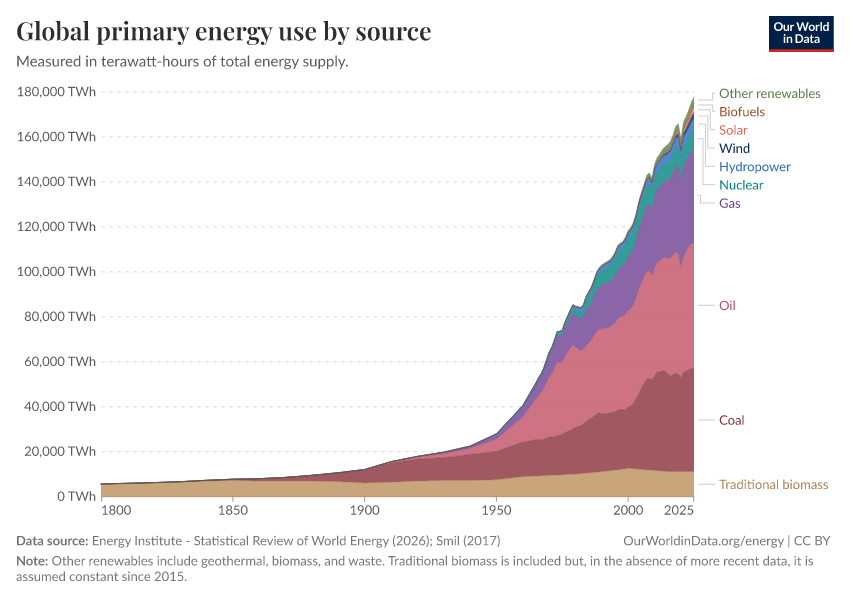
| |
| ▲ | tenacious_tuna a day ago | parent | next [-] | | > There's a weird "degrowth" mindset Matching demand to production where possible strikes me as a sane approach. Western nations have become very used to an incredibly high standard of living largely powered by disproportionately massive energy consumption per person. If it uses power more efficiently to dry one's clothes at night or run the dishwasher overnight, rather than during the day alongside AC and computers and whatnot, that seems eminently reasonable to do. This sharp resistance to minor personal inconvenience is bananas to me. If the alternative is to bring massive battery storage or nuclear plants online, vs "hey, maybe charge your car overnight" or "hey, timeshift your AC use and add some insulation to your house," why wouldn't we do that? | | |
| ▲ | krona a day ago | parent | next [-] | | > "hey, timeshift your AC use and add some insulation to your house" The UK has the oldest housing stock in Europe, and most
likely in the world. [0] Roughly 30% of the stock is single-skin, without a cavity. While it's not impossible to insulate such walls, it's generally inadvisable for many reasons. The same goes for the roofs of these houses; although you will find many companies willing to spray your roof with foam or other forms of thermal sealing, those roofs were never designed to be insulated, causing other potentially catastrophic problems once it's been done. Generally, the poorest and oldest people in society occupy these houses, but no matter; the government will ban the sale of gas boilers to coerce them in to installing heat pumps, despite them being incompatible with the existing pipework and radiators. 0: https://files.bregroup.com/bretrust/The-Housing-Stock-of-the... | | |
| ▲ | tenacious_tuna a day ago | parent | next [-] | | > Generally, the poorest and oldest people in society occupy these houses, Reasonable point, but I feel my case still stands: the population able to make these changes could do so, enabling existing infra (and housing stock) to "go further" before requiring expensive and disruptive overhaul. > the government will ban the sale of gas boilers to coerce them in to installing heat pumps I agree this is shortsighted, and it's better to incentivize more efficient systems rather than applying punitive strategies to less efficient ones. | | |
| ▲ | Fabricio20 a day ago | parent [-] | | >Reasonable point, but I feel my case still stands: the population able to make these changes could do so, enabling existing infra (and housing stock) to "go further" before requiring expensive and disruptive overhaul. I'm sorry but as an outsider to me this straight up just sounds like kicking the can down the road! Let's get it fixed, build more solar, get more power in the grid, deregulate personal solar so its an attractive incentive to get more people generating power, etc.. Rather than "you need to use less" mentality, especially while people literally die to the heatwaves the UK has been getting recently.. It's been pretty clear that globally the grid operators are all very much lazy and would rather increase prices and reap benefits short term than adding more capacity to the grid, even where i live (in Brazil) its very much clear that grid operators too would rather raise your bill and collude to add more taxes if you want to generate your own solar than to get more supply in the grid and make the bills cheaper (we have a minimum bill you have to pay even if you have full self-generated solar AND a thing called a "solar tax" because of course, the sun is the govt's property, gotta pay a tax for using it..). | | |
| ▲ | tenacious_tuna a day ago | parent [-] | | I think you're overstating my position. > Rather than "you need to use less" mentality, especially while people literally die to the heatwaves the UK has been getting recently.. I'm not saying _everybody_ must use less AC/clothes dryer/whatever. Grids are remarkably complex machines and are incredibly expensive to upgrade--which we should do! We should have done that ages ago, but the second best time to plant a tree is now. However, that's not an instantaneous process and requires quite a lot of political willpower to achieve, let alone the capex to bring new generation plants online. In the meantime, as you've noted, people die without access to critical infra, i.e. AC in heatwaves. If the options facing grid operators are "rolling brownouts to keep from blowing up a transformer" or "educate people on time-of-day use re: peak load to reduce grid strain," the latter is often dismissed out of hand when it seems a perfectly sane approach to maximizing the utility of existing systems. > deregulate personal solar so its an attractive incentive to get more people generating power, etc Solar has a tremendous to "democratize" access to resources [0], we should absolutely incentivize its adoption as much as possible... but changing regulatory or tax environments is difficult. *We should still do that,* but altering behavior is (comparatively) free, so long as you can get past people being personally offended for being asked to not water their lawn every day in July. [0]: https://mashable.com/article/solar-energy-rural-africa |
|
| |
| ▲ | sdsdssweew213 a day ago | parent | prev | next [-] | | How exactly would a heatpump be incompatible with existing pipework and radiators? I see them installed into all kinds of houses, summer cottages and whatever no problem. | | |
| ▲ | maccard a day ago | parent | next [-] | | Having 8mm pipework (microbore, which was fairly commonly used when central heating was being retrofitted) connected to standard sized radiators with a flow temp of 35 degrees is unlikely to actually heat a building. That said, most properties in the UK don't have this problem. They _do_ likely need bigger radiators which comes with a cost, but a lot of these houses would benefit from just upgrading from their single panel rad with no fins. | | |
| ▲ | hobo123 12 hours ago | parent [-] | | Older houses might need higher temperatures, but insulated ones might be fine with 40-50. My house is slightly over 20 years, and most of the time, we are completely fine with the radiators just lukewarm. If it's like -10 outside, they need to get warmer. |
| |
| ▲ | wongarsu a day ago | parent | prev | next [-] | | Many old-style radiators only work with high water temperatures. Uninsulated pipework can "waste" a lot of water temperature before you even reach the radiator I'm not sure any of that makes heatpumps technically impossible, but it makes them more expensive and less efficient | |
| ▲ | jvvw a day ago | parent | prev | next [-] | | We're about to get a heatpump (in the UK) and our pipework is fine but we need to replace pretty much all the radiators, both the old ones, about 45 years old, and the newer ones, about 15 years old, in order to be able to heat the house to a sensible temperature. | | |
| ▲ | Reason077 21 hours ago | parent [-] | | Is there reason why retaining radiators is preferable to an air heat pump (either ducted air or mini-split)? I guess it's cheaper to not have to install air ducting or indoor units if you can reuse existing pipes & radiators. But if you need to replace the radiators anyway, the cost might not be that much different? You'd get more precise temperature control, and cooling in the summer. | | |
| ▲ | Macha 21 hours ago | parent | next [-] | | The roof cavity is not large enough for hidden ducting and the ceilings in older houses low enough that exposed ducting would be a head impact hazard. So you'd end up needing one installation per room. Expensive, especially when the expertise isn't there, and mostly used by commercial users. | |
| ▲ | whatevaa 20 hours ago | parent | prev [-] | | Most old houses are not ducted and retrofiting them is very expensive, capital repair. Mini-splits are noisy and have major problems getting heat distributed over a whole house. |
|
| |
| ▲ | mindslight a day ago | parent | prev [-] | | What the other comment said, but more technically, the amount of heat transferred is proportional to delta-T. So older radiators have less surface area, relying on hotter water to transfer enough heat energy to make up for the heat loss of the building. Meanwhile the efficiency (COP) of a heat pump drops the higher its temperature differential is. So trying to keep the water loop temperature the same is a non-starter. (The same problem can happen with high efficiency condensing natural gas boilers which have much lower flue temperatures) (From an American perspective although I'll convert the units) - older radiator systems were designed for water temps of around 80C, room temp around 20C, so that is 60C (60 K/Kelvin, really) delta-T. Whereas if a heat pump wants to put out 50C water for half the delta-T (30K), you then need twice the amount of radiator surface area to transfer the same amount of heat. The system will work fine in the shoulder seasons when not much heat is required, but at the coldest nights design temperature it will not be able to keep up and your indoor air temperature will then drop despite the heat being on. (Pipe sizing enters into it as well but isn't as straightforward to explain) | | |
| ▲ | Scoundreller a day ago | parent [-] | | I can't be the first small-brained Canadian that stuck a fan in front of those euro apartment bloc radiators on a cold day. (And re-arranged the furniture a bit + stopped using the radiator as storage...) |
|
| |
| ▲ | coryrc a day ago | parent | prev | next [-] | | From a T&M standpoint it's affordable to use external insulation and cladding to safely insulate these old houses. But that runs afoul of planning/landmark laws (some places even mandate single-pane windows!) So some Brits freeze to death rather than hide some history. Their choice to make, I guess. | |
| ▲ | stuaxo a day ago | parent | prev | next [-] | | There has been research into Thin Wall Insulation for this very reason, and that would be a good start for much of the Victorian housing stock (e.g. Cork Spray which is permiable so avoids the problems of sealing up these older buildings). | |
| ▲ | youngtaff a day ago | parent | prev | next [-] | | > While it's not impossible to insulate such walls, it's generally inadvisable for many reasons Lime plaster with cork in it is fine way to insulate these buildings. It won't be as good as modern materials but is an improvement and is breathable > Generally, the poorest and oldest people in society occupy these houses, I own one of these houses – single skin, 200yr old farm workers cottage – I'm neither poor or that old Much of the expensive old housing in London, Bath etc is single skin too | |
| ▲ | hkt a day ago | parent | prev | next [-] | | Nobody is talking about banning the sale of gas boilers. What is happening is that new builds will have to be built with heat pumps from (if memory serves) 2035. Please don't scaremonger. Further, it is possible to run a heat pump at high temperatures: some use refrigerants specifically designed to do this relatively efficiently. | | |
| ▲ | krona a day ago | parent | next [-] | | > Nobody is talking about banning the sale of gas boilers. Several energy suppliers websites have pages dedicated to this very topic. The current 2035 target originates in the ministerial Heat and building strategy policy paper (2020): "Our ambition is to phase out the installation of natural gas boilers beyond 2035." In the Annex: Aiming to phase out the installation of new and replacement natural gas boilers from 2035, once costs of low-carbon alternatives have fallen, in line with the natural replacement cycle, including any hydrogen-ready boilers in areas not converting to hydrogen, to ensure that all heating systems used in 2050 are compatible with Net Zero. Given the energy policy of the UK, which to many engineers makes absolutely no sense at all, it's impossible to predict what will actually come out of the policy sausage factory next. | | |
| ▲ | youngtaff a day ago | parent [-] | | Hydrogen is a dead end for domestic gas Eventually everyone will need to switch from gas because as the number of heat pumps rise then number of gas consumers fall and the infrastructure costs for them will become uneconomic |
| |
| ▲ | adrianN a day ago | parent | prev | next [-] | | Either we ban gas boilers sooner rather than later, or we mandate expensive syngas to run them, or we can't reach net zero emissions. | | | |
| ▲ | whatevaa 20 hours ago | parent | prev | next [-] | | They can, but then their COP is like... 2. Which is not great. Coupled with high units costs, need to make math is it even worth it compared to just electric heating. | |
| ▲ | amiga386 a day ago | parent | prev [-] | | > new builds will have to be built with heat pumps from (if memory serves) 2035. England: from 24 March 2027 Scotland: since 1 April 2024. The legislation doesn't mandate heat pumps specifically, it mandates >=75% lower carbon emissions than homes built to the 2013 standards, which effectively requires heat pumps, solar panels, and significantly improved insulation. Build and running costs aren't measured, it's quite possible new homes will cost more to buy and run, and could be smaller to compensate. You remember "2035" because in 2021 the government announced it "wanted" to ban gas boilers entirety by that date: https://www.bbc.co.uk/news/business-58959045 ... but as far as I know, never enacted legislation to ban their sale or fitting in existing houses. And that aspirational policy has been announced as dropped multiple times, at least since last July, most recently today | | |
| ▲ | toyg 12 hours ago | parent [-] | | > could be smaller to compensate. New builds are already much smaller than previous generations' housing, to increase margins for developers. Smaller than that, we'll basically be like rats. |
|
| |
| ▲ | asanineassasin a day ago | parent | prev [-] | | [dead] |
| |
| ▲ | mrob a day ago | parent | prev | next [-] | | >This sharp resistance to minor personal inconvenience is bananas to me. I assume you're in good health, not poor, in a stable living arrangement, etc. The burden of "minor personal inconveniences" depends greatly on how many inconveniences you already suffer. Somebody working two jobs doesn't have much spare energy for optimizing utility use. | | |
| ▲ | tenacious_tuna a day ago | parent | next [-] | | > The burden of "minor personal inconveniences" depends greatly on how many inconveniences you already suffer. Excellent point, and I agree, though the vast, vast majority of the pushback I feel I get when advocating for these kinds of shifts are from wealthy/healthy individuals. It's a classic tragedy of the commons scenario: existing resources should be able to support our current level of creature comforts with minor conservation, even if a segment of the population is less able to support the conservation efforts, but the extremes people demand in turn place extreme load on our infrastructure. | | |
| ▲ | barrkel a day ago | parent [-] | | What is the point in being wealthy if it is not to avoid tedious inconveniences? | | |
| ▲ | williamdclt 16 hours ago | parent [-] | | Bit of a logical fallacy. Not avoiding ALL tedious inconveniences doesn't mean that being wealthy can't avoid MOST tedious inconveniences. You can have a weekly cleaner and a holiday house in the south of france and dry your clothes at night. |
|
| |
| ▲ | maccard a day ago | parent | prev | next [-] | | > Somebody working two jobs doesn't have much spare energy for optimizing utility use. Most of us don't. But smart meters are free in the UK, and if there was a way for my washing machine to have a 3h window overnight to run in to be done for 7:30 I'd do it in a heartbeat. Same for my dishwasher. Heating is a bigger issue. | | |
| ▲ | leni536 a day ago | parent | next [-] | | > and if there was a way for my washing machine to have a 3h window overnight to run in to be done for 7:30 I'd do it in a heartbeat. I think most of these appliances sold today have at least some sort of "delay start" function. We use that to do exactly what you describe. Not even for nght tariff, it's just convenient to time it like that. | | |
| ▲ | Jtsummers a day ago | parent | next [-] | | Every washer, even basic ones, I've owned that were made post-2000 had a delay start function. Even my most basic one that just had dials to select options, it had a 2/4/6/8-hour delay dial. I figured it was a common feature by now. | | |
| ▲ | leni536 a day ago | parent [-] | | A 2-hour granularity delay start would drive me insane. Better than nothing though. And maybe the dial one works with a timer on the outlet too, as the program is mechanically selected. |
| |
| ▲ | maccard 21 hours ago | parent | prev [-] | | Yep and I do it. But the point is that if everyone sets it to be done at 8am, you move the demand window to 6-8am. All o care about is that I can put it away when I wake up so if my energy company said “your electricity is cheap between4 and 6, go for it” my dishwasher, washing machine, hot water tank could all go at that time |
| |
| ▲ | dmurray a day ago | parent | prev [-] | | You probably want your washing machine to finish when you'll be ready to take the clothes out, rather than leave them sitting damp in the machine. There should be plenty of opportunity to load shift with other things though, a dishwasher as you mentioned, or a fridge or a storage heater or a charger for your electric car. All can be done with minimal inconvenience to the user. | | |
| ▲ | walthamstow a day ago | parent [-] | | > leave them sitting damp in the machine. Rinse hold solves this. Even the cheapest machines have it. | | |
|
| |
| ▲ | Frieren a day ago | parent | prev [-] | | > Somebody working two jobs doesn't have much spare energy for optimizing utility use. That is exactly the people reducing expenses even when they know that will be extremely painful. That is why the poor are poor, because they cannot afford that kind basic expense. They need to choose between heating and food. "Let's consume more" for the poor. It is a grotesque argument. | | |
| ▲ | tenacious_tuna a day ago | parent [-] | | > "Let's consume more" for the poor. It is a grotesque argument. OP was making a fair point that not everybody has the same amount of time and energy (or money) to tolerate shifts in their routine, which in the context of a "personal vs collective responsibility" style argument is entirely reasonable. By the same token, if only the _rich_ have the freedom to make such behavior changes for the sake of conservation it will only ever have a token impact, and in many cases the "correct" level to make an efficiency pitch at is the community: a decent light rail system will always outperform everyone driving their own vehicle to work/the store/downtown in terms of space and energy efficiency. ...but, to get people to buy into such "collectivist" systems, you often have to get them to contend with some perceived reduction in personal convenience: yes, a train doesn't need a parking lot and uses less gas per passenger-mile, but then you're beholden to the train schedule. It's exactly _that_ sentiment that I find frustrating in advocating for sustainable civic design. To OP's point: whatever that "collectivist" option is necessarily has to contend that standards of accessibility and convenience are not constant across the population. That doesn't inherently mean "the poor should consume more," but that "hang dry your laundry" isn't an option for everyone in the current dominant socioeconomic structure. |
|
| |
| ▲ | cameldrv a day ago | parent | prev | next [-] | | One measure of progress is not having to think about something. I don't want to have to think about when to wash my clothes or my dishes or whatever. I want to push the button and have it go. I'd be willing to make a concession for an EV since it consumes a lot of power, but it should be automatically controlled and not make me think. If we're going to electrify everything, we need a clean, plentiful, reliable electrical supply. There is no technical obstacle to having this. Saying "we can save $1000 per person in capital costs, they just need to deal with 5 extra minor inconveniences per day" is not how you run a developed country. | | |
| ▲ | coryrc a day ago | parent [-] | | Then you can pay a bit more for the battery capacity and others can take the discount to deal with the minor inconveniences. It works out for everybody. | | |
| ▲ | ilikerashers 16 hours ago | parent [-] | | You're pushing the burden back onto the consumer to find workarounds for a broken system. Having to install battery capacity in your own house is a step backwards. If water was unavailable for 4 hours a day, you would suggest putting in your own rainwater filtration system. | | |
| ▲ | coryrc 3 hours ago | parent [-] | | No, you pay full price and can use power at any time of day. People who don't mind the restriction pay substantially less than you. |
|
|
| |
| ▲ | jawiggins a day ago | parent | prev | next [-] | | Human development is all about removing minor inconveniences. It's how we progress from 0 climate control and lacking clean drinking water to how we live today. Here's a good article on the subject: https://www.thenewatlantis.com/publications/we-live-like-roy... | | |
| ▲ | Tade0 a day ago | parent | next [-] | | > Human development is all about removing minor inconveniences. That's a uniquely American perspective. Japanese homes often don't have space heating. The Swiss often keep their homes at 20°C in the winter. Most of the globe doesn't travel everywhere by car. Arguably it's the intention to remove pain as much as possible which resulted in the opioid epidemic. There's a point at which trying to get rid of inconveniences becomes harmful. | | |
| ▲ | ndriscoll a day ago | parent | next [-] | | Is 20°C supposed to be austere? Is that a typo? I keep my American home at 67-68°F in the winter... | | |
| ▲ | tenacious_tuna a day ago | parent [-] | | 20C in wintertime is quite cool for North America, in my opinion. I think 23C is commonly considered "comfortable," but obviously that will vary significantly by individual. Chicago building codes require 68F as a minimum for residential in winter conditions, so I think that's reasonable as a "habitable minimum yet not necessarily ideal" benchmark: https://www.chicago.gov/city/en/depts/bldgs/supp_info/chicag... | | |
| ▲ | ndriscoll a day ago | parent [-] | | Wow. Obviously there are humidity differences during different seasons, but 23°C is probably the limit of "this is uncomfortably warm" for me if I set my thermostat above that. | | |
| ▲ | lazyasciiart a day ago | parent | next [-] | | Me too, but my husband and guests are clearly uncomfortably cold at my preferred 66/67, and my sister with poor circulation just about has her hands go numb. | |
| ▲ | Tade0 a day ago | parent | prev [-] | | And to what temperature do you set your AC in the summer? | | |
| ▲ | SoftTalker a day ago | parent | next [-] | | For me, it depends on outside temp. The main advantage of AC is dehumidification. So if it's 95 degrees and humid outside, 78 degrees inside feels great, and keeps the AC running often enough to keep humidity down. If it's in the 80s outside, I'll probably drop the inside temp to 76, again to keep humidity down. I rarely set it below that. 74 feels cold in my normal summer attire of shorts and a tee shirt. If we have an 80 degree day with low humidity, I'll open the windows. | |
| ▲ | ndriscoll a day ago | parent | prev [-] | | 73-74F, so ~23C, my limit where it starts to feel too warm. | | |
| ▲ | Tade0 19 hours ago | parent [-] | | So you're just used to cold and not heat. The thing about the nations I mentioned is that they either barely use any AC, like Switzerland, or set it to 25°C or more, like Japan. They embrace discomfort - most of the world does. |
|
|
|
|
| |
| ▲ | hobo123 12 hours ago | parent | prev | next [-] | | 20 degrees is just fine. During winter I really don't want to sweat at home, nor do I want to only wear a T-shirt (like I would need at 22 or more). Whenever I go shopping, it's insane how much they heat most places, while people are wearing heavy winter jackets. | |
| ▲ | eddythompson80 a day ago | parent | prev [-] | | You think HVAC and cars are an American prospective? | | |
| ▲ | Tade0 18 hours ago | parent [-] | | I think waging war on discomfort is uniquely American. The rest of the world also has these things, just doesn't use them nearly as much. | | |
| ▲ | eddythompson80 13 hours ago | parent [-] | | I don’t think your thought is as insightful as you think it is. You simply fell for the American Exceptionalism propaganda thinking that Americans are some special breed of humans. America is the richest country in the world. And for most of the 20th century average Americans had the most disposable income and the largest consumer base of all countries. Of course they led the way on adopting luxuries and reducing discomfort. The rest of the world followed as the price became attainable and their purchasing power increased. 50 years ago hot middle eastern countries had no AC. Not because they had some sort of symbiosis with nature and the summer heat. It was because the average AC costed the sum of 8-month of average income. As AC prices dropped, and the average income increased, having an AC became the norm. Of course the richest people, richest economies get their first and to a non inquisitive or surface only thinking, it’s some how a unique was on discomfort or lust for luxury, when it’s just simple economics. You can see rich Asian countries and cities leading the “War on discomfort” now a days as their economies have developed and stabilized, but they face unique discomforts that previous rich nations didn’t. | | |
| ▲ | Tade0 11 hours ago | parent [-] | | > America is the richest country in the world. In absolute terms, yes. But per capita there are quite a few richer countries, like Switzerland, where people genuinely seem to brave the elements as part of their culture. Sure, everyone adopts conveniences, but I've never seen anyone do it to the extent Americans do. | | |
| ▲ | eddythompson80 10 hours ago | parent [-] | | The per capita numbers are more recent as opposed to be throughout the 20th century but even still the size of the Swiss market (in absolute terms) is tiny compared to the size of the American market. Unless the per-capita wealth or disposable income is 30x to make for the population size difference, the "reducing discomfort" goods market will still favor the larger (overall) richer and bigger markets then trickle down to smaller ones. I highly doubt the Swiss endure through cold winters by wearing more layers in doors and drinking lots of hot tea. > I've never seen anyone do it to the extent Americans do. Sounds more like observational or cognitive bias tbh. For example, the Japanese market is notorious for building gizmos and machines for far less grand inconveniences that the weather or long-distance travel. They eat a lot of rice in Japan, so it makes sense they invented the rice cooker. To many Americans (today) who don't eat a lot of rice having an entire appliance for just cooking rice might seem like a crazy war on discomfort and too much of adopting convivences. What's next? a machine just for Turkish coffee? |
|
|
|
|
| |
| ▲ | TheOtherHobbes a day ago | parent | prev [-] | | Smart human development is about thinking long term, not trading minor conveniences now for avoidable catastrophic consequences later. | | |
| ▲ | jawiggins a day ago | parent | next [-] | | It turns out that small minor improvements compound long term, and there are relatively few examples of massive step-changes that were centrally planned. Here's a good book on the topic that you may enjoy: https://press.stripe.com/origins-of-efficiency | |
| ▲ | Marha01 a day ago | parent | prev [-] | | > not trading minor conveniences now for avoidable catastrophic consequences later. Those minor conveniences are a drop in the bucket when it comes to total CO2 output. |
|
| |
| ▲ | leonidasrup 18 hours ago | parent | prev | next [-] | | You can timeshift your power consumption, but in many cases you can not timeshift industry power consumption, especially heavy industry power consumption. For example it takes few hours to start a big plastics injection plant, it takes few days to heat an aluminum smelter. High quality glass production needs few weeks of uninterrupted power supply. Iron blast furnaces run without interruption for years. But for example, cement production can be turned on and off quite easily, and is turned on and off on demand by the grid electric operators to help with grid stabilization (cement producers are paid for this grid stabilization service). | |
| ▲ | anthonypasq 9 hours ago | parent | prev | next [-] | | It drives me up a fucking wall that you think this is a preferable strategy to just idk, installing some solar or wind? Why is this so difficult. We have the technology for practiciatlly infinite cheap energy but we just wont build it. Are the Chinese the only people that arent too stupid to understand this? | | |
| ▲ | tenacious_tuna 8 hours ago | parent [-] | | That's some hostility, friend. It's not a "preferable" strategy, it's one that can (and should) be deployed in tandem with expanding our renewable generation and doing more "at scale" conservation of commercial resource use. We're already building wind and solar at bananas rates [0], _and yet_ we're not even capitalizing on that gain as much as we could because people don't want to tolerate the behavior changes necessary to do so. My beef isn't with expanding capacity, it's with that being the _only_ solution that's considered to match supply to demand instead of doing anything to manage demand. [0]: https://www.eia.gov/todayinenergy/detail.php?id=67367 | | |
| ▲ | anthonypasq 8 hours ago | parent [-] | | > We're already building wind and solar at bananas rates [0] no we arent. China added the entire capacity of the US grid in solar in the last 4 years and they are accelerating. That is bananas. We've barely increased total grid capacity in the last 20 years. It should be a national embarrassment. Energy abundance is possible, and one of the greatest ways to improve peoples lives. There are no energy poor countries that are rich. Half the state of Nevada should be a solar farm at this point if anyone actually cared about climate change, and that would do 10x to imrpve peoples lives than telling them not to use the dryer. again, the degrowth mindset relies on a fundamental paucity of imagination and will to actually solve the problem. |
|
| |
| ▲ | sdsdssweew213 a day ago | parent | prev | next [-] | | The rational approach is to both bring that new green / nuclear energy capacity online AND simultaneously reduce waste. | | |
| ▲ | tenacious_tuna a day ago | parent [-] | | Yes, but that waste reduction mindset is the 'degrowth' was being derided in the original comment I replied to :-) |
| |
| ▲ | fourseventy a day ago | parent | prev | next [-] | | Building more power plants seems like a pretty sane approach to me. | |
| ▲ | maccard a day ago | parent | prev | next [-] | | > add some insulation to your house, Adding insulation is expensive, and awkward. If you have cavity walls that are uninsulated, it needs to be done right. If you have single skim walls you either do external cladding (and change the outside of your building), or build an internal stud wall and insulate that, which is very effective but costs a decent amount, reduces internal floor space, and requires a full redecoration after. | | |
| ▲ | youngtaff a day ago | parent | next [-] | | Lime plaster with cork in it works, it's just a messy retrofit Lime render with cork is the outside version | |
| ▲ | Frieren a day ago | parent | prev [-] | | > Adding insulation is expensive, and awkward. Expensive short term, life saving long term. > requires a full redecoration after Tell me that you are rich without telling me that you are. |
| |
| ▲ | anax32 15 hours ago | parent | prev | next [-] | | surely, you mean matching production to demand? That's the way our system has developed for millennia. | |
| ▲ | yostrovs a day ago | parent | prev | next [-] | | You seem to be missing the human element in your calculation. It's not just power plants and the machines that use the electricity from them. The machines are built for humans, who want their clothes washed today so they can be folded today and ready for tomorrow. They want the dishes washed today so they can be put back on the shelves before tomorrow's breakfast.
And, by the way, grime on dishes gets more difficult to remove once it has sat drying, waiting for the machine to start. | | |
| ▲ | tenacious_tuna a day ago | parent | next [-] | | We also want everything in single use plastic containers and to drive big cars a mile down the road to buy groceries, but there's better solutions for those things that people are buying into more and more. I'm not saying human convenience should entirely take a backseat to machine efficiency; to your point, the very existence of these things is to make human life easier. My frustration is that Western approaches to these problems seem uniquely resistant to ever altering behavior for the sake of reducing ecological impact. (Dishwashers were a poor example for me to use anyway, they're remarkably efficient; a better one might be water usage: it's best to water plants in either the early morning or late evening, so the water doesn't evaporate as much, but people often prefer to do so during the day, which coincides with high household water usage for showers/laundry/whatever. though, I routinely run my dishwasher overnight and have never had issues with grime, so long as I prime the hot water feed.) | |
| ▲ | Sharlin a day ago | parent | prev | next [-] | | People want all sorts of things. Somewhere there’s a limit to what you can actually get in a finite world so that your kids and grandkids aren’t left with a lower standard of living because they have to pay for your externalities, never mind all the other damage to the ecosystem. Washing dishes when you want is probably okay, but dishwashers are remarkably efficient and really a red herring, or a motte-and-bailey type argument. Wanting to own, say, a massive F150 for the convenience of having your own personal tank and feeling better than others is probably not okay. | |
| ▲ | James_K a day ago | parent | prev [-] | | Then they can pay the higher rate for energy during the day, and if enough people want this it will be practical to build infrastructure to support them. This issue is they want it and they don't want to pay for it. |
| |
| ▲ | eli_gottlieb a day ago | parent | prev | next [-] | | > Matching demand to production where possible strikes me as a sane approach. No, you're supposed to do the other way around. | |
| ▲ | tancop a day ago | parent | prev [-] | | Why not bring massive energy storage and nuclear plants online? Because it's expensive? Or because we let oil companies and land owners make the rules? Making peoples lives worse to save money is a capitalist mindset and I don't understand why so many left wing people believe in it. The promise of socialism was always higher living standards for the working class (99 percent) at the expense of millionaires. | | |
| ▲ | tenacious_tuna a day ago | parent | next [-] | | > Why not bring massive energy storage and nuclear plants online? I'd argue there's more ecologically sound ways to supply the desired energy demand in combination with shifting some of the load away from peak times. I don't think that strictly correlates to "a lower standard of living" so much as "there's minor behavioral changes that would more efficiently use existing resources." > Making peoples lives worse to save money This is exactly the mentality that I'm surprised by: I suggest shifting high energy use slightly and your reaction is "that will make my life worse." Would it really have a strong negative impact on your life to run your dryer overnight for your towels/sheets/whatever if it meant 50% cheaper power? | | |
| ▲ | boredhedgehog a day ago | parent | next [-] | | > Would it really have a strong negative impact on your life to run your dryer overnight Absolutely. That thing is loud. | | |
| ▲ | triceratops a day ago | parent | next [-] | | Finally a reasonable objection. What if manufacturers developed quieter dryers? | | |
| ▲ | pigpop a day ago | parent [-] | | If you live in a small house or condo it's still going to be loud enough to wake you up in the middle of the night when it starts. It's a bit more difficult than making a quiet dishwasher (which I'd still find too loud to start running in the middle of the night) since a dryer has to move a bunch of heavy, wet clothing around and run a fairly strong fan to avoid starting a fire. | | |
| ▲ | triceratops a day ago | parent | next [-] | | Time of use plans generally have lower rates starting late evening. There's no reason to run the dryer or dishwasher in the literal middle of the night. An hour before most people's bedtimes will still be during a lower tariff period. According to https://www.energysage.com/electricity/whats-the-cheapest-ti... 9pm - 6am is common in the US. Hardly anyone is in bed by 9pm. In the UK it's 10pm - 5am or midnight-7am, depending on your plan. https://uk.jackery.com/blogs/knowledge/when-is-off-peak-elec.... But there's also a mid-day slot 1pm-3pm which can work if your dryer can be timed. You can also dry heavy items on a folding rack so the dryer doesn't run as long. | |
| ▲ | ButlerianJihad a day ago | parent | prev [-] | | Seems weird. Dishwashers, clothes washers and dryers are the epitome of "white noise" to me. I love sleeping with those things, drowning out all annoying noises and ensconcing me in a pleasant ocean of peaceful wooshes. The last time I had in-unit W/D, it was right outside my bedroom. Never bothered me in the least. Certainly not compared to the neighbors' dogs, pot-smoking, screaming arguments, etc. |
|
| |
| ▲ | lazyasciiart a day ago | parent | prev | next [-] | | That's a pretty solvable problem, since we're spending money to solve problems. | |
| ▲ | tenacious_tuna a day ago | parent | prev [-] | | Fair enough |
| |
| ▲ | lowbloodsugar a day ago | parent | prev [-] | | >Would it really have a strong negative impact on your life to run your dryer overnight In a london flat we rented, the washer-dryer was in a cupboard in the bedroom. So yes. At least it had one. |
| |
| ▲ | dalyons a day ago | parent | prev | next [-] | | Building expensive power sources (nuclear) is inevitably going to result in raised electrical rates for the working class. | |
| ▲ | secretsatan a day ago | parent | prev | next [-] | | Trump and doge once fired all the nuclear inspectors. | |
| ▲ | yostrovs a day ago | parent | prev [-] | | Today's leftists seem to not have any coherent philosophy at all. It's not better on the other side. Everything seems to be about grievances and assigning blame rather than rationally discussing practical solutions. | | |
| ▲ | wahern a day ago | parent | next [-] | | There's a significant misanthropic sentiment on the left stemming from, among other things, the mid-century environmental movement. It creates for a maddening incoherency, but I guess that's typical of all politics at scale. The misanthropy is infused in popular culture, and specifically in the way ecological sciences and history (for additional reasons) is taught in schools. I not infrequently have to discuss this with my kids when they recite something they've learned in school and I can hear the misanthropic cynicism in the framing and intonation. | | |
| ▲ | themanualstates 2 hours ago | parent | next [-] | | Only idiots think their kid, the teachers, ecological scientists, and the culture are all wrong and only you what’s right. Especially when you’re maddened about incoherencies that are merely the manifestation of the inherent entropy of our world! | |
| ▲ | TheOtherHobbes a day ago | parent | prev | next [-] | | It's quite eccentric to suggest the left is misanthropic when the right majors in racism, violence, short-sighted selfishness, and contempt for the weak, poor, and unusual - none of which are particularly humanitarian. Making your own planet less ecologically stable is certainly an interesting choice, but probably not the best long-term bet for anyone's kids. | | | |
| ▲ | Shog9 a day ago | parent | prev [-] | | This particular misanthropy does not seem to have a particularly strong affinity for either conservative or progressive groups; it is an opportunistic predator that attacks the weak and stupid in both camps, and has for generations. Be wary of anyone who argues the poor should go without food or protection from the elements, regardless of what flimsy justification they give for their cruelty; the most dangerous to each of us are those who appeal to our own beliefs. | | |
| ▲ | Dylan16807 a day ago | parent [-] | | Sure if they're actually saying the poor should go without and that's not a dumb strawman. The idea of consuming too much isn't usually focused on the poor. |
|
| |
| ▲ | jfengel a day ago | parent | prev | next [-] | | That is definitely the impression one would get if one watched Fox News. If one consumed nonfiction media one might get a different impression. | | |
| ▲ | timmmmmmay a day ago | parent [-] | | bro there are degrowth austerity leftists posting in this thread right now, it's not a Fox News caricature |
| |
| ▲ | ballmerpoint a day ago | parent | prev [-] | | Y’all are equally incomprehensible to us. Drastically reduced immigration, ineffective policies for incentivizing pregnancy, and no cash incentives for having multiple children (the one intervention that has been found to have a real, albeit modest impact on TFR). Degrowth under those conditions is all but certain. |
|
|
| |
| ▲ | ballmerpoint a day ago | parent | prev | next [-] | | When fertility rates fall below replacement rate, some amount of degrowth is all but inevitable. Probably multiple generations’ worth, assuming things remain at least nominally normal. That few in government are readying for that and are rearranging deck chairs instead is not particularly reassuring. | | |
| ▲ | pigpop a day ago | parent | next [-] | | It'll be temporary. Low fertility rates are an evolutionary bottleneck. After 100 years all of the people and ideologies predisposed to low fertility will have literally removed themselves and their bloodlines from existence and those who maintained a higher than replacement rate even when confronted with the ills of modern society will have taken their place. This works at the individual level, I'm not talking about race or nationality. | | |
| ▲ | lukeify a day ago | parent | next [-] | | Except ideologies aren't genetic are they? | | |
| ▲ | AnimalMuppet a day ago | parent [-] | | No, but they can be (and often are) inherited. | | |
| ▲ | lukeify a day ago | parent [-] | | At such a high concordance as to see ideologies disappear from the population? Or is it more likely that ideologies and people's beliefs are from social and environmental feedback? |
|
| |
| ▲ | Nicholas_C a day ago | parent | prev | next [-] | | The future is Amish. | |
| ▲ | ButlerianJihad a day ago | parent | prev [-] | | [flagged] | | |
| ▲ | Jtsummers a day ago | parent | next [-] | | > I was formed to work in an office, to go have a career and make money, and absolutely useless at any domestic task, such as cooking, cleaning, personal finance. Your parents never taught you how to balance a checkbook? That's just basic arithmetic, are you sure you were "formed to work in an office" when you can't even manage your own finances? Sounds like you weren't formed for anything, not even basic self-care. | | |
| ▲ | SoftTalker a day ago | parent [-] | | Balancing a checkbook isn't really the problem. It's running a household on a budget (whatever it is), making sure you still have enough at the end of the month to pay for school lunches and toilet paper, and don't do something stupid like borrowing from the 401k to buy a boat or an RV. | | |
| ▲ | KeplerBoy 19 hours ago | parent [-] | | That's still all trivial arithmetic and basic discipline assuming you have enough money to cover all your basic needs. | | |
| ▲ | SoftTalker 11 hours ago | parent [-] | | Right, but someone has to actually do it. It's not the difficulty of the task. |
|
|
| |
| ▲ | a day ago | parent | prev [-] | | [deleted] |
|
| |
| ▲ | antisthenes a day ago | parent | prev [-] | | The electricity generation in the article is shown per capita. Now I'm not saying we should generate as much as humanly possible, because even with renewables that has a cost. And some things have gotten genuinely more efficient (compare modern heat pumps to heating available in 1968). But why shouldn't we maintain the levels our parents enjoyed? And use the extra capacity if anything for EVs, grid stabilization, medical research, etc. So population degrowth is a pretty separate issue. | | |
| ▲ | expedition32 a day ago | parent [-] | | My mother moved to a brand new apartment. Everything is electric- heating and cooking. Gues what? Her bills went down. That is the power of modern construction techniques. Unfortunately this is out of reach of poorer people and it would takes a hundred years before all the old housing stock is replaced. But it's nice progress for the happy few. |
|
| |
| ▲ | epistasis a day ago | parent | prev | next [-] | | There's two things that are simultaneously true: 1) improving efficiency of electricity use is often the most cost effective use of a dollar. Better insulation, more efficient appliances, etc. are choices made purely on financial merits. 2) We're going to need to greatly increase electricity consumption in order to decarbonize. People working on the grid and in utilities are coming at this from a completely different perspective than degrowthers, in my experience. Grid ops are extremely conservative, and utilities have not adopted new tech in decades if ever, so they look at the trend of the past decades and think "the future is going to be exactly the same." They are not thinking of the grid change we need to deal with climate change, at least in the US. I only have deep understanding here in the US, but the "degrowth" subfaction of progressives are completely ineffectual, despite being very loud. They have zero influence, zero ability to organize into any sort of group with influence, and little desire to do anything except critique others. They can be safely ignored, because even their critiques are based on either very fundamental misunderstandings of the world, and they can only infect a very tiny subset of the population with their mind virus of ignorance. Perhaps other places, like the UK, has a more politically effective group of degrowthers. But in order to even believe the things they believe they have to dumb themselves down quite a bit so if there are politically effective degrowth movements it may be time for me to reevaluate my position. Anti-vaxxers are far more effective politically, despite having just as poor critical thinking skills, but with the anti-vax movement individual action has big impacts, unlike with grid decisions. | | | |
| ▲ | Otterly99 17 hours ago | parent | prev | next [-] | | I don't see what is so hard to understand at all, it is mostly ecologically minded. Human production and consumption (in a broad sense) is generating/leading to ecological catastrophes. Some people believe technology will solve the problem, some people believe the easier solution is to stop producing as much. Unfortunately, that means letting go of some privileges and not everybody will agree on what to let go. | |
| ▲ | carlosjobim a day ago | parent | prev | next [-] | | Nothing weird about it. They themselves have all their needs comfortably met, which is what matters. Other people have to learn to just accept their lot in life and not try climbing. | |
| ▲ | 233mhz a day ago | parent | prev | next [-] | | - global wildlife population declined by 70% since the 70s - climate change is having real measurable negative impacts already - 90% of the shit we create is useless low quality junk and e-waste with a two years life expectancy - green washing doesn't change the fact that the vast majority of industries are not compatible with long term sustainability What are your argument for infinite growth at all cost? | | |
| ▲ | cyberax a day ago | parent [-] | | > - global wildlife population declined by 70% since the 70s Here's an example of how to bullshit. The original report is here: https://www.worldwildlife.org/news/press-releases/catastroph... And it's missing the word "monitored". And then you read the methodology: > The LPI measures changes in the sizes of 35,803 populations of 5,790 vertebrate species (amphibians, birds, fishes, mammals and reptiles) that have been monitored over time. The latest LPI shows a decline of 73% (73.2%). This means that the size of these populations fell by, on average, 73% between 1970 and 2022. > This doesn’t mean that there are 73% fewer wild animals in total today than in 1970. The LPI measures changes in relative abundance, not the total number of animals. Changes in small populations with few individuals are averaged with changes in large populations of thousands of animals. Nor does it mean that 73% of species or populations are declining. In fact, around half of the studied populations are stable or increasing – but these gains are outweighed by the greater magnitude of losses elsewhere when calculating a global average. So basically, it's a made-up number. | | |
| ▲ | 233mhz 17 hours ago | parent [-] | | Ok and what's the current copium for this one? https://en.wikipedia.org/wiki/Holocene_extinction | | |
| ▲ | cyberax 16 hours ago | parent [-] | | Why should I cope with it? Humans change the planet, but the planet changes itself all the time. Mammoths disappeared without human intervention, for example. | | |
| ▲ | 233mhz 15 hours ago | parent [-] | | Ah yes, and let me guess "climate changed before human even existed" am I right? So nothing matters and you cannot be wrong, you got me! | | |
| ▲ | cyberax 10 hours ago | parent [-] | | No, you're not right. I actually worked (a little bit) on climate models. I just don't think that the only natural state for the Earth is change. And human-caused changes are neither bad nor good from that standpoint. |
|
|
|
|
| |
| ▲ | testing22321 a day ago | parent | prev | next [-] | | Surely you understand that infinite growth is impossible, and it will all come crashing down sooner or later. | | |
| ▲ | anthonypasq 9 hours ago | parent [-] | | what makes you think we are even remotely close to bumping against the barriers of infinity? like what are you even talking about? |
| |
| ▲ | otikik 19 hours ago | parent | prev | next [-] | | Doesn't the "growth" mindset also feels a bit alien to you? Everything must grow all the time because all we care about is compounding interest, and that can only exist with continuous growth. Finite resources and time be dammed. | | |
| ▲ | anthonypasq 9 hours ago | parent [-] | | If you arent growing you are dying. This is base biological reality. Its completely intuitive. |
| |
| ▲ | yyyk a day ago | parent | prev | next [-] | | It's not weird. Not politically. They know since the 80s they can't match growth of a capitalist society, they don't want that kind of society, so instead of considering their priorities, they market disadvantage as advantage. It makes perfect sense if gaining power is the prime concern. | |
| ▲ | Lammy a day ago | parent | prev | next [-] | | “Maintain humanity under 500 million in perpetual balance with nature.” | |
| ▲ | guitarlimeo 18 hours ago | parent | prev | next [-] | | Degrowth will need to happen at some point. I believe that people "with a growth mindset" are just hoping that by submitting to growth they believe it won't happen in their lifetime. Which is a fair gamble to be frank, I don't blame them. | |
| ▲ | adventured a day ago | parent | prev | next [-] | | The degrowth mindset has existed for at least 50-60 years on the left, it merely bubbles to the surface more prominently from time to time. It was extremely popular ideologically in the late 1960s and 1970s. For some on the left, they view humans as parasites. It starts as self-hate internally and expands outwards to encompass humanity more generally ('I love animals, I hate people'). Humans have to modify their environment to exist (shelter, farming, hunting, et al.), so the people that hold that ideology, you will find, they comprehensively hate any modification of the environment by humans, ie they want humans to cease to exist, rooted first in their own desire to not exist (they hate their own existence first and foremost). The world is at all times overflowing with people that hate existing. They're miserable sad sacks and they desperately want everyone to drown in it with them. Sometimes that gets formalized into projected ideology used as a weapon against the rest of humanity. | |
| ▲ | vkou a day ago | parent | prev | next [-] | | Given that the alternative is trying to communicate with someone who thinks that the physical-goods aspects of our economy can grow exponentially forever... I'm going to go with the degrowth, or the steady-state economics guys, they are more likely to be closer to the mark of what is actually achievable in the real world. | |
| ▲ | streetfighter64 a day ago | parent | prev | next [-] | | Hah, only an alien species would be of the idea that infinite growth in a finite planet is a bad idea. No, surely we can keep pressing the gas pedal forever, never slowing down sounds like a sound and reasonable plan. | |
| ▲ | throwitaway222 9 hours ago | parent | prev | next [-] | | You hit a nerve lol. | |
| ▲ | Barrin92 a day ago | parent | prev | next [-] | | there is some irony in the growth ideology, which is barely more than a century old, to claim that every other species on the planet, ecological thinking and most human life is somehow alien to existence here, when they are more fanatic than just about any religious cult the logical terminus of the growth fanatics is to literally want to leave the planet so I think we ought to reserve the label 'alien' for them | |
| ▲ | simianparrot 16 hours ago | parent | prev | next [-] | | This is why we should rename them to regressive. They somehow think going back to pre-industrialisation can work while they still keep their smartphones that they use to absorb their latest TikTok fuelled outrage, somehow incapable of understanding that they're not "de-industrialising", they're _exporting_ it to to other countries that are massively industrialising on their behalf, and now have tremendous power over them. Including via TikTok brainmelting slop. | |
| ▲ | preisschild 19 hours ago | parent | prev | next [-] | | Yeah, thats why im on the side of liberals who promote "abundance" policies (see the Book from Ezra Klein and Derek Thompson) | |
| ▲ | kypro a day ago | parent | prev | next [-] | | Here in the UK the debate around energy is really unbelievably stupid. It's not just degrowth mindset, but the dogmatic refusal to be pragmatic on energy. Given most UK homes are heated by gas and we have a lot of gas-powered power plants, it makes no sense for us to import natural gas where we can avoid it (especially LNG) as it's more costly and less green than domestic production. Plus, domestic production means more domestic jobs and additional tax revenues. It seems to me there's basically no upside of us refusing to exploit what we can of the North Sea. It's just people taking an ideological dislike to us doing it domestically because "fossil fuels = bad". Some people also just seem wildly misinformed. For example, our media seems to think 50% of our energy problems stem from it being priced wrong. I guess we have the same problem with housing – maybe everyone could have a home if we just sold them for less. It's really very stupid. | | |
| ▲ | youngtaff a day ago | parent | next [-] | | The North Sea is a mature basin and there isn't that much gas left in the UK sectors | | |
| ▲ | throwaway473825 a day ago | parent [-] | | If there's little left, why does it need to be banned? This is like the German argument against nuclear - it's supposedly expensive, and yet it needs to be banned because otherwise there would be plenty of it. | | |
| ▲ | teamonkey a day ago | parent [-] | | It isn’t banned. Well, fracking kind of is, we stopped after we tried it and it caused ground tremors. | | |
| ▲ | youngtaff 18 hours ago | parent [-] | | AFAIK we use fracking type techniques in the North Sea Part of the problem with fracking on mainland UK is not just the tremors but that there’s also not much proven gas either |
|
|
| |
| ▲ | panick21_ 14 hours ago | parent | prev [-] | | Look you can make an argument that slightly more domestic oil production could have happened. But lets actually be realistic. Even best case you don't get that much and it takes a long time. And its in no way going to solve any of the actual long term energy issues in the UK. For example, if you assume limited government resources, massive investment in North Sea fossil is just inherently stupid. Allowing some private exploration and production would be tiny and barley relevant to solve any problem. The right wing people who advocate this as some kind of 'solution' are more delusional then any 'leftist'. |
| |
| ▲ | mindslight a day ago | parent | prev | next [-] | | "progressive circles" ? The whole reactionary movement is essentially just one big self-own exercise in degrowth, just phrased in terms of being macho - like drunks thumping their chests before getting into a fight with the bouncer. But yes I do agree about the impossibility of communication. | |
| ▲ | verisimi a day ago | parent | prev | next [-] | | But, climate change! | | |
| ▲ | snapplebobapple a day ago | parent [-] | | Climate changeis a reason to produce more not less. Ac isnt energy free | | |
| ▲ | 233mhz a day ago | parent | next [-] | | "produce" what exactly? | | |
| ▲ | snapplebobapple a day ago | parent [-] | | Literally everything but specifically air conditioners and electricity to run the air conditioners. Better if production is skewed to productive equipment rather than consumer end goods but it isnt strictly necessary. More productive capacity will always do better against change than less. |
| |
| ▲ | secretsatan a day ago | parent | prev [-] | | Will ac fix all the other things that come along? Like, extreme weather, droughts, flooding? | | |
|
| |
| ▲ | jhoechtl a day ago | parent | prev [-] | | I sympatize with degrowth. But the measures are wrong. Take the idea of not being able to wash your cloths when you want. What a step back! But instead get rid of your heated pool or turn down heating by two degrees. | | |
| ▲ | apercu a day ago | parent | next [-] | | Right? Wear a f*cking sweater and socks in the winter, instead of shorts and a tank top, rather than not be able to do laundry. | |
| ▲ | tcfhgj a day ago | parent | prev [-] | | [dead] |
|
|