| ▲ | asmodeuslucifer 4 hours ago |
| I agree, I tell everyone who will listen that no country, not Russia, China, Japan, France, USA etc has ever made nuclear power profitable. And you can't blame it on the environmentalists in China and Russia. That being said, many countries consider it a national security issue not to be held hostage to foreign oil. |
|
| ▲ | planckscnst an hour ago | parent | next [-] |
| Is that because every country fails to adequately charge oil/coal/etc for its externalities? Are we essentially subsidizing oil, bringing the costs artificially low such that nuclear can't compete? |
| |
| ▲ | Arnt 34 minutes ago | parent | next [-] | | Nuclear has several major cost problems if it's own. Insuring against a major accident is prohibitively expensive, the kind of inspection+maintenance regime that's necessary for safety isn't amenable to cost reductions. The list goes on. Basically: Nuclear isn't similar to the things that grow cheaper as the operators gain experience. | | |
| ▲ | Llamamoe 27 minutes ago | parent [-] | | Much if fhe inspections and standards aren't "necessary for safety" but the direct product of paranoia and lobbying. Nuclear is brutally overregulated, far, far beyond what's necessary to ensure safety, and that's where most costs come from. | | |
| ▲ | markvdb 14 minutes ago | parent | next [-] | | Then why is the insurance for every single reactor public sector based? | | | |
| ▲ | Arnt 11 minutes ago | parent | prev [-] | | Are you saying that plutonium isn't nearly as poisonous as people claim, and watching for hairline cracks in containment walls is a waste of time? Or something like that? |
|
| |
| ▲ | elevaet an hour ago | parent | prev [-] | | Yeah, let's not forget defence budgets that are spent to prop up oil availability too. | | |
| ▲ | genxy 38 minutes ago | parent [-] | | War would be so much harder w/o oil, yet we fight wars for oil. Hmmm. |
|
|
|
| ▲ | Hammershaft 2 hours ago | parent | prev | next [-] |
| That... doesn't seem true? https://m.youtube.com/watch?v=cbeJIwF1pVY Here's an Illinois professor going through the economics compared to a gas plant. Nuclear power can become dramatically cheaper than other energy sources in the long run. |
| |
| ▲ | rstuart4133 41 minutes ago | parent | next [-] | | He mixed some units there, mostly by translating Chinese costs into OECD/USA costs. China does indeed take 5 years to build a reactor. That's what happens when you build a couple a year for decades. After 20 years, that might be true in the OECD/USA too, but for now you are looking at over 10 years, $10B/GW, and over 8% interest. None of that is the real issue though. The real issue is for at least 8 hours a day, but probably more like 16 hours a day, renewables can generate power at well under 1/2 the price of what he calculated. So they won't sell the 9 units of power he forecast - it will be at best 4.5 units, and the nuclear plant even at his optimistic assumptions never makes money. If you look at South Australia [0] - they are at 80% renewables now. At 80%, the average wholesale is cheaper than what nuclear can supply. The percentage will go higher, probably to around 90%..95%. They are and will achieve that with very limited (ie, cheap) storage. But obviously that isn't 100% - so it becomes a question of what can fill the gap of 60 days or so a year the cheapest. Nuclear has no hope. Generating and storing ammonia using excess renewables and burning it when needed is one of the most expensive forms of energy available - but if you only need to do it for 60 days a year, it is still far cheaper than nuclear, because nuclear's primary cost is it's interest bill, not fuel. The good professor paints gas fuel cost as a disadvantage. But when you are only burning it 60 days a year, then compared to paying nuclear's interest bill 365 days a year it's cheap. [0] https://www.energymining.sa.gov.au/consumers/energy-grid-and... | | |
| ▲ | filleokus a minute ago | parent | next [-] | | This must at least partly be region-dependent right? In the darker northern parts of Europe, the German transition to renewable haven't really been a cost-saving success story (right?). From my (very) casual Swedish vantage point, the wind build out here was a very government subsided race to zero marginal prices that barely helped anything? | |
| ▲ | dalyons 19 minutes ago | parent | prev [-] | | This really should be a top level comment. It accurately explains the broken economics of nuclear, and is the real reason effectively no nukes will be built going forward. Not the usual tired points about regulations and safety fears and Chernobyl or whatever | | |
| ▲ | dukeyukey 4 minutes ago | parent [-] | | To be fair South Australia is: * Incredibly sunny * Incredibly sparely populated * Functionally winterless Like it's the perfect setup for solar. Somewhere like Denmark, Japan, even the US Northeast does not have those. |
|
| |
| ▲ | epistasis 44 minutes ago | parent | prev | next [-] | | Some people have irrational exuberance around nuclear technologies, and the numbers in that overly long explanation are an example of that. $5B for 1GW of nuclear?! HAH! There's a systematic bias among all energy professionals to both vastly underestimate the cost of building nuclear, and overestimate the cost of solar, wind, and storage. Go back 5 or 10 years, look at the numbers projected, and it's just wild. I've never seen any other industry where there's such a mass hallucination among people that otherwise consider themselves "serious people." | | |
| ▲ | red75prime 10 minutes ago | parent [-] | | Look at LFSCOE instead of LCOE. The electric grid can absorb a bit of intermittency relatively cheaply, but then you need to account for the system costs. | | |
| ▲ | epistasis 4 minutes ago | parent [-] | | Or LACE, or Lazard's "Cost of Firming Intermittency" or whatever metric you want... The systematic bias against renewables and irrational exuberance around nuclear is true across all of those metrics. Even people that make their living on renewables underestimate how quickly it gets cheap. Jenny Chase, famous for pointing out that people underestimate the pace of solar technology, also underestimates solar technology. And the skepticism of batteries is similar. I can't tell you how many nuclear advocates have said in past years that grid-scale batteries are impossible because of "physics." Yes literally "physics" that they can't quite seem to cite. It's just a continual shifting of goal posts as people's systematic bias against batteries are again and again disproven by actual deployments and costs. |
|
| |
| ▲ | looofooo0 2 hours ago | parent | prev [-] | | Yes, thank you. Eroi ist the only thing which matters from a hard physics stand point. | | |
| ▲ | rgmerk an hour ago | parent | next [-] | | That’s just not true. An energy source with an EROI of 20 but which requires thousands of highly skilled people to tend it is going to lose to an energy source with an EROI of 15 that sits in a field and just works for 30 years. | | |
| ▲ | micromacrofoot 40 minutes ago | parent [-] | | 30 years is generally the guarantee for some minimum output so it's the floor too... could still be outputting 60-70% of original spec for 50 years |
| |
| ▲ | epistasis 43 minutes ago | parent | prev [-] | | It turns out that economic cost of labor and inputs also factors into energy considerations. It's rather soft thinking to ignore them, and leads to very bad conclusions. |
|
|
|
| ▲ | palata 3 hours ago | parent | prev | next [-] |
| Profit is not everything. > That being said, many countries consider it a national security issue not to be held hostage to foreign oil. Spot on. That, plus... peak oil. |
| |
| ▲ | jandrewrogers 2 hours ago | parent [-] | | Peak oil was supposed to have happened decades ago but current projections put it well past 2050. Demand for oil is going to fall due to electrification long before we run out of sufficient oil production capacity. It is clear at this point that peak oil was another failed Malthusian projection. I don't think peak oil is guiding much national policy aside from the national security aspects. | | |
| ▲ | asmodeuslucifer an hour ago | parent | next [-] | | Yes. There's all kind of hydrocarbons that aren't economic or barely so, like oil shale or shale oil, with is rock with a stain on it. Interestingly, Venezuelan extra heavy sour crude oil is not profitable to use at $55 a barrel, the price before the Iran war, but is profitable when it's over $90 a barrel. It's easy to make money when someone else pays the costs but you get to keep the revenue. | |
| ▲ | palata 37 minutes ago | parent | prev [-] | | This is wrong. The peak of conventional oil is documented around 2007. Since then, Europe's economy has been slowing down (if you look at physical indicators like how much is transported by trucks or what surface is being built each year, not artificial ones like the GDP). Global peak is estimated to be around now (a few years ago maybe?). |
|
|
|
| ▲ | ndr42 3 hours ago | parent | prev | next [-] |
| But many nuclear power plants in europe are running on russian uranium - so I don't get the argument that you are "hostage" to foreign oil just to become "hostage" of foreign uranium. Something like wind and solar combined with batteries would be a more sovereign form of energy generation that is (as a bonus) more decentral and less prone to attacks. |
| |
| ▲ | ink_13 2 hours ago | parent | next [-] | | Plenty of uranium available from Canada, Australia, and Namibia FWIW Russia produces less than either Kazakhstan and Uzbekistan | | |
| ▲ | LtdJorge 2 hours ago | parent [-] | | Even in Spain we have Uranium, but the politicians made it illegal to mine it, lol (I wanna cry) | | |
| ▲ | kccqzy 2 hours ago | parent | next [-] | | Why? Isn’t it in the national interest of a government to preferentially use foreign sources of uranium to preserve domestic sources? | | |
| ▲ | 31aHgd an hour ago | parent [-] | | It should be in the national interest. But every nation is determined to let Russia have the last resources in 30 years by boycotting Russian oil and gas. As we hear downthread though, we'll have warp drives by then. |
| |
| ▲ | succo an hour ago | parent | prev [-] | | there is a strong environmental reason for this without even considering that there are plenty of alternatives to nuclear energy that do not require destroying the environment, because everything has consequences. destroying entire ecosystems puts many species at risk, mining requires huge amounts of water, money, and often involves legal slavery. plus, the extraction and processing process releases significant amounts of CO2 due to heavy machinery and refining. So thankfully, your country took a good decision | | |
| ▲ | pigpop an hour ago | parent | next [-] | | Mining isn't a great argument against nuclear. Uranium fuel has an incredibly high energy density so a relatively small amount of high grade ore can be converted into a large amount of electricity so even when compared to the one time input from mining required to produce all of the components that go into making a PV installation it can still perform favourably. Uranium mining is also transitioning away from open pit mines to using in-situ recovery where a liquid solution is injected into a uranium ore formation to dissolve the uranium before recovering the solution, about 55% of current uranium production uses this method already. | |
| ▲ | rebolek an hour ago | parent | prev [-] | | Mining uranium in Spain would destroy environment and involve legal slavery? |
|
|
| |
| ▲ | dukeyukey 2 hours ago | parent | prev | next [-] | | Nuclear fuel is available from lots of countries, including Canada and Australia, plus deposits in Europe that aren't being minted because uranium is very cheap. Plus you can stockpile it super easy. | |
| ▲ | looofooo0 2 hours ago | parent | prev | next [-] | | Wrong uranium you can easily stock for 10years inadvance | | | |
| ▲ | XorNot 2 hours ago | parent | prev [-] | | Nuclear power plants refuel on yearly cycles. That's plenty of time to source alternative uranium supplies presuming you haven't stockpiled. Plus: Australia has an absolute ton of the stuff. |
|
|
| ▲ | graeme an hour ago | parent | prev | next [-] |
| >I agree, I tell everyone who will listen that no country, not Russia, China, Japan, France, USA etc has ever made nuclear power profitable. This is comparing to the base case of fossil fuels. But those have tremendous negative consequences. |
|
| ▲ | bdauvergne 2 hours ago | parent | prev | next [-] |
| Maybe you could give numbers because french nuclear industry is completely profitable. If you like numbers like me: there were more subsidies to wind and solar energy the last twenty years in germany than the price of the whole french nuclear program (300 billions) since its inception (250 billions since the 1974). The reliability of french electricity benefits both France and Europe as a whole. I cannot say the same about what germany is trying to do. |
| |
| ▲ | derriz 2 hours ago | parent | next [-] | | Why then was EDF nationalized in 2023? A year after making an €18B loss? Why was EDF forced to buy the massively loss-making Areva/Framatome in 2017? How will Flamanville 3 - the latest reactor - at a cost of €24B to deliver 1.6GW ever be profitable, given it will need to earn €138 per MWh over 60 years just to break even? This is over 2.5 times the average wholesale price of the market it will be selling into and twice the €70/MWh state mandated nuclear electricity price cap. - https://www.powermag.com/flamanville-3-europes-hard-won-nucl... - https://www.techniques-ingenieur.fr/actualite/articles/epr-d... | |
| ▲ | 40 minutes ago | parent | prev | next [-] | | [deleted] | |
| ▲ | ceejayoz an hour ago | parent | prev | next [-] | | Until the rivers run low. https://www.reuters.com/business/energy/hungarys-paks-nuclea... > Nuclear plants along the Danube river in Hungary and Romania were forced to cut output this week and could be shut down completely in the coming days due to record low water levels. | |
| ▲ | asmodeuslucifer 2 hours ago | parent | prev | next [-] | | Anything is cheaper when you don't count all the costs. In January 2017 a parliamentary committee reported: "The cost of decommissioning is likely to be greater than the provisions," the technical feasibility is "not fully assured" and the dismantling work will take "presumably more time than expected." https://world-nuclear.org/information-library/country-profil... | |
| ▲ | legulere 2 hours ago | parent | prev [-] | | > The reliability of french electricity Except for the winter of 2022 when more than half of French reactors were not running, which was especially critical because of the Russian War against the Ukraine. Coal reactors had to be reactivated in Germany so lights didn't turn off in France. Or summer when reactors have to be shut down because the rivers are too hot or running low. | | |
| ▲ | K3UL 2 hours ago | parent [-] | | So many reactors off was a special event of delayed maintenance, things are done so that does not usually happens.
And it's not true to say that Germany reactivated coal reactors for French lights. Germany activated coal to reduce dependance on gas, and Germany exported energy to France because of the maintainances ; you know, the old correlation =/= causation. That one occurence over 4 decades, I would say we can dare to call it pretty reliable |
|
|
|
| ▲ | asmodeuslucifer 4 hours ago | parent | prev | next [-] |
| Off topic, but this guy on youtube is a knowledgeable (pro-nuke) resource. https://www.youtube.com/@tfolsenuclear |
|
| ▲ | dev_l1x_be 2 hours ago | parent | prev | next [-] |
| I am not sure what you mean by profitable here? |
|
| ▲ | tremon 3 hours ago | parent | prev | next [-] |
| Why the myopic focus on profitability? Only one nation has succeeded in making healthcare profitable, please tell us how that has led to the best outcome for society? |
| |
| ▲ | JumpCrisscross 2 hours ago | parent | next [-] | | Power is an input. If it isn’t profitable it needs to be subsidized from elsewhere. Healthcare is the same. It just turns out subsidizing it from wages works because healthy people are more productive. Profitability isn’t a hard limit. But if something isn’t internally profitable, it requires an external partner to get going. | |
| ▲ | Klaus23 3 hours ago | parent | prev | next [-] | | Because for power creation there are alternatives, but for healthcare there aren't. Renewables are cheap now and they also solve the sovereignty issue. Ideally we could use land currently dedicated to energy crops to install solar panels that operate at a significantly higher efficiency. | | |
| ▲ | ImJamal 2 hours ago | parent [-] | | Many countries do not have the raw materials to build solar, wind turbines, and batteries so it doesn't solve the sovereignty issue. | | |
| ▲ | dalyons 2 minutes ago | parent | next [-] | | An awful lot more countries in the world have the potential to sovereign manufacture relatively simple renewables than the massive engineering in reactors | |
| ▲ | triceratops 19 minutes ago | parent | prev | next [-] | | That's like saying oil-producing countries aren't sovereign unless they also manufacture oil drills and pumps and pipes and tanks. The sun is an oil well. Panels are drills or pumps. Batteries are oil tanks. Not having oil drill and oil tank factories in your country isn't a critical energy sovereignty issue. | |
| ▲ | AndrewDucker an hour ago | parent | prev [-] | | Once you have a solar panel you can't be cut off from using it. It's not like oil where you need regular deliveries forever. | | |
| ▲ | ImJamal an hour ago | parent [-] | | Sure, but when your existing ones break or you need more you can have issues. | | |
| ▲ | triceratops 21 minutes ago | parent [-] | | > when your existing ones break They last 25 years. Enough time to spin up domestic manufacturing if you're really paranoid. > or you need more Lots of countries manufacture them today. |
|
|
|
| |
| ▲ | jacquesm 3 hours ago | parent | prev | next [-] | | Because for healthcare profit isn't a motive to begin with (or at least, it shouldn't be) and there aren't many different alternative sources for it either. | | |
| ▲ | Muromec an hour ago | parent | next [-] | | Neither it is for nuclear. It fixes the externality | |
| ▲ | palata 3 hours ago | parent | prev [-] | | Healthcare is profitable like schools are, or roads, or public transportation, or sanitary systems: the goal is for us a society to live better. When something is profitable in the sense that a few oligarchs make more an more money, I see it as a bug, not a feature. |
| |
| ▲ | frumplestlatz 3 hours ago | parent | prev [-] | | And in a society that hasn’t made health care profitable (Italy), I waited 12 hours, literally on the floor, with a broken arm and covered in my own blood, before I was seen after a motorcycle accident. I literally would’ve been better off flying to New York. I still have scars and nerve damage from the incredibly poor care in Italy’s medical system. In the US, I was rushed into the ER in an ambulance and seen immediately after a car hit me while I was bicycling — and that was just because they were worried about the speed at which the accident occurred. They had me patched up within the hour. I was fine, road rash and sore for a couple weeks. There’s no silver bullet here, but I’m very sure that healthcare is not a good analogy for nuclear power. I’m also very sure that anyone that advocates for government healthcare should try actually using it in one of these countries. I hope you enjoy waiting and long-term adverse health effects from poor, delayed, and inaccessible care. | | |
| ▲ | ktzar 2 hours ago | parent | next [-] | | I had an non urgent injury in Spain last week. Went to A&E and was seen by a doctor, x-rayed, and given advice and the results within 90 minutes. I paid zero euros for that on top of my taxes. Maybe it's an Italian problem... And for sure Spain has its own issues as well, but private is not always necessarily better. | | |
| ▲ | hunterpayne 2 hours ago | parent | next [-] | | I've lived in Spain a couple years ago. I've seen the quality of its health care. Its easily 20 years behind the US and that's being charitable. The family that lived next to me had a man who had the exact same break I had had 20 years before. He had worse, more primitive care than I did in the US decades before. I had to explain to them why it was a bad idea for him to sit in his wheelchair all day because nobody in the Spanish system seemed to know how to care for a simple broken leg. You got what you paid for... PS Spanish taxes are absurdly high...insurance in the US is still cheaper than the difference in taxes between the two countries. All that and an actual working economy and energy system. | |
| ▲ | frumplestlatz an hour ago | parent | prev [-] | | Sometimes it works — but the overall quality, speed, and care outcomes remain, on average, very poor when compared to the US. The price is only good if you ignore the outcomes and what you’re paying on the backend through taxes. |
| |
| ▲ | amarcheschi 2 hours ago | parent | prev | next [-] | | >I’m also very sure that anyone that advocates for government healthcare should try actually using it in one of these countries I actually do since I'm Italian lol Don't get me wrong, what has happened to you feels at best a bad practice, at worst something that goes on the news or that has a legal proceeding afterwards. I've known people with good and bad experiences, I can't complain too much about it. Can I ask in which region? Italian Healthcare is somewhat region-dependant | | | |
| ▲ | Mawr an hour ago | parent | prev [-] | | > I waited 12 hours, literally on the floor, with a broken arm and covered in my own blood, before I was seen after a motorcycle accident. So literally just a broken limb. Non-life threatening, can wait. Sorry, triage is a bitch. Some patients will literally die within minutes/hours if not actively treated. Go figure. > In the US, I was rushed into the ER in an ambulance The second they dispatch an ambulance, you owe them how much exactly these days? $5000? | | |
| ▲ | frumplestlatz 41 minutes ago | parent [-] | | A broken limb, fractured elbow, deep cuts/lacerations/abrasions on my legs, elbow, and arms. I was in pain, my wounds were filled with gravel and dirt, and I just closed my eyes and laid on the floor and disassociated for twelve fucking hours. My girlfriend was losing her shit trying to advocate for me. Subjectively applied, uncaring triage that leaves people poorly cared for is exactly what happens when you lack sufficient capacity, aren’t paying your staff enough to care, and staff’s incentives aren’t sufficiently tied to their outcomes. My father, an ER doctor in the US, was losing his shit over their quality of care when I FaceTimed him afterwards. Your lack of compassion is also exactly what produces these kinds of systems. Who cares about the actual outcomes or the affected individuals, as long as your ideological ideals aren’t challenged. > The second they dispatch an ambulance, you owe them how much exactly these days? $5000? Sure. My insurance covered all of it. The driver’s insurance reimbursed my own. And even if they hadn’t, I’d rather be in the hole financially than spend 12 hours in pain and have persistent issues caused by free health care doing a hack job putting me back together. The US healthcare system isn’t perfect, but I’ve got at least another four decades left on this planet, and the cost of US healthcare is nothing compared to not living out those decades in a body that’s as healthy as possible. |
|
|
|
|
| ▲ | nailer 2 hours ago | parent | prev | next [-] |
| Yes, while we’re looking at expenses, add the military to oil. |
|
| ▲ | looofooo0 2 hours ago | parent | prev | next [-] |
| This is wrong, Germanies Konvoi where immensely profitable. The greens complained about these as money printing machines. |
|
| ▲ | idiotsecant 3 hours ago | parent | prev | next [-] |
| What exactly does it mean for a powerplan in china or russia to be profitable? |
| |
| ▲ | ceejayoz 3 hours ago | parent [-] | | The same thing it means anywhere else? Any argument that environmentalists run amok is the sole cause of nuclear's failure to launch has to address the fact that these two places, where environmentalists are a lot more likely to get a club to the head than a say at the table, are largely not expanding their nuclear power that much versus, say, solar in China. |
|
|
| ▲ | EA-3167 4 hours ago | parent | prev [-] |
| China, Russia and the USA all have massive and vested interests in fossil fuels. In the US for example we’ve been subsidizing the everloving hell out of fossil, eroding regulations that would hold them accountable for externalities… …and then people wonder why nuclear isn’t competitive. When you hold one thing under a microscope because “radiation” scares people, we end up with millions dead per year from air and water pollution due to fossil fuels. |
| |
| ▲ | nradov 3 hours ago | parent | next [-] | | China has some coal reserves but overall they're a major net fossil fuel importer. They're quite short of crude oil and natural gas reserves relative to demand. This is a serious national security risk which is why they've been rapidly electrifying their economy and building solar, nuclear, and hydro power plants (along with coal fired power plants). | | |
| ▲ | EA-3167 3 hours ago | parent [-] | | They’ve been building out every form of power generation they can. Nuclear, solar, wind and fossil. It’s all skyrocketing. The talking point that they’re going green doesn’t stand up to scrutiny. https://www.globalelectricity.org/china-electricity-producti... https://en.wikipedia.org/wiki/Electricity_sector_in_China | | |
| ▲ | bryanlarsen 3 hours ago | parent | next [-] | | That link is out of date. China's coal share fell under 50% this year (your link says 58%), and their CO2 emissions dropped 1% the first half of 2026. So yes, it can be reasonably claimed that China is greening. "greening", not "green" -- 49.7% coal is still a lot of CO2. https://finance.yahoo.com/energy/articles/china-pushes-coal-... | | |
| ▲ | ericmay 2 hours ago | parent | next [-] | | Maybe emissions fell because industrial activity fell instead? Maybe oil and gas have been used less because the cost has risen. Maybe that explains coal as well depending on how it is used. I’m speculating coal might be used in the production of steel - what if that product is highly tariffed in the US and EU so China had to cut back? China is “greening” but we should be skeptical that it’s out of some lofty moral goal. If it was they wouldn’t be hoarding the production of rare earth minerals and would be freely giving away technology for the sake of the planet. | | |
| ▲ | triceratops 16 minutes ago | parent | next [-] | | > China is “greening” but we should be skeptical that it’s out of some lofty moral goal Why does the "why" matter? Tons of carbon are tons of carbon, right? That's what people say when you tell them about per-capita emissions. > they wouldn’t be hoarding the production of rare earth minerals and would be freely giving away technology for the sake of the planet. You can freely buy as many cheap panels and batteries and EVs and heat pumps from China as you like (unless your country is stupid enough to tariff or ban them). Those come with minerals. When they reach end-of-life they can be recycled. What exactly are they "hoarding" that the planet needs to go green? It hasn't prevented Pakistan or Vietnam from going ham on PV deployment. | |
| ▲ | an hour ago | parent | prev | next [-] | | [deleted] | |
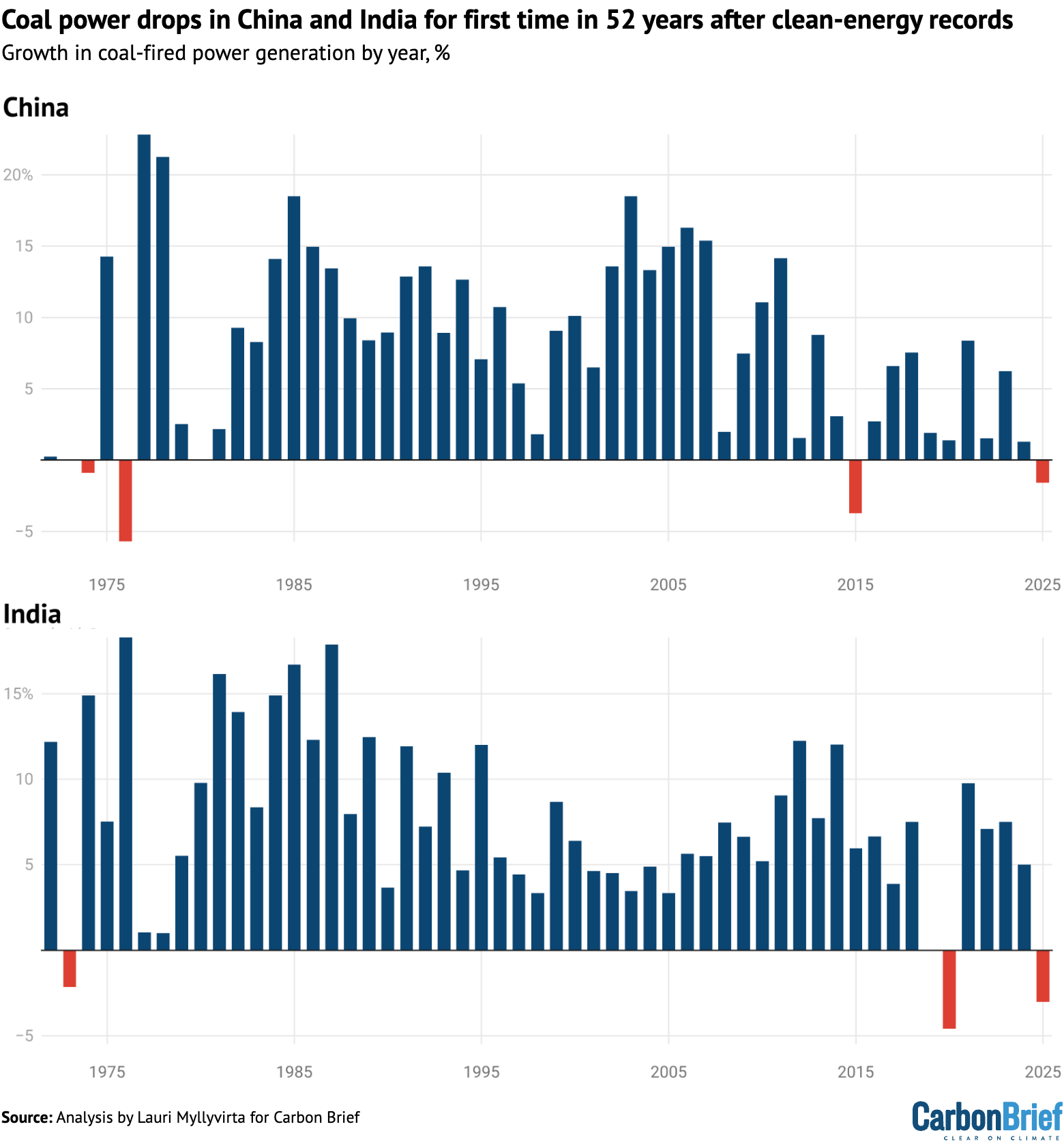
| ▲ | EA-3167 an hour ago | parent | prev [-] | | Oh you're correct, the same thing is happening in India without any of the nonsense fanfare. https://www.carbonbrief.org/analysis-coal-power-drops-in-chi... https://www.carbonbrief.org/wp-content/uploads/2026/01/span-... You can see the same dips hit at the same time for the same reason. In terms of Chinese coal though there's a reason boosters always talk about percentages and not absolute number... one goes down, but the other keeps rising. Even if China continues on the current course in terms of tonnage burned they won't reach "peak coal" until at least 2030. |
| |
| ▲ | rgmerk an hour ago | parent | prev [-] | | To add to this, China’s overall greenhouse gas emissions have been flat or declining for a couple of years now: https://www.carbonbrief.org/analysis-chinas-co2-emissions-ha... | | |
| ▲ | EA-3167 43 minutes ago | parent [-] | | Your own link says the following: > After the first three quarters of the year, China’s CO2 emissions in 2025 are now finely balanced between a small fall or rise, depending on what happens in the last quarter. And then goes on to describe how the largest drop (3%) is happening at a time when it just happens that fuel is increasingly expensive and scarce, shipping is increasingly expensive and slow, and the global economy has spent months grinding increasingly towards a terrible outcome. People might as well brag about their incredible weight loss journey through amputation. |
|
| |
| ▲ | triceratops 17 minutes ago | parent | prev | next [-] | | Fossil is flat or declining. Everything else is skyrocketing. | |
| ▲ | nradov 3 hours ago | parent | prev | next [-] | | I never claimed that China is "going green" (whatever that means), merely that they're gradually reducing their dependence on imported fossil fuels. | |
| ▲ | XorNot 2 hours ago | parent | prev [-] | | China can be going green while also refusing to constrain it's economic growth on the short term. When you actually build things, throwing up a coal plant for 10 years because you need it while you grow your solar and battery industries or wait for reactors to cover your base load is just sensible. All narratives about China always have this static world baked into them: "they're currently like this, and that's all they'll ever be". But China develops fast. Shenzhen was a farming village by a ditch. 10 years ago buying a Chinese car was inconceivable - I took delivery on one yesterday, etc. At some point in the very near future China is going to hit a cross over point on their emissions and they'll start falling fast because reactors + renewables will be building out fast enough they'll want the coal plants gone - no one likes ruling over a polluted wasteland. Edit: it can also be the case that they don't care at all about going green...but renewable energy technology is the most sovereign possible energy security. No one can take away your access to the sun. |
|
| |
| ▲ | lukan 3 hours ago | parent | prev | next [-] | | People who know how much effort it takes to constantly measure and contain radioactivity and what a mess it is to mine for Uranium in the first place also don't wonder. If not, reading a list of this helps: https://en.wikipedia.org/wiki/Lists_of_nuclear_disasters_and... But sure, oil leaks can be bad as well. Solar leaks on the other hand seem bearable. | | |
| ▲ | batisteo 3 hours ago | parent | next [-] | | I believe burning coal realease far more Uranium and radioactive material than nuclear ever did.
Listing the plane crashes over the last century wont buldge the statistics of the safety of this mean of transportation. | | |
| ▲ | lukan 3 hours ago | parent [-] | | Did I imply anywhere anyhow that I am a fan of coal? I just don't think it is a good idea to replace something dirty with something else dirty that is indeed quite safe if all goes well, but is horrible if something goes wrong. Italy has lot's of sun and wind (and geothermal potential). | | |
| ▲ | EA-3167 41 minutes ago | parent [-] | | Everything is a comparison to what exists, not your dreams. The alternative to coal today isn't just renewables, and thinking in those absolute terms is in large part what's handed the fossil fuel lobby decades of default victories. We don't have time for perfect solution, do all of what you said AND THEN ALSO MORE. |
|
| |
| ▲ | EA-3167 3 hours ago | parent | prev [-] | | I am someone who knows, hence my disgust. Time to learn about the radioactivity of coal fly ash and how carefully that’s managed. | | |
| ▲ | lukan 3 hours ago | parent [-] | | Oh, I know and am in favor of shutting coal down asap and before nuclear. But you seem to imply handling radioactivity is not a big problem compared to fossils, but I believe it is, considering how faulty and corrupt individual humans are, or corporations or government bodies doing the oversight. |
|
| |
| ▲ | otherme123 3 hours ago | parent | prev [-] | | China also? How is that? China is a big importer of oil, and is heavily burning coal (more than 50% their energy mix), that is also partly imported. They are fighting for a cleaner energy not because they are green but because they don't want to be dependent on imports, and some people even accuse them of undercutting solar panel pricing to get all the world market. They are installing nuclear power like no other country (1 GW yearly since 2014), and Wikipedia says that 50% of all nuclear capacity being built is in China (https://en.wikipedia.org/wiki/Nuclear_power_by_country): 37 new reactors, followed by India with 6 and Russia, Egypt and Korea with 4. USA and France, which are both pro-nuclear or nuclear neutral, are building 0 reactors. But yeah, China has interests against nuclear power. You are not helping your case by spreading misinformation and calling other people misinformed by making a strawman ("radiation scares people"). I am against nuclear (or rather not pro-nuclear) because it is not economically sound, because it is massively subsidized by Governments for the private sector to profit. | | |
| ▲ | hnedeotes 3 hours ago | parent | next [-] | | If china that is the number one producer of solar panels and batteries is investing in nuclear perhaps that shows that indeed it's not such a bad bet? Specially taking into account the military applications of such capabilities. It would also seem that investing into it may perhaps render significant gains into the future as R&D becomes more involved with actual running systems and funded (skin in the game?) It seems the only ones who lost by abandoning their nuclear programs were European countries (specially Germany) in detriment of Russia and other Oil trading countries... It's even probable that much of the "bad press" nuclear has had for the past decades was in fact instigated by oil-producing countries doesn't it? | |
| ▲ | bryanlarsen 3 hours ago | parent | prev [-] | | Coal's share of electricity production in China fell below 50% in 2026 for the first time ever. This is despite idling nat gas plants due to the war in Iran messing up shipments. Nuclear's share of electricity in China is below 4% and dropping. They do not use a significant amount of nuclear. That this insignificant amount of nuclear is more than any other country is quite telling. |
|
|