| ▲ | Nvidia dismisses "circular financing", says every $1 it invests brings back $100(invezz.com) |
| 109 points by mgh2 4 hours ago | 152 comments |
| |
|
| ▲ | silverFork 3 hours ago | parent | next [-] |
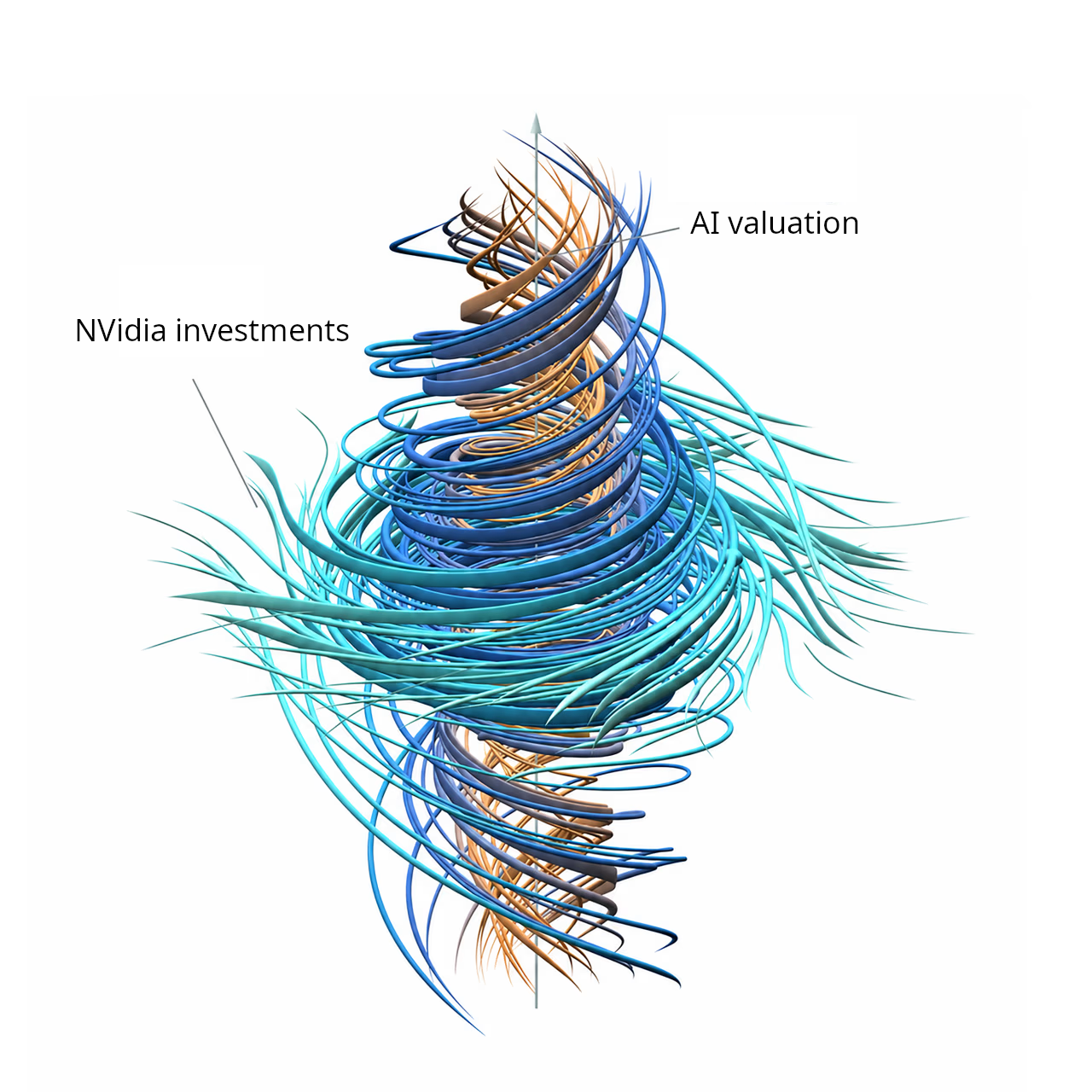
| A la Enron but completely legal. It is not just a circle, it is more like a swirl. Wallstreet invested in Ai Farms to purchase NVDA chips and then NVDA invested in Ai Farms and not only that it is investing in its customer, Anthropic and its IPO.. They are recycling the cash that they harvest from stock markets till it becomes the famous singularity in funding like a financial hurricane. |
| |
| ▲ | dzonga 2 hours ago | parent | next [-] | | 80-90% of AI costs are related to inference. Once zAI served their new model entirely on Chinese chips for free then the nVidia jig is up. who is going to pay back the money nVidia invests in AI labs, AI datacenter companies if the models are being served dirt cheap. the Chinese are not the only competitor - Amazon with their Trainium, Google with their TPUs etc. Nvidia might have a moat on training but on serving it's gonna be a blood bath. But for now they're capturing 80% of all the AI spend so they gonna keep making money. | | |
| ▲ | LogicFailsMe an hour ago | parent | next [-] | | Pretty much fanfic. The gap between premise and execution remains limiting. Nvidia has adapted to changing markets better than anyone else up to this date which is what got them to the top in the first place. What makes you think "this time it's different?" The fallacy I see repeatedly is someone spots a legitimate issue that could hurt Nvidia and by the time they have stood up the challenge to pull that off, Nvidia has pivoted and addressed it. Or more recently, they just acquired it like Groq. For your premise to hold, you're asserting Nvidia is blind to inference. And yet his public positioning suggests otherwise. https://qz.com/nvidia-gtc-2026-jensen-huang-keynote-takeaway... What makes you think they've hit some sort of metaphorical iceberg and all they'll do before they sink is rearrange deck chairs? | |
| ▲ | iterateoften an hour ago | parent | prev | next [-] | | There is the Law of Demand. As ai costs plummet, demand increases, just nobody knows the curve shape yet. But could be that cheap inference is how all the AI supply meets the demand | | |
| ▲ | JumpCrisscross 23 minutes ago | parent | next [-] | | > There is the Law of Demand What is this? Demand functions (price as a function of quantity demanded) take all kinds of shapes. Veblen goods are the silly example of wrong-sloped demand [1]. The in-vogue example of sigmoid demand, however, is hot water–make hot water (or lighting, for that matter, as another comment today pointed out for LEDs) cheaper and there is a limit to the things we want hot water for. Halving the cost of hot water doesn't induce much new hot-water demand, it increases demand for other goods and services. [1] https://en.wikipedia.org/wiki/Veblen_good | |
| ▲ | moffkalast 19 minutes ago | parent | prev [-] | | I don't think that follows when free plans to get people interested are still a thing. Most people aren't paying anything at all. |
| |
| ▲ | echelon an hour ago | parent | prev [-] | | > But for now they're capturing 80% of all the AI spend so they gonna keep making money. And this is why the stock remains high. This hasn't even started to make a dent in Nvidia's bottom line yet. These comparisons to Enron are absurd when Nvidia is generating this much cash flow. Let's see the other alternatives come online and start taking away sales. |
| |
| ▲ | iterateoften 2 hours ago | parent | prev | next [-] | | Wut? Enron was literally shutting down energy grids in one location to spike prices in another. Way way way more to Enron story than financing to begin with. Not everything is an Enron | | |
| ▲ | SecretDreams an hour ago | parent | next [-] | | > Enron was literally shutting down energy grids in one location to spike prices in another. Kind of reminds me of the current lack of supply of GPUs and ram to consumers. | | |
| ▲ | infecto an hour ago | parent [-] | | How? Two very different things but because we don’t like AI we make bad comparisons? |
| |
| ▲ | cmiles8 2 hours ago | parent | prev [-] | | Enron comparisons folks are making is about why they failed, not why they made a lot of money. They ultimately failed for reasons scarily similar to what’s going on now across the industry with special purpose vehicles and off balance sheet liabilities. | | |
| ▲ | infecto an hour ago | parent [-] | | Just wrong. It’s a superficial comparison at best. Enron was cooking books using entities they controlled but making it look like they did not. You could make an argument that maybe this is similar to oracle (I think?) in the com bubble financing networking gear to customers. I still think that misses the mark since the customers using hardware are have demand for computer by their customers. | | |
| ▲ | cmiles8 an hour ago | parent | next [-] | | And people were really buying electricity too. The WSJ recently reported that there’s around 3 trillion in off balance sheet liabilities floating around in AI. It’s very unclear where the $3 trillion to pay those bills will come from. Nobody is saying it’s “illegal” but it was news in the WSJ as the companies using creative accounting aren’t exactly going out of their way to make sure everyone knows that this $3 trillion in liabilities exists. | |
| ▲ | mrlonglong an hour ago | parent | prev [-] | | Boots. You could cook boots but they still won't be edible. |
|
|
| |
| ▲ | JumpCrisscross 3 hours ago | parent | prev [-] | | > Enron but completely legal Nvidia's financing is disclosed. Enron lied about its schemes. I've also seen zero evidence that Nvidia is extending this credit to related parties to put in sham orders–that was part of Enron's shtick, too. | | |
| ▲ | silverFork 3 hours ago | parent | next [-] | | The mechanics are legal but the objective is the same which is buy your own output by manufacturing a demand. I am sure they can buy good lawyers to keep it completely legal. | | |
| ▲ | nl 2 hours ago | parent | next [-] | | Vendor financing[1] has a long and successful history. Here's a good WSJ article from 2001 about the practice and risks[2], written after the DotCom crash in March 2000. There is nothing illicit or illegal in anyway about what NVidia is doing. It's reasonable business practice, and people on HN are simply ignorant to think otherwise. NVidia is very aware of the risks it entails, but has the money to cover those risks. [1] https://en.wikipedia.org/wiki/Vendor_finance [2] https://archive.is/mOIfg | | |
| ▲ | ElProlactin 2 hours ago | parent | next [-] | | A big problem in discussions about Nvidia is that people can't distinguish between: 1. The equity investments Nvidia has made in its customers. 2. The guarantees/backstops it has extended to some of its customers. 3. Vendor financing. The vendor financing is the least interesting of the bunch. Nvidia has already disclosed that when it provides vendor financing, the average customer pays in less than 60 days. These are not long-term financing arrangements and virtually every big company sells on these type of terms (net-30, net-60, etc.). The equity investments and guarantees are where there is room for legitimate debate. | | |
| ▲ | JumpCrisscross 2 hours ago | parent [-] | | > equity investments and guarantees are where there is room for legitimate debate The guarantees dwarf the equity investments. If there is a shenanigan, it's going to be there. A problem: the line between the guarantees and traditional vendor financing is blurry–one could argue use commitments are no different from repurchase commitments. |
| |
| ▲ | stymaar 2 hours ago | parent | prev [-] | | > There is nothing illicit or illegal Which is exactly the point of the person you're responding to. What part of “but completely legal” isn't clear enough? | | |
| ▲ | nl 2 hours ago | parent | next [-] | | Their implication ("A la Enron", "they can buy good lawyers to keep it completely legal") that there is something illicit or wrong in what NVidia is doing. The OP clearly is implying that it should be illegal for some reason. This is wrong - not only is it nothing like Enron (!?) but it's a great way for both NVidia and the companies building on them to build what they want. | |
| ▲ | JumpCrisscross 2 hours ago | parent | prev [-] | | Enron was illegal but also a sham. The point is we have no evidence Nvidia's financing is a sham. It could be. And if it is, it's a huge problem. But the shammiest parts of what Enron did do not apply to Nvidia, which makes the comparison a bit like saying OP is Hannibal Lecter but legal while glossing over the fact that OP never murdered anyone but once drank red wine. (Also note that illegal != illicit.) |
|
| |
| ▲ | nonethewiser 2 hours ago | parent | prev | next [-] | | Are you claiming NVIDIA manufactured the demand for AI? | | |
| ▲ | Avicebron 2 hours ago | parent | next [-] | | Not a lot of people were clamoring for copilot in their outlook. But NVIDIA are giving money to labs so that they will buy their hardware. Manufacturing demand for their hardware, which is used for more AI, which eager PMs stuff into every crevice they can find and call demand. | | |
| ▲ | CuriouslyC 2 hours ago | parent [-] | | ChatGPT was the fastest growing software of all time not that long ago. Citing a bad AI product as evidence for lack of demand is saying the failure of the Homer car was due to the fact that people don't like automobiles. | | |
| ▲ | oblio 2 hours ago | parent | next [-] | | ChatGPT was the fastest growing gratis software of all time. I wish we still lived in an age where things were sold to cover their costs. My money's on their product having 10% of its current user base if they charged 50 cents per month. | | |
| ▲ | 2 hours ago | parent | next [-] | | [deleted] | | | |
| ▲ | saberience an hour ago | parent | prev [-] | | You could have said this about Google's Search product... How much would the average normie pay if Google suddenly charged? Sure the user-base would drop. And what? Did Google suddenly become a bad business? I find it funny how people have these strange and hypocritical viewpoints when it comes to OpenAI and Anthropic when the hyperscalars like Google, Amazon etc, followed these exact same kinds of playbooks for years and years. | | |
| ▲ | detourdog 17 minutes ago | parent [-] | | Probably not a normie but I pay for Kagi search because it’s a lot like pre-seo google. So far haven’t tried any AI since OpenCYC. |
|
| |
| ▲ | simoncion 2 hours ago | parent | prev | next [-] | | > ChatGPT was the fastest growing software of all time not that long ago. Google+ was the fastest-growing social network of all time not that long ago. When you're one of a pair of VC darlings that have effectively-infinite money because of -in part- handwavy promises to cure cancer and eliminate 90% of payroll everywhere, or if you're an established company that has total control over very widely used consumer products, you can do all sorts of things to manufacture amazing growth numbers. In the case of those VC darlings, we're seeing their shift towards providing their products that are most expensive to create exclusively to B2B customers and also the shift towards justifying the elimination of most of their R&D expenditure. Every company performs belt-tightening in advance of their IPO, [0] and those two are no exception. [0] ...which is when their finances will be scrutinized by the public and regulators... | | |
| ▲ | echelon an hour ago | parent [-] | | ChatGPT is in my tool belt now, and I barely touch Google anymore. The world is fundamentally and momentously being rewired. |
| |
| ▲ | brazukadev 2 hours ago | parent | prev [-] | | Don't need to go far. Sora by the same company was the fastest incineration of dollars in software of all time. |
|
| |
| ▲ | silverFork 2 hours ago | parent | prev [-] | | Yup. Investing in your customer, what is that if it is not buying demand. They get the cash to buy your output. | | |
| ▲ | JumpCrisscross 2 hours ago | parent [-] | | > Investing in your customer, what is that if it is not buying demand It can be manufacturing demand that wouldn't otherwise exist. It can be facilitating demand to come online sooner and smoother. You can't tell which it is by only looking at the transaction; you need to know how many dollars are going into the ecosystem as a whole for purchases of goods and services. Until Anthropic's S-1 lands tomorrow-ish, we won't have that publicly. |
|
| |
| ▲ | CuriouslyC 2 hours ago | parent | prev | next [-] | | I'd argue that in this case, Nvidia is accelerating a flywheel to try and reach critical velocity rather than manufacturing demand. | | |
| ▲ | JumpCrisscross 2 hours ago | parent | next [-] | | > to try and reach critical velocity Do you mean economies of scale? | |
| ▲ | oblio 2 hours ago | parent | prev [-] | | > I'd argue that in this case, Nvidia is accelerating a flywheel to try and reach critical velocity rather than manufacturing demand. I'd argue that in this case, if the flywheel never reaches critical velocity, they are manufacturing demand. |
| |
| ▲ | JumpCrisscross 2 hours ago | parent | prev [-] | | > mechanics are legal but the objective is the same which is buy your own output by manufacturing a demand Eh, I think it's an open question whether OpenAI and Anthropic would be buying GPUs like they are with or without Nvidia's financing. Financing customers' purchases isn't proof per se of demand creation versus demand inducement. Anyone who claims they've seen a certain fact in these financings is deluded or lying. | | |
| ▲ | silverFork 2 hours ago | parent [-] | | The Ai companies are not really profitable now so they need cash incoming from the skies to grow even more and they are still losing money. Ai farms and much of Ai software world are money sucking machines with assumed profit in future. Their P/E is assumed to be positive in future but it isn't now. The hardware suppliers are making the real money now from the AI hardware pipeline and NVDA is pretty much the center of hardware pipeline sucking most of the cash. In my opinion NVDA knows that the profits from AI have to flow from Ai software to keep the music playing and that it has a lot of competition incoming and so it is funding its customers and buying its own output to circulate the cash towards itself to make as much money as possible now. It has no other choice in reality. | | |
| ▲ | JumpCrisscross 2 hours ago | parent [-] | | > Ai companies are not really profitable now You need to be more specific, because there are absolutely sections of the AI economy that are clearly and presently profitable. > Ai farms and much of Ai software world are money sucking machines If AI farms refers to datacenters, plenty of existing ones are currently profitable. | | |
| ▲ | silverFork 2 hours ago | parent [-] | | Their assets are depreciating faster than they can pay it off and that means that the profits are pretty much a temporary illusion in my opinion that is because the so called ai chips have short lifespans and don't age gracefully. What happens when you buy a car and say use it for delivery for income for example and then the engine dies. You have to buy a new car and pay for the old one as well. | | |
| ▲ | JumpCrisscross an hour ago | parent [-] | | > Their assets are depreciating faster than they can pay it off Whose assets? Where are you getting this from to be able to state it with this level of certainty? | | |
| ▲ | silverFork an hour ago | parent [-] | | I said in my opinion.. But here a reference;
https://www.tomshardware.com/pc-components/gpus/datacenter-g... | | |
| ▲ | phil21 18 minutes ago | parent | next [-] | | > The utilization rates of GPUs for AI workloads in a datacenter run by cloud service providers (CSP) is between 60% and 70%. With such utilization rates, a GPU will typically survive between one and two years, three years at the most, according to a quote allegedly made by a principal generative AI architect from Alphabet and reported by @techfund, a long-term tech investor with good sources. This is just extremely unbelievable to me. I am certainly not operating at a level the hyperscalers are and have much more limited direct experience. But I do actually put various GPUs inside datacenters (and much harsher locations) and have operated them at balls-to-the-wall 100% utilization for over a decade now. You get the typical bathtub curve of failures. Unless the hyperscalers are operating these things even more overclocked and beyond thermal specification limits than early GPU crypto miners used to do, I simply cannot believe that the average hardware life is less than the useful life of the whole chip generation itself. I have plenty of decade old GPUs that operate today just fine. Both consumer and datacenter form factors. The failures tend to be board-level like capacitors and such, so if you are operating at a massive scale partnering with someone who can fix those relatively cheaply is not all that difficult either. It could be that these H200 and above class sort of stuff is engineered extremely fragile, but I seriously doubt it. The prevailing "common knowledge" pre-AI for GPUs were that they'd burn out in a year or two of heavy use, and that was simply untrue. I saved a ton of money buying batches of used units because everyone was terrified of this - and had no more early failures than I did buying brand new after basic refurb of re-pasting and putting a new fan on them. | |
| ▲ | JumpCrisscross 17 minutes ago | parent | prev [-] | | > I said in my opinion I've been pitched data-center deals. They depreciate on an 18- to 24-month schedule, well under the Tom's Hardware terms. The ones who went online a year or two ago aren't losing their chips like ducklings through a storm gate; if anything, their resale value has remained remarkably stable because compute production is the bottleneck. You've given a source (a great one, btw) for depreciation but not revenue. If you can name a company, I can look if I have a public source that confirms what I know. But broadly speaking, no, unit economics in the AI economy is weirdly sound, though I suspect it's because every non-AI CEO is blowing out their budgets on frivolous spending. |
|
|
|
|
|
|
| |
| ▲ | fyredge an hour ago | parent | prev | next [-] | | Enron's mistake was doing it too early. Nvidia investing in AI labs to use their own chips falls under anti trust, but I don't think the latest administration is interested in investigating it. | |
| ▲ | cmiles8 2 hours ago | parent | prev | next [-] | | Within the whole industry (beyond Nvidia) this is starting to look a lot more and more like Enron. It does appear “legal” but the special purposes vehicles and off balance sheet commitments are having the same net effect. Convincing everyone things are fine while hoping they don’t notice the massive liabilities building up that are kept out of reporting. If you haven’t read “Smartest guys in the room” it’s important reading now as it’s scary similar to what’s going on now across AI. Nobody has alleged anything illegal but the net effect on building a house of cards in the AI bubble can be the same. And that gap in where people are watching (AI company press releases or the creative accounting going on) explains why those watching this are saying “oh no, we’ve seen this movie before” when others are blinding all rah rah about the AI bubble going on forever. | |
| ▲ | weird-eye-issue 2 hours ago | parent | prev | next [-] | | Right, that's why it's legal. We all get that | | |
| ▲ | JumpCrisscross 2 hours ago | parent [-] | | > that's why it's legal Which is a fundamental difference. When Apple extends me credit to buy an iPhone, that isn't circular financing in a problematic way. I was buying the phone anyway, the financing just made it easier. | | |
| ▲ | mschuster91 2 hours ago | parent [-] | | It's still questionable. Similar to car manufacturers or IKEA, who all have their own banks, Apple has an incentive to hand out credit to people who should not get it, increasing the likelihood of people getting underwater with their debt. Generally, the fact that most non-Boomer people simply don't have the means to even save up for basic consumer goods like cars, furniture or a phone but have to go into debt instead is scary. Our entire economy has become a house of cards. | | |
| ▲ | JumpCrisscross 2 hours ago | parent [-] | | > still questionable Oh hell yeah. But a lot of folks are treating the existence of customer financing as damning per se. The scale is daunting. But the scale of the entire AI enterprise is massive. | | |
| ▲ | jqpabc123 2 hours ago | parent [-] | | But the scale of the entire AI enterprise is massive. Yes --- and the scale of the money being set on fire is epic. And if/when the burning comes to a screeching halt, the resulting crash wil be likewise. |
|
|
|
| |
| ▲ | jqpabc123 2 hours ago | parent | prev [-] | | I've also seen zero evidence that Nvidia is extending this credit to related parties to put in sham orders Have you bothered to look at the finances of Nvidia's AI clients? None of them are making any money. They're borrowing money they don't have in oder to buy from Nvidia. And now some of this money is coming from Nvidia itself. In a round about way, Nvidia is buying it's own product. It's pretty clear that this sort of thing can't continue indefinitely --- just like any Ponzi scheme. | | |
| ▲ | JumpCrisscross 2 hours ago | parent | next [-] | | > None of them are making any money Who are you thinking of? Because yes, I have, and they're not in line with the YouTube influencer consensus. | | |
| ▲ | jqpabc123 an hour ago | parent [-] | | Who are you thinking of? All the "frontier" AI vendors are borrowing money to invest in AI (and buy from Nvidia). None of these Nvidia customers are actually making money from it. Anthropic and OpenAI are two cash burning machines that Nvidia has invested billions into --- so they can continue buying from Nvidia. Bottom line: A lot (if not most) of Nvidia's cash flow is borrowed money --- and some of it is borrowed from Nvidia itself. Some of it isn't even "cash flow". It's contract futures being counted as cash flow --- a la Enron accounting. |
| |
| ▲ | saberience an hour ago | parent | prev [-] | | All of what you said is totally wrong and deluded. The amount of money Nvidia has put into the ecosystem is much, much less than money coming into the ecosystem from actual customers who are willing to pay for the products! The idea that somehow Nvidia is financing the entire AI industry is laughable. The numbers do not add up at all if you look at the numbers of people paying for Google cloud GPU compute, AWS GPUs, Azure GPUs, Nebius, Coreweave, etc, not even including companies like Fireworks, BaseTen, Together AI, etc . The reality is this, enterprise companies are spending HUGE amounts of their money on AI products because they are gaining value from them. This money (which doesn't originate from Nvidia) is flowing into the ecosystem. The money being spent by enterprises combined is far, far more than Nvidia puts in. | | |
| ▲ | jqpabc123 38 minutes ago | parent [-] | | The idea that somehow Nvidia is financing the entire AI industry is laughable. Yes, it is --- and this is not something I said. This is an absurd extrapolation done by you. But there is no denying that Nvidia is investing billions in it's own customers (aka "lending") and others up and down the AI infrastructure stack. And all of it has one objective --- to create and enhance what is being marked as "sales" for Nvidia. In a round about way, Nvidia is buying at least some of it's own product. https://www.cnbc.com/2026/05/09/nvidia-embraces-ai-investor-... |
|
|
|
|
|
| ▲ | iammjm 3 hours ago | parent | prev | next [-] |
| Where are those 99$ coming from? Who is actually paying this money? Because it seems like so far everybody is losing money with no reversal of this trend in sight |
| |
| ▲ | JumpCrisscross 3 hours ago | parent | next [-] | | > Where are those 99$ coming from? If this isn't a house of cards, AI companies' customers. The companies and individauls ponying up for a Claude subscription or compute through OpenRouter. Customer financing isn't inherently fucked. It's just highly suspect at the scale Nvidia's doing it. There was another thread where I noted that Nvidia's investments are literally monetarily significant, to the point that I expect them to start being directly referenced in the Fed's beige book [1]. [1] https://news.ycombinator.com/item?id=49673871 | | |
| ▲ | polski-g an hour ago | parent [-] | | Demand for AI inference is infinite. It's coming from the rest of the economy. | | |
| ▲ | swiftcoder an hour ago | parent | next [-] | | Money flowing from the rest of the economy means money no longer being spent on something else. Assuming for the moment it's not all a big circular inflationary scheme, what exactly is being cut back on to fund this infinite spend on AI inference? | |
| ▲ | boesboes an hour ago | parent | prev [-] | | sure elon |
|
| |
| ▲ | fc417fc802 3 hours ago | parent | prev | next [-] | | And this is the actual problem. I can't see framing it as a ratio as anything other than an attempt to mislead. What do you predict will happen when the market deflates? Whether or not a segment will behave like a line of dominoes and catastrophically implode is the question. As I understand it they are risking that even if the major AI labs fail all the compute capacity that's been built out will remain in demand at sufficiently high prices. | |
| ▲ | jstummbillig 3 hours ago | parent | prev | next [-] | | > Where are those 99$ coming from? Who is actually paying this money? Companies who pay 99$ to make >99$ in return. I am not saying it works in all cases but that's the idea when a company spends money. > Because it seems like so far everybody is losing money with no reversal of this trend in sight I am not sure what you are seeing: Anthropic (as one of only two major companies that do just AI) is starting to return profits, while demand for AI is accelerating and, clearly, compute is maxed out. And I mean: On the entire planet. They are turning profits despite everything being in full buildout mode. | | |
| ▲ | edgyquant 2 hours ago | parent [-] | | Is Anthropic turning a profit? I thought that was only when considering discounted compute from spaceX |
| |
| ▲ | well_ackshually 3 hours ago | parent | prev | next [-] | | >Who is actually paying this money? You, when their circular financing scheme fails and you're the one left holding the bag as your government says "they're too important to let them fail". | | |
| ▲ | paulryanrogers 2 hours ago | parent [-] | | Also you if your retirement funds are heavily invested in AI, directly or indirectly through big caps who are. |
| |
| ▲ | marginalia_nu 3 hours ago | parent | prev | next [-] | | Inflated valuations, mostly. | | |
| ▲ | petcat 3 hours ago | parent [-] | | The current valuations are only inflated until they're not. Especially if the big American labs can convince the US government to work out a joint "AI non-proliferation" agreement with China which will allow both countries to essentially carve up and techno-colonize the rest of the world without any other competition except between themselves. We're already seeing signs of this strategy from Open AI and Anthropic warning about the dangers of AI and the need for safety regulations. None of that stuff matters if China is not also on board with it. | | |
| ▲ | marginalia_nu 3 hours ago | parent [-] | | > The current valuations are only inflated until they're not You could say that about any historically inflated valuation all the way back to the tulip mania. Either the expected profit materializes or it doesn't. > We're already seeing signs of this strategy from Open AI and Anthropic warning about the dangers of AI and the need for safety regulations I would read this as a desire to pause training to be able to present a profit in anticipation of the IPO. The major AI labs mad scramble to IPO is if anything a sign that they aren't at all confident in the valuation. If they were they would be no hurry to cash out. |
|
| |
| ▲ | simianwords 3 hours ago | parent | prev | next [-] | | You do realise it’s not a fixed pie right? | | |
| ▲ | streetfighter64 2 hours ago | parent [-] | | Well, it is. Thermodynamics. Earth is pretty much a closed system, except for the sun. So for example if you invest $100 in a farm and get a return of 10%, where does that come from? The nutrients in the soil, the effort expended by the workers, and the power of the sun to turn seeds into food. All value comes either from finite resources in the ground (nuclear, oil, ...), from solar power, or from human effort (work, innovations, etc.) So can you trace back Nvidia's incredible 10000% return on investment to any of these sources? Which ones? | | |
| ▲ | Footnote7341 2 hours ago | parent | next [-] | | Economic value isnt a physical resource being depleted.... | | |
| ▲ | ptx 40 minutes ago | parent [-] | | But it seems this "economic value" is often created by depleting actual physical resources (e.g. people's health, clean air and water), usually resources belonging someone other than the person capturing the "value". |
| |
| ▲ | chungy 2 hours ago | parent | prev | next [-] | | Money is created all the time. It is not a zero-sum game. | | |
| ▲ | someguyiguess 2 hours ago | parent [-] | | When money is created, the total amount of money in circulation increases, decreasing the value of each unit of money overall. It’s called inflation. | | |
| ▲ | simianwords an hour ago | parent | next [-] | | No it’s not fixed like that. Total prosperity of world has increased inflation adjusted over 100 years. Why? Surprised basic stuff is now being questioned. | |
| ▲ | YetAnotherNick an hour ago | parent | prev [-] | | It's not that simple. Of course there is inflation but in the long run in history, real money has increased massively. We have give opportunity of education to almost everyone, abolished slavery, given food and basic medicine to almost everyone. 100 years back having all of these sounded like a perfect world. |
|
| |
| ▲ | simianwords an hour ago | parent | prev [-] | | If it’s a fixed pie why do we have more collectively now than 200 years ago? Value also comes from technology which you seem to suspiciously remove |
|
| |
| ▲ | neonstatic 2 hours ago | parent | prev [-] | | This month I spent $50 on OpenRouter credits. I find it very useful for coding assistance (not coding per se). It's $50 that I never spent before on this kind of service. That's what we call growth - it quite literally came out of nowhere. | | |
| ▲ | hypercube33 2 hours ago | parent | next [-] | | This month I reduced my spend on cloud AI and started using local models as primary - it's maybe 2 or 4 times slower for some things but it still is getting the job done just fine. I talked to a friend of mine who's been doing the same running smaller Qwen models locally for coding. | |
| ▲ | oblio 2 hours ago | parent | prev [-] | | Your $50 isn't enough to sustain trillions of dollars in CapEx investments. This investment cycle - at this scale - only makes sense if within the next 5 years AI replaces something crazy like 5-10% of jobs, if not more. Not changes, replaces completely. And I'd argue the timer started in 2023. | | |
| ▲ | neonstatic an hour ago | parent | next [-] | | I merely pointed out, that there is real growth behind this - 50$ from my wallet went to this, that did not go towards it at any point in the past. Your argument that my 50$ is not enough is duly noted, but also intellectually lazy. | |
| ▲ | brunoarueira an hour ago | parent | prev | next [-] | | It's the marketing they were doing all the time that AI will replace developers and other jobs, then the companies started this bullshit firing thousands of people without really thinking through. It's more sane to advertise that AI will augment us and I guess if they followed this path a more sustainable growth is expected to happen! | |
| ▲ | saberience an hour ago | parent | prev [-] | | I've spent several 1000 dollars on AI products this month, roughly 3000 dollars. Trust me, there are many other people like me in the world and the enterprises are spending even more. There is more money flowing into the overall AI ecosystem (by far) than the money Nvidia puts in. The idea that Nvidia is artificially creating the whole demand is laughable and doesn't add up. | | |
| ▲ | ReflectedImage 6 minutes ago | parent [-] | | The AI numbers only work if it replaces white collar work. Power tools for knowledge workers, which is what we are getting, isn't enough to save it. |
|
|
|
|
|
| ▲ | vardump 3 hours ago | parent | prev | next [-] |
| I first read that "every $1T brings back $100", thinking, wow, is it THAT bad? No, it's very unlikely at this point every $1 Nvidia invests brings back $100. Stating something like that is almost a red flag that things are overheating. |
| |
| ▲ | nerbert 3 hours ago | parent | next [-] | | Every $1 they invest brings back $100 in their valuation maybe. | | |
| ▲ | willis936 2 hours ago | parent [-] | | But even that isn't really true since Nvidia P/E was unreasonably high even 4 years ago. So how is this not lying to investors (a thing that is illegal)? | | |
| ▲ | thunky 2 hours ago | parent [-] | | Because a PE is a fact not an interpretation. | | |
| ▲ | vardump 2 hours ago | parent [-] | | It's interesting how people who stare only at P/E make consistently bad investment decisions. Perhaps P/E is not such an important indicator overall? |
|
|
| |
| ▲ | nonethewiser 2 hours ago | parent | prev | next [-] | | Its definitely consistent over the past several years. | |
| ▲ | thousand_nights 3 hours ago | parent | prev | next [-] | | > The figure was rhetorical, not a disclosed 100-times investment return. seems no one is reading the article.. | | |
| ▲ | streetfighter64 2 hours ago | parent [-] | | It's a very stupid thing to say though, it's like Trump's promise to reduce drug prices by 1000%. I guess that was also just a figure of speech. | | |
| ▲ | delecti 2 hours ago | parent [-] | | It's not nearly that stupid. If their investments are, on-average, bringing sizable returns, it's a perfectly cromulent figure of speech. | | |
| ▲ | tavavex 8 minutes ago | parent [-] | | +20% is a sizeable return, but I don't think anyone would look at me right if I made such an investment and then said "I earned $100 for every $1 invested". This is a mathematical statement with concrete numbers, you can't use it as a figure of speech. |
|
|
| |
| ▲ | stkdump an hour ago | parent | prev | next [-] | | They also said that theur hardware scales faster than Moore's law, when in reality it is way slower than Moore's law. Which I guess at least is a good thing for hyperscalars because it helps with their decision to write off their GPUs over a much longer period. But still, it seems that billionaires are lying left and right. It isn't just Elon. | |
| ▲ | cyanydeez an hour ago | parent | prev [-] | | they're talking about book value, which is all the AAR garbage VC's throw around with their infinite TAMs and all the other clutches of bullshit capitalists need to put in their nests to make themselves feel like they arn't just very complex parasites. So, in one aspect, like the Matrix, they're not lying: they litterally see that on the paper they're reading from. But like in the matrix, they just need to be unplugged from the bullshit machine to recognize that this money doesn't exist in the real world. Scientists, particularly the ones who get ragged on, you know, social scientists, are now well aware that no matter how well any given social goal works in the lab; no matter how much pscyhology they evaluate, depend on, etc, what matters is real world implementation. Thier sheets of cash raining in from some future valuation simply do not exist in a vacuum, but they want to pretend it does. So we're litterally watching capitalists look at their piece of meat inside the matrix, and telling us: they do not care that it doesn't actually exists, because on the Capitalism ledger, it feels like real meat. |
|
|
| ▲ | bhouston 3 hours ago | parent | prev | next [-] |
| It is a bit circular but it also a growing real market. NVIDIA is accelerating the market and also making money. It is a smart strategy on their part. We are not at the top of this trend yet so I do not see this as over investment. I remember the criticism Microsoft got for investing in Facebook/Meta that gave them a whooping $15B valuation and getting 1.7% in 2007. Not all deals will turn out that prescient but a few will and make up for any duds. This is a real market. |
| |
| ▲ | BunsanSpace 3 hours ago | parent | next [-] | | > It is a smart strategy on their part. No, it's a high risk gamble. If the market grows enough they will win the bet, but if the market doesn't or we get a recession that dries up capital they will be holding the bag. | | |
| ▲ | Avicebron 3 hours ago | parent | next [-] | | > If the market grows enough they will win the bet So for this to become true there are some number of jobs that that pay $N salary are replaced completely by LLMs that do the job for $N-0.01? Is that what you mean by "market grows enough" | |
| ▲ | bhouston 3 hours ago | parent | prev [-] | | > No, it's a high risk gamble. Even in a recession I think the shift towards AI would just accelerate since it is usually cheaper than humans. The real risk I feel if what if AI is too successful and there is a lack of human demand because of dropping wages/employment? (Then I wonder if sentient robot demand will make up for it? Although I realize that veers into science fiction futures.) | | |
| ▲ | someguyiguess 2 hours ago | parent [-] | | I think it’s safe to venture into science fiction futures at this point. We have AI and government mass surveillance technology. We’re living in science fiction futures. |
|
| |
| ▲ | malthaus 26 minutes ago | parent | prev | next [-] | | sure, as long things go up, smart. when things no longer go up, they will take the whole economy down with them akin to the banking crisis in 2008 or the dotcom bubble before that (which both had far less circular incestuous activity going on) and will shamelessly act surprised after the fact. as long as things go up people conveniently ignore the lessons from the past. we are long overdue for a correction and given the fear mongering oligopoly shenanigans we must be very close. | |
| ▲ | ulfw 2 hours ago | parent | prev [-] | | Tell us how you know we are not at the top of this trend yet please | | |
| ▲ | bhouston 2 hours ago | parent [-] | | Because the benchmarks are stilling going up fairly rapidly. There are rumors of RSI. We are not at the top definitely. And then the following trend will be humanoids and similar and they are barely getting started. |
|
|
|
| ▲ | blitzar 3 hours ago | parent | prev | next [-] |
| I don't know about $100 back ... but their profit margin is $0.90 on the gpu that is bought with the $1 they lend / swap for equity + they get ongoing interest / equity stake. Its a mighty fine deal for Nvidia |
|
| ▲ | zug_zug 2 hours ago | parent | prev | next [-] |
| I spent a few hours trying to run all the numbers myself from first principles (e.g. sum of all American salaries is 11.7T, plus international), to see what I could come up with. What I came up with was Nvidia is maybe slightly overpriced currently, but a bad stock to buy or hold onto because the risk of it shrinking is significantly higher than the risk of it ever doubling again (and it trades at a tech/growth multiple). The case is far worse for Anthropic/OpenAI who, at current pricing, capture such a tiny slice of the pie it's hard to see how they will stay in business long term. |
|
| ▲ | Ekaros 3 hours ago | parent | prev | next [-] |
| So if they just had spare 100 billion they could make 10 trillion? Sounds reasonable and plausible right? Sadly market manipulation is not being prosecuted. |
| |
| ▲ | hyperionultra 3 hours ago | parent [-] | | After the downfall - it will be prosecutable. Of course before that we (simpletons) will have to pay for those companies to avoid “economic collapse”. |
|
|
| ▲ | serbuvlad 5 minutes ago | parent | prev | next [-] |
| I find that the people who are most concerned about circular financing in the case of AI, are those who fearmonger about deflation and talk about the importance of monetary velocity for the economy. Isn't this a contradiction? |
|
| ▲ | nicman23 3 hours ago | parent | prev | next [-] |
| are those 100$ in the room with us right now |
| |
| ▲ | dgellow 3 hours ago | parent [-] | | They are definitely in NVIDIA’s own rooms! It’s like, they invest $1 in AI companies, that pay back NVIDIA $100 for GPUs. If you draw the lines you will see something that looks a bit like an ellipse. Or maybe a boomerang path. Or like, a 2d sphere. A bit frustrating we don’t have a simpler word for such a shape | | |
|
|
| ▲ | wartywhoa23 3 hours ago | parent | prev | next [-] |
| Those $99, where do they come from? |
| |
| ▲ | rwmj 3 hours ago | parent | next [-] | | Shush there! Don't ask any difficult questions! | |
| ▲ | brianpane 3 hours ago | parent | prev | next [-] | | https://www.youtube.com/watch?v=tO5sxLapAts | |
| ▲ | OroPla 3 hours ago | parent | prev | next [-] | | The Fed is printing them. Just like they print all other money. From the article: > I put in one, and a hundred comes back.” > The figure was rhetorical, not a disclosed 100-times investment return. There's a lot more words in there, but it doesn't seem to say anything else. | | |
| ▲ | someguyiguess 2 hours ago | parent [-] | | Printing money doesn’t create value. It dilutes value. | | |
| ▲ | OroPla an hour ago | parent [-] | | It does neither, as money is simply a representation of wealth. Increasing the supply of money without increasing the wealth will mean you'll have more money representing the same wealth. This is called inflation. But the wealth, or value if you will, remains unaffected. Money isn't wealth. It's just a representation. It used to be wealth back in the days before paper money, when a coin actually had the value it said it had. |
|
| |
| ▲ | __patchbit__ 3 hours ago | parent | prev [-] | | The future we want. Not the wasteful F-35 'Fat Amy' lemon future noone except the fighterjet mafia wants.. |
|
|
| ▲ | alexdns 3 hours ago | parent | prev | next [-] |
| nvidia invests $1 in AI company , datacenters with GPUs , AI company / datacenters buy $x worth of GPUs from NVIDIA , in a circle |
| |
| ▲ | david-gpu 3 hours ago | parent [-] | | Isn't vendor financing a common business practice to finance the cost of equipment? What makes it nefarious in this instance? | | |
| ▲ | crote 2 hours ago | parent [-] | | Because it isn't a simple loan, and the value of the equipment itself as collateral is highly doubtful anyways. Nvidia is investing in their customers by buying their stock. Nvidia is directly buying compute from their customers. Nvidia is making "if you can't find a customer, we'll take all of your capacity" deals. Nvidia is making a ton of fake huge-number deals which are supposed to be realized over time but most likely never will. They are doing everything they can to make that customer look like a healthy and valuable business which everyone should invest in and loan money to - which in turn flows directly back to Nvidia to buy GPUs and boost their revenue. They are essentially creating sockpuppets to keep external money flowing in so they can keep the money printer running. |
|
|
|
| ▲ | youoy 3 hours ago | parent | prev | next [-] |
| Woah, better than Madoff! How can i give him money? |
|
| ▲ | epsteingpt 44 minutes ago | parent | prev | next [-] |
| AI isn't showing up in S&P 500 company earnings as a line item.
proof: https://aiearnings.dev given the stakes, we'd better hope it starts showing up soon. |
|
| ▲ | AyanamiKaine 2 hours ago | parent | prev | next [-] |
| I always here how Nvidia's investment "scheme" is like previous company X that was destroyed using said scheme. But its quite obvious that while there are some similarities its simply not the same. Most analysis, so it seems, are quite surface. Are there any deeper finical analysis on the investments of Nvidia and how they are financed? |
|
| ▲ | xnx 2 hours ago | parent | prev | next [-] |
| Isn't most of the financing just another way of expressing discounts and payment plans for very expensive hardware? |
|
| ▲ | sva_ 2 hours ago | parent | prev | next [-] |
| > so why does the stock keep falling When I zoom out to 5 years, it does not look like "keeps falling". |
| |
|
| ▲ | hacker_88 2 hours ago | parent | prev | next [-] |
| They sell shovels in the gold rush and invest on the miners as well. The gold is the tokens . As long as the tokens are consumed,they are fine . |
|
| ▲ | ozgrakkurt 3 hours ago | parent | prev | next [-] |
| Like a grade school student claiming they peed for 10 minutes straight yesterday |
|
| ▲ | scotty79 7 minutes ago | parent | prev | next [-] |
| NVidia just has the money to overleverage themselves by buying companies in AI industry (coincidentally their own customers). If they put all of their money in the chip business they'd have major problem once someone else makes good enough chips in volume. And Chinese are obviously going to do that very soon. But if NVidia owns comapnies who buy chips it's winning no matter who they buy the chips from. With what NVidia is doing, it's making the ride better for themselves and provide a soft cushion for when it ends. The only way for NVidia to lose is for AI to fail utterly. Which is pretty impossible. |
|
| ▲ | RugnirViking 3 hours ago | parent | prev | next [-] |
| Amazed by these comments? Yes, it seems very possible to me that Nvidia makes a lot of money. They are literally the largest company in the world. Who pays? Only all the companies, desperately raising as much capital as possible, issuing new stock to do it, going for unprecedented investment rounds, burning cash reserves to fund the largest data centre rollout in history. Who builds the things that go into said datacenters? The thing that has also raised in price dramatically in recent years? |
| |
| ▲ | Ekaros 3 hours ago | parent | next [-] | | It is always about scale. At scale today's Nvidia does anything is so big that 100x is not anymore reasonable. Or then it is not significant... From sub million to hundreds of millions I could theoretically see. Even tens of millions to billions. And even then I would be extremely skeptical. But with Nvidia we are talking somewhere in the scale at tens or hundreds of billions. And that is actually very large sums of money. Even if it often does not look like it. | |
| ▲ | rwmj 3 hours ago | parent | prev | next [-] | | In a very narrow sense it may be true that Nvidia expects to make some multiple of the money invested (unlikely to be 100x but whatever). But you can't talk about that without talking about the wider economy. If the wider economy, and especially the pension funds putting money into the scheme, cannot sustain this, it'll eventually collapse and then everyone including Nvidia will lose lots and lots of money. | |
| ▲ | well_ackshually 2 hours ago | parent | prev [-] | | The only metric by which they are the largest company in the world is valuation. There are thousands of companies more important to your daily existence than Jensen's leather jacket factory. They are also talking out of their asses, as they are massively overselling their capacity, and everyone is on a 5 to 10 year backlog. |
|
|
| ▲ | sajithdilshan 3 hours ago | parent | prev | next [-] |
| 100$ for every 1$ invested would definitely be branded as a ponzi scheme if it was done by a regular Joe |
|
| ▲ | bandrami 2 hours ago | parent | prev | next [-] |
| Ken Lay would like a word |
|
| ▲ | jqpabc123 2 hours ago | parent | prev | next [-] |
| "Every $1 invested brings back $100" --- Bernie Madoff |
|
| ▲ | fwlr 3 hours ago | parent | prev | next [-] |
| It’s not circular because we put a little bit of money in, and a lot of money comes back
Ah yes, it’s not circular, because it’s a pyramid. |
|
| ▲ | vrganj 3 hours ago | parent | prev | next [-] |
| You see, it's not a circle, it's a pyramid! Just buy in right now and you'll get unprecedented returns! Nothing could possibly go wrong! My name is Charles Ponzi and I approve of this message. |
|
| ▲ | somepleb 2 hours ago | parent | prev | next [-] |
| Cisco has entered the chat. |
|
| ▲ | Eddy_Viscosity2 3 hours ago | parent | prev | next [-] |
| 10,000% growth! No way that could be wild claim! How dare we doubt them. |
|
| ▲ | haritha-j 2 hours ago | parent | prev | next [-] |
| Where does the $99 come from you ask? Your salaries if AI works (and takes your jobs), and your taxes if it doesn’t (bubble bursts, your taxes bail them out Becasue it’s too big to fail). |
|
| ▲ | andrepd 3 hours ago | parent | prev | next [-] |
| Reads like satire. "I get 100$ for every 1$ I put in" is exactly the kind of phrase that triggers ponzi alarm bells on anybody reading this x) |
|
| ▲ | ulfw 2 hours ago | parent | prev | next [-] |
| Every $1 it invests brings back $100 Mega eyeroll God heavens. It's worse than 2000/2001! Gotta start selling my portfolio |
|
| ▲ | behnamoh 3 hours ago | parent | prev | next [-] |
| Nvidia is full of shit. Leatherman thinks Astra = AGI. |
|
| ▲ | Flavius 3 hours ago | parent | prev [-] |
| So for every trillion that was invested, 100 trillion were made. Got it. |