Remix.run Logo
jasonjmcghee 7 hours ago

A big name in proc gen is Kate Compton who coined the term "10,000 bowls of oatmeal" to describe this phenomenon of technically unique but not different enough to matter - I googled "10000 bowls of oatmeal" to see if there was a good article and the second link was about it and nms

https://www.challies.com/articles/no-mans-sky-and-10000-bowl...

fxwin 2 hours ago | parent | next [-]

I haven't played it myself, but surely an article written one month after the game's release doesn't do it justice, considering there have been multiple major updates attempting to address the gripes players initially had with the game in the 10 years since then (And review trends on steam indicate that these attempts were successful)

belval an hour ago | parent | next [-]

I played it in VR and it still does.

No Man's Sky suffers from planets being "deserts", they have different attributes but it's still a fairly lifeless empty world.

Ironically this is realistic but also not terribly fun as a player.

ghostly_s an hour ago | parent | prev [-]

Indeed, I remember it being pilloried after release but the Steam reviews now are generally quite positive from players who've logged tons of hours.

jasonjmcghee 2 minutes ago | parent [-]

The original massive controversy was the founder of the studio claiming it had multiplayer when it very clearly didn't which was such an odd thing to claim and easy to prove false.

That and the trailer was very different than the released game.

They apologized IIRC and then continued to work on it for like a decade - adding multiplayer and many large changes to the game

kjs3 6 hours ago | parent | prev | next [-]

That's pretty much the perfect description of NMS. Every planet is 'different', every site on the planets are 'different', but not different in any meaningful way. Oh look...this planet has 4 legged animals that are green and bumpy and the last one they were brown and spiky...but they move the same and act the same. Yawn.

swat535 4 hours ago | parent | next [-]

It's not just NMS.. the "10,000 bowls of oatmeal" is a plight of all AAA games these days.

Ubisfot is a perfect example, look at their "Watch Dogs: Legion" for example. They decided to get creative and give you random characters generated by AI.. it turned out to be a disaster.

Another one is their Far cry games, where they copy and paste the same events but slightly different, all over the map and call it a day.

I think these efforts more have to do with bean counters taking over the industry than game designers being lazy. I'm sure there are plenty of talented people working at these studios, but they are held back by MBAs.

porphyra 2 hours ago | parent [-]

Fallout 4's endgame with the autogenerated "quests" of defending settlements get boring extremely fast.

porphyra 2 hours ago | parent | prev | next [-]

It's even worse when you see the exact same animal asset but scaled differently with a different color hue on a completely different planet. Ruins the immersion immediately. Obviously, it has come a long, long way since the 2016 article, but still.

empyrrhicist an hour ago | parent [-]

For me it's the asteroids. Having space being so densely populated with procedural asteroids is immediately, irreversibly immersion breaking for me. Like... space would be opaque and life on these plants would immediately cease in a cataclysm of bombardment.

This was also one of many gripes I had with Starfield.

montagg an hour ago | parent [-]

I think you gotta set aside some of that to enjoy both as Sci-Fi games, not space sim games. In Sci-Fi, asteroids are close together and you can shoot them for resources or lose an enemy in them like a dark forest, because those things are fun. IRL, they are ridiculously far apart and not nearly as fun.

It's always a potential danger to one's enjoyment to know too much about something though. :)

Twirrim an hour ago | parent | prev | next [-]

I played it about a year ago for the first significant time after having bought it some point a long time back.

It's... fine? It kept me engaged until it didn't. Part of the "didn't" came about because I was being paper-cut to death by bugs that googling showed me had been reported for a long time, if not since the very beginning.

I kept feeling like it was a game on the verge of happening throughout, and it never quite made it. Lots of things to go do to serve.. no purpose. Nothing was that unique or memorable, and I often had very little clue where I was in relation to anything. At one stage I was overseeing a town but that seemed to do nothing for me other than make me go back and make a snap decision for no discernible reason, occasionally fight hostile creatures, and also act as a sink for resources I was gathering.

I kept thinking "Why am I even doing this" until it really sunk in "Why am I even doing this?" and quit.

It also exasperated me that even though I was using a pretty fast gaming system, on a regular basis assets would take ages to appear, including buildings. "Fly to this place on the planet, land at this archaeological dig, wait 3 minutes for the dig to bother to appear before you can do anything." (saw identical behaviour on my steamdeck too, so doesn't seem "my machine" per se?)

glenstein 6 hours ago | parent | prev | next [-]

I still think it's a remarkable success story and they can and should be incredibly proud of what they've built. But this vision of what is meant by cosmic depth and expansiveness seems to tragically miss the point.

Compare it to even our own solar system where even so much as a new high-res photo of the hexagon storm on Saturn comes with stunning new and specific detail, or the "heart" on Pluto, we're practically ambushed with novel configurations of atmospheric dynamics and geology. It's frustratingly rare for games to truly activate that feeling of wonder.

I think NMS is still an unbeatable deal for what it is as a game but it's a frustrating near miss flyby of what I think people want a true space exploration game to feel like.

k4j8 6 hours ago | parent | next [-]

The best space exploration game I've played is Outer Wilds (https://store.steampowered.com/app/753640/Outer_Wilds/), but instead of the NMS sandbox there are puzzles.

benterris 2 hours ago | parent | next [-]

Outer Wilds is really an amazing game. I highly recommend playing it without looking at anything online: when I started I reached for google every time I was stuck, just to realise I could have found answers if I has searched just a little bit more. After a while I stuck to a rule to never look at answers online, and it was such a bliss to finally crack puzzles after trying lots of different things.

peheje 5 hours ago | parent | prev | next [-]

one of those games where i wish i could erase my memory just to play it again, still think about it, i think it's like a year ago i played it, maybe more. idk. great game.

IshKebab 2 hours ago | parent | prev [-]

I played it recently. Very good game (although mediocre ending if we're being honest). The thing they did really really well is that it's true exploration in the sense that you could complete the game very quickly if you've already played it, because the only thing you need to complete it is some knowledge that you discover by exploring.

For example there might be a wormhole that takes you to a different destination if you fly through it backwards. You're very unlikely to find that out by chance, but if you explore you'll find a thing that tells you (probably behind some other puzzle).

Great game.

embedding-shape 6 hours ago | parent | prev | next [-]

What do you think people want a true space exploration game to feel like?

dividefuel 36 minutes ago | parent | next [-]

There are different ways to take it.

There's the Kerbal Space Program approach, where space exploration is tough and you need to learn a LOT to succeed at it. The tradeoff of this is a high sense of accomplishment, where simply landing and returning from another body feels like you did something incredible.

There's also the Outer Wilds approach, where the story carries it. Moving around isn't hard at all, but you have specific goals to accomplish that move you towards a final ending. Diversity in how you accomplish those goals makes it feel fresh.

Mass Effect is similar, where you have some freedom to explore, but it's again in the pursuit of this broader story. So exploration feels like a rich side quest more than the main point of the task.

weard_beard 2 hours ago | parent | prev | next [-]

Rick and Morty. Procgen surfaces but a human story under every furniture-aliens-sit-on-humans multiverse.

Or alternatively Scavengers Reign

Personally I want spelljammer. Baldurs Gate meets Sea of Thieves in space with 80s killer clowns

There is so much drama that can happen there and the scale is the least of it.

chrisjj 5 hours ago | parent | prev [-]

Depends on which they want more. True space or true game.

soulofmischief 6 hours ago | parent | prev [-]

Have you played Outer Wilds? It nails this feeling. If you haven't played it, don't read or watch a single thing about it and just play it with zero expectations.

kaashif 2 hours ago | parent | prev [-]

Spore had that but I kind of liked it. I guess that was 20 years ago almost, maybe my standards were lower. It felt charming seeing others' animals, some of them looked pretty cool.

DonHopkins an hour ago | parent [-]

There's a fundamental difference between procedurally generated worlds and how Spore actually works.

The creatures, vehicles, and buildings weren't generated -- they were created by other players and exchanged asynchronously, then seeded into your procedurally generated galaxy.

Will Wright called it a Massively Single Player Online Game: no real-time multiplayer, but your galaxy fills with other people's content.

That's the opposite of the oatmeal problem. Procgen gives you infinite bowls that all taste the same. Spore gave you a finite but large set of bowls, each made by someone who cared about it. Different tradeoff, different failure mode -- but not the one this thread is about.

GDC 2005, Will Wright, The Future Of Content:

https://www.youtube.com/watch?v=N4ScRG_reIw

>[...] Also I want to apologize for the title of this talk in the description, which I know was kind of hopelessly vague.

>What usually happens every year is GDC, they call me up, and they say "we want you to do a talk" and I say okay, and then a week later they say "what's your talk about" and so then I think about it for a while and oh, get a rough idea of what I'm going to talk about, and I give them some kind of generic title in that area.

>That's what usually happens. But this year was different. This year when they asked me what I was going to talk about, I just flat out lied.

>But, so I'm not really going to talk about the future of content. I'm really more in fact going to talk about a possible future of content you know.

>It seems like the theme that I'm coming away from this conference with so far is that the next generation titles are going to be incredibly expensive, we're going to have to build mountains of content, and it's going to drive most of the smaller players out of the market.

>And I'd like to offer potentially an alternate vision of that. You know I think that there is a way to deal with that more creatively. So maybe a more accurate title for this talk would be "What I learned about content from The Sims".

Will's advice for game designers and creative humans in general:

>Advice: If you have a weird idea that’s so outside of the box, don’t forget it. You should go back and revisit your weird ideas later, because you can never know where they might lead to.

GDC 2005 Report: The Future of Content

https://www.gamedeveloper.com/design/gdc-2005-report-the-fut...

I posted more details on the Spore Stats discussion in 2023:

https://news.ycombinator.com/item?id=36280275

>Here are my notes and summary of the GDC 2005 talk where Will Wright first revealed Spore, which I asked Will to review and check for accuracy. It's interesting to compare the design he described in the talk with what Maxis eventually shipped. Video of the hour long talk: [...]

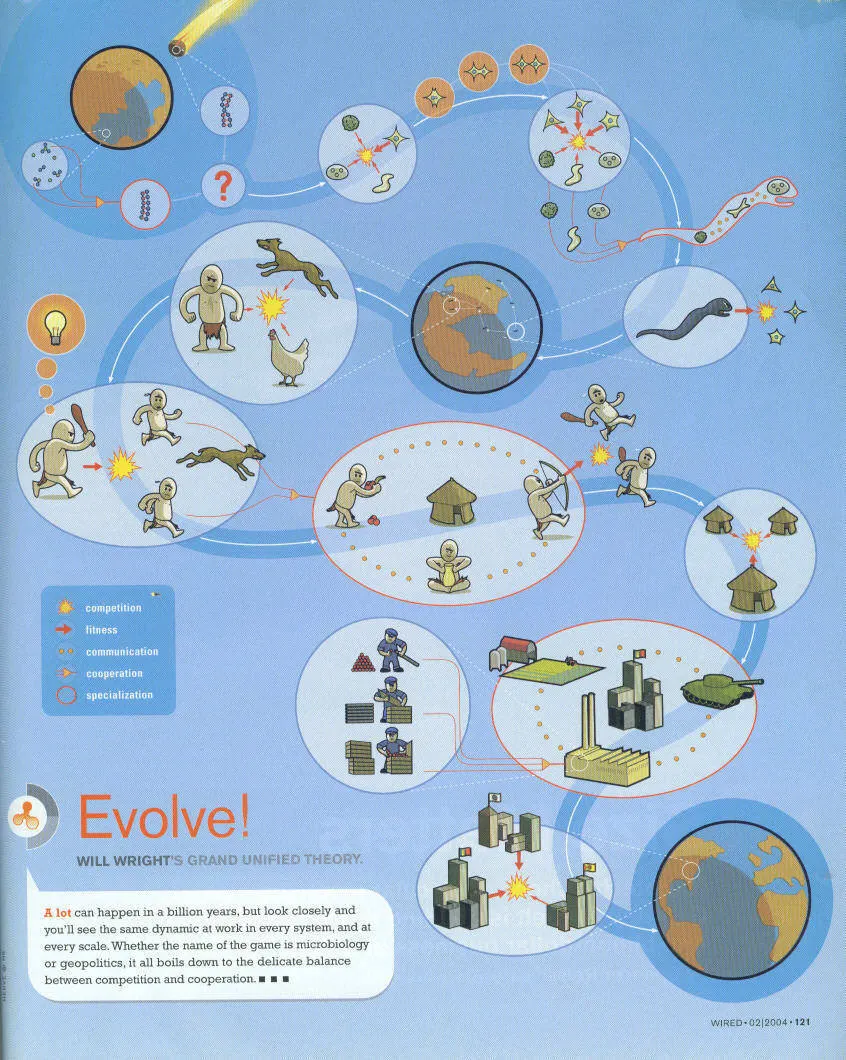
>Wired asked for an illustration to print in the magazine, anything he wanted. So he made a diagram of Spore that Wired published, but he didn’t tell them what it was. The design docs for Spore have been out in Wired Magazine for a year now. (It’s in the Feb 2004 issue of Wired.)

>Will’s Secret Diagram of Spore published in February 2004 Wired:

https://donhopkins.com/home/WiredSporeDiagram.jpg

https://news.ycombinator.com/item?id=36280831

>And that is the whole point, how you win the game: become involved with the content creation community!

>The powerful but easy to use direct manipulation editor tools, the automatic content sharing system, and the online community around user created content, were together the most innovative and successful things about Spore. (As contrasted with the not as well realized gameplay and storytelling design goals.) [...]

>Chaim Gingold, A Brief History of Spore:

http://www.levitylab.com/blog/2011/02/brief-history-of-spore...

>Creativity

>Of course, these aren’t any old aliens we ask players to invest in — they’re your creation, your aliens. Once you start customizing, and design your creature, emotional investment is generated. It’s magic. Even the ugly ones are loved by their parents. Many games thrive on the interest generated by players’ creative investment. Console role playing games, for example, get this effect when players invest time in equipping and naming characters. I’ve always felt more attached to my characters as I fuss over their outfits and equipment. Creative interaction seems to always generate emotional involvement and attachment. Psychologically, it would seem that part of this stems from the sunk cost fallacy — we become attached to things we’ve invested time and energy into. Of course, it’s not just the hundreds of hours invested in a World of Warcraft character, their relationships, and possessions that generate attachment, it’s the sense that our fabrications are extensions of ourselves. As recipients of our attention and creative energy, our handiworks are reflections of who we are, tangible manifestations of our personalities. It’s no wonder we become attached to what we make, and take the success or failure of our own work and ideas very personally.

>Spore neatly solves the alien attachment problem by asking the player to design them. If a player makes a creature, and it’s appealing, they’ll be quite invested in it. Reflecting on the success of The Sims Exchange, where players shared stories, characters, houses, and objects for The Sims, Will realized that shared creativity would give Spore a broader appeal. Why not build creative exchange into the game, rather than as a website that orbits it? Player created assets are constantly being uploaded and downloaded by Spore, enough material to fill a galaxy. There’s nothing like taking home your latest finger painting, and having mom hang it on the fridge for everyone to see. Sharing not only fills up the galaxy with cool stuff, but allows the entire world to see your fridge, motivating you to continue creating.

>Of course, a lot of deep magic must work properly for something like Spore’s creature creator to function properly. It must be natural to use, easily producing satisfying results for anyone, from beginners to advanced users. And these aliens, lumps of polygons that no animator has ever seen before, must be brought to life. These are rather complicated endeavors, from a design, aesthetic, and technical point of view, but the player should never notice any of it. The game design implications are also challenging — the game must be playable and interesting, regardless of the creatures dropped into it.

smugglerFlynn 6 hours ago | parent | prev | next [-]

   > you must ask yourself a single tough question: 
   > How much do you value technological wonder over everyday, solid, smart game design?
This quote applies to so much more than just gaming
meowface 7 hours ago | parent | prev | next [-]

One thing this article lacks is any tips on how to still do procedural generation while partly mitigating the oatmeal issue. In other words, define a more sophisticated generation procedure that can add character and identity.

It probably won't be as good as an artful human designer hand-crafting a world, but it can be better than something overly random and blandly uniform in distribution.

kettlecorn 5 hours ago | parent | next [-]

I've thought about it a bunch over the years and my advice is to follow a few principles: procedural elements should almost always impact how the player plays, procedural elements should cross-interact with each other as much as possible, and procedural elements should be understandable to the player.

As an example in No Man's Sky the player immediately starts with a jetpack. It makes it so the terrain is approached the same way every time: you just jetpack over it. Very rarely something is tall enough to require you to walk around.

Legend of Zelda: Breath of the Wild is a positive counter example. You have stamina so you're constantly thinking about the height of cliff faces, you can glide so you're thinking about height points and straight lines through the world, cliff faces cannot be climbed in rain so you think about the weather, slopes can be slid down on a shield, etc. There are a bunch of systems that may you think about the topology of the terrain, so even just varying the height map becomes interesting.

Similarly in No Man's Sky there are different resources but they work the same way on each planet and the player interacts with them pretty much the same way everywhere.

When I say elements should be "understandable" what I mean is that a trap, which Dwarf Fortress falls into, is to add a vast simulation which the player feels they can never really grasp. Simulations should not be a black box because then they begin to feel like a random number generator.

The aim shouldn't be to make an "infinite" game but to make a very interesting system for the player to slowly understand and master. The developer shouldn't just add stuff, but they should think about the long journey (and eventual mastery) a player might take as they spend significant time with the systems.

nkrisc an hour ago | parent | prev | next [-]

Procedural generation is not gameplay. Procedural generation makes your already fun game more interesting via more variety.

If you don’t already have a fun game, then pro gen won’t make it any more fun than it already is. It turns a fun 1-hour game into a much longer fun game.

If every single Minecraft player loaded into only a single Minecraft world, it would still be as fun as it is. Would No Man’s Sky really be that much different if it just shipped with a handful of pre-defined planets? It might have less replay value but the gameplay wouldn’t be any different.

Good proc gen changes things in your game such that the player is given interesting reasons to make different choices each time they play.

rcxdude 6 hours ago | parent | prev | next [-]

The advice I've heard is 1) have as many different dimensions of variation as you can manage, and try to have them matter, 2) resist the urge to impart correlations into the generation, since this just reduces variety, and 3) allow your parameters to become extreme occasionally, so that some parts of your generation are notably different, and special because they're rare.

1) is the really hard part, I think: it's a challenge to come up with enough meaningful variations that also work from a gameplay point of view.

feoren 6 hours ago | parent [-]

> 2) resist the urge to impart correlations into the generation

I think the opposite. The more dimensions you have, the more "invalid space" there should be. Otherwise you end up with giant dinosaurs with tiny feet and fairy wings. You end up with a yellow kitchen with a barrel full of arrows next to a blue dungeon with a giant dresser. You end up with nothing making sense, and everything feeling random in the same way. Trying to spot the differences between 100100111101011110110001001011101 and 1101101110111010000100111001011101 is exactly the "bowl of oatmeal" problem. The vast majority of possible combinations of values should be invalid and impossible, otherwise the choices actually don't matter.

schnevets 3 hours ago | parent | next [-]

Agreed. Elsewhere in this conversation people mention simple games that procgen well: Spelunky, Terraria, Dwarf Fortress, Dungeon Crawl Stone Soup

These are games painting with a 16 color palette while the technology exists for any shade in RGB. The more variations, the less likely things will be coherent (let alone brilliant)

rcxdude 6 hours ago | parent | prev [-]

I mean, almost no games have that many meaningful dimensions in the first place. It's more likely that the correlations you add just reduce the potential for interesting combinations to arise in the first place.

mostly_harmless 6 hours ago | parent | prev | next [-]

Spelunky and Terraria do a good job with Procgen.

Spelunky uses handcrafted chunks that are connected together like a puzzle. Each generation feels interesting because each chunk is interesting and they are just strung together into a unique maze.

Terraria does a similar thing, where all the things that matter are hand-crafted. Bosses, items, layer details, progression. The map and cave system is generated but the caves tend to string together hand-crafted experiences and hand-crafted monsters. Many areas are generated, but in a unique style for variety. And there was still a fixed progression in the background (ore and boss progression). I think its in a big contrast to a similar game like Starbound, where all the weapons and creatures and maps were procgen at first, and it felt very '10000 bowls of oatmeal'. Terraria vs Starbound is the most like-for-like comparison I've seen for "procgen done right vs wrong"

nemomarx 6 hours ago | parent | prev | next [-]

You want to look at dwarf fortress talks for that, I think?

OkayPhysicist 6 hours ago | parent [-]

IMO, Dwarf Fortress benefits greatly from the player seeing relatively few samples of the world gen, and the geography actually mattering to gameplay.

The actual geography doesn't vary that wildly most of the time ( if you've seen one lightly forested river valley, you've seen them all), but players generate a relatively low number of worlds, and in each world probably only see a handful of sites, where dwarf-scale world gen actually matters. Unlike NMS, though, the details of world gen matter to gameplay a lot. Trade caravans and invading armies can't traverse mountain ranges and ocean, so a mountainous peninsula can be extremely isolated. At the site level, you'll probably want to design your fortress to take advantage of local geography to help fortify your fortress and provide resources, so terrain and features like rivers, volcanoes, etc. placement matters a lot.

In contrast, No Man's Sky world gen feels pretty tangent to the actual gameplay. The game does a good enough job incentivizing you to explore lots of planets, but in terms of the survival/base-building aspects, there's a pretty short list of resources that matter to deciding where to setup, and geography hardly matters in terms of how you build.

WhatIsDukkha 6 hours ago | parent | next [-]

If your proceduralism doesn't generate easy to hard solvable problems (ie from geometry constraints etc), its not really adding to the gameplay, only the visual experience.

nemomarx 5 hours ago | parent | prev [-]

I'm thinking of the generated history and legends too - NMS only seems to gesture at this with wrecks of ships but I don't think it actually gives each planet a history.

setr 2 hours ago | parent | prev [-]

Roguelikes are the ultimate in procgen technology, and should be the basis of any design. (DF is the ultimate simulation but uses procgen as a tool to achieve it; a different vein than NMS trying to explore the procgen and its direct outcomes itself)

1. Any imaginary world needs to be internally consistent to be interesting. Procgen does not void this rule; randomization needs to be gated to that internal consistency.

2. A world can be composed of multiple environments, and each environment can a different definition of internal consistency. Dungeon Crawl Stone Soup does this very openly and to fairly good effect, but pretty much any decent procgen game will inevitably end up with the same choice, because it's what enables you to play with various procgen systems/rules while still having a coherent overall game.

3. Generalizing 2, procgen systems generally do not start from nothing; You embed reasonably well-defined bases (races, weapon forms, etc) and then apply randomization on top of those bases to form the final element. Meaningful fundamental variation in those bases leads to guaranteed meaningful variation in the end result.

4. Games are fundamentally interactive systems. Generating a thousand variations without actually changing interaction is equivalent to generating exactly one variation. A blue orc vs a red orc is a not real variant, unless you make it so by attaching effects / statuses / capabilities. The color distinction is then a signal into the more abstracted changes that have occurred. This is where NMS falls over -- the images have changed, but the interaction has not.

5. A corollary to point 4, changing numbers without changing interaction is equivalent to doing nothing. If a meaningful damage threshold is functionally every 10 points of damage, then generating numbers 0-9, 11-19, etc is equivalent to generating just the numbers 0 and 10. This is where borderlands falls over -- a million variations in guns, but the vast majority of those variations are just numeric differences that don't change anything in practice.

6. If the procgen applies to equipment/builds, you pretty much need permadeath as a driver for exploring a procgen game and its systems, because you need players to explore for a local optima. Exploring the space for a global optima in a procgen game inevitably devolves into a gambling simulator, because players optimize out the fun, and the optimal play is to the kill unit XYZ repeatedly for the 0.5% drop. Games like Terraria fall into this trap (though Terraria resolves it mostly by making unit XYZ be trivially summon-able bosses)

7. Procgen can never guarantee interesting results; You inevitably need a system of vaults/artifacts -- hardcoded quality items -- to guarantee periodic interesting locations/items. Ideally more notable than average generation, but less than strictly optimal so as to not overpower the other systems -- an issue I've had with games like Diablo 3, where finding an item-set was vastly more powerful than anything else that I acquired for the next 5+ hours, eliminating the entire looting system (and even character skill system, since it forced my build too)

8. Decent Procgen is inevitably rule-based, with possibly multiple chained-rules each doing their own rolls, to ensure coherency. Ideally the rule-chain is roughly discoverable from the end results (by virtue of following internally consistent and apparent rules) -- an end-result that cannot be explained is indistinguishable from pure-random, and pure-random in incoherent. See any Tabletop RPG generation tables.

9. Hell, just start any procgen design from tabletop RPG tables.

10. The number of variations that can be produced is meaningless. This is only for marketing.

11. A procedural system that generates exactly once is fairly pointless. Permadeath.

12. A procedural system is inherently unfair, because you cannot guarantee difficulty, proper placement, unit composition, etc without removing the procedural systems outright. Embrace the unfairness, and design around it. Permadeath.

13. A procedural system is inherently unfair; you need to give some guaranteed items with guaranteed results to navigate an uncertain world (e.g. escape tools).

14. It's always good to enable some control by the player over the procedural generation. Choice of environments, chances at additional loot, etc. You want the player to engage with procgen rules, because they're interesting (and if they're not, what are you doing?), and the easiest way is to give them tools to manipulate it to their advantage. Also permadeath.

agentultra an hour ago | parent [-]

You can work around 12. with constraint satisfaction solvers.

After generating the level structure, emplace an entrance and exit such that they are maximally apart. And emplace a strong monster in one of the rooms around the exit. And emplace a health potion in one room before the strong monster. And emplace treasure in the exit room.

That sort of stuff and be specialized and coded towards your particular games structures fairly easily.

Scale is much harder though. In something like NMS it’d be intensive doing such a constraint solver on the whole galaxy. Might work in chunks or regions though.

setr an hour ago | parent [-]

The problem is setups like in slay the spire, if we imagine there was no path selection, you can run into scenarios that are functionally unwinnable (I recall someone finding a seed in StS that was literally unwinnable, but ignoring that). Eg Act1 elites that counter your build, but too early for you to consistently have secondary options/workarounds.

Obviously people have high consistent wins in StS1/2 so it’s not like they’re guaranteed unwinnable, but for the average human (mostly just boils down to “path to do act1 elites until after you probably have a counter to all of them)

Your options are:

1. All scenarios are easy enough that you can get away with just about anything sensible

2. You don’t have any counter mechanics, which is basically the same as 1, and is difficult to do anything interesting with

3. You announce up-front what you’re going to deal with, so the onus is now on the player to find a solution in the meantime

4. You give the player a NOPE utility

In a roguelike, I think 4 is the better design, but 3 is also reasonable. 1 & 2 just makes things less interesting.

schnevets 5 hours ago | parent | prev | next [-]

I vaguely recall an episode of the Triple Click podcast around 2023 where they had a serious AI fanboy who was rah rah-ing about future procedural generation in games. It might have been Casey Anthony, but I'm unable to re-listen while at work.

The fanboy started saying how they could have endless different levels in Destiny 2... which is absurdly off-base since the entire game is just running through the same 9 sandboxes and 12 raids over and over and over again

He then went on to talk about AI creating an album as perfect as OK Computer on-demand, which was gently putdown by Kirk (who is an exceptional musician but also chill enough to suffer fools)

analog8374 a minute ago | parent [-]

I'm listening to OK Computer right now. Came upon this reply half way through "Let Down". Hmm.

In my own procedural explorations, the solution to the 10,000 bowls of oatmeal problem is to manually curate them and give the user only the exceptionally good ones. It's a tedious lot of work.

EagnaIonat 5 hours ago | parent | prev | next [-]

That article is 10 years old. NMS then versus now are two very different games.

ratelimitsteve 3 hours ago | parent | prev [-]

even as someone who enjoyed NMS as a nightly bowl of oatmeal, a second screen game while I listened to a podcast or a documentary, I can't dispute the accuracy of this metaphor. After a while it became brain off semitainment, and when paired with hands off semitainment I ended up with a full experience, but years later it still costs $70 to become nearly entertained and its become obvious that there are limits to how much you can make procedural generation not such as the core, heart and soul of a gaming experience.