| ▲ | kaashif 2 hours ago | |
Spore had that but I kind of liked it. I guess that was 20 years ago almost, maybe my standards were lower. It felt charming seeing others' animals, some of them looked pretty cool. | ||
| ▲ | DonHopkins an hour ago | parent [-] | |
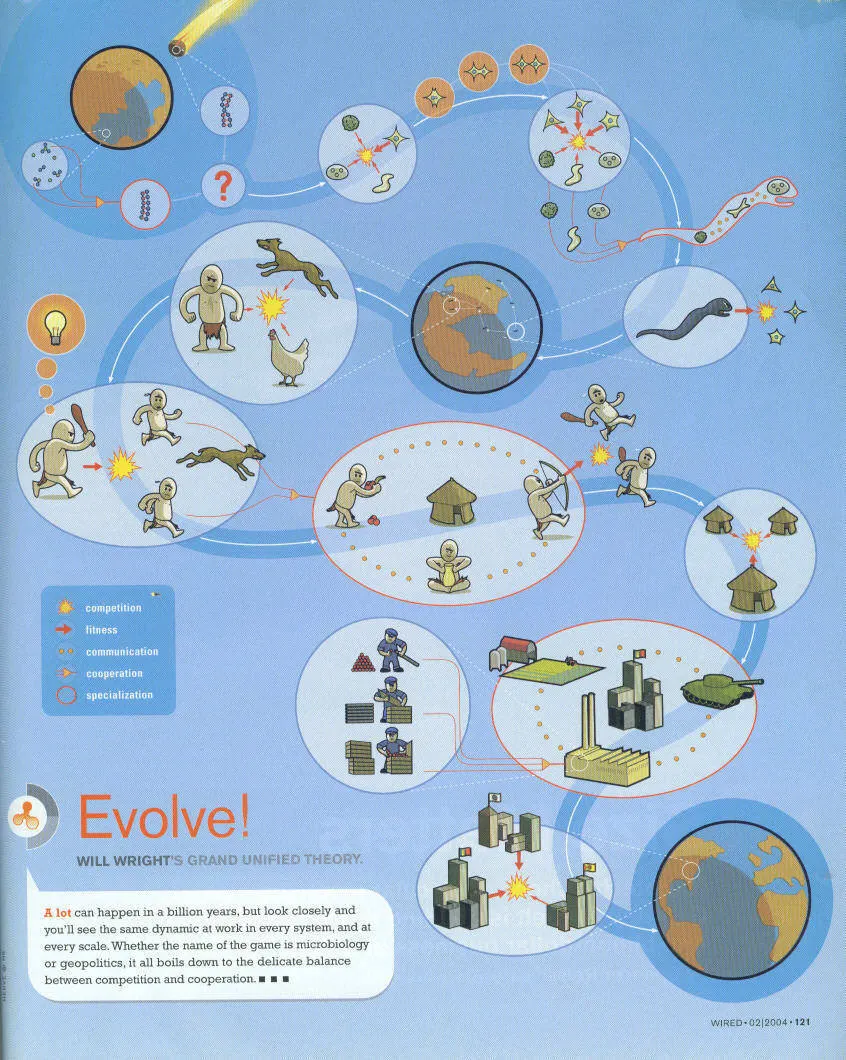
There's a fundamental difference between procedurally generated worlds and how Spore actually works. The creatures, vehicles, and buildings weren't generated -- they were created by other players and exchanged asynchronously, then seeded into your procedurally generated galaxy. Will Wright called it a Massively Single Player Online Game: no real-time multiplayer, but your galaxy fills with other people's content. That's the opposite of the oatmeal problem. Procgen gives you infinite bowls that all taste the same. Spore gave you a finite but large set of bowls, each made by someone who cared about it. Different tradeoff, different failure mode -- but not the one this thread is about. GDC 2005, Will Wright, The Future Of Content: https://www.youtube.com/watch?v=N4ScRG_reIw >[...] Also I want to apologize for the title of this talk in the description, which I know was kind of hopelessly vague. >What usually happens every year is GDC, they call me up, and they say "we want you to do a talk" and I say okay, and then a week later they say "what's your talk about" and so then I think about it for a while and oh, get a rough idea of what I'm going to talk about, and I give them some kind of generic title in that area. >That's what usually happens. But this year was different. This year when they asked me what I was going to talk about, I just flat out lied. >But, so I'm not really going to talk about the future of content. I'm really more in fact going to talk about a possible future of content you know. >It seems like the theme that I'm coming away from this conference with so far is that the next generation titles are going to be incredibly expensive, we're going to have to build mountains of content, and it's going to drive most of the smaller players out of the market. >And I'd like to offer potentially an alternate vision of that. You know I think that there is a way to deal with that more creatively. So maybe a more accurate title for this talk would be "What I learned about content from The Sims". Will's advice for game designers and creative humans in general: >Advice: If you have a weird idea that’s so outside of the box, don’t forget it. You should go back and revisit your weird ideas later, because you can never know where they might lead to. GDC 2005 Report: The Future of Content https://www.gamedeveloper.com/design/gdc-2005-report-the-fut... I posted more details on the Spore Stats discussion in 2023: https://news.ycombinator.com/item?id=36280275 >Here are my notes and summary of the GDC 2005 talk where Will Wright first revealed Spore, which I asked Will to review and check for accuracy. It's interesting to compare the design he described in the talk with what Maxis eventually shipped. Video of the hour long talk: [...] >Wired asked for an illustration to print in the magazine, anything he wanted. So he made a diagram of Spore that Wired published, but he didn’t tell them what it was. The design docs for Spore have been out in Wired Magazine for a year now. (It’s in the Feb 2004 issue of Wired.) >Will’s Secret Diagram of Spore published in February 2004 Wired: https://donhopkins.com/home/WiredSporeDiagram.jpg https://news.ycombinator.com/item?id=36280831 >And that is the whole point, how you win the game: become involved with the content creation community! >The powerful but easy to use direct manipulation editor tools, the automatic content sharing system, and the online community around user created content, were together the most innovative and successful things about Spore. (As contrasted with the not as well realized gameplay and storytelling design goals.) [...] >Chaim Gingold, A Brief History of Spore: http://www.levitylab.com/blog/2011/02/brief-history-of-spore... >Creativity >Of course, these aren’t any old aliens we ask players to invest in — they’re your creation, your aliens. Once you start customizing, and design your creature, emotional investment is generated. It’s magic. Even the ugly ones are loved by their parents. Many games thrive on the interest generated by players’ creative investment. Console role playing games, for example, get this effect when players invest time in equipping and naming characters. I’ve always felt more attached to my characters as I fuss over their outfits and equipment. Creative interaction seems to always generate emotional involvement and attachment. Psychologically, it would seem that part of this stems from the sunk cost fallacy — we become attached to things we’ve invested time and energy into. Of course, it’s not just the hundreds of hours invested in a World of Warcraft character, their relationships, and possessions that generate attachment, it’s the sense that our fabrications are extensions of ourselves. As recipients of our attention and creative energy, our handiworks are reflections of who we are, tangible manifestations of our personalities. It’s no wonder we become attached to what we make, and take the success or failure of our own work and ideas very personally. >Spore neatly solves the alien attachment problem by asking the player to design them. If a player makes a creature, and it’s appealing, they’ll be quite invested in it. Reflecting on the success of The Sims Exchange, where players shared stories, characters, houses, and objects for The Sims, Will realized that shared creativity would give Spore a broader appeal. Why not build creative exchange into the game, rather than as a website that orbits it? Player created assets are constantly being uploaded and downloaded by Spore, enough material to fill a galaxy. There’s nothing like taking home your latest finger painting, and having mom hang it on the fridge for everyone to see. Sharing not only fills up the galaxy with cool stuff, but allows the entire world to see your fridge, motivating you to continue creating. >Of course, a lot of deep magic must work properly for something like Spore’s creature creator to function properly. It must be natural to use, easily producing satisfying results for anyone, from beginners to advanced users. And these aliens, lumps of polygons that no animator has ever seen before, must be brought to life. These are rather complicated endeavors, from a design, aesthetic, and technical point of view, but the player should never notice any of it. The game design implications are also challenging — the game must be playable and interesting, regardless of the creatures dropped into it. | ||