Remix.run Logo
kjs3 6 hours ago

That's pretty much the perfect description of NMS. Every planet is 'different', every site on the planets are 'different', but not different in any meaningful way. Oh look...this planet has 4 legged animals that are green and bumpy and the last one they were brown and spiky...but they move the same and act the same. Yawn.

swat535 4 hours ago | parent | next [-]

It's not just NMS.. the "10,000 bowls of oatmeal" is a plight of all AAA games these days.

Ubisfot is a perfect example, look at their "Watch Dogs: Legion" for example. They decided to get creative and give you random characters generated by AI.. it turned out to be a disaster.

Another one is their Far cry games, where they copy and paste the same events but slightly different, all over the map and call it a day.

I think these efforts more have to do with bean counters taking over the industry than game designers being lazy. I'm sure there are plenty of talented people working at these studios, but they are held back by MBAs.

porphyra 2 hours ago | parent [-]

Fallout 4's endgame with the autogenerated "quests" of defending settlements get boring extremely fast.

porphyra 2 hours ago | parent | prev | next [-]

It's even worse when you see the exact same animal asset but scaled differently with a different color hue on a completely different planet. Ruins the immersion immediately. Obviously, it has come a long, long way since the 2016 article, but still.

empyrrhicist an hour ago | parent [-]

For me it's the asteroids. Having space being so densely populated with procedural asteroids is immediately, irreversibly immersion breaking for me. Like... space would be opaque and life on these plants would immediately cease in a cataclysm of bombardment.

This was also one of many gripes I had with Starfield.

montagg an hour ago | parent [-]

I think you gotta set aside some of that to enjoy both as Sci-Fi games, not space sim games. In Sci-Fi, asteroids are close together and you can shoot them for resources or lose an enemy in them like a dark forest, because those things are fun. IRL, they are ridiculously far apart and not nearly as fun.

It's always a potential danger to one's enjoyment to know too much about something though. :)

Twirrim an hour ago | parent | prev | next [-]

I played it about a year ago for the first significant time after having bought it some point a long time back.

It's... fine? It kept me engaged until it didn't. Part of the "didn't" came about because I was being paper-cut to death by bugs that googling showed me had been reported for a long time, if not since the very beginning.

I kept feeling like it was a game on the verge of happening throughout, and it never quite made it. Lots of things to go do to serve.. no purpose. Nothing was that unique or memorable, and I often had very little clue where I was in relation to anything. At one stage I was overseeing a town but that seemed to do nothing for me other than make me go back and make a snap decision for no discernible reason, occasionally fight hostile creatures, and also act as a sink for resources I was gathering.

I kept thinking "Why am I even doing this" until it really sunk in "Why am I even doing this?" and quit.

It also exasperated me that even though I was using a pretty fast gaming system, on a regular basis assets would take ages to appear, including buildings. "Fly to this place on the planet, land at this archaeological dig, wait 3 minutes for the dig to bother to appear before you can do anything." (saw identical behaviour on my steamdeck too, so doesn't seem "my machine" per se?)

glenstein 6 hours ago | parent | prev | next [-]

I still think it's a remarkable success story and they can and should be incredibly proud of what they've built. But this vision of what is meant by cosmic depth and expansiveness seems to tragically miss the point.

Compare it to even our own solar system where even so much as a new high-res photo of the hexagon storm on Saturn comes with stunning new and specific detail, or the "heart" on Pluto, we're practically ambushed with novel configurations of atmospheric dynamics and geology. It's frustratingly rare for games to truly activate that feeling of wonder.

I think NMS is still an unbeatable deal for what it is as a game but it's a frustrating near miss flyby of what I think people want a true space exploration game to feel like.

k4j8 6 hours ago | parent | next [-]

The best space exploration game I've played is Outer Wilds (https://store.steampowered.com/app/753640/Outer_Wilds/), but instead of the NMS sandbox there are puzzles.

benterris 2 hours ago | parent | next [-]

Outer Wilds is really an amazing game. I highly recommend playing it without looking at anything online: when I started I reached for google every time I was stuck, just to realise I could have found answers if I has searched just a little bit more. After a while I stuck to a rule to never look at answers online, and it was such a bliss to finally crack puzzles after trying lots of different things.

peheje 5 hours ago | parent | prev | next [-]

one of those games where i wish i could erase my memory just to play it again, still think about it, i think it's like a year ago i played it, maybe more. idk. great game.

IshKebab 2 hours ago | parent | prev [-]

I played it recently. Very good game (although mediocre ending if we're being honest). The thing they did really really well is that it's true exploration in the sense that you could complete the game very quickly if you've already played it, because the only thing you need to complete it is some knowledge that you discover by exploring.

For example there might be a wormhole that takes you to a different destination if you fly through it backwards. You're very unlikely to find that out by chance, but if you explore you'll find a thing that tells you (probably behind some other puzzle).

Great game.

embedding-shape 6 hours ago | parent | prev | next [-]

What do you think people want a true space exploration game to feel like?

dividefuel 35 minutes ago | parent | next [-]

There are different ways to take it.

There's the Kerbal Space Program approach, where space exploration is tough and you need to learn a LOT to succeed at it. The tradeoff of this is a high sense of accomplishment, where simply landing and returning from another body feels like you did something incredible.

There's also the Outer Wilds approach, where the story carries it. Moving around isn't hard at all, but you have specific goals to accomplish that move you towards a final ending. Diversity in how you accomplish those goals makes it feel fresh.

Mass Effect is similar, where you have some freedom to explore, but it's again in the pursuit of this broader story. So exploration feels like a rich side quest more than the main point of the task.

weard_beard 2 hours ago | parent | prev | next [-]

Rick and Morty. Procgen surfaces but a human story under every furniture-aliens-sit-on-humans multiverse.

Or alternatively Scavengers Reign

Personally I want spelljammer. Baldurs Gate meets Sea of Thieves in space with 80s killer clowns

There is so much drama that can happen there and the scale is the least of it.

chrisjj 5 hours ago | parent | prev [-]

Depends on which they want more. True space or true game.

soulofmischief 6 hours ago | parent | prev [-]

Have you played Outer Wilds? It nails this feeling. If you haven't played it, don't read or watch a single thing about it and just play it with zero expectations.

kaashif 2 hours ago | parent | prev [-]

Spore had that but I kind of liked it. I guess that was 20 years ago almost, maybe my standards were lower. It felt charming seeing others' animals, some of them looked pretty cool.

DonHopkins an hour ago | parent [-]

There's a fundamental difference between procedurally generated worlds and how Spore actually works.

The creatures, vehicles, and buildings weren't generated -- they were created by other players and exchanged asynchronously, then seeded into your procedurally generated galaxy.

Will Wright called it a Massively Single Player Online Game: no real-time multiplayer, but your galaxy fills with other people's content.

That's the opposite of the oatmeal problem. Procgen gives you infinite bowls that all taste the same. Spore gave you a finite but large set of bowls, each made by someone who cared about it. Different tradeoff, different failure mode -- but not the one this thread is about.

GDC 2005, Will Wright, The Future Of Content:

https://www.youtube.com/watch?v=N4ScRG_reIw

>[...] Also I want to apologize for the title of this talk in the description, which I know was kind of hopelessly vague.

>What usually happens every year is GDC, they call me up, and they say "we want you to do a talk" and I say okay, and then a week later they say "what's your talk about" and so then I think about it for a while and oh, get a rough idea of what I'm going to talk about, and I give them some kind of generic title in that area.

>That's what usually happens. But this year was different. This year when they asked me what I was going to talk about, I just flat out lied.

>But, so I'm not really going to talk about the future of content. I'm really more in fact going to talk about a possible future of content you know.

>It seems like the theme that I'm coming away from this conference with so far is that the next generation titles are going to be incredibly expensive, we're going to have to build mountains of content, and it's going to drive most of the smaller players out of the market.

>And I'd like to offer potentially an alternate vision of that. You know I think that there is a way to deal with that more creatively. So maybe a more accurate title for this talk would be "What I learned about content from The Sims".

Will's advice for game designers and creative humans in general:

>Advice: If you have a weird idea that’s so outside of the box, don’t forget it. You should go back and revisit your weird ideas later, because you can never know where they might lead to.

GDC 2005 Report: The Future of Content

https://www.gamedeveloper.com/design/gdc-2005-report-the-fut...

I posted more details on the Spore Stats discussion in 2023:

https://news.ycombinator.com/item?id=36280275

>Here are my notes and summary of the GDC 2005 talk where Will Wright first revealed Spore, which I asked Will to review and check for accuracy. It's interesting to compare the design he described in the talk with what Maxis eventually shipped. Video of the hour long talk: [...]

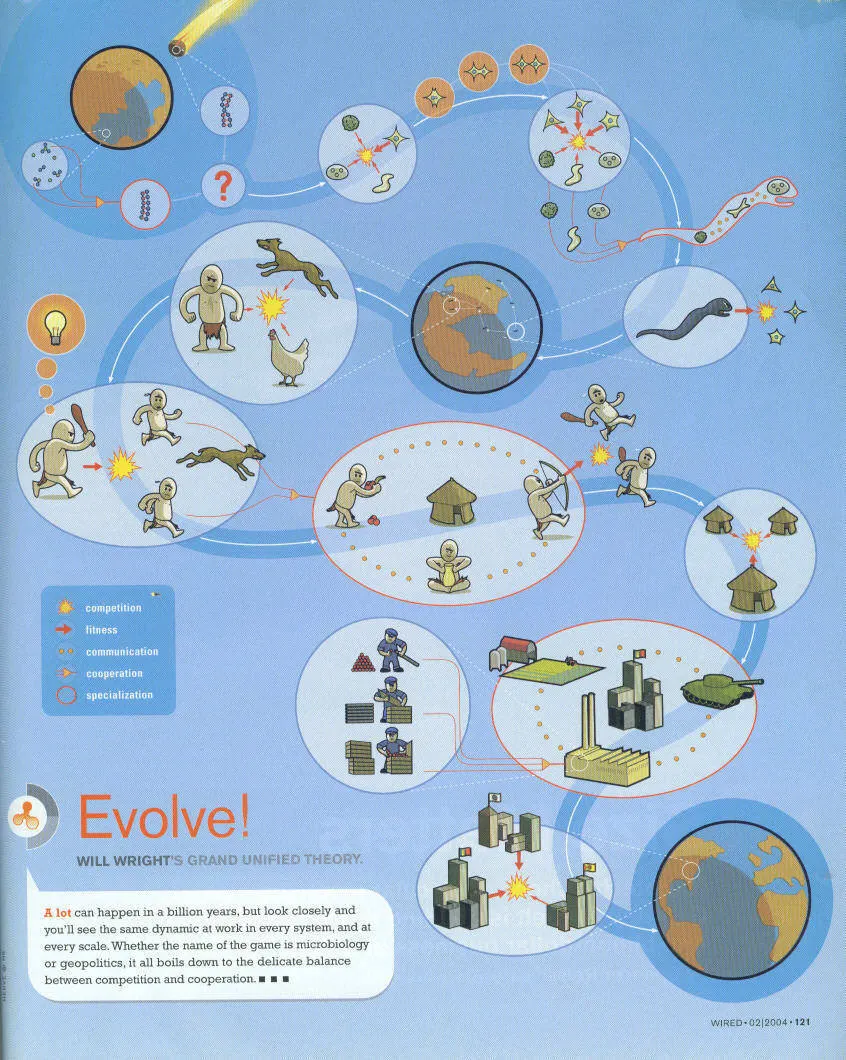
>Wired asked for an illustration to print in the magazine, anything he wanted. So he made a diagram of Spore that Wired published, but he didn’t tell them what it was. The design docs for Spore have been out in Wired Magazine for a year now. (It’s in the Feb 2004 issue of Wired.)

>Will’s Secret Diagram of Spore published in February 2004 Wired:

https://donhopkins.com/home/WiredSporeDiagram.jpg

https://news.ycombinator.com/item?id=36280831

>And that is the whole point, how you win the game: become involved with the content creation community!

>The powerful but easy to use direct manipulation editor tools, the automatic content sharing system, and the online community around user created content, were together the most innovative and successful things about Spore. (As contrasted with the not as well realized gameplay and storytelling design goals.) [...]

>Chaim Gingold, A Brief History of Spore:

http://www.levitylab.com/blog/2011/02/brief-history-of-spore...

>Creativity

>Of course, these aren’t any old aliens we ask players to invest in — they’re your creation, your aliens. Once you start customizing, and design your creature, emotional investment is generated. It’s magic. Even the ugly ones are loved by their parents. Many games thrive on the interest generated by players’ creative investment. Console role playing games, for example, get this effect when players invest time in equipping and naming characters. I’ve always felt more attached to my characters as I fuss over their outfits and equipment. Creative interaction seems to always generate emotional involvement and attachment. Psychologically, it would seem that part of this stems from the sunk cost fallacy — we become attached to things we’ve invested time and energy into. Of course, it’s not just the hundreds of hours invested in a World of Warcraft character, their relationships, and possessions that generate attachment, it’s the sense that our fabrications are extensions of ourselves. As recipients of our attention and creative energy, our handiworks are reflections of who we are, tangible manifestations of our personalities. It’s no wonder we become attached to what we make, and take the success or failure of our own work and ideas very personally.

>Spore neatly solves the alien attachment problem by asking the player to design them. If a player makes a creature, and it’s appealing, they’ll be quite invested in it. Reflecting on the success of The Sims Exchange, where players shared stories, characters, houses, and objects for The Sims, Will realized that shared creativity would give Spore a broader appeal. Why not build creative exchange into the game, rather than as a website that orbits it? Player created assets are constantly being uploaded and downloaded by Spore, enough material to fill a galaxy. There’s nothing like taking home your latest finger painting, and having mom hang it on the fridge for everyone to see. Sharing not only fills up the galaxy with cool stuff, but allows the entire world to see your fridge, motivating you to continue creating.

>Of course, a lot of deep magic must work properly for something like Spore’s creature creator to function properly. It must be natural to use, easily producing satisfying results for anyone, from beginners to advanced users. And these aliens, lumps of polygons that no animator has ever seen before, must be brought to life. These are rather complicated endeavors, from a design, aesthetic, and technical point of view, but the player should never notice any of it. The game design implications are also challenging — the game must be playable and interesting, regardless of the creatures dropped into it.