| ▲ | blenderob 5 hours ago |
| I read several blogs that use British English, including this OP's blog. Some of my favourite blogs in my RSS reader are British English blogs, or at least they use British English spellings and grammar. I find their use of the English language very charming and funny in a unique way. It surprises me that anyone would feel entitled to ask a blogger to change the variety of English they use. American English is only one of many forms of English. The world is richer for its many varieties of English, and languages, and that diversity makes it more interesting, not less. |
|
| ▲ | penguin_booze an hour ago | parent | next [-] |
| The way Americans speak and write, when compared to actual English, is terrible. No structure, wrong and misplaced punctuation, and lax grammar (if any). Speaking is even worse: a diarrhea of filler words, like 'like', 'I mean', and 'you know'. Practically no living American knows neither the word 'whom' nor when to use it. It's as if grammatical casing had been declared unconstitutional. If you ask me, it's more a speech impediment than any other classification. But the thing is that every one (at least those below a certain age) speaks like this these days, thanks to the non-stop American content online. So it's basically normalized. This is why it's on my publish wish list that someone develops an AI that can filter out the American-ness, thereby Making English Great Again (MEGA). Further, I think that institutions (those pertaining to education, at least) elsewhere in the world should issue PSA about too much exposure to American content--both written and spoken--and offer or mandate detox sessions. Perhaps the only American to whom (there it is!) I can bear listening, is Steven Pinker. |
| |
| ▲ | kurtis_reed 21 minutes ago | parent [-] | | Actually, it's "either the word 'whom' or when to use it". I guess you should learn actual English. |
|
|
| ▲ | vitally3643 5 hours ago | parent | prev | next [-] |
| Certain cultures teach that diversity is a bad thing to be feared and extinguished. Diversity is only a good thing when your mind has been poisoned by "education" and "experience". It requires an open mind to see diverse experiences as a good thing, and certain cultures think having citizens with open minds is an unprofitable way to run a society. |
| |
| ▲ | throwaway2037 4 hours ago | parent | next [-] | | > Certain cultures teach that diversity is a bad thing to be feared and extinguished.
Ok, I take the bait. Which ones? | | |
| ▲ | hdgvhicv 3 hours ago | parent | next [-] | | Just today https://timesofindia.indiatimes.com/education/news/mandarin-... | | |
| ▲ | throwaway2037 33 minutes ago | parent [-] | | Mainland Chinese gov't claims to have 56 official ethnicities in their country. They are certainly celebrated by official media. In particular, they seem to love the southwest portion of the country (Guangxi and Yunnan) with many mountaineous regions and various ethnic groups, mostly because they do not protest the central gov't. Also, look at the coins and bills of yuan -- many different ethnicities. |
| |
| ▲ | therealdrag0 21 minutes ago | parent | prev | next [-] | | More approachable framing: tribalism (generally accepted human tendency) is inherently anti-diversity. | |
| ▲ | vitally3643 3 hours ago | parent | prev | next [-] | | The one where I live :( | | | |
| ▲ | tpoacher 3 hours ago | parent | prev | next [-] | | Is it bait? I'm pretty sure it's a reasonably factual, albeit general claim. Asking chatGPT for country-specific examples for instance gives this: > Yes—some countries have (at various times, and in some cases still today) adopted policies aimed at making the population more “homogeneous,” through segregation, assimilation pressure, or exclusion/deportation. Concrete examples: - South Africa (apartheid era, 1948–1990s): An official system of racial classification and enforced separation (“separate development”). - Germany (Nazi period, 1933–1945): State ideology enforced a racial hierarchy and pursued forced removal and mass murder of those deemed “undesirable.” - Israel (state policies affecting Palestinian citizens and occupied territory, especially since 1967): Includes laws and administrative practices that many observers describe as producing or enforcing unequal status by group; key issues include citizenship status differences and restrictions tied to national/ethnic identity. - Myanmar (Rohingya): Policies and law enforcement that stripped/blocked citizenship for Rohingya and enabled persecution, culminating in mass violence and displacement. - Canada (Indigenous assimilation policy, especially 19th–20th century into 1996): Forced assimilation via residential schools and bans on language/cultural practices; many have characterized this as cultural genocide. - United States (Jim Crow + earlier immigration/citizenship rules; and internment): Historical legal regimes created segregation and restricted citizenship/naturalization based on race/national origin (e.g., earlier Asian-exclusion immigration restrictions). You may disagree with some examples on this list, but I'm sure even you would consider that the first two are clear examples of diversity-fearing 'cultures' rather than 'bait'. And this is even before considering the wider definition of the word 'culture', which can be even more exclusionary. | | |
| ▲ | dhosek 3 hours ago | parent [-] | | I would edit the US item to remove “historical” given the current efforts to reinstate everything in parentheses and add new ones. | | |
| ▲ | throwaway2037 23 minutes ago | parent [-] | | Fair point. I did not write my response from a historical viewpoint. I was writing from a current persepective. To give credit to their reply, many of their example are correct. With the exception of some very backwards dictatorships, at this point, pretty much most countries value some diversity. Plus, after 2010, all people under 30 have watched thousands of hours of YouTube, so they know the world is big, cool, and very diverse. |
|
| |
| ▲ | contagiousflow 3 hours ago | parent | prev [-] | | Have you never met a pro ICE person from USA? |
| |
| ▲ | Redoubts an hour ago | parent | prev | next [-] | | Ok sure. The Home Secretary just banned new asylum seeker housing near schools and nurseries, fyi. | |
| ▲ | umeshunni 4 hours ago | parent | prev [-] | | [flagged] | | |
| ▲ | freehorse 4 hours ago | parent | next [-] | | Historically many (predominantly muslim) places in near and middle east have been very diverse, though maybe not exactly the kind of diversity usually conceptualised in the west. If anything, the idea of homogeneous nation states is more like rooted in the enlightenment. | | |
| ▲ | fmajid 4 hours ago | parent | next [-] | | > the idea of homogeneous nation states is more like rooted in the enlightenment. More precisely the Peace of Westphalia, which was a deal between the crowned heads of Europe to stop rocking the boat, and the absolute opposite of what the Enlightenment wanted since it was designed to consolidate royal political control. https://en.wikipedia.org/wiki/Peace_of_Westphalia | | |
| ▲ | TFNA 3 hours ago | parent [-] | | The striving for a linguistically homogeneous nation state in Europe is strongly associated with the French Revolution, which was one of the major expressions of the Enlightenment. It was then that a centralized government began strongly sanctioning regional languages that the monarchical regime had largely left alone (albeit out of any official use). After that, the next big wave was the revolutions of 1848, which were inspired by national romanticism, but it’s valid to see that as an evolution of ideas that first arose in the Enlightenment. It certainly wasn’t out of any belief in royal absolutism. |
| |
| ▲ | dgellow 4 hours ago | parent | prev | next [-] | | > If anything, the idea of homogeneous nation states is more like rooted in the enlightenment. The seeds were planted during the enlightenment period but I believe the raise of nationalism is generally considered post-enlightenment | |
| ▲ | snowpid 4 hours ago | parent | prev | next [-] | | I think you make an too easy argument:
Compared to e.g. Christian places in Europe where people still the same tongue like before the Christianisation (roughly speaking), Aramic, Demotic or Berbic languages, once majority languages are now minority languages in Arabic enviroments. Ironically Aramic and Demotic are spoken mostly by Christian minorities. Also I see the Islamic movement in recent years pushing for Islamic homogeneous countries and driving ethnic, religious, language and sexual minorities out of their homelands (mainly into Europe). Compare to today (often secular) European counterparts Arabic nations are homogenous and root cause was Anti enlightenment ideologies. | |
| ▲ | umeshunni 4 hours ago | parent | prev | next [-] | | Islam is accepting of cultures as long as they convert to Islam. Everyone else is kaffir and pays the jizya or is killed. | | |
| ▲ | mghackerlady an hour ago | parent [-] | | Extreme Islam acts like that, as does extreme Christianity or any extreme religion. Out of all the Muslims I've met and all the Christians I've met, the Muslims have been by far the more tolerant (granted, I live in the US so there is a very obvious bias in both directions) |
| |
| ▲ | suddenlybananas 4 hours ago | parent | prev [-] | | While this was definitely true historically, it's becoming much less the case. Plenty of minorities have had to flee the Near/Middle East from persecution or genocide. The Middle East has become massively more (orthodox) Muslim in the last hundred years. |
| |
| ▲ | ChrisRR 4 hours ago | parent | prev | next [-] | | I'm fairly sure they were referring to the americans that this post is about | | |
| ▲ | kelvinjps10 4 hours ago | parent | next [-] | | And in the US you can see so many different cultures in one place | |
| ▲ | kelvinjps10 4 hours ago | parent | prev [-] | | This culture they inherited from the British that annihilated the indigenous population compared with the Spanish or Portuguese that breeded with the native population | | |
| ▲ | vitally3643 3 hours ago | parent [-] | | No, the Spanish did plenty of genocide as well. | | |
| ▲ | kelvinjps10 3 hours ago | parent [-] | | Im not denying that but still the they had a higher offspring with the native comparable to the approach of the British of removing most of the indigenous population |
|
|
| |
| ▲ | LadyCailin 4 hours ago | parent | prev | next [-] | | You’d be surprised how much radical Islam and the American far right have in common. | | | |
| ▲ | frereubu 4 hours ago | parent | prev [-] | | You look around the world, including the rise of far-right parties across the Western world who talk about the "great replacement" conspiracy theory, and the first example you reach for is Islamic cultures? | | |
| ▲ | umeshunni 4 hours ago | parent [-] | | Considered that there are organizations like the Taliban and Boko Haram that rule entire countries and regions and have anti-education as a principle, yes it's those cultures that I reach for. |
|
|
|
|
| ▲ | dofm 4 hours ago | parent | prev | next [-] |
| Right. As a Brit I am entitled to think we speak the best version (because we do; ISE is a close second) but I am not entitled to believe everyone else's is wrong, because that is ahistorical. They have diverged repeatedly and thus ours is one of the divergences. Much of British English was standardised long after several waves of the US settlers left our shores, so US english has some traits of pre-standardised English dialects, and ours is different again. It's equally silly when some Americans claim their English is closer to the "true" English as a result, because, again, there was really no standardised "true" English when they left. Along with some simplifications and some things reintroduced from german settlers, it has some traits of older English that the British abandoned in our own simplification of the language. Is ours the best? Of course it bloody is :-) But is it "true" English? No more than anyone else's. That is the enormous power of English. |
| |
| ▲ | gnubison 4 hours ago | parent [-] | | What is ISE? | | |
| ▲ | dofm 3 hours ago | parent [-] | | I mean Indian Standard English here. | | |
| ▲ | chrismorgan 2 hours ago | parent [-] | | I have never heard of a thing called “Indian Standard English”, nor (as an Australian who has moved to India) does it sound a very realistic concept. Can’t find any search results for it as a phrase, either. | | |
|
|
|
|
| ▲ | rahimnathwani 4 hours ago | parent | prev | next [-] |
| I agree in general, but there's one exception: use of the word 'tabled'. This means roughly the opposite in British and US English, and there's often insufficient surrounding context to alert the reader to their error. (OTOH I don't think you should suppress 'false friends' like biscuits, pants etc.) |
| |
| ▲ | mrob 4 hours ago | parent | next [-] | | >there's one exception: use of the word 'tabled'. Another exception: "moot", as in "moot point". In the UK it means "subject to debate", while in the US it means "inconsequential and therefore not subject to debate". | | |
| ▲ | lbriner 3 hours ago | parent [-] | | I'm British but I always understood it as the second meaning. e.g. "We were going to consider XYZ but now it's a moot point because the project is cancelled." | | |
| ▲ | mrob 3 hours ago | parent | next [-] | | I've heard it used that way in the UK too, but the first meaning is traditional. Wiktionary has some examples: https://en.wiktionary.org/wiki/moot I expect the US meaning will eventually become standard everywhere. | |
| ▲ | dofm 3 hours ago | parent | prev [-] | | It sort of means both simultaneously, doesn't it (we could discuss it but it's inconsequential), but we do tend to use it in that formulation most. |
|
| |
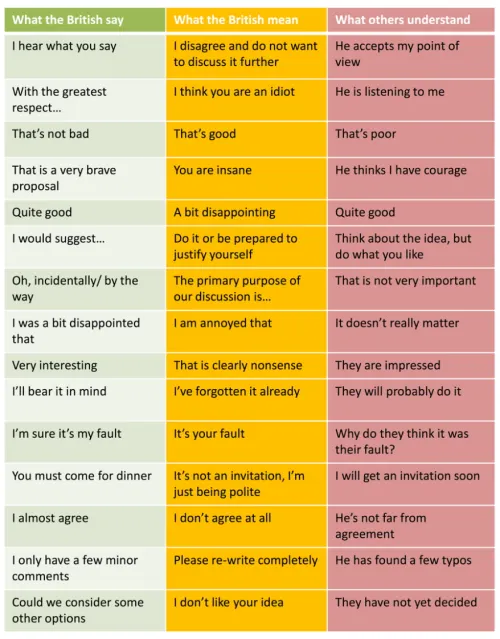
| ▲ | jwatzman 4 hours ago | parent | prev [-] | | There are a few others. “Quite” comes to mind — “I am quite hungry” or “that meal was quite good” can mean opposite things, depending on the speaker region and even voice inflexion if spoken. | | |
| ▲ | MrJohz 4 hours ago | parent | next [-] | | Once you start going in that direction, a lot of things that British people say can require some amount of translation, see e.g. this table: https://miro.medium.com/v2/resize:fit:640/format:webp/0*0Fs1... | | |
| ▲ | seszett 3 hours ago | parent [-] | | Honestly it's not the first time I read such comments, and... they're not about the British as much as they are about the Americans, I'd say. I think almost all of the expressions in the left-hand side have direct, almost literal equivalents in French for example, with the same meaning as they have for the British, including being very context-dependent. Also works for Flemish by the way, although the Dutch are supposed to be more literal so maybe Flemish/Dutch is to be seen the same way as British/American. |
| |
| ▲ | dofm 3 hours ago | parent | prev [-] | | Quite, indeed, has no simple meaning in British English. Any non-British attempt to assign one meaning that is different to their regional meaning is doomed to failure :-) I use it in different senses all the time. |
|
|
|
| ▲ | kurtis_reed 26 minutes ago | parent | prev [-] |
| Imagine someone wrote a blog in some obscure language that few people speak. If you happen to know that language, you'd think wow this is great. If you don't happen to know that language, you'd just think it's a shame. This is the same thing, just to a lesser degree. Some people might be interested in putting in the effort to learn a bunch of foreign cultural references, but not everyone. |