| ▲ | rahimnathwani 4 hours ago |
| I agree in general, but there's one exception: use of the word 'tabled'. This means roughly the opposite in British and US English, and there's often insufficient surrounding context to alert the reader to their error. (OTOH I don't think you should suppress 'false friends' like biscuits, pants etc.) |
|
| ▲ | mrob 4 hours ago | parent | next [-] |
| >there's one exception: use of the word 'tabled'. Another exception: "moot", as in "moot point". In the UK it means "subject to debate", while in the US it means "inconsequential and therefore not subject to debate". |
| |
| ▲ | lbriner 3 hours ago | parent [-] | | I'm British but I always understood it as the second meaning. e.g. "We were going to consider XYZ but now it's a moot point because the project is cancelled." | | |
| ▲ | mrob 3 hours ago | parent | next [-] | | I've heard it used that way in the UK too, but the first meaning is traditional. Wiktionary has some examples: https://en.wiktionary.org/wiki/moot I expect the US meaning will eventually become standard everywhere. | |
| ▲ | dofm 3 hours ago | parent | prev [-] | | It sort of means both simultaneously, doesn't it (we could discuss it but it's inconsequential), but we do tend to use it in that formulation most. |
|
|
|
| ▲ | jwatzman 4 hours ago | parent | prev [-] |
| There are a few others. “Quite” comes to mind — “I am quite hungry” or “that meal was quite good” can mean opposite things, depending on the speaker region and even voice inflexion if spoken. |
| |
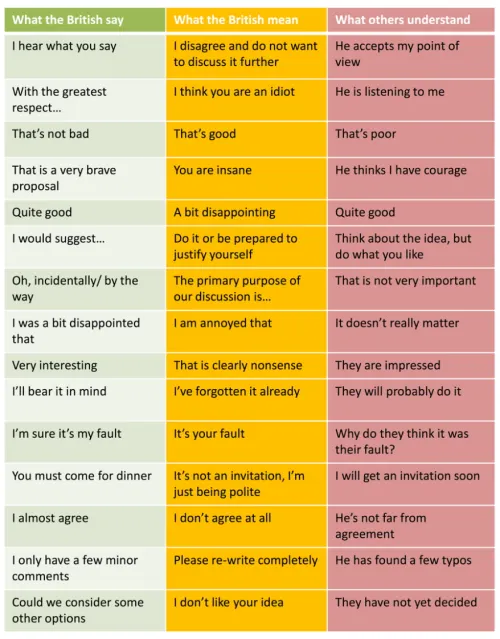
| ▲ | MrJohz 4 hours ago | parent | next [-] | | Once you start going in that direction, a lot of things that British people say can require some amount of translation, see e.g. this table: https://miro.medium.com/v2/resize:fit:640/format:webp/0*0Fs1... | | |
| ▲ | seszett 3 hours ago | parent [-] | | Honestly it's not the first time I read such comments, and... they're not about the British as much as they are about the Americans, I'd say. I think almost all of the expressions in the left-hand side have direct, almost literal equivalents in French for example, with the same meaning as they have for the British, including being very context-dependent. Also works for Flemish by the way, although the Dutch are supposed to be more literal so maybe Flemish/Dutch is to be seen the same way as British/American. |
| |
| ▲ | dofm 3 hours ago | parent | prev [-] | | Quite, indeed, has no simple meaning in British English. Any non-British attempt to assign one meaning that is different to their regional meaning is doomed to failure :-) I use it in different senses all the time. |
|