| ▲ | solid_fuel 7 hours ago |
| I would be interested in seeing a similar list of predictions from Altman, Amodei, etc with annotations about how many have come true. Ed Zitron is a blow hard and frequently overstates things to the point where it is hard to take seriously, but so are the AI industry leaders. I have heard multiple breathless press releases warning that the end of white collar work is "just 6 months away" and that people not using the latest Mythos/Fable/Whatever model will be hopelessly left behind. |
|
| ▲ | tptacek 7 hours ago | parent | next [-] |
| Dan Luu's piece talks about this! He gives the example of Ray Kurzweil, who is similarly catastrophically wrong about everything, just in the opposite direction as Zitron. Luu's point isn't that anti-AI analysis is bad; it's that Zitron is bad. Zitron is bad in this analysis no matter what Altman says. It could be the case that Altman is also bad. |
| |
| ▲ | dinfinity 6 hours ago | parent | next [-] | | > He gives the example of Ray Kurzweil, who is similarly catastrophically wrong about everything Is he, though? It seems to me that a lot of his predictions were surprisingly close to the mark, especially given how long ago they were made. | | |
| ▲ | Terr_ 5 hours ago | parent | next [-] | | I'm convinced all of Kurzweil's predictions through the years can be simplified as (and originate from) "whatever least-implausible dream scenario allows a man of Ray Kurzweil's exact age and health to barely avoid the hitherto-universal icy grip of mortality." | | |
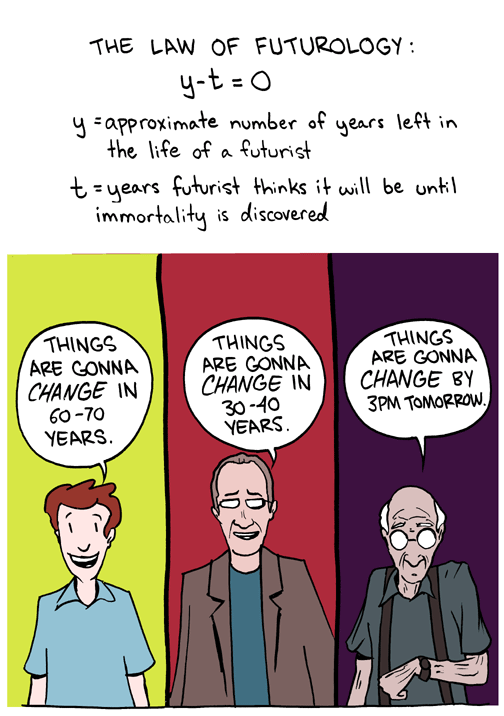
| ▲ | bluealienpie 3 hours ago | parent | next [-] | | I was awed by the future he promised, especially https://en.wikipedia.org/wiki/Respirocyte Looking back, he’s great at selling a future of possibility as long as you don’t track all the errors. | |
| ▲ | Ygg2 5 hours ago | parent | prev [-] | | This SMBC comic
https://www.smbc-comics.com/comics/20100813.gif | | |
| ▲ | Terr_ 4 hours ago | parent [-] | | Tangentially related in terms of "old stuff from other things I read", this 2006 critique [0] by Derek Lowe: > Later in Kurzweil's article, he says: > > "So what does the future hold? By 2019, we will largely overcome the major diseases that kill 95 percent of us in the developed world, and we will be dramatically slowing and reversing the dozen or so processes that underlie aging." > [...] I really do expect to put cancer, heart disease, the major infections, and the degenerative disorders in their place. But do I expect to do it by 20-flipping-19? It's hard to be optimistic when it's been those 13 years plus another 7 and somehow measles is back again, although I admit that's one isn't a pure technology-problem. [0] https://www.science.org/content/blog-post/ray-kurzweil-s-fut... | | |
| ▲ | sanderjd 3 hours ago | parent [-] | | But that's kinda the point, there's no such thing as "a pure technology-problem". I think that's the fundamental - and obvious - thing that these folks seem to constantly miss. |
|
|
| |
| ▲ | nl 6 hours ago | parent | prev [-] | | Luu's piece linked his analysis! Kurzweil scores 7% accuracy. If you scroll to the appendix he grades individual predictions. https://danluu.com/futurist-predictions/ | | |
| ▲ | scarmig 5 hours ago | parent | next [-] | | Reading through them, Luu's grades seem fair and accurate to me. Best defense of Kurzweil I can give is that if you give a grace period of a decade and scope them down substantially (to maybe a subset of well-off Americans in coastal cities), he looks much better, though still under 50%. One of Kurzweil's close-but-no-cigar failed predictions was "neural nets and genetic algorithms," killed off by the conjunction and being a couple years too early (2009 for increasing interest, and 2019 for wide use). | | |
| ▲ | roenxi 3 hours ago | parent [-] | | Fair, sure. But it seems to be underselling how reasonable Kurzweil is. We've got things like 2009 - "Computers can recognize their owner's face from a picture or video. No." And ok, sure, but that has happened by 2026 and we have more than 2000 years of recorded history of people making predictions. I don't think that situation reflects at all badly on Kurzweil except that he doesn't explicitly say he has a 15 year error bar. Which, yes, technically inaccurate, but it seems quite likely nobody would be talking about him if he spent that much time exploring the minor caveats. And hitting him for the "and genetic algorithms" is verging on pedantry. Ok so genetic algorithms aren't a civilisation-level success that appears to be reshaping the fate of the species in the same way neural nets are. He was right that learning systems were going to be huge and he was off on a detail. |
| |
| ▲ | dinfinity 5 hours ago | parent | prev | next [-] | | The list in the appendix is pretty telling: Yes, the moments are off by a lot, but many of the predictions describe reality well. I'd say that 7% accuracy is on the low side and 86% on the high side. Looking through the list I'd put it more at 50-60% personally. For me that still means that I'd much rather hear about what he has to say about the potential future than most other people. | |
| ▲ | Veedrac 4 hours ago | parent | prev | next [-] | | If you grade what was linked by whether it is "approximately achievable today", and not some less interesting metric like being predicted for the correct year or if it was outcompeted by some other thing, he's closer to 70-90% depending on how close you're willing to grade. It's very easy to say 'person X made a highly specific testable prediction, while respectable people said nothing like it would ever happen, and it only 90% happened, so person X was a fool unlike all the respectable people', but it's a trap. In reality Kurzweil was directionally correct about most things, overspecified the details, and had optimistic timelines in the way that everyone has optimistic timelines about everything. | |
| ▲ | p1esk 3 hours ago | parent | prev [-] | | Kurzweil predicted in the late 90s that we will have AGI by 2029. And ASI by 2045. Seems very likely to me. |
|
| |
| ▲ | getnormality 5 hours ago | parent | prev | next [-] | | Altman and Zitron are like pro wrestlers. Their speech acts aren't for truth, they're for some spectacular effect on your feelings and your imagination that keeps you coming back for more. I encourage anyone interested in this to read On Bullshit by Harry Frankfurt, the best popular philosophy work in a long time. | | |
| ▲ | notatoad 5 hours ago | parent | next [-] | | Ed Zitrons wild claims might be for entertainment value, but Altman’s are for his own valuation. He’s bringing in hundreds of billions of dollars off those claims. | | |
| ▲ | jfb 3 hours ago | parent [-] | | Talking one's own book is a grand and ancient American tradition! |
| |
| ▲ | woodruffw 5 hours ago | parent | prev | next [-] | | Without reference to either person, I think this is essentially a misunderstanding of Frankfurt’s analysis: On Bullshit is about expressing sentiments without caring about their truth value, i.e. the concept of a “bull session.” Both Altman and Zitron are the opposite of Frankfurt’s bullshitter, because they both appear to evince genuine care for the truth value of their position. (Frankfurt is very subtle about this, in that he distinguishes the kind of performative lying you’re suggesting as distinct in moral and rhetorical content from bullshitting. The liar wants you to believe a specific thing; the bullshitter wants to regale you.) | | |
| ▲ | getnormality 4 hours ago | parent | next [-] | | Bullshitting is where you don't care about whether what you say is true. Your goal is to influence a certain way of thinking or feeling, and you just say stuff that you think will cause that in other people. Appearing to care about truth is not opposed to that, it's part of it. | | |
| ▲ | woodruffw 3 hours ago | parent [-] | | I don’t think these mental states are in evidence for either of them. I think they’re both credibly earnest in their views. (Frankfurt’s characterization of the bullshitter rests on not just the truth value being absent, but also on the bullshitter’s misrepresentation of what he’s “up to.” I don’t feel that either Zitron or Altman is misrepresenting what they’re getting up to.) | | |
| ▲ | getnormality 3 hours ago | parent [-] | | So, you don't see how someone could both be "credibly earnest" and misrepresenting what they're up to? Do you think misrepresentation has to be consciously deceptive? That it feels insincere to the person doing it? | | |
| ▲ | woodruffw 3 hours ago | parent [-] | | I mean, the point of Frankfurt’s bullshitter is that we know they’re bullshitting (or more expansively, Frankfurt gives us a set of criteria to test them against). We know they don’t care about the truth value of their statement, only that they are misrepresenting themselves because of a hidden “enterprise.” But there’s no such unknown enterprise in either’s case, and neither appears to be misrepresenting themselves (to my point about appearing earnest). Maybe that latter part is itself deception, but without the former they would fall into Frankfurt’s classification of a “liar” instead. (I have to admit a bias when it comes to Frankfurt: I don’t think On Bullshit is that convincing. In particular, I think Frankfurt doesn’t do a good job of motivating the connection between bull sessions and bullshit in his strong sense, and many of his examples - like the Pascal/Wittgenstein one - don’t demonstrate misrepresentation either.) |
|
|
| |
| ▲ | ahf8Aithaex7Nai 3 hours ago | parent | prev [-] | | > Both Altman and Zitron are the opposite of Frankfurt’s bullshitter, because they both appear to evince genuine care for the truth value of their position. I can't really judge Zitron, but when it comes to Altman, I have absolutely no idea how you arrived at that assessment. In my view, he's clearly dishonest. I’ll remind you of his attempt to use government intervention to erect barriers to market entry for his competitors. Or his claims about AGI being just around the corner—claims that haven’t come true so far and were clearly aimed at investors. I’ve never heard a single statement from this man that struck me as honest. |
| |
| ▲ | conductr 5 hours ago | parent | prev [-] | | I think it’s appropriate in this day that people have to really shout and lament on and on about their thing just to get a few people to listen and/or consider parts of their argument. Nobody listens if you’re just casually proselytizing your grift. |
| |
| ▲ | bpodgursky 3 hours ago | parent | prev | next [-] | | Kurzweil made one big claim — Singularity around 2045. Everyone at the time thought it was a total joke and hundreds of years off, if even possible. Now, that is seen as a laughably long timeline. The rest is noise, I don't care what minor predictions he was wrong about, he called the big trend back when nobody else could make a trendline. | |
| ▲ | pembrook 6 hours ago | parent | prev | next [-] | | The fact that you know Ed Zitron's name means that, regardless of his predictions being consistently wrong (which they are), his strategy for manipulating human attention has been correct. The question is whether he sincerely believes his own predictions or if he cynically is aware that you can create a career for yourself being a guy who says bombastic clickbait-worthy things people emotionally want to be true, instead of measured assessments of reality. Problem is, you wouldn't know Ed Zitron's name if every piece he wrote basically said "AI might be a bit overhyped short term but will have lasting economic impacts." Booooorrrring. The reverse is also true. OpenAI and Anthropic aren't going to get much media attention if they don't make silly claims like "all white collar jobs gone in 2 years." And no, this isn't a new problem due to "the algorithm." Media has always been like this. Zitron is just another Peter Schiff with younger skin. The problem is human nature in general. Hence why AI isn't going to kill media. We don't actually want sober, rational assessments of all available information from hyper-intelligent LLMs. This is unsatisfying. We want emotional validation, drama, adversarial identity and spectacle. Truth is rarely what we are seeking. | | |
| ▲ | tptacek 6 hours ago | parent | next [-] | | I don't care whether he believes his own predictions, only that they're so frequently incoherent and false. | |
| ▲ | mbesto 5 hours ago | parent | prev [-] | | > his strategy for manipulating human attention has been correct. "Correct" is not the word you're looking for here. More like "very effective". His strategy for manipulating human attention is very effective, but the correctness of his strategy isn't relevant here, so I'm not sure why you're bringing that up. | | |
| ▲ | pembrook 5 hours ago | parent [-] | | Because a sincere discussion of media (a fundamentally insincere medium with perverse incentives) is silly without addressing this. Autistically pretending the world is rational and not factoring this in is just as false as Zitron’s predictions. | | |
| ▲ | drdeca 5 hours ago | parent [-] | | Nothing in acknowledging those perverse incentives requires that one misleadingly use the word “correct” in place of “effective”. |
|
|
| |
| ▲ | socalgal2 6 hours ago | parent | prev [-] | | I'm going to need some evidence that Kurzweil was wrong. AFAICT he was right in 80%+ of his predictions with several more on track. | | |
|
|
| ▲ | ElProlactin 6 hours ago | parent | prev | next [-] |
| > Ed Zitron is a blow hard and frequently overstates things to the point where it is hard to take seriously, but so are the AI industry leaders. Except that the AI industry leaders actually have skin in the game/are in the trenches and competing in the market. Ed Zitron wants you to subscribe to a newsletter so that you can read doom and gloom and...? If you invested based on his advice, you'd have missed huge gains and/or lost money. And I say this as a person who thinks most of the "AI industry leaders" are ethically questionable, at best, and ethically bankrupt, at worst, and that the stock market should be approached with caution due to valuations. |
| |
| ▲ | RachelF 3 hours ago | parent [-] | | The fact is there is BullSh_t and hype on both sides. Both Zitron and AI execs have good points, but both are trying to sell you something. The murky truth lies between the two extremes. IMHO, having Zitron around is a counter to the AI leaders. Is he the best? No. Is he the loudest? Yes. | | |
| ▲ | ElProlactin an hour ago | parent [-] | | Anthropic's ARR is reportedly now above $60 billion. OpenAI's is reportedly above $40 billion. Countless people and businesses are using AI to create tangible value and reduce costs. We can debate whether the level of investment in AI is excessive and what any malinvestment will eventually cost when the market has to recognize it. But Zitron is selling you a $70/year subscription to a newsletter that constantly reminds you that AI is a bubble and the technology is worthless. The AI people aren't selling you the same thing Ed is. And let's be honest here: it's not like Zitron has any credentials of substance that are relevant. He's not an accountant and constantly demonstrates that he can't read a balance sheet or financial statement, doesn't understand basic account principles, etc. He's not a technologist, so he can't speak credibly to AI tech and how it's being used. He never worked in AI, even in a non-tech role, so he has no first-hand experience that's unique. Basically, he's a former PR shill who, from what I can tell, saw an opportunity to profit by hitching himself to the AI zeitgeist as a naysayer. I'm sure his grift is keeping his bills paid, but anyone taking action based on his doom and gloom thesis has missed out on one of the biggest investment opportunities in history. And just to be clear: this is not to say that stocks will go up forever, that valuation concerns aren't legitimate, or that there aren't aspects to AI infrastructure financing that are a bit concerning. But if you had ignored Ed from the minute he started whining and sold all of your AI investments tomorrow, you'd be much wealthier. | | |
| ▲ | RachelF an hour ago | parent [-] | | Very true. The problem is mainstream business media hasn't asked the questions that Zitron has. So, much like current US politics, we're left with hype on both sides. That's all that gets the clicks/attention, and little balanced analysis in the middle. | | |
| ▲ | ElProlactin an hour ago | parent [-] | | This isn't true though. There is significant discussion in the financial media about the valuations of AI-related companies, the financing of the AI infrastructure buildout, etc. Academics are talking about it. Investment banks are talking about it. Policy people are talking about it. Zitron is one of the loudest voices and he attracts attention because his thesis is so black and white: it's all a scam, there's no value, it's all going to $0, the sky is falling. As a PR shill, he was obviously clued in to the fact that a lot of people prefer black and white, oversimplified and bombastic theses. To buy into Zitron's ideas (and pay him $70/year), you don't need to understand how AI works. You don't need to understand the difference between capex and opex. You don't need to know how to read a balance sheet or financial statement. All you need to do is believe that everything is a massive fraud. |
|
|
|
|
|
| ▲ | nl 6 hours ago | parent | prev | next [-] |
| > multiple breathless press releases warning that the end of white collar work is "just 6 months away" I'd like to see an example of this. I think Altman and Amodei have been quite sober with their actual predictions. They've said things like "models can now do white collar work" but haven't yet said it is the end of white collar work. The closest actual quote to this was in In March 2025, Anthropic CEO Dario Amodei told a Council on Foreign Relations audience that AI would be writing 90 percent of code in three to six months, and essentially all of it within twelve months. I think that he underestimated how long it takes for technology to get uptake but in terms of capabilities he was perhaps 6 months out. I'd say that Fable class models are definitely capable of writing essentially all software, and that was released June 2026. |
| |
| ▲ | solid_fuel 5 hours ago | parent | next [-] | | You could try checking the news. > In a remarkable interview with Y Combinator in November 2024, Sam Altman, CEO of OpenAI, shared a vision that could redefine the technological landscape as we know it. Altman confidently revealed that OpenAI has a clear roadmap for achieving AGI by 2025. https://www.tomsguide.com/ai/chatgpt/sam-altman-claims-agi-i... Now Altman is claiming it'll be this year for sure: https://www.msn.com/en-in/news/other/sam-altman-makes-bold-a... | | |
| ▲ | nl 5 hours ago | parent [-] | | What specifically was he wrong about in either of those? I.e, something that can be falsified. > Altman claimed that AGI could be achieved in 2025 during an interview for Y Combinator, declaring that it is now simply an engineering problem. He said things were moving faster than expected and that the path to AGI was "basically clear." "AGI" isn't a useful term because - as noted in the article you linked - people disagree about what it means. Also his actual claim here seems to have been that the path to AGI was "basically clear." That isn't a prediction that can be falsified. | | |
| ▲ | solid_fuel 5 hours ago | parent [-] | | Whoa, be careful, I think those goalposts just broke the speed of sound. > Altman claimed that AGI could be achieved in 2025 during an interview for Y Combinator, declaring that it is now simply an engineering problem. He said things were moving faster than expected and that the path to AGI was "basically clear." He was wrong that AGI was "now simply an engineering problem". He was wrong that the path to AGI was "basically clear". And if you want to play definition games and start waving your hands around and accept the claim "oh well actually we don't really know how to define AGI now", then he was wrong to claim that the path to AGI was "basically clear"! Even if you play that game, it's still simple: either he was wrong about the path being clear, or he was wrong about the destination being clearly definable. That's still being wrong. | | |
| ▲ | nl 5 hours ago | parent | next [-] | | > He was wrong that AGI was "now simply an engineering problem". > He was wrong that the path to AGI was "basically clear". Why do you say that? For context, Jensen Huang says: > "For many tasks, we could say that we’ve already achieved AGI... I think of all of those milestones…they’re kind of senseless at this point.[1] Even if you disagree with that, Altman's statement seems more about the idea that "more data + more compute + transformer based neural networks" will get us to something called AGI. I think that statement is true. I guess you don't. > if you want to play definition games and start waving your hands around and accept the claim "oh well actually we don't really know how to define AGI now", then he was wrong to claim that the path to AGI was "basically clear"! No - because I think his and Jenson's definition means we have achieved AGI. So it goes back to my point: this isn't falsifiable. [1] https://mashable.com/tech/nvidia-ceo-jensen-huang-says-agi-a... | | |
| ▲ | solid_fuel 4 hours ago | parent [-] | | > Why do you say that? Because he was wrong. That's how it works. > For context, Jensen Huang says: >> "For many tasks, we could say that we’ve already achieved AGI... I think of all of those milestones…they’re kind of senseless at this point.[1] This statement is nonsense. It's Artificial General Intelligence that was promised. Not Artificial Some Things Intelligence. > Even if you disagree with that, Altman's statement seems more about the idea that "more data + more compute + transformer based neural networks" will get us to something called AGI. His statement was wrong. I don't care what other ideas you want to read into it, he was incorrect about AGI arriving in 2025. That's all there is to it. Twist it into a knot and smear butter on it if you want, wrong is wrong. > No - because I think his and Jenson's definition means we have achieved AGI Yeah they can twist definitions all they want. I don't really care. We have seen that LLMs and transformers have not delivered AGI, and they certainly didn't deliver it in 2025. | | |
| ▲ | nl 4 hours ago | parent [-] | | > Because he was wrong. That's how it works. > His statement was wrong. I don't care what other ideas you want to read into it, he was incorrect about AGI arriving in 2025. No Sam Altman never claimed we'd get AGI in 2025. That is Tom's Hardware incorrect headline. Altman's quote is: "I felt like we actually know what to do like I think from here to building an AGI will still take a huge amount of work there are some known unknowns but I think we basically know what to go what to go do and it'll take a while it'll be hard but that's tremendously exciting I also think on the product side there's more to figure out but roughly we know what to shoot at and what we want to optimize for that's a really exciting time.." See here: https://youtu.be/xXCBz_8hM9w?t=2327 It's not Altman's fault that people misreported him. | | |
|
| |
| ▲ | MaybiusStrip 4 hours ago | parent | prev [-] | | All in all, it's clearly the AI skeptics that have egg on their faces. Sam Altman is very flawed and you could make a strong argument for why that's why he blew an enormous lead to Anthropic. Dario's predictions in general haven't been that far off. The general public is becoming increasingly aware of AI as a big deal (and something about 60% hates). Our jobs, regardless of where on the adoption curve we are, have undeniably changed a lot. Zitron and a whole lot of people on HN were trying to claim this was a nothingburger or at least no more important than the invention of IDEs up until Dec 2025, and then all of a sudden everyone quietly shifted what the "reasonable" opinion was. If I were those people, I'd spend more time taking a look at what was wrong with my priors than look outward. |
|
|
| |
| ▲ | usef- 4 hours ago | parent | prev [-] | | Note that no one ever quotes the end of Dario's line, either, where he said programmers would still be needed in that 12 months. People think the prediction was more extreme than it really was because all the clips didn't include the latter part. > .... and in 12 months, we might be in a world where the ai is writing essentially all of the code. But the programmer still needs to specify what are the conditions of what you're doing; What is the overall app you're trying to make; What is the overall design decision; How we collaborate with other code that has been written; How do we have some common sense with whether this is a secure design or an insecure design. So as long as there are these small pieces that a programmer has to do, then I think human productivity will actually be enhanced |
|
|
| ▲ | sarjann 7 hours ago | parent | prev | next [-] |
| I think one important distinction is at least they have some humility to admit they were wrong. I think Ed Zitron has rarely, if ever acknowledged he was wrong. |
| |
| ▲ | achompas 7 hours ago | parent | next [-] | | I actually think you’ve got it backwards I think one of Zitron’s problems is that his moral righteousness has blinded him to how embarrassingly incorrect he is about the AI space. It’s similarly hubristic with the benefit of shielding from his adversarial framing. | | |
| ▲ | pfdietz 7 hours ago | parent | next [-] | | I see this so much. "This shouldn't work, therefore it won't work." It's like the world is imagined to run on a moral causal framework rather than uncaring quantum mechanics. | |
| ▲ | cduzz 6 hours ago | parent | prev [-] | | I have watched many of his screeds; I think he undercuts his thesis with excess bile. His core observation is that the unit economics of openAI and anthropic don't actually yield enough profit to pay off the huge debts that these two companies have incurred, and that as a result all the debt they've taken on will have to be written off which will trigger "the hyperscalers" to themselves suffer huge losses (likely wounding google and microsoft and destroying oracle). He is rather more negative about the utility of LLMs than lots of other people (myself included); but his overall view of 1. they're not completely trustworthy
2. they're really expensive to train
3. it isn't obvious that anyone's willing to pay the full freight for the resulting product
4. lots of large orgs "that should know better" have gone far down the LLM "AI" road because they're looking for "the next big thing" when they should be pivoting to "mature, stable" companies instead of "hypergrowth" companies.
5. there's lots of debt and obligations and no obvious way for all of it to be paid off from revenues from openai / anthropic.
seems pretty reasonable. There seem to have been lots of bets placed on the hope that this stuff will continue scaling as it has in the past, if it is given more compute and data, and that bet is one that has yet to have demonstrated itself as correct.Elsewhere, people have pointed out that many of the "FAANG" companies have shed lots of people and driven lots of profits, largely on the back of internal use of LLM tools. That doesn't necessarily contradict the skepticism that anthropic and openAI will succeed, and given all their obligations, if they fail it'll be a big mess. But again, big Z doesn't do himself any favors when he rants about "failsons" or whatever. | | |
| ▲ | taberiand 4 hours ago | parent [-] | | Seems to me it's a reasonable position that runs face first into the irrational market. Like they're digging a gigantic hole and Ed's up the top saying if you keep digging the hole will collapse (+ a whole lot of unnecessary swearing), and then a bunch of people jump into the hole to brace it and say "nuh uh, see we can keep digging" but really it's just postponing the inevitable and increasing the number of people who will be destroyed when it all crashes down |
|
| |
| ▲ | iLoveOncall 7 hours ago | parent | prev | next [-] | | > I think one important distinction is at least they have some humility to admit they were wrong. I'd be amazed to see a source proving that statement. There's never been a retraction around the AGI claims for example as far as I'm aware. | | |
| ▲ | sarjann 7 hours ago | parent [-] | | I can't find a counter to every statement they have made and not sure about your specific AGI claim but. https://www.youtube.com/shorts/QMhtTO3u61A
https://www.youtube.com/watch?v=L_ueDUrkOlQ Examples of acknowledging he was wrong | | |
| ▲ | iLoveOncall 6 hours ago | parent [-] | | I only watched the first one so far but you misunderstood what he says, he doesn't admit being wrong at all, in fact he doubles down on wrong claims. | | |
| ▲ | krcz 5 hours ago | parent | next [-] | | Interesting; he is clearly saying that they were ("as a field") "confident and wrong" to believe that "the economy would have been completely upended" by the appearance of a model as strong as GPT4. What seems to be missing, from your point of view, to consider it an admission of being wrong? | |
| ▲ | 5 hours ago | parent | prev [-] | | [deleted] |
|
|
| |
| ▲ | greekrich92 7 hours ago | parent | prev [-] | | Humility? I don't think they know what the word means let alone possess the capacity to demonstrate it. | | |
| ▲ | CamperBob2 7 hours ago | parent [-] | | Altman has admitted that some things are taking longer than he expected, and has walked one or two things back (usually to keep people from throwing bombs at his house, but still...) Zitron continues to boast of a predictive record entirely unblemished by accuracy. | | |
| ▲ | arealaccount 7 hours ago | parent | next [-] | | When Altman “admits” things it seems more manipulative than humility | |
| ▲ | only-one1701 7 hours ago | parent | prev [-] | | The until Anthropic et al IPO to the tune of trillions Ed is more right than he is wrong. |
|
|
|
|
| ▲ | sroerick 7 hours ago | parent | prev | next [-] |
| Man, as a former extreme skeptic, I watched a video from Eric Schmidt in early 2025 where he said that by the end of the year nobody would be coding, and that one was dead frickin on. |
| |
| ▲ | tensor 6 hours ago | parent | next [-] | | As far as I'm aware, aside from toy prototypes, all software is still built by humans coding, albeit with better auto-complete. | | |
| ▲ | nl 6 hours ago | parent | next [-] | | This seems to be more a problem of your awareness than a lack of projects. Apart from every software engineer I know building almost completely with AI now there have been numerous projects posted on HN that are AI coded. There's also Claude desktop which is famously all AI built and very widely used. | | |
| ▲ | tensor 3 hours ago | parent | next [-] | | > now there have been numerous projects posted on HN that are AI coded. Yes, all of which are toy projects and get criticized every time they are posted. On actual serious projects, not someones pet home project, I've only seen "vibe coding" used in very low risk places like small UI components. And even then they are generally heavily tweaked after the fact. My anecdotal personal experience seem to agree with the general sentiment I see here on HN. Some people or companies do it, but with generally heavy criticism. | |
| ▲ | paodealho 5 hours ago | parent | prev | next [-] | | Have you ever considered: - that you don't know most people in the world - that some of the people you know are using these tools because they were forced ? | | |
| ▲ | nl 5 hours ago | parent [-] | | > that you don't know most people in the world Of course. To be clear, the claim was "all software is still built by humans coding" I know this all software claim is false because I've seen it. Proof by example. > that some of the people you know are using these tools because they were forced Irrelevant to that claim. | | |
| |
| ▲ | 3ddds 6 hours ago | parent | prev [-] | | [dead] |
| |
| ▲ | aka-rider 6 hours ago | parent | prev [-] | | It is all very unevenly distributed. SaaS and general web is basically on auto mode. A lot of infra is vibe coded nowadays too. Even prototypes are contributing to the speed of software development. Many people vibe code throwaway dashboards around the main platform which gives a lot of insights. | | |
| |
| ▲ | torben-friis 7 hours ago | parent | prev | next [-] | | I guess I don't exist... | | |
| ▲ | marcosdumay 6 hours ago | parent [-] | | I guess the GP is joking. But on the current climate, it's really hard to be sure. |
| |
| ▲ | rapind 4 hours ago | parent | prev | next [-] | | Everyone who started using claude clode when it came out in early 2025, knew it was coming (not quite yet). That felt more like reporting than prophesying. | |
| ▲ | bandrami 5 hours ago | parent | prev | next [-] | | There are whole industries that still don't let LLM-generated code touch production | |
| ▲ | solid_fuel 7 hours ago | parent | prev | next [-] | | You may be living in a bubble. There are tons of developers still coding by hand, and many industries that don't trust machine generated code in general. | | |
| ▲ | HDBaseT 7 hours ago | parent | next [-] | | It does raise the question, what percentage of programmers are predominantly writing code by hand? Is it higher than 50%? | |
| ▲ | tty456 7 hours ago | parent | prev | next [-] | | Do they also not trust their code review processes? | | |
| ▲ | applfanboysbgon 6 hours ago | parent [-] | | Have you considered that they do trust their code review processes, and that they don't trust the generated code because it doesn't pass their process? | | |
| ▲ | Supermancho 5 hours ago | parent [-] | | > they don't trust the generated code because it doesn't pass their process That's not a credible scenario. Developers can either make changes by hand, or by asking an LLM, which is the common process when there is a downstream failure. Humans dont metaphorically throw their hands up and say "well the tool doesn't meet our expectations at every scale so we're not going to use it". Granted, most developers scale back how much they rely on it based on experience (good and bad). | | |
| ▲ | skydhash 5 hours ago | parent [-] | | That's very much a credible scenario. I think I use code from SO in a single digit of occasions. But I use it a lot more for giving me insight like a keyword for doing a proper web search. Or the name of a flag for a cli command, or the general shape of an algorithm or what to check in a troubleshooting session. I won't generalize, but it's very rare for me to need code as most of my diffs are either boilerplate (generated with a tool or copied from docs or samples) or core logic that is mostly the translation of some design that I've already spent hours or days on. My core issue has always been incomplete specs from Product or incomplete docs for some tool/sdk/library (alleviated by having access to the source code). Generated code is just not that useful, especially when designing the core architecture of a new project. And later it's not that useful either as the specs (why and how) is more valuable than any code (what). |
|
|
| |
| ▲ | semiquaver 6 hours ago | parent | prev [-] | | > many industries that don't trust machine generated code in general.
Which ones? Why wouldn’t careful human code review and extensive test coverage suffice? I work in one of the most conservative and highly regulated industries in the country. My company and every single one of my peer companies I have knowledge of has transitioned to almost exclusively 100% LLM-generated code (with plenty of human review).I don’t live on a coast and I have a large and broad social network. I don’t know anyone who still mostly codes by hand except the small amount needed to preserve some aspect of their skills. I’m sorry to say that if I did I’d consider them foolish. Even a very restrictive workflow where you used an LLM to specify granular edits you intend to make is vastly faster than doing it by hand. And the level of test coverage and depth you can achieve now is simply life-changing. It’s much more likely that you are not a professional, or you are the one in a bubble. | | |
| ▲ | qsera 3 hours ago | parent | next [-] | | >Why wouldn’t careful human code review and extensive test coverage suffice? I have come to understand that LLM generated code, even when carefully reviewed, ends up being hard to review as time progress. This is because when you are coding yourselves, you get a first hand sense of the complexity creeping in. Then you refactor some stuff to keep complexity in check. LLMs does not "feel" such friction, and will happily keep adding on complexity until meaningful reviews are impossible beyond a certain point. At this point, you need an LLM to review the changes and at that point, all bets are off. | | |
| ▲ | autaut 3 hours ago | parent [-] | | This is a very good point. So many times I would refactor entire parts of the code base just because it’s getting too complicated and an easier solution was possible. AI is do often just let’s drill down all these variables, whatever |
| |
| ▲ | solid_fuel 6 hours ago | parent | prev | next [-] | | > Which ones? Any that value correctness over speed. Banking, safety critical embedded work, aerospace work, etc. > Why wouldn’t careful human code review and extensive test coverage suffice? Because anyone who has been in the industry for a while knows that code review is not a substitute for intentionality and understanding when writing the code. To properly validate a change you must fully understand the intention behind it and the design at play, and then check the changes made against the system design. That is best done by a human subject matter expert (this is the role which software developers have traditionally filled, for anyone new to the industry). > I work in one of the most conservative and highly regulated industries in the country. My company and every single one of my peer companies I have knowledge of has transitioned to almost exclusively 100% LLM-generated code (with plenty of human review). That's called "being in a bubble". > I don’t live on a coast and I have a large and broad social network. I don’t know anyone who still mostly codes by hand except the small amount needed to preserve some aspect of their skills. I’m sorry to say that if I did I’d consider them foolish. And I think it's foolish to let your coding and critical thinking skills atrophy like this, but you do you. > It’s much more likely that you are not a professional, or you are the one in a bubble. Not even worth a reply. | | |
| ▲ | semiquaver 5 hours ago | parent [-] | | > That's called "being in a bubble".
I’m perfectly willing to consider the possibility that you may be right, but “a bubble” implies something massive outside of it which constitutes a large majority of the whole, and that’s simply not the case here. I just don’t believe there are more than a small handful of companies like you describe. It’s not like these things aren’t extensively studied, and all the industry surveys I’ve seen point in the direction of more and more LLM-assistance in coding worldwide.I have connections in most of the industries you named and I can promise you that they are no different. I don’t particularly care whether you believe me, but I encourage you to self-examine to understand whether what you are saying is what you would like to be true (I do too!) or whether it actually is. | | |
| ▲ | solid_fuel 5 hours ago | parent [-] | | > I have connections in most of the industries you named and I can promise you that they are no different. I don’t particularly care whether you believe me, but I encourage you to self-examine to understand whether what you are saying is what you would like to be true (I do too!) or whether it actually is. You are literally talking with a professional developer who is telling you that they don't use LLMs to write their code and that they have connections who also continue to do this work manually. I don't particularly care whether you believe me either, but I encourage you to take a look around - your initial claim that coding has been automated across the industry is incorrect and you seem to be in denial about that for some reason. You should question where your priors are coming from, and remember that just because your circle is comprised of people who are heavily using LLMs does not mean the entire industry is that way. | | |
| ▲ | semiquaver 5 hours ago | parent [-] | | Of course I believe that you act as you describe. But you are not an industry unto yourself. I apologize for questioning your professionalism and wish you all the best. Truly. |
|
|
| |
| ▲ | Danox 3 hours ago | parent | prev [-] | | So no one is in control at the wheel? Just press a button? I can see in the future in school or on the job. Oral testing is coming back. You’re gonna have to explain everything you are doing at some point to your teacher/boss or to a panel of your peers in detail. |
|
| |
| ▲ | weakfish 7 hours ago | parent | prev | next [-] | | I mean, I code? | |
| ▲ | goatlover 4 hours ago | parent | prev | next [-] | | On a second reading I'm going to take this as sarcasm. | |
| ▲ | meowface 7 hours ago | parent | prev | next [-] | | Dario Amodei and Eric Schmidt seem fairly well-calibrated, although a bit early. Elon Musk is constantly way, way overoptimistic (perhaps to the point of willful fraud). Zitron is hopelessly and ridiculously incompetent (and there are allegations he is willfully lying, too, but who knows). | | |
| ▲ | marcosdumay 6 hours ago | parent [-] | | The AGI that appeared mid 2023 and killed single every person in 8 months was neat! | | |
| |
| ▲ | zombiwoof 7 hours ago | parent | prev [-] | | [dead] |
|
|
| ▲ | anonuser123 7 hours ago | parent | prev | next [-] |
| My bet is that Amodei's claims about the dangers of AI are the most likely to come true – I'm predicticing amodei/anthropic will become the evil it was against. |
| |
| ▲ | m4rtink 4 hours ago | parent | next [-] | | I predict they go bankrupt. | |
| ▲ | ngcazz 6 hours ago | parent | prev [-] | | Those claims are warnings if you're working class, and marketing if you're corporate. |
|
|
| ▲ | sanderjd 3 hours ago | parent | prev | next [-] |
| Yep I distinctly remember at the beginning of 2023 that folks were predicting that we were less than two years away from there being no jobs for software developers. Pretty soon we'll reach double that timeline. And of course it really has changed everything! But that was not all that a lot of people were prognosticating. |
|
| ▲ | tadfisher 7 hours ago | parent | prev | next [-] |
| No, you see, they were right all along, they just "didn't anticipate the public outcry against data center expansion", thus the obviously inevitable AI takeover of the economy is being slowed by NIMBY curmudgeons who should be ignored and punished. |
|
| ▲ | melagonster 5 hours ago | parent | prev | next [-] |
| The end of white collar work mean that company can finish all jobs by new model. |
|
| ▲ | Danox 3 hours ago | parent | prev | next [-] |
| The 5090 Nvidia card evidently is selling for five grand now! It’s just a question of when the bubble burst…. |
|
| ▲ | jimmis 7 hours ago | parent | prev | next [-] |
| To be fair, Zitron's career is as a commentator. To some extent, I expect CEOs of companies to make ridiculous claims. At the end of the day, when shareholders come knocking, what they care about is whether or not your company is growing. No such mechanism for social media personalities. You can be wrong 90% of the time, and your audience will still praise you for the 10% of the time you were right. |
| |
| ▲ | solid_fuel 5 hours ago | parent | next [-] | | > To be fair, Zitron's career is as a commentator. To some extent, I expect CEOs of companies to make ridiculous claims. This is not a comment directly at you, because I understand where you're coming from, but I think this attitude shows how far leadership and our expectations of the professional class in America have deteriorated. My expectations are inverse to yours. I don't care if a commentator makes a claim that's wrong, if they keep being wrong people will stop listening. (In theory. Jim Cramer still has a job so who knows, really.) I certainly don't expect a commentator to have accurate internal information about a company. CEOs on the other hand should be expected to be honest and accurate in their claims. The information a CEO shares should be accurate so that investors can make informed decisions. Instead, we seem to accept CEOs who act as salesmen first and leaders last. If a CEO claims a product will be out later this year, and the stock goes up, then they announce actually things are delayed, and the stock still goes up, what is actually being rewarded here? | |
| ▲ | jgalt212 7 hours ago | parent | prev | next [-] | | CEOs and leaders used to trade on credibility. | |
| ▲ | Pxtl 5 hours ago | parent | prev [-] | | I don't think of Zitron as a journalist, I think of him as an entertainer, no different from all the columnists paid to tell people that what they already think is right. The fact that you're holding him to a higher standard than fabulously compensated professional c-suite officers whose products are used in matters of life and death is... kinda weird? |
|
|
| ▲ | ALittleLight 4 hours ago | parent | prev | next [-] |
| The big difference is that Altman et al aren't just, or even mainly, pundits or prognosticators. Zitron's whole thing is commentary and predictions about AI and his predictions are almost all wrong. Altman and friends are mainly actually making and delivering AI. If they also hype their timelines/valuations, they also seem to make directional progress on the goals. |
|
| ▲ | xgulfie 6 hours ago | parent | prev | next [-] |
| Here's an example https://en.wikipedia.org/wiki/List_of_predictions_for_autono... |
|
| ▲ | achompas 7 hours ago | parent | prev | next [-] |
| But I think anyone who evaluates their claims understands that they’re talking their own books. Zitron’s problems are more subtle. He benefits financially from his own claims, while also touting his impartiality and capacity for objective thought. |
| |
| ▲ | only-one1701 7 hours ago | parent [-] | | A person savvy enough to understand the indirect financial benefit to Dario promising that Claude is so dangerously smart it must be regulated understands Zitron’s schtick |
|
|
| ▲ | 6 hours ago | parent | prev [-] |
| [deleted] |