| ▲ | dinfinity 6 hours ago |
| > He gives the example of Ray Kurzweil, who is similarly catastrophically wrong about everything Is he, though? It seems to me that a lot of his predictions were surprisingly close to the mark, especially given how long ago they were made. |
|
| ▲ | Terr_ 5 hours ago | parent | next [-] |
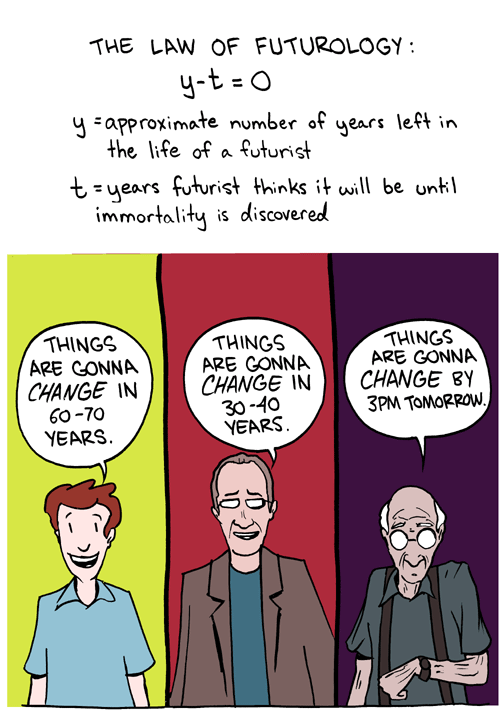
| I'm convinced all of Kurzweil's predictions through the years can be simplified as (and originate from) "whatever least-implausible dream scenario allows a man of Ray Kurzweil's exact age and health to barely avoid the hitherto-universal icy grip of mortality." |
| |
| ▲ | bluealienpie 3 hours ago | parent | next [-] | | I was awed by the future he promised, especially https://en.wikipedia.org/wiki/Respirocyte Looking back, he’s great at selling a future of possibility as long as you don’t track all the errors. | |
| ▲ | Ygg2 5 hours ago | parent | prev [-] | | This SMBC comic
https://www.smbc-comics.com/comics/20100813.gif | | |
| ▲ | Terr_ 4 hours ago | parent [-] | | Tangentially related in terms of "old stuff from other things I read", this 2006 critique [0] by Derek Lowe: > Later in Kurzweil's article, he says: > > "So what does the future hold? By 2019, we will largely overcome the major diseases that kill 95 percent of us in the developed world, and we will be dramatically slowing and reversing the dozen or so processes that underlie aging." > [...] I really do expect to put cancer, heart disease, the major infections, and the degenerative disorders in their place. But do I expect to do it by 20-flipping-19? It's hard to be optimistic when it's been those 13 years plus another 7 and somehow measles is back again, although I admit that's one isn't a pure technology-problem. [0] https://www.science.org/content/blog-post/ray-kurzweil-s-fut... | | |
| ▲ | sanderjd 3 hours ago | parent [-] | | But that's kinda the point, there's no such thing as "a pure technology-problem". I think that's the fundamental - and obvious - thing that these folks seem to constantly miss. |
|
|
|
|
| ▲ | nl 6 hours ago | parent | prev [-] |
| Luu's piece linked his analysis! Kurzweil scores 7% accuracy. If you scroll to the appendix he grades individual predictions. https://danluu.com/futurist-predictions/ |
| |
| ▲ | scarmig 5 hours ago | parent | next [-] | | Reading through them, Luu's grades seem fair and accurate to me. Best defense of Kurzweil I can give is that if you give a grace period of a decade and scope them down substantially (to maybe a subset of well-off Americans in coastal cities), he looks much better, though still under 50%. One of Kurzweil's close-but-no-cigar failed predictions was "neural nets and genetic algorithms," killed off by the conjunction and being a couple years too early (2009 for increasing interest, and 2019 for wide use). | | |
| ▲ | roenxi 3 hours ago | parent [-] | | Fair, sure. But it seems to be underselling how reasonable Kurzweil is. We've got things like 2009 - "Computers can recognize their owner's face from a picture or video. No." And ok, sure, but that has happened by 2026 and we have more than 2000 years of recorded history of people making predictions. I don't think that situation reflects at all badly on Kurzweil except that he doesn't explicitly say he has a 15 year error bar. Which, yes, technically inaccurate, but it seems quite likely nobody would be talking about him if he spent that much time exploring the minor caveats. And hitting him for the "and genetic algorithms" is verging on pedantry. Ok so genetic algorithms aren't a civilisation-level success that appears to be reshaping the fate of the species in the same way neural nets are. He was right that learning systems were going to be huge and he was off on a detail. |
| |
| ▲ | dinfinity 5 hours ago | parent | prev | next [-] | | The list in the appendix is pretty telling: Yes, the moments are off by a lot, but many of the predictions describe reality well. I'd say that 7% accuracy is on the low side and 86% on the high side. Looking through the list I'd put it more at 50-60% personally. For me that still means that I'd much rather hear about what he has to say about the potential future than most other people. | |
| ▲ | Veedrac 4 hours ago | parent | prev | next [-] | | If you grade what was linked by whether it is "approximately achievable today", and not some less interesting metric like being predicted for the correct year or if it was outcompeted by some other thing, he's closer to 70-90% depending on how close you're willing to grade. It's very easy to say 'person X made a highly specific testable prediction, while respectable people said nothing like it would ever happen, and it only 90% happened, so person X was a fool unlike all the respectable people', but it's a trap. In reality Kurzweil was directionally correct about most things, overspecified the details, and had optimistic timelines in the way that everyone has optimistic timelines about everything. | |
| ▲ | p1esk 3 hours ago | parent | prev [-] | | Kurzweil predicted in the late 90s that we will have AGI by 2029. And ASI by 2045. Seems very likely to me. |
|