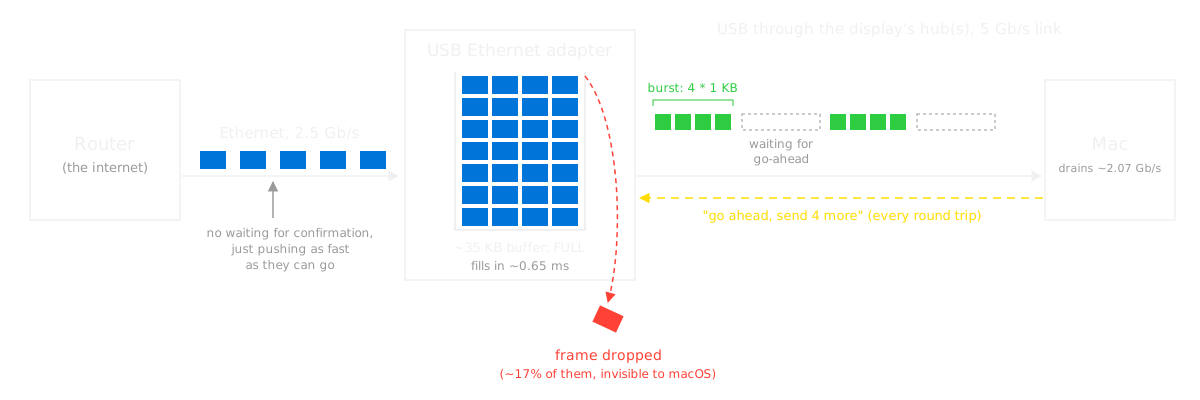
| ▲ | My Monitor Was Cutting My Download Speed by 75%(blog.tymscar.com) |
| 192 points by soheilpro 5 hours ago | 75 comments |
| |
|
| ▲ | senko 3 hours ago | parent | next [-] |
| This reminds me of a (completely different, but felt equally) bizzare problem with ghostty (the terminal emulator) on Linux and Steam, specifically Baldur's Gate 3. At the start of the game after an update, BG3 compiles the (Vulkan) shaders. To avoid hammering the computer, it checks the load, including I/O pressure, and then throttles itself. It turns out that Ghostty uses io_uring, and even if it's not doing anything this somehow counts as pressure. This was made worse by the fact that I usually have a dozen or so Ghostty windows. End result, BG3 compiles shaders using 1 core, throttled, instead of all available 20 cores. Instead of a minute or so, it'd take several hours. (For closure: I configured ghostty to use epoll instead. Probably not optimal but works around the problem.) |
| |
| ▲ | dustbunny an hour ago | parent | next [-] | | Amazing. How did you figure this out?! | |
| ▲ | simonask 2 hours ago | parent | prev [-] | | I hate this. We have a whole operating system doing its absolute best to prioritize hardware resources. Don't be out here throttling yourself. Especially for something like compiling shaders. It literally never happens unless the user is about to go play a game, which is going to consume most resources anyway. To the user, there's nothing more important running right now. | | |
| ▲ | cowlevel an hour ago | parent | next [-] | | Especially on Linux, the default throttling just doesn't work very well. | |
| ▲ | embedding-shape 2 hours ago | parent | prev [-] | | > To the user, there's nothing more important running right now. Well, to a certain degree. I have a relatively uncommon GPU, and run games on Steam (and Linux), so literally every game does shader compilation for me. Even with a beefy CPU and beefy GPU, if the shader compilation uses more than 16 threads, my computer basically freezes until its done with it, as it's so performance intensive, kind of have to throttle things if I want to be able to use the desktop for the 10 minutes the shader compilation takes sometimes. Edit: "Do you use Linux? That only happened to me when I was using a dram-less ssd for swap and doing IO heavy operations on the NFS mounted drive" I do! I do have NFS drives, but not for Steam games or anything else relevant. I'm also not using swap at all. RAM seems fine during this, it's just pegging all cores to 100% usage immediately and stays there, making everything else suffer. | | |
| ▲ | Aurornis an hour ago | parent | next [-] | | > Even with a beefy CPU and beefy GPU, if the shader compilation uses more than 16 threads, my computer basically freezes until its done with it Strange. This never happens to me on Windows. I only notice that the fans spin up a little because all cores are pegged. | | | |
| ▲ | braiamp 2 hours ago | parent | prev | next [-] | | Do you use Linux? That only happened to me when I was using a dram-less ssd for swap and doing IO heavy operations on the NFS mounted drive, since the system will use ram as a buffer (which pushes things to swap) | |
| ▲ | Hendrikto 2 hours ago | parent | prev [-] | | > Even with a beefy CPU and beefy GPU, if the shader compilation uses more than 16 threads, my computer basically freezes Sounds like a scheduling problem that should be adressed at the OS level. | | |
| ▲ | embedding-shape 2 hours ago | parent [-] | | Seems a deep one if so. I've tried a bunch of alternative schedulers to try to avoid the issue, like Bore and BMQ, but seems to happen regardless. Been like this on previous computers too, fwiw, unless I turn down the concurrency for shader compilation stuff will lag heavily until it finishes. | | |
| ▲ | bilegeek an hour ago | parent [-] | | > tried a bunch of alternative schedulers 1. Have you tried enabling full preemption as well? I run Debian, and before I did that I had lots of stutters from any kind of background load thanks to dynamic preemption. 2. Even then, ZFS was causing stutters until I lowered it's priority as well (spl_taskq_thread_priority=0) 3. On non-ZFS drives, try setting your I/O scheduler to Kyber for NVME or BFQ for everything else. "mq-deadline" isn't great for interactive use on a SATA SSD, even for non-boot drives, and even NVME sometimes stutters under "none" for some people. > I'm also not using swap at all. 4. zswap (combined with zstd compression, "min_ttl_ms=1000", and "vm.page-cluster=0") and "defer+madvise" memory compaction can help. (Something about the kernel really liking having swap on-hand.) Steam runs shader compilations at batch policy and nice 19, so without RAM or I/O bottlnecks even gaming shouldn't be too bad (though from personal experience it still induces some stuttering). It's just most distros are tuned horribly for this. (Not to sound flippant, I understand the frustration of "just try this" and it doesn't work, but it's everything I can think of RN.) |
|
|
|
|
|
|
| ▲ | manarth 44 minutes ago | parent | prev | next [-] |
| Better description: "My USB network switch was cutting my download speed". The fact that it's a monitor is a little bit irrelevant. |
|
| ▲ | throw0101d 2 hours ago | parent | prev | next [-] |
| Meta: > Somehow I am one of those few very lucky people to have the opportunity of owning a 2.5 gig symmetrical line for my internet. I'm not going to complain against more bandwidth (as a GenXer I stared my online journey at (IIRC) 9600bps (maybe lower): much celebration with V.32/V.90), but I'm curious to know how many residential use-cases can take advantage of that much bandwidth. Linux ISOs? How many services allow that much speed on a single stream / (TCP) session? Maybe you could have five at 500 Mbps? Certainly downloading security updates or games may be quicker, but I would think that above 500Mbps (and certainly 1 Gbps) there would be major diminishing returns. Is anyone regularly getting close to that utilization in their daily work / hobbies (and not just a momentary spike on patch Tuesday)? |
| |
| ▲ | Zyst an hour ago | parent | next [-] | | Torrents, and things like downloading games from Steam feel really good if you have a very strong connection. A lot of games can be downloaded in the time it takes to go grab a drink from the fridge. It adds some nice quality of life, there isn't as much need to keep a large downloaded set - just download when you need it, and it'll be there quickly. I think going from something like 100 Mb download to 1 Gb is slightly overrated. You hit heavy diminishing returns. Symmetric Upload, for me, is what really changes your quality of life a lot. Uploading a youtube video suddenly isn't an event, it takes a few seconds. Want to upload an image in any chat? Done before you consciously see it uploading. Heavy commits are instant, even with a bunch of resources. It changed my behavior. I started uploading more stuff to remote servers because the cost in time got so much lower. | | |
| ▲ | Guillaume86 an hour ago | parent [-] | | Yup as someone on a 1000/20 link (can’t get anything better in my little village in BE), decent upload is far more useful than more download after a point (far before 1gbps). |
| |
| ▲ | Aurornis an hour ago | parent | prev | next [-] | | The major CDNs routinely deliver full throughput. It’s great when experimenting with LLMs because I can quickly try new models and download from the internet almost as fast as if coming from my NAS. Game updates are also a great use case. I don’t game often so when my friends want to play I often have to update the game. Some patches are 60GB or more. When they come down at full line speed that’s valuable time I’m getting back to spend with my friends in game. | |
| ▲ | nunez 27 minutes ago | parent | prev | next [-] | | 2.5Gbit (or 5Gbit in my case) is INFINITELY helpful if you run k8s clusters. Container images download as quickly as moving a big file on a spinning rust hard drive even if someone else is watching TV or doing equally intensive stuff. | |
| ▲ | WhiteDawn an hour ago | parent | prev | next [-] | | 99% of the time I don’t need it. However, when I do need it, it sure is nice to move quickly during updates or downloading sdk/assets. Even better is those can saturate as much bandwidth as possible while the rest of the family are uninterrupted with Netflix or video calls. | |
| ▲ | makeitdouble an hour ago | parent | prev | next [-] | | > Maybe you could have five at 500 Mbps? Let's say you're on a Meet call with a dozen of people, one of them presenting their screen to explain an ongoing incident. You're following along while checking your dashboards and code on a remote server. You're of course keeping Slack sessions in the background. I don't think you'd be saturating a 2.5G bandwidth, but perhaps about half of it ? If your family is also using it in parallel that could get close to full use. | | |
| ▲ | Aurornis an hour ago | parent | next [-] | | > Let's say you're on a Meet call with a dozen of people, one of them presenting their screen to explain an ongoing incident. You're following along while checking your dashboards and code on a remote server. You're of course keeping Slack sessions in the background. This is closer to 1-10Mbps than 2.5Gbps. Slack is negligible bandwidth. Video conferencing is high compression, low bandwidth video. The 1G and 2.5G lines benefit bulk file downloads. | |
| ▲ | throw0101d an hour ago | parent | prev | next [-] | | > Let's say you're on a Meet call with a dozen of people […] I have been on Zoom and Google Meets calls with that many people on my laptop which has a Wifi connection of ≤400 Mbps (sometimes <200Mbps). You don't need >500 Mbps for online meetings. Are you in meetings where everyone is sending 4Kp60? | | |
| ▲ | silvestrov 24 minutes ago | parent [-] | | I (for one) would definitely NOT want to see the faces of my colleagues in 4K. lowres, please. only 4K if the feed is from a full room with +10 people in it. |
| |
| ▲ | rayiner an hour ago | parent | prev [-] | | That wouldn’t come close to saturating 100 mbps. Screen sharing even at 4k is ridiculously efficient, maybe 4-5 mbps for what you’re describing where most of the image isn’t changing most of the time. |
| |
| ▲ | NBJack an hour ago | parent | prev | next [-] | | I doubled my measly 20 MPBps upload speed to 40 simply because of how long it was taking me to get rendered assets to someone. Having higher bandwidth than that (eventually, I hope) would be a real help in video editing. | |
| ▲ | penagwin an hour ago | parent | prev | next [-] | | I think steam lets you get to at least 2gbps. An interesting side effect is that bufferbloat becomes less of a problem - you’re more likely able to pull 1gbps without spiking your ping. But to be honest unless you have a household with multiple people, it’s something you mainly notice occasionally with updates, backups, large assets, etc. | |
| ▲ | seiferteric an hour ago | parent | prev | next [-] | | My cable is I think up to 2Gbps now and I regularly see game updates in steam hit like 1.4gbps. Probably it is closely located in a CDN I would assume. | |
| ▲ | rayiner an hour ago | parent | prev | next [-] | | I have 10 gig into my house, and most services can’t saturate it. Microsoft is crap, big game downloads don’t even top out the gigabit link in the xbox. Apple gets 2-3 gig downloading xcode updates and the like. | | |
| ▲ | nunez 20 minutes ago | parent [-] | | I wish I could get 10Gbit; friggin' AT&T lol. Fetching from Google or anything on S3 can definitely fill your pipe |
| |
| ▲ | zeristor an hour ago | parent | prev | next [-] | | I do homebrew updates regularly, and quite often it can take more than an instant. On my 40Mb connection it’s slow. Run it in background, don’t update so often perhaps; I guess I just update as tic. | |
| ▲ | monster_truck an hour ago | parent | prev [-] | | You definitely notice it |
|
|
| ▲ | gh123man 2 hours ago | parent | prev | next [-] |
| I have nothing useful to add other than I feel so validated reading this. Ive been struggling with this issue on and off for over a year. With the release of Astra, it was able to finally unstick me to the point of enabling flow control which has been good enough. I experienced this problem with a macbook and a thunderbolt dock. I had tried multiple different brands of docks and ethernet adapters, and various macbooks. One interesting thing I discovered is if I plugged a non-thunderbolt cable between the dock and the laptop, I would achieve full speed with no packet loss, so interestingly the issue doesn't occur over pure USB but only over thunderbolt. This has got to be a bug on Apple's side right? Would be nice if they fixed it. |
|
| ▲ | fancyfredbot 2 hours ago | parent | prev | next [-] |
| Since lots of comments misunderstood the article, the extra latency from going through the monitor meant his laptop couldn't acknowledge the packets quickly enough. That led a buffer on the ethernet adapter to fill and that led it to drop packets. A different adapter which required less frequent acknowledgement fixed the problem for him. It is quite a nice post which gets to the bottom of incredibly opaque behaviour of USB hubs. |
| |
|
| ▲ | zodwick 31 minutes ago | parent | prev | next [-] |
| >It’s run by this one guy This was super surprising, have always thought ISPs are a super hard businesses. But good for you mate, good ISPs are lifesavers. I have had the opposite experience with my ISP guys. One of the VMs I got as part of work only had IPv6 and to my shock my internet didn't have one. When I contacted my ISP they legit told "You can either have IPv4 or IPv6, but not both". Unfortunately I was on a 12 month plan and couldn't easily cancel so ended up working around using tailscale. |
|
| ▲ | throw0101d an hour ago | parent | prev | next [-] |
| What's the difference in BOM cost for Realtek RTL8153 (1GigE) versus RTL8156 (2.5G) versus RTL8157 (5G) versus RTL8159 (10G)? |
| |
| ▲ | Palomides 36 minutes ago | parent [-] | | chips are probably like $2 to $50 across that range, hard to tell since realtek sucks |
|
|
| ▲ | srcreigh 4 hours ago | parent | prev | next [-] |
| Nice post. Unsatisfying conclusion - did you ever figure out why the original adapter was throttled when plugged into the monitor, and not when plugged into the computer? |
| |
| ▲ | cibyr 3 hours ago | parent | next [-] | | The additional latency from going through the monitor made the bandwidth-delay product exceed the amount of data the adapter was able to send before receiving an ack. I thought that was fairly clear from the explanation, but now I notice that he didn't mention the latency without the monitor. | | |
| ▲ | nh2 an hour ago | parent [-] | | That doesn't seem to be described by the article at all. The latency added in the monitor is described as around 8 us, completely negligible compared to any Internet connection's latency. So the latency without the monitor should be completely irrelevant. |
| |
| ▲ | nh2 37 minutes ago | parent | prev | next [-] | | The article answers this "if the speed of the drain from my adapter to my Mac is half a gig slower than the speed of the input, then you can imagine the buffer getting filled more and more until it overflows. Those are dropped packets, which result in a hard backoff when the router resends them, so you drop loads in speed. And that’s the reason for all of this." With diagram https://blog.tymscar.com/studio-display-ethernet/bottleneck.... The monitor decides to send the adapter's packets on at only 2 Gbit/s, which leads to buffer overflow, thus packet loss, thus e.g. TCP congestion-control backoff. The only thing we don't know is _why_ the monitor chooses to limit the bandwidth to those 2.07 Gbit/s (computed as the 41 KiB blocks per (7.6+8.2) µs). If it sent e.g. 81 KiB blocks, doubling the bandwidth, the problem wouldn't happen. That'd be between Apple and the monitor. | |
| ▲ | archerx 4 hours ago | parent | prev [-] | | I’m guessing it’s a USB bandwidth issue. I learned about these kind of limitations when I tried to have 3 kinects running at the same time on the same USB bus. | | |
| ▲ | swiftcoder 3 hours ago | parent | next [-] | | > I’m guessing it’s a USB bandwidth issue It's explicitly not a bandwidth issue (that would also affect the SSD). It's a latency issue - the chip doesn't have a big enough buffer to keep sufficient packets in flight at once. | | |
| ▲ | nh2 an hour ago | parent [-] | | > It's explicitly not a bandwidth issue That's explicitly the opposite of what the author says. "the speed of packets coming into the adapter is 2.5 Gbps. That’s what the router pushes in. The speed going out is around 2 Gbps." Of course latency is always on the denominator side in the "bandwidth = data / time" equation, but it seems wrong to claim it's latency when it could also be improved by fixing the numerator; it's the entire fraction that's insufficient, thus bandwidth. As written: "The reason is that if you add up the average time it takes to get the go-ahead through my monitor’s hub, which is around 7.6 µs, to the average time it takes to send 4 KB, around 8.2 µs, you can find what the maximum speed is" And later, increasing the numerator is exactly what fixes it with the other hardware: "I can see that instead of sending 4 1 KB packets per burst, it would send 8!" > the chip doesn't have a big enough buffer to keep sufficient packets in flight at once How does this make sense?
Even if his buffer was 100x larger, if the fill bandwidth exceeds the drain bandwidth, it'll eventually fill up.
The article says that explicitly: "Well, if the speed of the drain from my adapter to my Mac is half a gig slower than the speed of the input, then you can imagine the buffer getting filled more and more until it overflows." | | |
| ▲ | swiftcoder 12 minutes ago | parent | next [-] | | > Even if his buffer was 100x larger "buffer" was perhaps a poor choice of words on my part, because "buffer" is ambiguous. In this case I am referring to the "transmit buffer", which is 4 in the non-working case and raised to 8 in the working adapter. > Even if his buffer was 100x larger "buffer" was perhaps a poor choice of words on my part, because "buffer" is ambiguous. In this case I am referring to the notional "transmit buffer", which is 4 in the non-working case and raised to 8 in the working adapter. > "I can see that instead of sending 4 1 KB packets per burst, it would send 8!" Increasing the number of packets in flight does not change the bandwidth, it only improves latency sensitivity (i.e. you can fire more data before requiring an ACK). > it seems wrong to claim it's latency when it could also be improved by fixing the numerator. Increasing the bandwidth without increasing the transmit buffer would not fix this issue. The adapter he ends up buying does both (allow 2x the packets in flight, and 2x the bandwidth). The bottom line here is that the original adapter handles full duplex 2.5g when plugged into the laptop directly, and the SSD gets full duplex bandwidth in excess of 2.5g through the same intermediate link (i.e. the display), so both the adapter and the display have sufficient bandwidth. The added hop of latency however makes the short transmit buffer insufficient to cover the latency. | |
| ▲ | chrisweekly 28 minutes ago | parent | prev [-] | | This primer on latency and bandwidth is 13 years old but still worth sharing (for the sake of all readers) https://hpbn.co/primer-on-latency-and-bandwidth/ |
|
| |
| ▲ | KeplerBoy 3 hours ago | parent | prev | next [-] | | He states that high speed SSDs through the monitor are fine though. | |
| ▲ | prepend 3 hours ago | parent | prev [-] | | Uploads were fine. |
|
|
|
| ▲ | iamflimflam1 an hour ago | parent | prev | next [-] |
| I recently tracked down some poor network performance to some dodgy Ethernet cables in my patch panel. |
|
| ▲ | usr1106 3 hours ago | parent | prev | next [-] |
| Could this be some kind of https://en.wikipedia.org/wiki/Bufferbloat problem? Sure we are talking about a different level in the networking stack and very different protocols. But with every component you add things get less synchronous. Well, no buffering needs to involved by the middleman, the mechanism for the throttling could also be different. What do I know... |
| |
| ▲ | nh2 17 minutes ago | parent [-] | | No, the problem does not match the topics discussed in https://en.wikipedia.org/wiki/Bufferbloat The 35 KiB buffer from the article is not very large, and the problem would exist unmodified if it was smaller. As the article explains, "if the speed of the drain from my adapter to my Mac is half a gig slower than the speed of the input, then you can imagine the buffer getting filled more and more until it overflows", and this would hold for any buffer, smaller or larger. Bufferbloat causes primarily latency problems, not bandwidth problems. Bandwidth problem would occur at most as secondary effects, e.g. if a packet is delayed by a buffer for so long that the sender-expected timeout for an ACK expires, it considers the packet lost, and throttles down sending. But that's not happening here. |
|
|
| ▲ | cozzyd 2 hours ago | parent | prev | next [-] |
| Would bbr congestion control help here to.get speeds to 2 Gbps? |
| |
| ▲ | nh2 24 minutes ago | parent [-] | | Seems likely. BBR (v1) does not do the hard 30% "multiplicative decrease" on packet loss (caused by the frame drop in the article's diagram), so I'd expect it to be able to correctly estimate the bandwidth to the ~2 Gbit/s bottlenecked by the monitor-Mac connection. |
|
|
| ▲ | luxuryballs 42 minutes ago | parent | prev | next [-] |
| I'm always jealous of people who have the willpower and time to investigate this kind of stuff, I would have plugged it into the laptop and moved on! It's perhaps the most nerdy "grass must be greener" luxury I can imagine (in a good way). |
|
| ▲ | ferdzo 3 hours ago | parent | prev | next [-] |
| I've encountered a similar problem, the wifi on a MacBook Air was dying once connected to a Dell monitor over USB-C. The wifi signal was going from full to nearly no signal. Connecting to the same monitor with a dongle and HDMI didn't have the same outcome. Never had a time to find the culprit. Probably EMI or bad grounding. |
| |
| ▲ | gdevenyi 2 hours ago | parent [-] | | USB3 has huge EMI issues that haven't been very discussed. It's messing with your signal. |
|
|
| ▲ | entrope 3 hours ago | parent | prev | next [-] |
| What a click-bait headline. The conclusion was that it was due to having a more bottlenecked USB-to-Ethernet adapter path. Would the same result have held with a discrete Thunderbolt 5 hub, either with a built-in 2.5 Gbps or faster Ethernet port or with the original USB-to-Ethernet adapter? Would it have held with another USB hub? Who knows -- just blame it on the expensive monitor! |
| |
| ▲ | rustyhancock 3 hours ago | parent | next [-] | | In a sense it felt like the obvious outcome of a "one cable" setup. It's unreasonable assumption to expect such a setup to manage multiple full speed connects in my opinion. If I was running support it and later heard on I just unplugged the ethernet from my monitor direct to my laptop and the speed improved I'd dispair. | | |
| ▲ | ricardobeat 2 hours ago | parent | next [-] | | > It's unreasonable assumption to expect such a setup to manage multiple full speed connects The bandwidth in question is nowhere near saturating even a single USB3 connection. | |
| ▲ | dan_grec 3 hours ago | parent | prev [-] | | But now it is doing exactly that. |
| |
| ▲ | ricardobeat 2 hours ago | parent | prev [-] | | The explanation is not that clear, but you missed the point. It is a networking issue known as 'bandwidth-delay product': the combination of latency and bandwidth is what limits the speed, and in this case the extra latency from the monitor hop was the culprit. Not the adapter. The faster adapter is a workaround. |
|
|
| ▲ | Sopel 3 hours ago | parent | prev | next [-] |
| > So I thought I would do what any ~~human~~ apple user would do, and I spent more money on a new adapter. |
| |
| ▲ | Moto7451 2 hours ago | parent [-] | | Most people probably would buy another adapter. Most people would probably not debug the USB connection for its latency and throughput over USB. | | |
| ▲ | alt227 an hour ago | parent [-] | | Most Apple users would do this. Most other people would have just used wifi on the laptop and an HDMI cable for plugging their monitor in. | | |
| ▲ | Sopel an hour ago | parent [-] | | or have RJ45 on hardware they want to connect to the internet via cable | | |
|
|
|
|
| ▲ | Pxtl an hour ago | parent | prev | next [-] |
| What's your handle on Sauerbraten? |
|
| ▲ | jmyeet 2 hours ago | parent | prev | next [-] |
| A couple of thoughts: 1. These 1 cable solutions are nice but (IME) incredibly finnicky. I've gone through several Caldigit docks that have died; 2. When you think about it, these docks (and monitors) are really 100+ Gb/s switches. It's kind of no wonder that there are odd behaviors; 3. IME that cable that provides power to the laptop and handles power/video (you know, so it really is 1 cable) is the absolute worst. Whenever you buy them, buy 2-3 because I can almost guarantee 1 will be faulty and it'll be weird, annoying problems eg the screen gling black for a split second randomly; 4. I did a lot of testing with 1GbE USB-Ethernet adapters and it's true that they are not all created equal. In a perfect world, they should do ~930Mb/s. Depending on which one you get it'll be as low as 880 (or lower); and 5. I would honestly expect better from Apple. With the price premium you pay for these Studio monitors, I would expect the hub part to be pretty much seamless. |
|
| ▲ | taneq 2 hours ago | parent | prev | next [-] |
| Hah, well if my monitor at home ever does this to me I can take my revenge by slowly removing my jacket, or sitting down on my chair. (Samsung Odyssey G9, it's ultra-sensitive to ESD anywhere near it so if I'm wearing the right jumper I can move my chair or wave my arms around and the capacitative heresy will make it wig out for a good 2-3 seconds.) At work we run HP Z40c monitors and while they've been bulletproof in terms of image quality, on my old laptop the mouse cursor was definitely more laggy when running in a one-cable setup. We're using Logitech MX Master combos so I just moved the dongle from the monitor to my laptop and that fixed the lag issue. Wow this sounds like a shill post. If anyone from HP or Logitech wants to talk message me. Otherwise Logitech Opti+ or whatever its called can fk off. |
|
| ▲ | candl 2 hours ago | parent | prev | next [-] |
| I hate this attitude:
"I wasn’t getting three quarters of the speed I was paying for"
No, you were. It was not the ISPs fault.
I get constant support requests like that. People install their own equipment, adapters, wifi repeaters, sketchy unmanaged switches and keep complaining about speeds when the ONT/CPE whatever works perfectly and the connection is fine.
All it takes is to connect to the CPE directly and do a measurement.
It's like people calling the power plant operator directly if one of their light bulbs is dimmer than the rest. |
| |
|
| ▲ | TacticalCoder 2 hours ago | parent | prev | next [-] |
| I've only read the headline: USB degrading speeds? (five minutes passed, I skimmed through TFA) Ah yup, of course it's somehow related to USB. It's like the infamous line: "It's always DNS" (and when it's not it's the firewall). When download speeds are degrading like that, it's always some weird USB thing. In the earlier days people didn't know that, for example, plugging a monitor into an USB hub could, as a result, make the rest degrade to USB 2.0 speeds. Unplug the monitor, HUB is speedy again now that it doesn't need to deal with that 4K / 60 Hz or whatever monitor data. It's not a criticism or anything and I'm not saying that's what's going on here: I'm just saying USB has many gotchas and there can be, as in TFA and as in many other (document or not) cases, weird things happening. At times (and doubly so when troubleshooting), you're better to simply try to plug your USB cable directly in the computer instead of in a USB hub / monitor USB hub. (EDIT: ah yup, ofc eventually he try that) There are thing too complex to ever be secure and then there are things too complex to not have gotchas. USB is... Wild? P.S: and then of course in addition to this USB wildness there's the mad insanity of USB... Cables. |
|
| ▲ | thefz 2 hours ago | parent | prev [-] |
| I knew it was Apple even before clicking |
| |
| ▲ | skibble an hour ago | parent [-] | | No, it was his Ethernet adapter. | | |
| ▲ | alt227 an hour ago | parent [-] | | When he plugged the original ethernet adapter straight into the laptop it worked as expected. It was the monitor not supporting that specific setup and chip. | | |
| ▲ | aaronmdjones 40 minutes ago | parent [-] | | It has nothing to do with the monitor's support. The GP is correct; the fault is in the Ethernet adapter. Specifically, it doesn't have a buffer large enough to sustain 2.5 Gbps when going via the monitor because the latency is too high. You'd have the same problem on many USB hubs and it would still be the Ethernet adapter's fault. It could have used a larger buffer or it could send more data at a time to the host so that the buffer doesn't fill up, but it doesn't. |
|
|
|