| ▲ | Margaret Hamilton has died(news.mit.edu) |
| 1105 points by muglug 8 hours ago | 93 comments |
| |
|
| ▲ | diskzero 6 hours ago | parent | next [-] |
| I was able to meet her, and others who worked at the MIT Instrumentation/Draper Lab, as a start-up I was with received funding from a VC firm founded by other Draper Lab members from the Apollo era. I was totally out of my league talking with them. This was thirty years ago and I remember her talking about formalized control systems. It was fascinating but went totally over my head. My startup was a fairly silly multimedia CD-ROM company and I was just happy to be in the room. |
|
| ▲ | divbzero 2 hours ago | parent | prev | next [-] |
| Related: Margaret Hamilton Led the NASA Software Team That Landed Astronauts on the Moon - https://news.ycombinator.com/item?id=36720448 - July 2023 (32 comments) Margaret Hamilton oral history (2017) - https://news.ycombinator.com/item?id=30668338 - March 2022 (7 comments) An interview with Margaret Hamilton - https://news.ycombinator.com/item?id=20453737 - July 2019 (12 comments) Grace Hopper and Margaret Hamilton Awarded Presidential Medal of Freedom - https://news.ycombinator.com/item?id=12991524 - Nov 2016 (70 comments) Profile of Margaret Hamilton, programmer of the Apollo software - https://news.ycombinator.com/item?id=10379904 - Oct 2015 (58 comments) Margaret Hamilton, lead software engineer, Project Apollo - https://news.ycombinator.com/item?id=8735912 - Dec 2014 (94 comments) |
|
| ▲ | WarOnPrivacy 8 hours ago | parent | prev | next [-] |
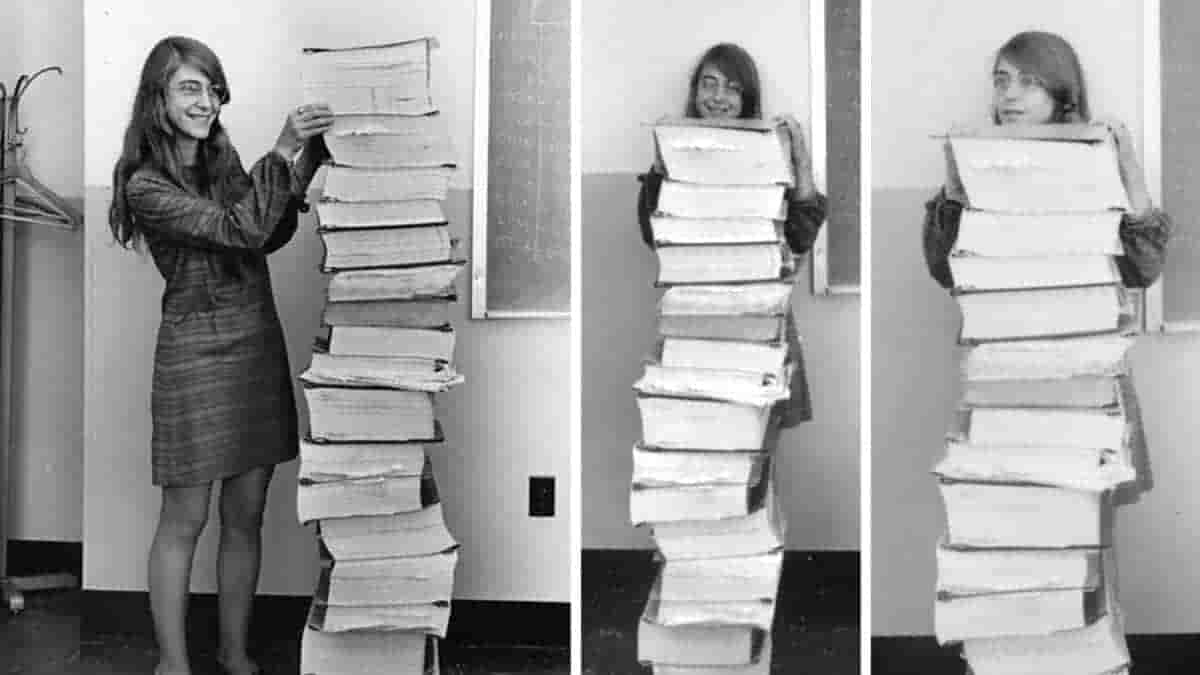
| Dang. She was a remarkable stand-out, in fields full of remarkable people. The pic here is often people's first intro to her https://news.mit.edu/2016/scene-at-mit-margaret-hamilton-apo... |
| |
| ▲ | el_benhameen 4 hours ago | parent | next [-] | | “There was no choice but to be pioneers” is a great line. | | |
| ▲ | burningChrome 3 hours ago | parent [-] | | At the dawning of the technological age that would change the word in some many ways. Like the quote infers, everything they did was something nobody had before. You think of the immense advantages we have now whereas back then, they had none. Which makes her contributions as a scientist that much heavier and important. |
| |
| ▲ | underlipton 5 hours ago | parent | prev | next [-] | | First thing I thought of, too. "Who? ...Wait, not the cool book chick!" Tangential: the software documented in the books next to her were likely developed with a level of rigor that consumer software can only dream of, per the seminal article on similar matters: https://www.eng.auburn.edu/~kchang/comp6710/readings/They%20... | | |
| ▲ | da_chicken 4 hours ago | parent | next [-] | | The term she coined for it was "man-rated". Meaning that it had been tested rigorously enough to be trusted to keep humans alive. During the Apollo 11 descent to the lunar surface, Buzz Aldarin pressed a button to display altitude and position during the landing sequence. As it turns out, this was the 8th task the Apollo 11 lander's guidance computer was asked to run, and it was only capable of running 7 tasks in real-time. Thanks to Hamilton and her team's priority scheduler, the guidance computer threw an alarm, killed the lowest priority task, and then resumed the execution of the other 7. If that hadn't been programmed to rescue itself like that, the computer would have crashed, and the Apollo 11 lander would not likely not have been the success that it was. | | |
| ▲ | setr 3 hours ago | parent [-] | | That does not seem like particularly notable example of foresight & robustness, given that it’s such a low number of maximum tasks, and such a fundamental & frequently used element of its operation. Like it wouldn’t even be describable as a “rescue itself” if the response was simply “No. Too many jobs running. Please kill one to continue” | | |
| ▲ | jacquesm 3 hours ago | parent | next [-] | | At that time running that many concurrent tasks on such anemic hardware was a small miracle. This wasn't your average linux kernel. | |
| ▲ | jonstewart 3 hours ago | parent | prev | next [-] | | The Apollo Guidance Computer had 4KB of RAM and 16KB of ROM. Can you write a scheduler that would execute 8 programs related to landing on the moon in 4KB? | | |
| ▲ | da_chicken 2 hours ago | parent | next [-] | | An asynchronous scheduler with task priority, interrupts, and real-time response. That goes on a spaceship with less than 70 Watts of power available for the computer. That weighed about 70 pounds. When there has never been that sort of a multi-tasking computer controlled avionics before. At a time when the contemporary computer systems that used asynchronous, priority-scheduled multitasking operating systems were things like IBM OS/360 mainframes and DEC PDP-6/PDP-10 minicomputers. It was like having an Apple II in mid 1960s with double the word size. | | |
| ▲ | Gibbon1 42 minutes ago | parent [-] | | I used san RTOS written in assembly for the Atmel AVR. AvrX (by John Barello) You can look at the code here. https://github.com/kororos/AvrX Compiles down under 2k. The thing is while actually doing that isn't crazy hard, they did that with hardly any existing examples to go by. And without modern tools. |
| |
| ▲ | bronson 2 hours ago | parent | prev [-] | | And it ran at 0.043 MIPS. Each task would get maybe 5000 instructions per second, minus scheduler overhead. |
| |
| ▲ | coffeefirst 3 hours ago | parent | prev [-] | | You’re forgetting this had never been done before. |
|
| |
| ▲ | robbs 4 hours ago | parent | prev | next [-] | | That is an excellent article and I’d like to read more. Are there other resources about the shuttle software development or projects with a similar level of software engineering? | |
| ▲ | jonstewart 3 hours ago | parent | prev [-] | | “Cool book chick”? “Cool book chick”?!? I’m sorry, I thought this was Hacker News, not Bros R Us. Ms. Hamilton worked on three seminal software projects: Ed Lorenz’s meteorology programs which led to the Lorenz attractor, SAGE, and Apollo. It is hard for me to square your first paragraph with your second, but I’d submit she’s deserving of far more respect than “cool book chick.” | | |
| ▲ | pstjean 2 hours ago | parent [-] | | It is possible to respect someone and also give them a silly nickname. At least I sincerely hope it is, considering some of the things my children call me. |
|
| |
| ▲ | autoexec 3 hours ago | parent | prev [-] | | > The pic here is often people's first intro to her Why link to an article instead of an actual picture? The page you linked failed to show any image without JS enabled (although my ad blocker might share some of the blame, there are a handful of trackers on that site) and the article doesn't link directly to it either. I'm guessing you mean the pic here: https://www.thetechoutlook.com/wp-content/uploads/2023/01/Ma... |
|
|
| ▲ | muunbo 7 hours ago | parent | prev | next [-] |
| Margaret Hamilton actually coined the term "software engineer" IIRC. Rest in peace |
| |
| ▲ | catskull 5 hours ago | parent | next [-] | | She did! A few years ago I actually tracked down the source of that, which was an interview done for an obscure textbook and republished it on my blog if you are interested in learning more: https://catskull.net/interview-with-margaret-h-hamilton.html | | |
| ▲ | autoexec 3 hours ago | parent | next [-] | | out of curiosity, how'd you get your hands on the textbook? | |
| ▲ | srcreigh 5 hours ago | parent | prev [-] | | This is incredible, thanks a lot for making it available for us. |
| |
| ▲ | penskymaterial 5 hours ago | parent | prev | next [-] | | Little did she know, the term would be co-opted by guys changing the color of a button on a web site. | | |
| ▲ | doginasuit 5 hours ago | parent | next [-] | | And gate-kept by just as many. I wonder what she'd take more issue with. My understanding is she wanted to elevate people who work on software, not draw a line around it. | | |
| ▲ | Dylan16807 an hour ago | parent [-] | | If I had the option I would prefer the term "engineer" be gatekept. Terminology can help elevate something that's often overlooked, but if every programmer gets called a "software engineer" there's no way to distinguish the special stuff. | | |
| ▲ | altmanaltman 20 minutes ago | parent [-] | | So are you okay with actual engineers having a problem with the term used in software since you support gatekeeping? Engineer is a term that was used far before software was a thing. So if you support gatekeeping, you should let engineering refer to "actual work" not "code" and find a new term that doesn't engulfs the "original meaning". Or just accept terms change as society and technology does. |
|
| |
| ▲ | onion2k 4 hours ago | parent | prev [-] | | And then other guys made frontend dev tooling so complicated that it does actually require a software engineer to change the color of a button. |
| |
| ▲ | worldsavior an hour ago | parent | prev | next [-] | | I wouldn't say coining "software engineer" requires special skills or personality uniqueness. It's just who is more famous and the right time. | | |
| ▲ | 0xR1CK 24 minutes ago | parent [-] | | It's not too soon to delete this, dude. The tone of this statement is cynical, reductive, and dismissive. I bet you're fun at parties. |
| |
| ▲ | pvab3 4 hours ago | parent | prev [-] | | IMO software is not engineering because it has nothing to with the physical sciences | | |
| ▲ | akamaka 4 hours ago | parent | next [-] | | It becomes engineering when the software is flying to the moon and back. | |
| ▲ | phinnaeus 3 hours ago | parent | prev | next [-] | | Grace Hopper would like to show you her collection of nanoseconds. | | |
| ▲ | Dylan16807 an hour ago | parent [-] | | Up at the software level, the relevance of that distance is only the barest hint of physics behind a frosted glass window. This does not successfully counter what GP was saying. |
| |
| ▲ | monocasa 4 hours ago | parent | prev | next [-] | | Quite a few practical constraints on software are imposed by the physical world and our current ability to construct devices out of it. Working within those constraints to provide value that people can depend on isn't the worst definition of engineering I've heard. | | |
| ▲ | autoexec 3 hours ago | parent [-] | | I just wish that software engineers had a similar level of accountability that an engineer building something like a bridge is held to. When a negligent software engineer causes harm to people nothing typically happens. No real risk of lawsuits, or loss of license, or worry about their liability insurance. This also means that software engineers can't effectively push back when their bosses want them to implement things that they know are insecure or dangerous | | |
| ▲ | saimiam 2 hours ago | parent [-] | | Well, Meta just settled with states to the tune of 17 billion dollars for harm caused by its algorithms. Air Canada, a few years back, was found liable when its ai bot promised discounted fares to a customer. Companies are getting hacked and held to ransom regularly so bad software is getting punished alright. Maybe the guy writing the actual line of code (or the guy in whose name AI code is being pushed to git) isn’t getting punished but software is definitely being scrutinised for ill effects. | | |
| ▲ | autoexec an hour ago | parent [-] | | > Meta just settled with states to the tune of 17 billion dollars for harm caused by its algorithms. Those were working as intended, unlike a bridge that collapses because of bad design. > Air Canada, a few years back, was found liable when its ai bot promised discounted fares to a customer. That was a solid win for AI accountability, but it only cost them $812.02. They most likely made money using that lying AI bot. It wouldn't take a week of paying just one employee minimum wage to hit $812. Last I heard they're still using the chatbot. It's true that bad code can cost a company something, but its obviously not costly enough that they take the needed actions to avoid shipping it. |
|
|
| |
| ▲ | lazyasciiart 2 hours ago | parent | prev [-] | | I hope you don’t write your own crypto. |
|
|
|
| ▲ | EvanAnderson 7 hours ago | parent | prev | next [-] |
| There is a very nice oral history the Computer History Museum produced: https://computerhistory.org/blog/margaret-hamilton-in-her-ow... In Levy's "Hackers" there is a story about late night hacking on the TX-0 that fouled-up some weather simulation code an academic user of the computer was running. After hearing this oral history I believe Margaret was the programmer and the code was for Prof. Edward Lorenz. |
| |
| ▲ | bitwize 7 hours ago | parent [-] | | Allison Parrish talks about this in some depth. Turns out toxic masculinity was an integral part of the old-school "hacker" culture from the jump. http://opentranscripts.org/transcript/programming-forgetting... | | |
| ▲ | kragen 6 hours ago | parent | next [-] | | That page is 403, but I was able to get it at https://web.archive.org/web/20161220114912/http://opentransc... I don't think it justifies your claim; there's nothing in the historical sources about masculinity, just irresponsibility. It's probably true that women were not allowed to be as irresponsible as the guys who screwed up in this case, but that's not because of those guys' understanding of masculinity. It's because the sexist culture of the time afforded fewer opportunities to women, in particular, cutting them less slack for misbehavior. With a less sexist culture, we could have seen Margaret Hamilton's computational fluid dynamics project stymied by irresponsible monkeying by women instead of irresponsible monkeying by men. With a more sexist culture, we would have seen Margaret Hamilton unable to get her grievances redressed because she was a woman, and the midnight wiring club would have continued interfering with officially sanctioned users until one of them was a man. | |
| ▲ | 0xpgm an hour ago | parent | prev | next [-] | | On Margaret Hamilton from Chapter 5 of Hackers by Steven Levy "She was well aware of the hackers’ playfulness around the ninth floor, and she was moderately friendly with some of them, even though they would eventually blend into one collective personality in her memory: one unkempt, though polite, young male whose love for the computer had made him lose all reason." | |
| ▲ | MarkusWandel 7 hours ago | parent | prev [-] | | I had to go to an archive site to actually read it; the link says 403 forbidden. I don't really see this as toxic masculinity just because the officially sanctioned user was female. Just an honest mistake - they did test their mod, just not enough for all possible use cases of the computer. | | |
|
|
|
| ▲ | dadrian an hour ago | parent | prev | next [-] |
| Hamilton invented the idea of error handling in software, and that error handling in the Apollo computer is why Buzz Aldrin was able to handle the error 1201/1202 in the minutes before the Eagle landed on the moon, instead of having to abort the mission. |
|
| ▲ | 101008 3 hours ago | parent | prev | next [-] |
| Her story and her work is so inspiring. And I feel a bit sad reading about it... When I started working on this field I dreamt of working on things like that. Not sending anything to the moon, but code that would achieve difficult stuff, challenging tasks, things I would be proud of. Today I mostly do silly APIs, and with AI is worse and worse... I wonder if there are still jobs where you have to do novel stuff, new algorithms, more like a scientific approach to the code, instead of just deploy the same thing every other company has already done. |
| |
| ▲ | diskzero an hour ago | parent [-] | | Yes, there are still jobs where you have to do novel and interesting things. It is hard to compare these to the work the Draper Lab did, but that was an exceptional moment in time that an exceptional group of people were able to do because they were at the right place at the right time. Much of the interesting stuff I was able to do in the past was a result of being at the right place at the right time, but others were because I took some wild chances. I realize it can be a privilege to take wild chances and it isn’t an option for many. When I read this site, or the media in general, AI exuberance and/or doom and gloom is everywhere. I also felt like the opportunities you are thinking about are vanishing. My current job is actually pretty exciting to me; building a new distributed audio software and hardware solution. The hardware element makes it very real; there are no endless cloud compute resources to help out. I guess what I am saying there still seems to be interesting and challenging tasks out there, but the green fields do seem to be vanishing. |
|
|
| ▲ | leelasankhar 4 hours ago | parent | prev | next [-] |
| I feel very sad. I always wished I could meet her and have a little talk. She'll be forever remembered thanks to that coolest badass picture of her. Om shanti! |
|
| ▲ | sib 3 hours ago | parent | prev | next [-] |
| "Because software was a mystery, a black box, upper management gave us total freedom and trust." If only! |
|
| ▲ | rietta 4 hours ago | parent | prev | next [-] |
| I am extremely sorry to hear of Ms. Hamilton's passing. I will be sure to tell my daughters in the morning. I told them a bit about her. They found the life size cardboard cutout at the Computer History Museum in Roswell, GA, very interesting. They love the Apollo section of the exhibit. |
|
| ▲ | marcelo-earth 4 hours ago | parent | prev | next [-] |
| RIP. I'll always remember her iconic pic with the stack of printed code |
|
| ▲ | QuantumAtom 6 hours ago | parent | prev | next [-] |
| May her memory be a blessing |
|
| ▲ | metadaemon 6 hours ago | parent | prev | next [-] |
| Weird, I was thinking about her monumental achievement just a few hours ago. |
| |
| ▲ | ghastmaster 5 hours ago | parent [-] | | She was an excellent leader in a time when women were not commonly in leadership roles. She clearly understood coding and perhaps changed the way the field viewed the importance of software. Did she do any coding that was monumental herself? All I can find is fluff pieces. She managed a team that developed the code for Apollo 11. She did not write all the code in the famous pictures. Did she write some of it or just guide the team in the right direction? | | |
| ▲ | jojobas 3 hours ago | parent [-] | | She assumed management of the team after most of the code was written. She probably did something cool, but almost certainly not as much the praise articles of the last 15(?) years would like you to believe. |
|
|
|
| ▲ | dzonga 5 hours ago | parent | prev | next [-] |
| her pic with the stack of printed code will always be iconic. rest well pioneer. |
| |
| ▲ | jshier 5 hours ago | parent [-] | | I don't usually correct this, but in her iconic photo she's standing next to printed output of an Apollo simulator run, not the actual source code for the AGC or lunar module. Edit: this may or may not be true. From what I can find it's probably a combination of both. IIRC she was running the simulation side of the lab that produced the AGC and LEM guidance software at the time of Apollo 11, then the AGC side, then the unified lab when it was reorganized in 1970. | | |
|
|
| ▲ | customguy 7 hours ago | parent | prev | next [-] |
| According to Wikiquote, she coined the phrase "software engineering": https://en.wikiquote.org/wiki/Margaret_Hamilton > In the early days of this project, software was treated like an adopted child and not taken as seriously as other engineering disciplines, such as hardware engineering, and was thought of as art and magic, not science. I have always believed that art and science were involved in its creation, but at the time most people thought otherwise. Knowing this, I fought to legitimize software so that both software engineering and those who built it would receive the respect they deserved, so I began using the term “software engineering” to differentiate it from hardware and other forms of engineering. When I first started using these words, they were considered funny. It was a running joke for a long time. They liked to make fun of my radical ideas. Software eventually earned the same respect as any other discipline. found another retelling: https://www.theguardian.com/technology/2019/jul/13/margaret-... > During the early days of Apollo, software was not taken as seriously as other engineering disciplines. Though in fact we had a complex system of systems, we weren’t getting credit for what was a legitimate field. It was out of desperation I came up with the term, to say: “Hey, we’re engineering too.” It was an ongoing joke for a long time. Then one day in a meeting, one of the most respected hardware gurus explained to everyone that he agreed with me. The process of building software should also be considered an engineering discipline, just like with hardware. It was a memorable moment. |
|
| ▲ | schaefer 5 hours ago | parent | prev | next [-] |
| Is any of the original Apollo code available to read? |
| |
| ▲ | dudewhocodes 5 hours ago | parent | next [-] | | https://github.com/chrislgarry/apollo-11 | | | |
| ▲ | xtajv 5 hours ago | parent | prev [-] | | Not a direct answer to your question per se, but I would wholeheartedly recommend Frank O'Brien's "The Apollo Guidance Computer: Architecture and Operation" (ISBN 978-1-4419-0876-6). It reads like a lead engineer walking a new hire through the codebase. | | |
| ▲ | schaefer 4 hours ago | parent [-] | | This is a great recommendation. And considering the code base is in assembly, I'll gladly welcome a walkthrough. | | |
|
|
|
| ▲ | Kim_Bruning 5 hours ago | parent | prev | next [-] |
| timmg's video explaining how the AGC worked is one of the better ones I've seen, if you actually want to understand in detail. |
|
| ▲ | bitwize 7 hours ago | parent | prev | next [-] |
| I've talked a lot about PRIDE, Milt Bryce's information-systems methodology that was perhaps the first commercially available, rigorous methodology for developing software and the first serious attempt to transform information systems development in the commercial sector from an arcane art into a proven, repeatable science. It really has few forbears. But... Margaret Hamilton was one of those forbears. She got the ideas out there; PRIDE just commercialized them and made them palatable to business IT shops. |
|
| ▲ | ChrisArchitect 3 hours ago | parent | prev | next [-] |
| RIP legend. Noting Ada Lovelace Day was a few days ago also https://findingada.com/. |
|
| ▲ | xiphmont 4 hours ago | parent | prev | next [-] |
| Rest in peace, Ma'am. |
|
| ▲ | shaunxcode 3 hours ago | parent | prev | next [-] |
| NXVI |
|
| ▲ | toomuchtodo 8 hours ago | parent | prev | next [-] |
| https://en.wikipedia.org/wiki/Margaret_Hamilton_(software_en... Threads: https://hn.algolia.com/?dateRange=all&page=0&prefix=false&qu... |
|
| ▲ | ChrisArchitect 3 hours ago | parent | prev | next [-] |
| NYT obit: https://www.nytimes.com/2026/10/07/obituaries/margaret-hamil... |
|
| ▲ | throw_m239339 5 hours ago | parent | prev | next [-] |
| RIP, what a fantastic person she was. |
|
| ▲ | jamiek88 6 hours ago | parent | prev | next [-] |
| The word legend is used too much. She absolutely qualifies. |
| |
|
| ▲ | saulpw 8 hours ago | parent | prev | next [-] |
| This feels like a black bar event. RIP Margaret Hamilton. |
| |
|
| ▲ | markus_zhang 7 hours ago | parent | prev | next [-] |
| This definitely asks for a black ribbon on top of HN. What a loss! |
| |
|
| ▲ | CyberMacGyver 4 hours ago | parent | prev | next [-] |
| For years, I took piano lessons from an incredible teacher in Seattle who actually happens to be Margaret Hamilton’s sister. Looking back, I had no idea just how deeply she would impact both me and my family. |
|
| ▲ | golergka 3 hours ago | parent | prev | next [-] |
| There two dead comments saying that her achievements might have been overstated. Personally, I don’t know enough to have an opinion, and I’m not sure if it’s appropriate to discuss in comments about her death either. However, downvoting and killing comments just because you disagree with them is not right. I hope this discussion will have its space on hacker news, perhaps if as a separate post. |
| |
| ▲ | userbinator 22 minutes ago | parent | next [-] | | I don't know enough either, but one only needs to have a functioning brain to see something is amiss; others have clearly have been brainwashed by the echo-chamber. "Truth does not resist questioning." | |
| ▲ | rsalama2 an hour ago | parent | prev | next [-] | | your comment is being shadowbanned too from what I see. How do we know 'she' was real at all? (let alone did all those amazing, yet unprobable things.) How's the saying go? "if you know what someone's religion then find out who you are not allowed to criticize."? (or something like that) | |
| ▲ | saagarjha 2 hours ago | parent | prev [-] | | It is not appropriate and downvoting those comments is how one indicates this. |
|
|
| ▲ | groundzeros2015 3 hours ago | parent | prev [-] |
| A link has been removed from other comments which argues with primary sources that she did not participate in the moon landing project to the extent suggested here. Her rise in popularity coincided with a Wikipedia effort to identify "overlooked heroes" in math and science. |
| |
| ▲ | userbinator 27 minutes ago | parent [-] | | Not surprisingly, the comments are being downvoted and flagged. "Truth does not mind being questioned. A lie does not like being challenged." |
|