| |
| ▲ | europoorean 30 minutes ago | parent | next [-] | | > a wealth transfer to support poor rural American communities My immediate reaction to this is: it's probably a wewlth transfer to the few landlords owning the land and probably charging higher rent, not to the communities. Of course I haven't analysed the data. If I am wrong, hopefully someone will feel compelled to correct me. | | |
| ▲ | b112 20 minutes ago | parent [-] | | My understanding is that it caused the price of corn to go way up, meaning the poor in Mexico found food far more expensive. International markets and all that... |
| |
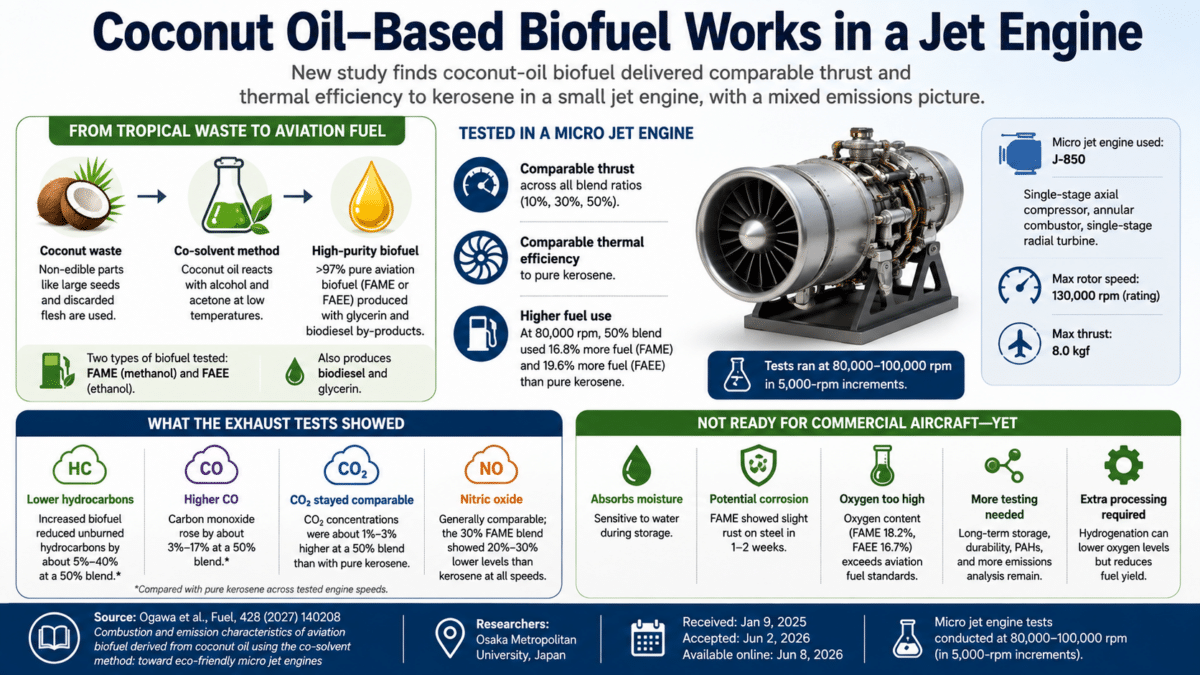
| ▲ | mdp2021 2 hours ago | parent | prev | next [-] | | They already grow, they are already harvested, and this process uses discarded parts of the harvest. It is putting in use what we already had but had no use for. Edit: the article speaks about possibilities that open. It also clearly notices that the a number of problems are unsolved. The infographic is direct: https://studyfinds.com/wp-content/uploads/2026/08/Coconut-Bi... Note that if some product available in limited amount, say "coconut oil", becomes an asset to improve any context, say "aviation", it does not follow that one should maximize that amount psychotically without a cost-risk-benefit. You can just exploit the available yield through planning. | | |
| ▲ | willtemperley 2 hours ago | parent | next [-] | | That infographic says it uses 16-20% more fuel per unit of thrust. That's a significant amount more weight for an aircraft to carry, but because carrying extra fuel also burns fuel, extra fuel use would compound exponentially. This would probably mean significantly more than 20% extra fuel would be required for long-haul flights. | | |
| ▲ | Animats 29 minutes ago | parent [-] | | Ouch. There's one plantation of under 1000 hectares in Papua New Guinea that makes biodiesel from coconut oil to power their own operation and vehicles on the island.[1]
But they don't export. On an island with few energy sources, the process makes sense. This is more like an industrial process that self-powers from its own waste. Sewerage treatment plants do that - the process produces methane, often enough to power the plant. Not enough to put them into the gas business, though. Amusingly, corn to ethanol plants in the US do not generally self-power. They consume natural gas to produce ethanol.[2] Net energy gain is maybe 1.3. Only subsidies keep this going. About 40% of US corn production goes into this boondoggle. Sugar cane, though - that's a win for biomass. [1] https://www.theguardian.com/world/article/2024/may/10/png-co... [2] https://en.wikipedia.org/wiki/Ethanol_fuel_energy_balance |
| |
| ▲ | brainwad 2 hours ago | parent | prev | next [-] | | I presume that the market for coconut oil is far smaller than for jet fuel, so this solution can't scale without wreaking havoc on the environment. These sort of clever uses for exisiting byproducts only work when the market for the main product is much bigger than for the byproduct (e.g. down is a byproduct of duck/goose meat, leather is a byproduct of beef). | |
| ▲ | clickety_clack 2 hours ago | parent | prev | next [-] | | Apparently (I’m relying on facts from Claude here), aviation uses about 100 billion gallons of oil a year and coconuts yield about 250 gal/acre, so assuming you can approximately replace them 1:1, you would need to plant about 400 million acres under coconut plantation, an area the size of Mexico. Edit: you don’t have to plant all of Mexico, every percent of fuel you replace is the equivalent of a percentage of a country under a single crop, displacing what would have been there before (presumably some kind of food). | | |
| ▲ | mdp2021 2 hours ago | parent [-] | | Yes, but nobody said that it would replace kerosene. Especially at this stage. |
| |
| ▲ | dylan604 2 hours ago | parent | prev [-] | | To what scale though? Doubtful it's going to be enough for a replacement. Just as GP stated, the corn grown for ethanol is nothing more than an additive and it is quite easy to find fuel without it. It's a boondoggle and not any where close to being a fossil fuel replacement | | |
| ▲ | fc417fc802 24 minutes ago | parent [-] | | Isn't that simply a matter of cost? It's pretty difficult to complete with pulling an energy dense material out of the ground. If we were to globally tax oil extraction proportional to the actual cost of equivalent carbon capture I imagine biofuels would begin to look quite reasonable. That said it seems to me that tying the energy and food supply together economically in such a direct manner is likely to have some deleterious effects on poor countries. |
|
| |
| ▲ | 317070 2 hours ago | parent | prev | next [-] | | > it’s led to poor use of land with questionable climate impact. In the short term, yes, because they were unnecessarily using carbon energy to grow the fuel. But if we want to de-fossilise society in the long run, we need solutions for flying and long distance travel. Electric flying seems infeasible at the moment, and people are looking for suitable bio-fuels to make flying carbon neutral. Afaik the maximum planes were allowed to handle up to now, was a 50-50 mix kerosene-biofuel. [0] Coconuts could be a breakthrough! [0] https://en.wikipedia.org/wiki/Aviation_biofuel | | |
| ▲ | sixtyj 2 hours ago | parent | next [-] | | How many coconuts are on one tree and how many tons of coconuts would be needed to replace kerosene globally? I am 100% for decarbonization as fast as possible. BTW Law of Conservation of Energy will be applied to coconut-based energy as well. Vaclav Smil mentions in his book that we should consume less. I see so many cheap weekender air tickets… it’s almost impossible to resist the temptation. Annually 5 billions people travel by plane… | | |
| ▲ | pfdietz an hour ago | parent [-] | | Vaclav Smil so wildly mispredicted the trajectory of renewables that his worldview should be taken with heavy skepticism. |
| |
| ▲ | Saline9515 2 hours ago | parent | prev | next [-] | | I'm not sure that mass air transit has a place in a post-oil society were we try to leave at peace with the planet. Not just for the carbon impact, but also for the diversity of our species and cultures. Should every Chinese and Indian visit Venice, even though it destroys the city little by little? Should we send things as futile as watermelons by plane? Of course, the market wills it so some may think that it must happen, yet I feel that the globalisation and massification of everything made the world a less diverse and interesting place overall. | | |
| ▲ | 317070 an hour ago | parent | next [-] | | > I'm not sure that mass air transit has a place in a post-oil society were we try to leave at peace with the planet. Me neither, but that doesn't stop me from celebrating possible breakthroughs in decarbonisation. | |
| ▲ | Larrikin 22 minutes ago | parent | prev | next [-] | | Why not stop other Europeans from going as well? | |
| ▲ | pudgywalsh an hour ago | parent | prev [-] | | > Should every Chinese and Indian visit Venice, even though it destroys the city little by little? Should we send things as futile as watermelons by plane Who are you to dictate where Chinese and Indians can and cannot visit or enjoy delicious watermelons? If someone wants to eat a watermelon like a dirty slave that is their business and you are not going to deny them that right. This is pure insanity. China and India are the biggest domestic aircraft markets in the world. The manufacturers literally cannot keep up with the demand. If trains were more effective they would have built them already. If California has taught us anything it's that implementation of high speed rail is a joke. I am appalled at the level of delusion and craziness in these responses, it would take a year to respond to them all. Air travel is not going anywhere and we are not setting society back 100 years on account of dubious climate histrionics. Want to save the environment? Ditch smartphones (future e-waste) and all their useless apps (and resource-sucking infra) we could all live without tomorrow. Turns out we were as effective in moving goods and services and leisure travel in 2008 as we are today. We just couldn't post to social media about how uncomfortable the airplane seat was and how the onboard Wi-Fi sucked. | | |
| ▲ | fc417fc802 5 minutes ago | parent [-] | | > If trains were more effective Well they're more convenient by virtue of being faster. The well off will inevitably pay for convenience if allowed. > If California has taught us anything it's that implementation of high speed rail is a joke. The only thing California stands as an example of in that regard is political dysfunction. A hypothetical benevolent dictator could have built out high speed rail there on time and on budget. > I am appalled at the level of delusion and craziness in these responses Has it not occurred to you that maybe that's a red flag that perhaps your own views or emotional state are a bit off? > on account of dubious climate histrionics. An empty dismissal of a vague and poorly defined (on your part) concept. How about engaging with a real position instead of name calling a straw man? > Ditch smartphones (future e-waste) And what do you suppose the combined total environmental impact is for those globally compared to other categories? |
|
| |
| ▲ | steve1977 2 hours ago | parent | prev | next [-] | | The best solution to flying and long distance travel is to reduce it as much as possible. This means no more travelling for hedonistic (touristic) purposes. I.e. measures like massive taxation (also for private jets of course). | | |
| ▲ | openasocket 24 minutes ago | parent | next [-] | | I think that's a bad frame of mind in general. One of the primary ways industry tries to prevent regulation is by putting the burden on the individual. People think the only way we can have a healthy environment is by sacrificing things for the average person. And one of the worst things environmentalists can do is play along with that. In the US there's a push to ban plastic straws, which is annoying to the average consumer, while basically every item you can purchase comes wrapped in tons of plastic packaging. Industry LOVES things like this because it does little to actually reduce plastic consumption, and pits the average person against the environmental movement. As another example, the amount of greenhouse gas emissions from airplanes is several times less than the amount of methane that leaks out of natural gas pipelines every year (here I'm weighting emissions by their global warming impact). The overwhelming majority of those leaks can be prevented with minimal effort, but industry hasn't been incentivized to do so. Maybe before we start banning tourism, we have some inspectors checking pipelines for pinhole leaks? | |
| ▲ | WillPostForFood 2 hours ago | parent | prev | next [-] | | So no tourist travel for the poor or middle class, just the elite rich? And no tourist income for the poor and middle class? This is a policy only the top .1% will enjoy. | | |
| ▲ | mdp2021 2 hours ago | parent | next [-] | | But the purpose of money is exactly to be a currency to be spent on choices. And, I must unfortunately repeat myself with regards to what I wrote nearby, externalities can be charged as a cost - and it is probably the way to handle it. "You pollute, you pay" - then, you acquire money to invest it, especially in activities with downsides. | |
| ▲ | steve1977 an hour ago | parent | prev [-] | | I didn't say tax everyone the same amount. Make it hurt. Tax the elite a million per flight. And yes, no tourist income. It's dirty money. |
| |
| ▲ | toomuchtodo 2 hours ago | parent | prev [-] | | Electrified high speed rail solves this, with flying reserved for transoceanic needs. Private jets should not exist outside of scientific, medical, or other non luxury/personal use cases. Travel and tourism will always be with us, and should be imho. Carbon taxes, laws, whatever is needed to accomplish it. | | |
| ▲ | mdp2021 2 hours ago | parent | next [-] | | > should not exist outside of Externalities can be made to bear a cost. | | |
| ▲ | toomuchtodo 2 hours ago | parent [-] | | Currently, there is no effective way to put carbon back in the ground, and therefore no way to make the externality bear the cost. This is an excuse to justify high emission, low efficiency use cases. It’s capitalism cope meets buying a Catholic indulgence. “I am wealthy and deserve this and so I will pay a token amount that is meaningless to continue to justify this excessive, unnecessary consumption.” If the use case does not require fossil fuels, certainly, carry on. Same if your biofuel isn’t going to cause the Amazon to be clear cut and can be economically produced at scale. But until then, have to aggressively impair the consumption of fossil fuels, because it’s only going to keep getting hotter, year after year, long after we reach net zero (which is still a decade or two away). Maybe one day we’ll have a mechanism to sequester carbon, and enough low carbon energy to suck all of the CO2 emitted since the industrial revolution started out of the atmosphere for long term, stable storage to mitigate climate change. But not today, and therefore, these are the facts that must drive policy until the facts change. Climeworks' capture fails to cover its own emissions - https://news.ycombinator.com/item?id=44017317 - May 2025 > Al Gore gave a TED talk in 2023 where he discussed the carbon capture and disposal industry and specifically mentioned Climeworks. He made fun of the company, calling the capture industry nothing more than a cover for oil and gas companies to keep their businesses afloat. Even if you don’t like Al Gore, the math remains the math. | | |
| ▲ | mdp2021 an hour ago | parent [-] | | > there is no effective way to put carbon back in the ground, and therefore no way to make the externality bear the cost The cost applied to externalities can be spent to amend the specific damage, which is sometimes impossible, or can be commensurate to the estimate damage in order to create different benefit. > indulgence I concour with the analysis, but not necessarily with the moral evaluation. I have already mentioned nearby that money is a token to be spent on freedom in a framework of choice in allocation: Economics, science of Optimization, is the science of the management of Scarcity to some authors - and that scarcity is structural, existential (as evident in the case of Time). The purpose of resources is to invest them according to preference - some choices more loaded, but the computation compares the values of said "load" with the "preference" and the "resource (money etc.)". The actual rebuttal: if you had to go "black vs white" in preferences, vs the continuous framework I proposed, than heating for example would be a problem - an externality bearing investment that we could not compensate with a reversal of the damage. But should we do without heating? You yourself defend touristic travel. Where can we put a threshold? At that point, it is best to quantify damages and charge the externalities. | | |
| ▲ | toomuchtodo an hour ago | parent [-] | | Mental model: Electricity->Batteries, renewables, geothermal, hydro, transmission, cross country interconnectors HVAC->Heat pumps, low carbon district heating, insulation, sand heat batteries Mobility->Electric vehicles, bikes, scooters, light rail, heavy duty electric vehicles Marine traffic->Low carbon produced methanol or ammonia For air travel that must remain and cannot be replaced with an electrified or low carbon alternative (until low carbon solutions exist), the component that must remain be made as efficient as possible. Regardless of wealth, you fly commercial, just like everyone takes the subway, regardless of wealth or status, in cities with high quality mass transit. Your need is met, just within our collective societal tolerance for the harm incurred for the travel desired (Point A->B). We may disagree, and that’s fine. I believe the climate data is clear as an input to this decisioning. Whether you’re wealthy should not be a factor in outsized carbon emissions (private jet travel, specifically) simply because the socioeconomic system is defective on this. I assume the appetite for this goes up as climate change consequences become more dire, compelling more appetite for extreme actions to course correct. |
|
|
| |
| ▲ | runako an hour ago | parent | prev [-] | | > Electrified high speed rail solves this Curious -- what speed are you assuming for such a high speed rail? | | |
| ▲ | toomuchtodo an hour ago | parent [-] | | The last high speed rail I was on was Fuxing Hao series in China, ~200mph. If we can go faster, go faster. Shanghai Maglev can do ~260mph. Japan’s Shinkansen tops out at ~199mph, a bit higher than the TGV in France (~186mph during commercial operations, but has achieved speed records as high as ~360mph). Within the scope of land travel, it’s clear it can be built. If it isn’t built, of course, that’s a choice. But it’s a lie to say it cannot be done. |
|
|
| |
| ▲ | the_sleaze_ 2 hours ago | parent | prev [-] | | Saw a recent post about an electric plane - was pretty sweet let me dig it up. $5 worth of fuel! > https://www.heartaerospace.com/newsroom/heart-aerospace-comp... |
| |
| ▲ | qeternity 2 hours ago | parent | prev | next [-] | | Is it not a bad thing to encourage poor people to continue doing the thing that has apparently made them poor? It's also very not true that farmers are poor in the US (median household income about 30% greater than general population). This mindset is like a century old. | | |
| ▲ | giantg2 2 hours ago | parent | next [-] | | "It's also very not true that farmers are poor in the US (median household income about 30% greater than general population)." Most farmers work a "real" job in addition to the farm work. Then you also have farm workers, who do not own the farm, and they tend to be poor. | |
| ▲ | Spooky23 2 hours ago | parent | prev | next [-] | | That is both true and not quite true at the same time. The notion of the Yeoman farm family supporting itself off its land is mostly a myth. Like everything else. it’s been capitalized and farms have consolidated over time. There were lots and lots and lots of farm workers. who are pretty poor and now lack the assets that their grandparents had. | |
| ▲ | pudgywalsh an hour ago | parent | prev [-] | | > Is it not a bad thing to encourage poor people to continue doing the thing that has apparently made them poor? Right, we should tell the farmers to "learn to code"? Too bad you can't ask Claude to grow potatoes. Though it probably uses the same amount of water and fuel to tell you it can't. |
| |
| ▲ | zdragnar 2 hours ago | parent | prev | next [-] | | All subsidies are wealth transfers. That's the whole point- to incentivize something that wouldn't otherwise happen at a scale the government deems to be of benefit or necessary. Biofuels are part of the all-in-one story of renewable energy, especially the transition phase of reducing carbon emissions before we can get to full electrification. The question of whether or not they are effective in doing so- and whether or not the money for those subsidies would better benefit society elsewhere- is the very same one that skeptics of solar and wind hammer on. I would much rather see those subsidies go to farmers growing human consumer food, and sending the excess to bioreactors to produce fertilizer and/or methane for power generation. Cheaper groceries make it easier for people to eat more whole foods, after all. Just last week, I found napa cabbage at $3/lb- meaning one head would have been $24. Fresh broccoli and other good veg are also expensive. The reduction of harm from reduced CO2 by bio-jet-fuel would pale in significance compared to, say, subsidies in regenerative farming practices, or even simply healthy crops. | | |
| ▲ | giantg2 2 hours ago | parent [-] | | A lot of food cost is due to food waste and convenience (refrigerated shipping, out of season crops, etc). There's already a lot food waste due to logistics and consumer preference. |
| |
| ▲ | zweifuss 2 hours ago | parent | prev | next [-] | | Middle of the road, comparable to Sunflower oil. But they want to utilize waste products and a low energy conversion process. | | |
| ▲ | mjevans 2 hours ago | parent [-] | | Is Jet Fuel really the best use of coconut oil? I'd imagine it's far better as a lubricant or ingredient in things more directly adjacent to human rather than mechanical use. |
| |
| ▲ | giantg2 2 hours ago | parent | prev | next [-] | | "It’s effectively become a wealth transfer to support poor rural American communities" I'm skeptical that rural community are the primary beneficiaries. Seems more likely that it's benefiting people who own the patents/companies. | |
| ▲ | mortoc 2 hours ago | parent | prev [-] | | Are the people against bioengineered produce also be against us working towards super efficient coconuts or some other plant we designed to fill the same role? |
|