| ▲ | xyzsparetimexyz 5 hours ago |
| How would we do that? There's no historic precedent for that. Its fundamentally an information theory thing: what's the max amount of intelligence you can get out of 1 KB/MB/GB? There has to be a limit and I'm not convinced that it's far off. |
|
| ▲ | esterna 5 hours ago | parent | next [-] |
| Once I start a conversation about Postgres query plans, maybe 95% of the knowledge will be almost certainly not needed, and for an inference provider there will be many more concurrent queries with reasonably large overlap. Maybe future architectures will be able to take advantage of this so not all parameters are needed in memory for almost all instances. If we are talking about all knowledge, then I agree that the compression ratio is very impressive already. |
| |
| ▲ | NaiveBayesian 4 hours ago | parent [-] | | Mixture of Experts is already used by pretty much all modern LLMs to address exactly this phenomenon. Hopefully, future models can be trained to be even more aware of external knowledge, accessible through web search / RAG / whatever it will be then, and might not need to internalize much knowledge at all. | | |
| ▲ | bbatha 2 hours ago | parent [-] | | > future models can be trained to be even more aware of external knowledge Then you need longer contexts, which is proving to a much more stubborn problem than general knowledge compression. |
|
|
|
| ▲ | xscott 4 hours ago | parent | prev | next [-] |
| All the terms are squishy, but being sloppy about it, I think there's intelligence that needs to be in the model, and knowledge that could live in a database. Right now, models are memorizing a lot of stuff they don't need to. We know how to index lots of information on (comparatively slow) SSDs or across a network. See Karpathy's "Cognitive Core" idea. (I don't have a good link) |
| |
| ▲ | t-3 an hour ago | parent [-] | | I was recently skimming through some 20-30 old books about Information Retrieval (https://en.wikipedia.org/wiki/Information_retrieval), and it was immediately quite striking to me that LLMs are the culmination of the integration and development of many ideas in IR that were impractical or theoretical back then. Decoupling the database from the search interface would make the relationship between modern AI and IR even clearer. |
|
|
| ▲ | anon373839 4 hours ago | parent | prev | next [-] |
| So far, frontier capability keeps getting shrunk to fit consumer level hardware. The lag time being over a year, though, precludes this from being called SOTA by the time it arrives. There must be a limit, I agree, but there have been no signs of approaching it yet. The most recent cohort of small models have shown the biggest leap in capability so far. |
|
| ▲ | londons_explore 5 hours ago | parent | prev | next [-] |
| It doesn't matter. However much intelligence you can squeeze into 1 GB, people will always want more. Standard Def TV was plenty for 50 years. But when more was on offer, everyone went for it, and now you can't even buy a 480p TV. |
| |
| ▲ | CamelCaseName 5 hours ago | parent | next [-] | | Your example contradicts you. 2K, 4K, and 8K+ TVs have been around forever, and although 4K has become the norm, it's widely accepted that there isn't much benefit for most people above 1080p | | |
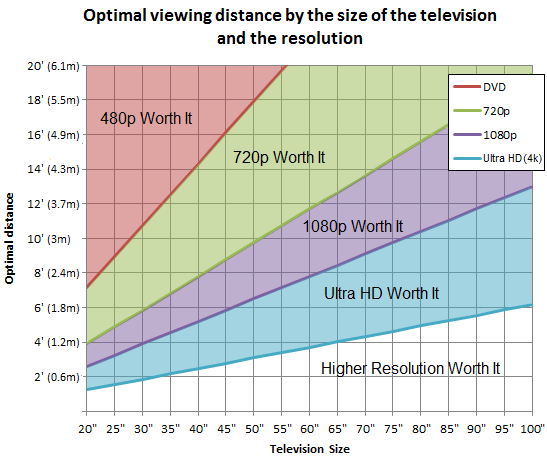
| ▲ | brianwawok 4 hours ago | parent | next [-] | | Depends on distance and size, there is a lovely chart. My projector at 10 feet away is night and day difference at 4k. Mathematically 8k should look identical, so I haven’t spent the money to try it to confirm. The 1080p thing is true in the age of 40” TVs but not so much now, think Costco has a 95” TV if not 100”. | | |
| ▲ | phatfish an hour ago | parent [-] | | I can definitely tell the difference between 1080 and 4k on my 55inch at around the recommended viewing distance. Less so on a 42 inch. A 4k image will look good even on a projector, as you say. Personally I think 4k (with HDR) is good enough for consumer use, so agree with the parent theoretically just not quantitatively. It did take around 20 years from DVD to 4k Bluray though. |
| |
| ▲ | HelloMcFly 3 hours ago | parent | prev | next [-] | | > it's widely accepted that there isn't much benefit for most people above 1080p Is it? By whom? For larger TVs, closer distance, or a combination of the two, there absolutely is value from 4k. https://i.rtings.com/images/optimal-viewing-distance-televis... Though I'm unlikely to ever upgrade from 1440p on my computer, personally. | | |
| ▲ | t-3 44 minutes ago | parent [-] | | Talking about resolution is pointless without mentioning screen size and display tech. PPI is better, but doesn't always work well comparing between technologies. |
| |
| ▲ | StilesCrisis 4 hours ago | parent | prev | next [-] | | It depends on TV size. If you've ever experienced Netflix on a 75" TV, 1080p content looks mediocre on it. So really it's better expressed as "there isn't much benefit for most TV sizes." | | |
| ▲ | broeng 3 hours ago | parent [-] | | I wont quite argue, that 1080p is always enough on a 75", but your example is more a Netflix problem; their compression results in hideous quality, and it's not really representative of what 1080p could be. | | |
| ▲ | StilesCrisis 3 hours ago | parent [-] | | Granted, maybe Netflix wasn't the best example, but I was just trying to be succinct. |
|
| |
| ▲ | oblio 5 hours ago | parent | prev [-] | | Yeah, but that's based on a hard limits, the physics of the eye. The example was poorly chosen. |
| |
| ▲ | t-sauer 5 hours ago | parent | prev | next [-] | | Your example also counters your point: A lot of people do not care about 4k, and even less do care about 8k or above. We reached a point where most people are completely happy with the quality they get. | | |
| ▲ | lelanthran 4 hours ago | parent | next [-] | | > Your example also counters your point: A lot of people do not care about 4k, and even less do care about 8k or above. We reached a point where most people are completely happy with the quality they get. And when (not if) we get to the 4k (or 8k) equivalent of LLMs, they'll just be baked into hardware and we'll have near instant responses while running locally. There is no future where OpenAI, Anthropic, etc survive with their current business model; at some point we will hit a point where training a new model is done only every 5 years or so, and in that scenario we aren't going to be running models of pricey server GPUs with latencies measured in seconds and full responses measured in minutes. We'll be running locally with sub-millisecond latencies and responses measured in milliseconds. There is no way for any big company to compete with the current business plan of selling inference or subscriptions. | |
| ▲ | seb1204 3 hours ago | parent | prev | next [-] | | I dare say many are watching on handheld devices and not big screens. At least a sizeable percentage I would say. My guess. | |
| ▲ | phoghed 4 hours ago | parent | prev [-] | | Likely constrained by the fact people are mostly watching low bitrate Netflix streams. |
| |
| ▲ | sureglymop 5 hours ago | parent | prev | next [-] | | Don't forget that it's only an assumption that scaling more results in better models. There may be a ceiling to that. If that is hit and the best performing possible model can run in little VRAM, your argument here doesn't hold anymore. In a way it is actually the same thing that makes us accept AI as working in the first place. It only needs to be good enough for human perception. The same is probably true for compute. | | |
| ▲ | oblio 4 hours ago | parent [-] | | I'd argue we've already hit the ceiling. Can you truly tell the different between SOTA models from 9 months ago and those from today? There are some improvements but they're mostly marginal. Plus there is a chance the actual scaling that matters is beyond our reach. Think instead of TB models, PB or ZB models. We don't even have that kind of information. Humanity in its entire history hasn't generated 1ZB of information. | | |
| ▲ | xyzsparetimexyz 2 hours ago | parent [-] | | > Can you truly tell the different between SOTA models from 9 months ago and those from today On a task that corresponds to the benchmarks, yes absolutely. |
|
| |
| ▲ | flohofwoe 3 hours ago | parent | prev | next [-] | | FWIW I still play PC games on 1080p (also has the nice side effect that I don't need to buy an overpriced highend GPU, nor use upscaling hacks like DLSS which trash image quality). | |
| ▲ | lelanthran 4 hours ago | parent | prev [-] | | > Standard Def TV was plenty for 50 years. But when more was on offer, everyone went for it, and now you can't even buy a 480p TV. And yet when we hit 4k, that's were people just stopped buying higher res. 8K is still useful, but only when the screen is so large that it doesn't fit in the room :-/ | | |
| ▲ | bogdan 4 hours ago | parent [-] | | There's barely any media in 8k. There's so many ppi you can squeeze before your eye can't tell the difference anymore. |
|
|
|
| ▲ | odyssey7 4 hours ago | parent | prev | next [-] |
| Historical precedent: Quickselect, or any other discovery of a surprising algorithmic speed-up. LLMs haven’t been on the scene for very long. There’s still lots of room for efficiency discoveries. Plus, I keep hearing quantum is going to be a big deal in the next few years. |
| |
| ▲ | _glass 4 hours ago | parent [-] | | Super interesting, when Quantum computing would enable really large models, or much larger contexts. But QRAM is even more behind than pure fault-tolerant gates. |
|
|
| ▲ | an hour ago | parent | prev | next [-] |
| [deleted] |
|
| ▲ | EarthMephit 4 hours ago | parent | prev | next [-] |
| I haven't tried it, but colibri is meant to allow running GLM 5.2 the 744B model in 32GB by using prefetches and streaming from fast SSDs. https://github.com/JustVugg/colibri |
| |
| ▲ | kcb 2 hours ago | parent [-] | | Terrible performance on $20,000 worth of GPUs. |
|
|
| ▲ | fooker 2 hours ago | parent | prev | next [-] |
| I'm claiming that the max amount of intelligence you get out of a 100GB model is unlikely to be that much lower than what you can get out of a 1TB model. |
|
| ▲ | yieldcrv 5 hours ago | parent | prev | next [-] |
| It’s not just about small models, that’s only one part of evolution Some groups are baking models into silicone, Deepmind has an example, it gets 18,000 tokens/sec on Llama 3.1, not sure about parameter size |
| |
| ▲ | fooker 2 hours ago | parent | next [-] | | > Some groups are baking models into silicone While some other groups are baking silicone into models :) | |
| ▲ | intrasight 5 hours ago | parent | prev [-] | | I think this is the future - at least it will be for on-device models. Apple, for instance, will "bake silicon" once a year for their current model, and use that chip in all their devices. |
|
|
| ▲ | petesergeant 4 hours ago | parent | prev | next [-] |
| > How would we do that? There's no historic precedent for that. Its fundamentally an information theory thing Maybe? Human science history is absolutely littered with examples of things that were “constrained” by a fundamental law … until they weren’t, because we’d misunderstood or misapplied the law. |
|
| ▲ | lelanthran 4 hours ago | parent | prev | next [-] |
| > How would we do that? There's no historic precedent for that. Its fundamentally an information theory thing: what's the max amount of intelligence you can get out of 1 KB/MB/GB? There has to be a limit and I'm not convinced that it's far off. Sure, it might be very near using the current approach, but... it might also be might be very far off because we are using the wrong approach. I mean, look at the max amount of intelligence you can get out of a human brain powered by two bananas... |
| |
| ▲ | leoc 4 hours ago | parent [-] | | Though even if there are big further breakthroughs to be made here, they won’t necessarily be made soon, and if they aren’t made in the next ~10 years then they won’t really affect the outcome of chip investments made now or in the immediate future. |
|
|
| ▲ | bebe8393jrir 3 hours ago | parent | prev [-] |
| Just replicate dogs brain. It is the ultimate state of art (far smarter than people). But you need a few kb of memory to replicate resoning skills. Dogs are very smart! |