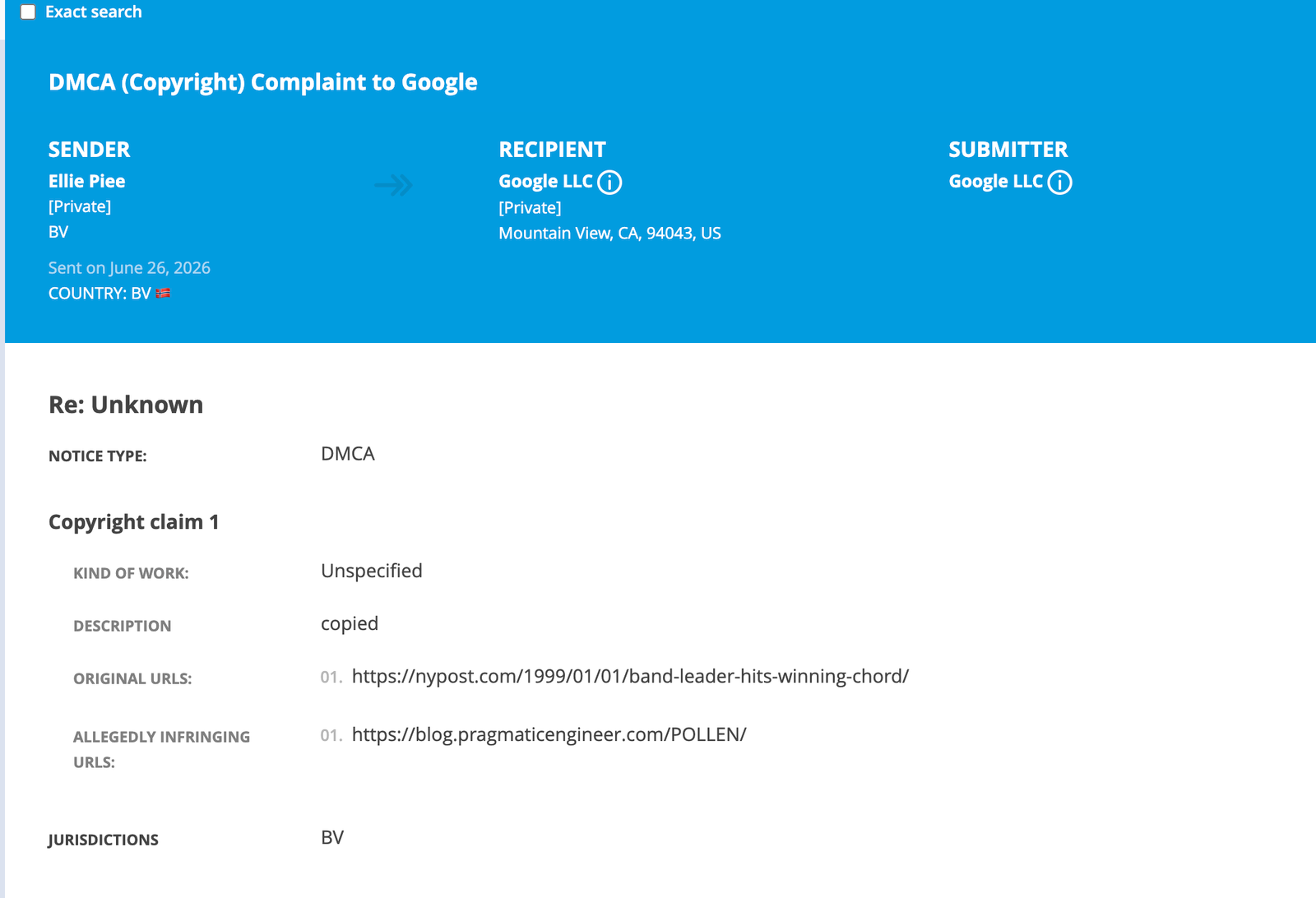
| ▲ | pibaker 5 hours ago |
| Ah, yes, you know someone's desperate when you see a bogus DMCA claim like this. Not the first time this happened and definitely won't be the last. This also demonstrates why it is bad for a law to mandate private entities to do moderation, in this case taking down copyright infringement materials when reported. Google, like basically all big platforms, doesn't care if a claim is fraudulent because the parties impacted cannot hold it accountable — google will just tell you they are themselves victims of the fraudulent claim. And to be fair, they are. But it has to enforce the claims or else lose its safe harbor exemption. This practically allows bad actors to use platforms as their shields, and in the end no one but the victim suffers any consequences for their abuse of the copyright laws. I think a more sane approach would to require every copyright takedown to require a court order. Granted, the legal system is not perfect, but judges are not incentivized to always side with the supposed copyright holder like online platforms do. They will not be letting someone claiming to be living on a deserted island to file a claim and even when fraud does occur, they will at least know where the claim is actually coming from and be able to punish the fraudster accordingly. |
|
| ▲ | atombender 4 hours ago | parent | next [-] |
| A good start would be to require that claimants must verify their real identity. The claim in this case was made by an apparent pseudonym and their address is fictional. Both should themselves be reason to reject the claim. The fact that anyone apparently can submit claims to Google under false names seems insane to me. |
| |
| ▲ | pibaker 3 hours ago | parent | next [-] | | This is another problem with letting private entities be the arbitrator. How is Google supposed to know if Ellie Piee is a real person? It can ask for ID verification of course, but these can be faked, and when that happens there is little Google can do to hold the claimant accountable. A court will certainly have an easier time verifying the identity of the claimant and take action when fraud occurs. | | |
| ▲ | buran77 2 hours ago | parent | next [-] | | > How is Google supposed to know if Ellie Piee is a real person? That doesn't really matter. Anyway it's silly to question whether Google, a multi-trillion dollar company, can validate someone's ID when they already do it in many other aspects of their business. But is Google treating some claims different from others? Are Ellie Piee's claim against Gergely Orosz's article, and the latter's appeal treated exactly the same as any other? In other words, if I use an obviously bogus identity to make DMCA claims against Google content on their own platforms, will they immediately take it down and then go through the same standard appeal process? If not, then the system isn't "abused" it's used exactly as it was designed to be used. In an asymmetrical manner to the benefit of some. So the real question isn't "how can Google validate an identity", it's "why is Google treating some different from others"? It sure isn't an accident. | | |
| ▲ | FireBeyond 28 minutes ago | parent [-] | | Google has no problems "verifying" me with mapping to my phone number, etc. (Actually, it does, after a long and storied startup career, I can no longer create a new Google account because my phone number "has been used too often"). There's also the asymmetry of "you don't need to supply ID to make a DMCA claim, but you will to appeal it", which people can and have used to discover identities for more harassment. |
| |
| ▲ | Geezus_42 3 hours ago | parent | prev | next [-] | | We already have private entities checking IDs everyday for all kinds of things. That is a solved problem. | |
| ▲ | nextaccountic 2 hours ago | parent | prev [-] | | How are banks supposed to know if Ellie Piee is a real person? Actually How is Google supposed to know if Ellie Piee is a real person when Ellie Piee pays for a Google product? Or otherwise uses a Google service that requires identity |
| |
| ▲ | wizzwizz4 4 hours ago | parent | prev [-] | | Who decides what counts as a "real identity"? Fictional address, sure: that would, as I understand, be some kind of fraud, and can reasonably be prohibited if there's a mechanism to do so… but then you run into the problem that not everyone has an address. | | |
| ▲ | atombender 3 hours ago | parent | next [-] | | The onus is on the DMCA processor to verify the legitimacy of the claim. I don't have a real solution, but Congress created the problem and should solve it. There's of course a whole legal system that has been dealing with this since for ever. If I were to implement it myself, I'd use a third party service like those that can verify passports and driver's licenses and so on. | | |
| ▲ | kevin_thibedeau an hour ago | parent [-] | | No they don't. The onus on them is to comply with the takedown request and provide for immediate restoration with a counter-notice. If the initiator is acting in bad faith it will be exposed if they attempt to litigate. The friction free restoration flow is what Google is missing because they don't actually follow the DMCA process. Amend the law to strip safe harbor immunity in this scenario and suddenly we'd see abuse effectively combated. | | |
| ▲ | ryantgtg 42 minutes ago | parent [-] | | Etsy seems to operate in the same way as google. I had a DMCA against a listing of mine that should have been protected as parody. Etsy immediately complied with the takedown, and then I emailed the complainant and they agreed it was a mistake from their system/consultant. But they never took the next step of contacting Etsy to say they were wrong. So I could never restore the listing. |
|
| |
| ▲ | chrisweekly 3 hours ago | parent | prev | next [-] | | I appreciate the sentiment, as someone who is sympathetic to the plight of the homeless / unhoused. But in practical terms, when it comes to aligning a system with justice, IMHO requiring DMCA plaintiffs to have a legal address seems preferable to the status quo. | |
| ▲ | skeeter2020 3 hours ago | parent | prev | next [-] | | from another perspective - who is better resourced than Google to determine if a person and place are real or fictitious? They make these decisions all the time when it suits them. And explain to me this population who is filing DMCA take-down requests that doesn't have an address? the Venn diagram seems shockingly small. | |
| ▲ | criddell 2 hours ago | parent | prev | next [-] | | > Who decides what counts as a "real identity"? Notaries do this all the time often for free or for a fairly minimal fee. The solution doesn't have to be perfect to be better. | |
| ▲ | nkrisc 3 hours ago | parent | prev | next [-] | | Establish the identities of people is something the courts have long had to deal with and is nothing new for them. | | |
| ▲ | wizzwizz4 2 hours ago | parent [-] | | Indeed. But it's not something that Google can do, so bolting on an identity verification requirement to the DMCA process isn't helpful. Re-routing DMCA requests through the bureaucracy of the courts might work. If counterclaims require doxxing yourself under penalty of perjury, then I would assume that's still perjury even if the other guy started it, so just making the counterclaim process easier doesn't fix the problem. |
| |
| ▲ | 3 hours ago | parent | prev [-] | | [deleted] |
|
|
|
| ▲ | HillRat 3 hours ago | parent | prev | next [-] |
| A middle ground (which wouldn't clog up an overburdened court system) would require a US attorney to draft and sign a complaint for a takedown request, putting their accreditation on the line. |
| |
| ▲ | lokar an hour ago | parent [-] | | You could also require a signed letter that has been properly notarized. Again, adds an independent 3rd party with a verified identity and something to loose. And falsifying is a crime. |
|
|
| ▲ | bluGill 3 hours ago | parent | prev | next [-] |
| Was this really DMCA? The article implies it is, but I don't see any evidence (maybe I missed it). There is discussion of what the DMCA says, and Google took the article down. However it is generally understood that DMCA rarely is used to take things down. Instead Google has a "I can't believe it isn't DMCA" process that looks similar, but in reality it isn't actually DMCA. If this is really DMCA then the author should press charges - DMCA take downs are done under penalty of prejury which is a criminal act. Since author legally has copyright they have legal protections under DMCA for exactly this. If this isn't DMCA then it is just Google decision not to index something. They have the right to not index anything they choose not to. Nothing the author can directly do about this - but indirectly they can be witness that Google isn't a "common carrier" since they choose not to index that wasn't copyright, so you just need to find some case where someone else sues google because they found something "harmful" (likely something like suicide instructions) |
| |
|
| ▲ | abirch 5 hours ago | parent | prev | next [-] |
| 1)The legal system is not fast.
2) which jurisdiction should have the right to ask the judge to take down the material? |
| |
| ▲ | b112 4 hours ago | parent [-] | | This could be like warrants and judicial overview. Warrants are not slow. This is only a gatekeep on "does this make any sense". And of course, the cost of the court system/overview/etc could be born by judgments against those found actually guilty. | | |
| ▲ | miyoji 10 minutes ago | parent | next [-] | | > Warrants are not slow. Well, they would be if you needed one for every DMCA takedown. | |
| ▲ | Geezus_42 3 hours ago | parent | prev [-] | | And just like DMCA, warrants are already over used and can often be overly broad. |
|
|
|
| ▲ | RealityVoid 3 hours ago | parent | prev | next [-] |
| > you know someone's desperate when you see a bogus DMCA claim like this I don't think this means desperation, it's just these assholes weaponize the law on a regular basis. Honestly, I usually like to give people the benefit of the doubt. But these Pollen guys seem like grade-A assholes. It is astonishing to me the gall to double charge people on the order or $3.2M and never return the money. I can't bear to not repay someone even a dollar, but intentionally doing stuff like this seems to be run of the mill for these guys. I can't even get in the headspace of people who would do this. |
| |
| ▲ | chrisweekly 3 hours ago | parent [-] | | Agreed 100%. Also (tangential nit for the sake of information-sharing), to "bare" oneself is to be vulnerable; you meant "bear" as in to be able to carry or support something -- and the "myself" is extraneous. So, "I can't bear to..." HTH! :) |
|
|
| ▲ | Geezus_42 3 hours ago | parent | prev | next [-] |
| Our courts are already packed. You'd have to fix that first. |
|
| ▲ | lxgr 4 hours ago | parent | prev | next [-] |
| > I think a more sane approach would to require every copyright takedown to require a court order. In a country with an efficient legal system, maybe… Requiring the claimant to put something at stake (make it a nominal deposit you get back in case of either no challenge or the case actually going to court) seems more realistic, but I’m not holding my breath for a reform of the law to that extent. |
| |
| ▲ | NetMageSCW 44 minutes ago | parent | next [-] | | Why does DMCA need to be handled quickly? | |
| ▲ | bluGill 3 hours ago | parent | prev [-] | | Claimants put something at stake: false DMCA takedowns are under prejury laws which carry prison sentences. I doubt this is really a DMCA case though. DMCA laws exist, but to invoke them requires some specific steps which Google prefers you skip. The fact that this probably isn't DMCA may leave Google open to being sued, but you would have to see a lawyer - be prepared to spend several million dollars to win a few thousand. | | |
|
|
| ▲ | applfanboysbgon 4 hours ago | parent | prev [-] |
| I fucking loathe the current DMCA regime with all of my being. That being said, it is currently the only chance of victims of revenge pornography getting any reprieve whatsoever. I think the solution needs to be to actually punish bad-faith actors rather than to make it more onerous to report violations. It is already illegal to file false DMCA claims, but it has literally never been enforced. Changing the laws doesn't help when the existing laws already have an answer for the problem but aren't being enforced. |