| ▲ | asdff a day ago |
| It is shocking how quickly California developed from agriculture to this, and how it basically stopped developing further after hitting this point. These photos could just as believably be van nuys in 2026. No wonder why we have a housing crisis. Progress and building to meet demand has been refused for almost 60 years. |
|
| ▲ | eagleinparadise a day ago | parent | next [-] |
| I work in commercial real estate, grew up in San Diego and work in the SoCal market. I am not joking that the MAIN problem is Prop 13, which came into effect 5 years after this video was made. I deal with these owners EVERY DAY who would rather sit on crappy buildings and land because why not, it costs them nothing. They've owned forever. Literally TODAY I had an offer rejected from a Seller that would have yielded 80 units of affordable housing in an area with $150k median income, delivering completion in 2028-2029. |
| |
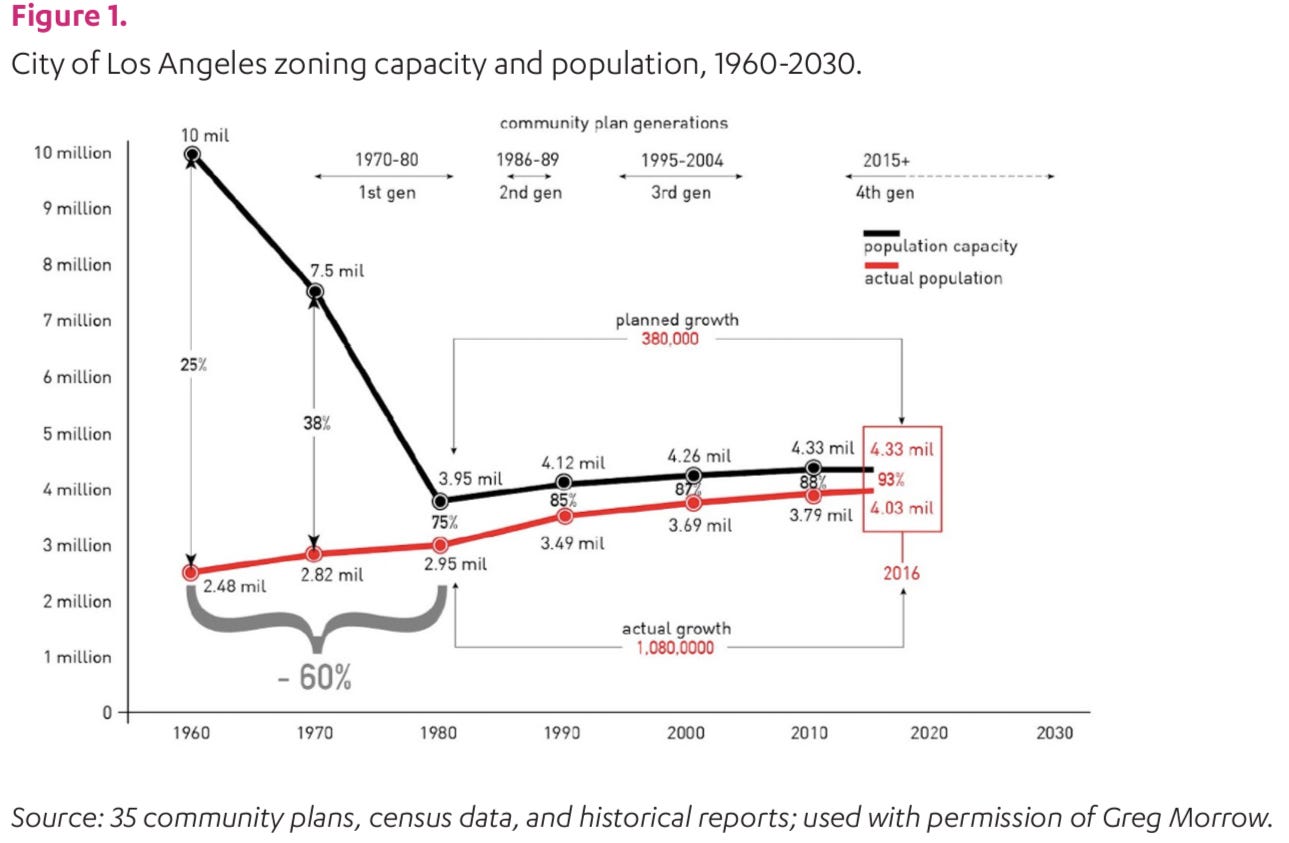
| ▲ | asdff a day ago | parent [-] | | Prop 13 only sees statewide median homeownership period go up slightly in california compared to national average. The real issue is not these edge cases that prop 13 might bring about, but zoning. Have a look at this graph:
https://substackcdn.com/image/fetch/https%3A%2F%2Fsubstack-p... You can see how even with prop 13, even with various RSO ordinances, even with red tape, even with building code requirements, the demand for development has always been enough to build to the limits of what has been allowed through zoning, ever since cities like LA were widely downzoned in response to redlining being made illegal in the early 1970s and succeeding zoning plans. | | |
| ▲ | pchristensen a day ago | parent [-] | | Porque no los dos? Zoning limits what and how much is permitted. Prop 13 changes the economics and greatly reduces churn and supply, both for redevelopment and migration. Prop 13 takes the normal supply problems introduced by zoning and turbocharges them. | | |
| ▲ | asdff 17 hours ago | parent [-] | | The reason why it isn't both is because the data suggests prop 13 isn't really changing homeownership periods by very much. Consider this idea of "sitting on some land because taxes are low" with the reality that this land can't be developed in a very lucrative way against the cost of developing said land. That math changes overnight if that land is now allowed to have a 100 story tower on top of it instead of a single story commercial building perhaps with maybe four tenants paying rent. Now you are sitting on an asset you could actually sell for an appreciable amount of money to someone who will bring the financing to build that 100 story tower, and you can now dump that cash into some investments that will make you more rich. Really, most of the world that is in a housing crisis fits this pattern: high demand for housing, existing environment built to the limits of zoned capacity, local government unwilling to ease zoning so as to preserve the power to anoint land for instantaneous demand driven development. Most (all?) of these places also regularly reassess property tax. |
|
|
|
|
| ▲ | littlexsparkee a day ago | parent | prev | next [-] |
| That was my biggest gripe growing up in SD - felt like Caltrans / SANDAG abdicated responsibility for developing good transit/bike/ped infra, doubling down on car dependency. It should be a mecca of active transportation given the weather! |
| |
| ▲ | asdff a day ago | parent | next [-] | | It is actually absurd the amount of freeways there are in San Diego. How many north south and east west freeways are there? And they are like sometimes 1 mile or less apart from another parallel running freeway. Then you have all these thick roads where its 6-8 lanes across with a 50 mph speed limit basically freeway capacity right there. Probably the most "built for car" urban area in california IMO, with orange county a close second for basically the same reasons (lot of freeway redundancy and also high capacity high speed roads). LA county would be closer but they never finished their highway master plans and it shows with some of the freeway void spaces where planned freeways were never built for varying reasons. They have those 50mph high speed roads but its limited to the comparatively newer sections of LA county like santa clarita, which is very much built in a "san diegan" way compared to the older san fernando valley. | |
| ▲ | jallmann a day ago | parent | prev [-] | | Agreed it's a bummer. There's a lot of low-density sprawl in San Diego county which makes effective transit difficult, and because you have to drive everywhere, sentiment trends anti-bicycle. The previous CEO of SANDAG tried to push a mobility-centric vision but left because of intense pushback from folks who wanted more funding for roads and freeways, rather than transit and bike paths. |
|
|
| ▲ | lapetitejort a day ago | parent | prev | next [-] |
| I love looking at historical photos of Southern California if only to re-enforce this exact phenomenon. At one point the largest vineyard in the world existed in Southern California [0]. Just a small patch of green and some abandoned buildings remain [1]. [0]: https://en.wikipedia.org/wiki/Guasti%2C_California [1]: https://www.google.com/maps/place/Guasti,+Ontario,+CA+91761/ |
|
| ▲ | nomel a day ago | parent | prev | next [-] |
| I think it's the only possible outcome if sprawl is allowed. New families with some money spend too much income buying house. Kids move out, parents get old and don't get out as much. Don't keep up the house, because they need to retire. Sell house that's only attractive to lower income. Low income statistics take over the area. Nearby businesses close from everything related to low income statistics. Repeat with new families and newly built houses at edge of city, letting the interior rot. Like a slime mold. |
| |
| ▲ | asdff a day ago | parent [-] | | Infill development used to be allowed in California but it stopped in the early 70s when communities turned to zoning to exclude blacks and browns after redlining was made illegal. The many sundown towns did not go without a fight. There are still some pieces of what that infil looked like. The bog standard brick 5 story building you see all over east coast cities can be found in california in parts, often sticking out like a sore thumb because nothing has been allowed to be built to that height since the late 1960s/early 1970s. The dingbat is another example of infill housing that was since made illegal although it was quite popular. Most blocks you see with some sort of apartments were at one point single family home lots, but this sort of development carefully limited to the blocks you now see them instead of widespread throughout the area. There was even a time when very large highrises were being constructed e.g. Wilshire Blvd's condo canyon. But that was also seen as a blight and quickly stopped in its tracks from expanding beyond the immediate arterial frontage. All hell would surely break loose if you allowed for student housing to be built on the eastern edge of UCLA instead of contained in the sliver of land between the school and veterans cemetery I guess. Unfortunately for the student body, the school is shoehorned in between two prestigious country clubs, and it is clear where priorities lay among local leadership. | | |
| ▲ | socalgal2 a day ago | parent [-] | | Communities did not turn to zoning in response to infill being disallowed. Zoning was around since at least 1917 and already for that purpose. Zoning in the 70s was more a response to (1) homeownership property value protection (2) nimbys being given the power to block projects like they still do today, especially in highly "progressive" cities. The more progressive, the harder to build (3) people claiming expansion was bad for the environment. | | |
| ▲ | asdff a day ago | parent [-] | | >Communities did not turn to zoning in response to infill being disallowed. ??? Zoning is the mechanism to disallow infill, it can't come in response to it. The book "The Color of Law" by Richard Rothstein covers how zoning as used as a new tool for racial exclusion in its third chapter. Indeed, modern socal remains a highly segregated area thanks to zoning decisions that ensure working class people, who are predominantly nonwhite, will find no suitable housing they might afford in the various lily white strongholds. | | |
| ▲ | socalgal2 7 hours ago | parent [-] | | Ridiculous. Every community in Socal is massively more integrated than it's ever been. Quit making shit up and then geting inraged by it and actally look at the numbers. |
|
|
|
|
|
| ▲ | socalgal2 a day ago | parent | prev [-] |
| > It is shocking how quickly California developed from agriculture to this Check out Disneyland. There was nothing else there when it opened in 1955 https://www.youtube.com/watch?v=YtrVcOxVDls |