| ▲ | tristanj 9 hours ago |
| This question has multiple layers of thinking: 1. People who can't read pick randomly. 2. People who can read, but are too dumb to model or care about other people pick red. 3. People with enough intelligence for basic cognitive empathy pick blue. 4. People a little smarter and think through game theory overall pick red, and think they are smart for doing so. 5. People smarter than #4 and capable of seeing the big picture realize they don't want to leave people who choose #1 and #3 dead, so they pick blue. 6. People who realize the game theory optimal strategy is to announce you're pressing blue and convince everyone else to press blue, but privately press red. There are probably more layers to this but the whole debate involves people getting upset at each other and accusing people of being in groups they are not. Red group #4 accuses blue group #5 of being #3 (not thinking beyond basic cognitive empathy). Blue group #5 accuses red group #4 of being group #2 (too dumb to model how others act). It's almost a perfect ragebait question. As for which camp I am in, I am pressing blue and think you should too. |
|
| ▲ | quuxplusone 6 hours ago | parent | next [-] |
| The framing in terms of colors helps the reader to interpret the thought experiment in terms of "groups" or "teams" — as if there's a "blue team" that you can join by helping, and help by joining. Many readers will quickly [ https://en.wikipedia.org/wiki/Stroop_effect ] intuitively choose to join the blue team, and then rationalize their choice as a strategy to help their blue teammates. But in fact the thought experiment doesn't say there are teams or groups at all! The reader imposes that part on their own, unconsciously at first, because of the description's emphasis on colors. I predict that running the same Twitter poll with flipped colors — so that red means "I die, unless a majority of my fellows pick red" and blue means "I survive no matter what" — would yield a majority for blue too. What was previously justified as the "virtuous" choice (blue) would now be justified as the "only intelligent" choice (blue). |
|
| ▲ | troglodytetrain 9 hours ago | parent | prev | next [-] |
| Your entire logical chain, and your self importance, well, it explains why I'm always picking red. If you win and most pick blue, I'm safe, otherwise, I'm also safe. You get to feel intellectually superior choosing the only option that can lead you to die. The simple answer is everyone should pick red. |
| |
| ▲ | 3 hours ago | parent | next [-] | | [deleted] | |
| ▲ | DetroitThrow 9 hours ago | parent | prev [-] | | >The simple answer is everyone should pick red. The simplest answer is that everyone should pick blue, actually. This is because choosing blue results in no consequences, but choosing red does result in consequences. Why not choose the simple option? It's literally the "no consequences" button. Seems like these reds are overcomplicating a simple question. | | |
| ▲ | troglodytetrain 9 hours ago | parent [-] | | Please explain. Red guarantees safety. Why wouldn't everyone pick red? The only option that leads to a statistical chance of death is blue? | | |
| ▲ | troglodytetrain 9 hours ago | parent | next [-] | | I think this hypothetical captures a sort of hero complex. You think everyone is too stupid to choose the right choice so you will save us all... Except we all chose red because its the obvious choice and now you are dead. | |
| ▲ | gpm 7 hours ago | parent | prev | next [-] | | The only option that leads to a statistical chance of murder though is red. | |
| ▲ | blargey 3 hours ago | parent | prev [-] | | The framing leads many people to pick blue for its altruistic framing. Enough, in fact, that 50% quorum is honestly not difficult. A lot of red-advocates seem to have a False Consensus Effect going where they're convinced way more people than in reality will interpret this "dilemma" as "do you step in the human grinder in hopes of jamming it", and act accordingly. A 70% or 90% requirement, or just explicitly framing it as "do you step into the human grinder" would make it vastly easier to aim for 100% red, but we're dealing with the literal words of the "everyone lives button" here. |
|
|
|
|
| ▲ | allajfjwbwkwja 9 hours ago | parent | prev | next [-] |
| (6) isn't correct. Left alone, everyone rational would pick red because it's the only logical option. You trying to convince them otherwise might end up getting 49% of the population killed. You should try to get everyone to pick red, not blue. |
| |
| ▲ | DetroitThrow 9 hours ago | parent [-] | | Left alone, everyone rational would pick blue, actually. | | |
| ▲ | allajfjwbwkwja 9 hours ago | parent [-] | | And why do you think that? | | |
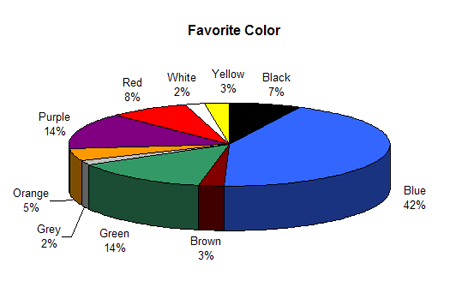
| ▲ | DetroitThrow 9 hours ago | parent [-] | | Since if a rational actor would understand that the group can avoid ever dying to this game by simply choosing blue. There is no consequence for choosing blue - but there is a consequence for choosing red. Also, regardless of these specific consequences, people who are rational/ethical will by default choose blue because it is a good color. See also, people by default choose blue at 5x the rate as red, really putting a dent in "red==rational" conjecture: https://www.joehallock.com/edu/COM498/media/graphs/fav-color... I hope this makes sense! | | |
| ▲ | nostrademons 6 hours ago | parent | next [-] | | There are two globally optimal solutions to this problem: > 50% pick blue (saving everybody), and 100% of the people pick red (saving everybody). There is only one Nash equilibrium, which is for everybody to pick red. This is also strictly dominant for each player (if they choose red, they have a 100% chance of surviving, while if they choose blue, they only survive if > 50% of other people also choose blue). Knowing this, every participant has an incentive to choose red. | | |
| ▲ | adverbly an hour ago | parent [-] | | > Nash equilibrium Bro... Game theory laws like Nash equilibrium dont apply if the population is irrational. Which it largely is! Good luck explaining Nash equilibrium to a baby. |
| |
| ▲ | allajfjwbwkwja 9 hours ago | parent | prev | next [-] | | Only irrational people will pick blue. Let's say that's ~3% of the population. Trying to get another 47% of the population to pick blue risks losing all of them as well. That's not ethical. | |
| ▲ | pessimizer 7 hours ago | parent | prev | next [-] | | People's "by default" behavior will never define what is rational. You don't do polling to choose rationality. If there is a game in which you choose between two buttons, you know everyone will get this same choice, and one button says that you definitely live and the other button says that there's a chance that you will die, adding more rules to the "maybe death button" can not make it a more rational choice. This is actually an experiment that I would get behind doing in real life. I will pick the red button. We could do it every morning. There are enough collective action problems with real and obvious benefits leading to catastrophe without the need to create more unnecessarily, or to have any confidence in in a world full of strangers' collective ability to solve them. Campaigning for blue is actually murder; you've encouraged a situation that may result in the deaths of 49% of the population. | |
| ▲ | nicebyte 7 hours ago | parent | prev [-] | | > There is no consequence for choosing blue there are consequences in both cases. |
|
|
|
|
|
| ▲ | hx8 9 hours ago | parent | prev | next [-] |
| You've structured ways to think about the problem in a hierarchy of intelligence, which is a classic economics mistake. People are not rational actors, and the primary factors determining who pushes the button will be self-preservation or group-preservation. Emotional factors. Also, I think that's a simplistic view of intelligence. |
|
| ▲ | alienbaby 7 hours ago | parent | prev | next [-] |
| You have two buttons. If you press that one, you might die. If you press the other one, you won't die. Which one do you press? |
| |
| ▲ | gpm 7 hours ago | parent [-] | | You have two buttons. If you press one, you're more likely to die. If you press the other, you might murder millions of people. Am I talking about the game, or a preemptive nuclear strike that has a good chance of knocking out the enemies ability to ever launch? | | |
| ▲ | Imustaskforhelp 6 hours ago | parent [-] | | Not to be political but we literally vote blue and red in politics and that can sometimes kill people literally in wars and some die silent deaths because of the impacts of their policies. I would say that its hard to underestimate the social estimates of these things. A person who will genuinely be impacted by it themselves would fall into these traps more than one might think. History has many examples of fascism that some suggest that these periods of turmoil are the norm rather than exception. Once again an obligatory message about how the world faces some genuine issues but instead of fixing them as a civilization, We would much rather prefer to have scapegoats and this goes both ways and might be true in a certain way and at a certain path both sides are too extreme to ever collaborate for the most part that a nation of once great strength might die a slow exhausting death if nothing changes. I have come to the realization, The world has always been like this and it might always be like this. Its messy but also one can imagine this as a side effect as the mere coexsistence of our species in such massive numbers might demand polarization. Some people create initial changes (for greed, genuineness etc.) people then follow it (true belief) people then meet other people and become friends with them and create a community. new people are born or who change because of the community aspect (Since most things are nuanced, it is easy to frame anything and sometimes everything into such communities.) The original people who made the thing dies/are out of power and new people from the community join. these communities gain influence and decide the decision making but the heads of such communities are prone to narcissism or any other ways to draft as much as attention as possible as it seems that all attention is (good attention??) More corruption follows, even the people of community are impacted and they might hear criticisms but the lock-in is too much. Stockholm syndrome. Everyone else face the consequence and someone new creates a new movement and create another set of intial changes. Competition between multiple colors follows, we also see cooperation between red and blue to prevent outside competition. In such sense, change creates change and cycle repeats. It is up to our interpretation on if there is any idea itself which can remain logical if its implementation or implementors get corrupted in a sense similar to erosion of the main values. more than anything, humanity wants a community. a human somehow wants acceptance and validation for himself and he is selfish in the sense that he will put a blind eye sometimes if he isn't virtuous to damage outside his house (sometimes inside as well) and he wants a community because that is the only way he functions within a society of millions and billions while monkeys cant operate on more than hundreds. More than a political critique, my point is, we should be more aware of this human tradeoff from empirical evidences and open up this blind spot and perhaps be more aware about it. |
|
|
|
| ▲ | 2muchinternet 4 hours ago | parent | prev | next [-] |
| You're missing the seventh group: trolls/assholes who will always press red but try to convince/muddy the waters about the blue button aiming to get a not-insignificant amount of <50% blue pushed to get people killed. Prime candidate pool: 4chan. If the question was restricted to local communities with 0 internet access, I would be more inclined to press blue. But on a global scale? No fucking way. |
|
| ▲ | jmull 4 hours ago | parent | prev | next [-] |
| I was thinking that if some evil god could credibly force this sadistic choice on humanity we’re all in trouble, regardless of the button you push. I’d probably turn my mind to resistance and refuse to push any buttons if possible. |
|
| ▲ | halter73 9 hours ago | parent | prev | next [-] |
| > 6. People who realize the game theory optimal strategy is to announce you're pressing blue and convince everyone else to press blue, but privately press red. A lot of this analysis depends on accurately guessing how people will react, so it's probably hard to say any strategy is game theory optimal without a lot of unrealistic simplifying assumptions. In a world where you're able to convince a lot of people anything, it might better to convince everyone to press red. If it looks like 99.99% of people will press red without your influence, you're probably best off spending your time convincing the .01% who might press blue not to do so. It also has the upside of not making you a dirty liar. I wonder, what would Kant think about this hypothetical? |
|
| ▲ | ncruces 7 hours ago | parent | prev | next [-] |
| So… you're 6? |
|
| ▲ | DetroitThrow 9 hours ago | parent | prev | next [-] |
| Missing the layer where blue is my favorite color and therefore I will always choose blue. From this perspective, all other reasonings lack basic empathy and/or intelligence. |
|
| ▲ | aaron695 5 hours ago | parent | prev [-] |
| [dead] |