|
| ▲ | jcranmer 4 hours ago | parent | next [-] |
| A lot of people hate standard time in winter because the sun sets at 4 or 5, and they want the sun to instead set at 8 or 9 like it does in summer. DST in winter doesn't actually give you the 8 or 9 sunset, it gives you a 5 or 6 sunset (which doesn't get you all that much) combined with moving your sunrise to 8 or 9, which causes its own set of issues most people don't think about. The last time we went to year-round DST, we stopped almost immediately because people experienced what winter DST was actually like and went "wait, this sucks." |
| |
| ▲ | somat 3 hours ago | parent | next [-] | | Obviously(/s) the solution is to change to a sunset centered day. new day starts at sunset so people can get up late and enjoy the maxim number of daylight hours. I always find it strange how particular people are about the numbers attached a purely astronomical phenomena(myself included, but I am pretty hard in the "let the sun figure it out camp"). If they want more "daylight" hours then get up at a time to enjoy them. But people would rather bend over backwards fiddling with the numbers as if that is going to change how long a day is. | | |
| ▲ | toast0 an hour ago | parent | next [-] | | Does the night belong to the day it follows or the day it precedes? Does it become Friday at dawn, at sunset, at noon, or at midnight? This is all convention and not something that can be decided objectively. | |
| ▲ | anal_reactor an hour ago | parent | prev [-] | | I think that midnight should be around current 4AM because that's the brief moment when party people already sleep and work people aren't awake yet. |
| |
| ▲ | verall 2 hours ago | parent | prev | next [-] | | No, I hate standard time, because in winter the sun sets at 4 or 5, when it could set at 5 or 6, i.e. daylight when leaving work. I do not care if the sun is up as I shuffle groggily into the building. I don't think I'm alone. | |
| ▲ | illusive4080 an hour ago | parent | prev | next [-] | | Despite all this I am a permanent DST fan. However I’ll be happy with permanent anything over the current madness | |
| ▲ | dave78 2 hours ago | parent | prev [-] | | > which doesn't get you all that much After college I moved from the far western edge of one timezone to the far eastern edge of another zone. I grew up with 5-5:30pm sunsets in winter, and now I live with 4-4:30pm sunsets. I moved here 25 years ago, and every single year when November/December come around and I get those early sunsets I hate it. It's one of the reasons I'd like to move away from here. I know it's just one person's opinion, but to me those extremely early sunsets in the middle of winter are a huge quality of life reduction. I believe part of the problem is that if you're in the middle or western edge of your zone, the winter sunsets aren't so bad. I suspect a lot of people who would prefer DST year round live on the eastern edge. |
|
|
| ▲ | sorenjan 4 hours ago | parent | prev | next [-] |
| They worked best when everybody were farmers and had to get up early and go to bed early. Now most people don't live their lives centered around noon, our free time comes after our work is done at around 17:00, so having more light in the evening instead of worthless light in the night makes sense. |
| |
| ▲ | bryanlarsen 4 hours ago | parent [-] | | That's a myth. Farmers have to wake up early because their animals wake up at sunrise and some tasks are best performed at that time. So they wake up before sunrise regardless of the clock time. Human, like farm animals, are better off if they wake up at sunrise and go to sleep in full dark. At the equator that's easy, wake at 6, bed at 10PM. And standard work hours are 7-3 or 8-4. | | |
| ▲ | sorenjan 4 hours ago | parent | next [-] | | Right, but where I live sunrise is in the middle of the night in the summer (around 03:30). Using standard time in the summer gives me one less hour of useful sunlight in the evening, and while it doesn't technically disappear it gets moved to where I can't use it because that's when I sleep. It's the same for people further south as well, another bright hour in the early morning before they wake up is a wasted bright hour that would make more sense in the evening, when most modern humans are awake. The argument "noon should coincide with solar noon" is nonsensical to me, the clock is a social construct and should make sense for how most of us live our lives. | | |
| ▲ | 1718627440 4 hours ago | parent | next [-] | | But the social construct of work hours shifted later by more than that one hour during the last century, so this is not what people actually prefer by their actions. | |
| ▲ | bryanlarsen 4 hours ago | parent | prev [-] | | Optimizing for summer is silly. Summer gets lots of daylight already. We need to optimize for winter. | | |
| ▲ | layer8 3 hours ago | parent [-] | | People disagree on whether to prioritize mornings or afternoons in the winter. For the summer, only very few people care if the sun rises at four or five (or whatever), but most people like having long summer evenings. Therefore the summer tips the scales. | | |
| ▲ | 1718627440 3 hours ago | parent [-] | | Then they are also social activities that you just need to wait for in summer, because they can only happen after sunset. Viewing a movie (outside), sitting around a fire, having a party all just really happen after sunset. |
|
|
| |
| ▲ | dessimus 4 hours ago | parent | prev [-] | | So, it sounds like you're actually arguing that the numbers are just a construct and that we should all just use UTC and set appropriate work hours to the times that most correlate to the solar day in our region rather than adjust the clock approximately 1 hour per 15 degrees around the equator and have an International Date Line. I think this would make way more sense, when they say the Olympic Opening Ceremony start at 18:00, its 18:00 for everyone around the world. No one as to work out which TZ Italy is in or scheduling meetings with Tech Support in far flung locales does not require knowing IST is how far ahead or behind. | | |
| ▲ | shagie 4 hours ago | parent | next [-] | | Yes. https://en.wikipedia.org/wiki/Sandford_Fleming ( https://www.smithsonianmag.com/smithsonian-institution/sandf... ) > He promoted worldwide standard time zones, a prime meridian, and use of the 24-hour clock as key elements to communicating the accurate time, all of which influenced the creation of Coordinated Universal Time. The one bit where this would be problematic would be "what day is it?" When does today become tomorrow? There are a lot of systems that we've built that depend on that distinction. Things like business days and running end of day so that everything that happens on March 2nd is logged as March 2nd. I've encountered fun with Black Friday sales where the store is open over the midnight boundary and the backend system really wants today to be today rather than yesterday (sometimes this has involved unplugging a register from the network so that it doesn't run end of day, running EOD on the store systems, and then plugging the register back in after it completes and then running a reconciliation.). Other than that particular mess of banks and businesses... yea, running everything on UTC would be something nice in today's world. --- This is also kind of what happens in China (with a complicated history). https://github.com/eggert/tz/blob/main/asia#L272 https://en.wikipedia.org/wiki/Time_in_China UTC+08:00 is observed throughout the country even though it spans about 60° of longitude. --- Aside on the "changing clocks" and realizing my flexible schedule privilege at a company I worked at I switched my schedule from 8-4 to 9-5 with the change in daylight savings so that I maintained a consistent "this is the hour I wake up". | |
| ▲ | fc417fc802 3 hours ago | parent | prev [-] | | > arguing that the numbers are just a construct Yes. > and that we should all just use UTC and ... No. that does not follow. Abstraction is useful. Having commonly understood terms (in this case hours of the day) that share certain traits regardless of where you happen to be in the world facilitates communication. |
|
|
|
|
| ▲ | tbrownaw 4 hours ago | parent | prev | next [-] |
| We don't use standard time because it works best, we use it because it's "correct" relative to the position of the sun. Now, standard business hours (9-5 or whatever) were probably chosen for working well in the circumstances where they became standard, and it might be interesting to watch for whether tweaking the clocks leads to tweaking the nominal time of things... |
|
| ▲ | jamie_ca 5 hours ago | parent | prev | next [-] |
| The US decided (and Canada followed) that daylight time was more correct for the larger portion of the year, presumably it's easier to transition the remaining 4mo to daylight than it is to move 8mo to standard. But also, all the opinion polling (business and individual) was like over 90% in favour of year-round daylight time, so here we are. |
| |
| ▲ | tzs 2 hours ago | parent [-] | | > The US decided (and Canada followed) that daylight time was more correct for the larger portion of the year, presumably it's easier to transition the remaining 4mo to daylight than it is to move 8mo to standard. How is transitioning permanently to one easier than transitioning permanently to the other? How to transition to permanent DST: wait until we are in DST and then stop switching. How to transition to permanent Standard time: wait until we are in standard time and then stop switching. | | |
| ▲ | toast0 35 minutes ago | parent | next [-] | | If you adopt permanent DST, the there's a 1 hour difference between the current clock and the future clock for 4 months, and nothing for 8 months. If you adopt permanent ST, the difference between the current clock and future clock is 1 hour for 8 months and nothing for 4 months. It's a 4 month-hour difference over the year, instead of an 8 month-hour difference. Personally, I'd prefer standard time, but having all days be 86400 seconds is a pretty great improvement over status quo. I find what most people really would like to change is the amount of time with sunlight in the winter, especially the more north they live... but changing the clock doesn't change the number of hours of sunlight; Vancouver, BC just doesn't have much sunlight in the winter. | |
| ▲ | tempestn an hour ago | parent | prev [-] | | If we assume that the ideal time for 8 months of the year is DST and for 4 months is standard, but we want to eliminate the switch, then permanent DST gives you only 4 months out of the ideal timezone rather than 8. |
|
|
|
| ▲ | throwaway7783 3 hours ago | parent | prev | next [-] |
| The article, however, says 93% wanted daylight savings in the linked public engagement report. |
|
| ▲ | delta_p_delta_x 4 hours ago | parent | prev | next [-] |
| > It's "standard" for a reason The reason is that with standard time, solar noon coincides with local noon, so the day is approximately symmetric about noon, not regarding atmospheric refraction lengthening the day. It wasn't done on a whim. |
|
| ▲ | rawgabbit 12 minutes ago | parent | prev | next [-] |
| Meh. The nerd in me prefers the French Revolutionary clock of 10 hours in a day. https://en.wikipedia.org/wiki/Decimal_time. I want to be able to say I sleep from 0 to 3 hours or 30 percent of the day. |
|
| ▲ | Gimpei 4 hours ago | parent | prev | next [-] |
| I’d guess that there is less of a need for light at the beginning of the day since most people don’t farm. Personally I prefer more light at the end of the day. |
| |
| ▲ | 1718627440 4 hours ago | parent | next [-] | | I don't get that argument. The numeric time is just a measure for the state of the sun in the sky. When you choose your day to have ended is completely independent. There is already a high enough variance of people deciding when they go to sleep, that DST is hardly relevant. Some people have dinner at half past 5, some do at half past 8, the hour daylight saving time can't possibly make that difference. | | |
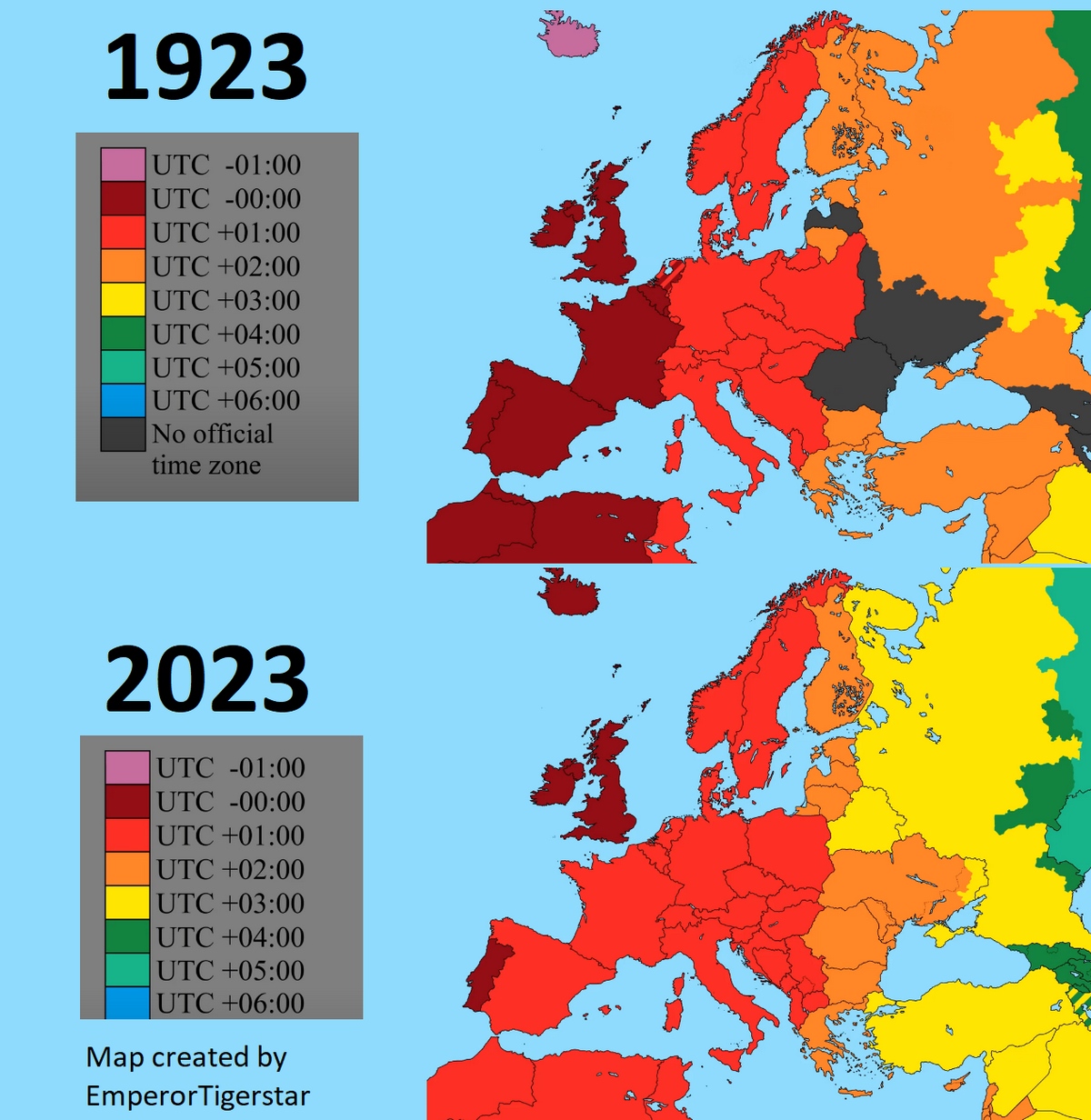
| ▲ | prmoustache 4 hours ago | parent | next [-] | | Exactly, here in Spain we have lunch between half past 2 and half past 3 on workdays, which can extend up to 5pm in the weekend and I usually finish dinner at half past ten. Why? because they decided to be on the same timezone as our eastern neighbors in Europe.
The eastern part of Polonia is on the same timezone and probably have probably the opposite with much much earlier lunch and dinner than we do. | | |
| ▲ | 1718627440 4 hours ago | parent [-] | | The timezone centered across Görlitz made a lot of sense for the German empire, because it was nearly in half longitude wise and 15° away from Greenwich. It is still somewhat centered in Europe. If you wanted to divide it again, you would need to decide whether the border should be between Germany and France or France and Spain. If you place it between Germany and France, which side will the BeNeLux countries be on? France still has some parts that are nominally in +1 and we don't want to disturb the German-French "friendship", so maybe place it between Spain and France, where there is at least a mountain border? Would that be acceptable? Railways connections between Spain and France are also much less and concentrated than between Germany and France. ----- https://vividmaps.com/wp-content/uploads/2024/02/time-zones-... The old borders aligned with the sun a lot more, so we can blame that on WW2 as well. |
| |
| ▲ | wat10000 4 hours ago | parent | prev [-] | | It's not just a measure for the state of sun in the sky, it's also a measure for the state of society on the ground. It's an arbitrary number in a sense, but it also strongly influences my schedule. And yes, we could have all the schools and everything else open later in the winter than the rest of the year, but it turns out it's easier to change the clocks. | | |
| ▲ | 1718627440 4 hours ago | parent [-] | | But the school schedule does already shift and it shifts later, so in the opposite direction. The policy trend is going in the opposite of what you want to achieve with year-long DST, you could instead vote for the status quo and have the same effect. | | |
| ▲ | wat10000 3 hours ago | parent [-] | | Do BC schools have a different winter schedule? That's not how it is where I live, at least. It seems like it would be pretty annoying to have to reschedule activities around getting to/from school twice a year. | | |
| ▲ | 1718627440 3 hours ago | parent [-] | | I can only comment on some parts in Germany, and no I don't know of different seasonal schedules. I meant that the general trend is for the school day to start later, so that the teenagers get more of their precious sleep. Year-long DST would get them to get up earlier again compared to the sun. This trend is the same for office hours and working shifts, they become later, since people just want to sleep longer. (Which is obviously bullocks.) |
|
|
|
| |
| ▲ | jonny_eh 3 hours ago | parent | prev [-] | | Farmers don't care about clocks, they do the work whenever needed. Roosters crow whenever they want. There's literally no point in talking about farmers in this debate. |
|
|
| ▲ | taeric 4 hours ago | parent | prev | next [-] |
| Sadly, this isn't really right. Humanity settled on solar time. For somewhat obvious reasons. Alas, I don't see my preferred method of changing the clock by 10 minutes every month taking hold. Basically ever. :D I also don't think this is nearly as important for places that are not further away from the equator. If you are on the equator, you are almost certainly fine with no change throughout the year. |
| |
| ▲ | fhars 3 hours ago | parent [-] | | That method wont work, that is a too large change that happens to seldom. What you want is a leap second every hour for five months to switch between standard and daylight savings time and back, with a month of constant time around each solstice. That gives you a smooth transition without perceptible discontinuities. |
|
|
| ▲ | karlosvomacka 3 hours ago | parent | prev | next [-] |
| the reason was valid 50 years ago when most people didn't work 9-5 in front of a computer. |
| |
| ▲ | 1718627440 3 hours ago | parent [-] | | Yeah they started work at 6. So the working schedule shifted later by three hours, but with year-long DST it will shift back only one hour. Sounds like people don't actually want what they now vote for. My bet is that the work hours will just move later yet another hour in the future. |
|
|
| ▲ | wvenable 4 hours ago | parent | prev | next [-] |
| > Humanity settled on these numbers long ago because they work best. Absolutely not. It was a compromise tempered by practical and political considerations. |
|
| ▲ | mhurron 4 hours ago | parent | prev | next [-] |
| And that reason was that it was the standard before the standard was rethought. There's no deeper meaning to it. And we rethought it yet again, should we go on the time standard (DST) that we're already on for ~65% of the year, or the one we're on for ~35% the year. It should be pretty obvious why DST is the new winner, it's the current standard. |
|
| ▲ | wat10000 4 hours ago | parent | prev | next [-] |
| Not that long ago, and we keep fiddling with them. The US time zones were adopted just over a century ago. The dates for daylight saving time were changed less than 20 years ago. Much of Western Europe changed time zones (much of it rather violently) in the 1940s, as did China. The tz database often requires updates for changes. If you want to go with what was settled long ago, that would probably be a return to each town observing its own time based on local solar noon, which would be pretty annoying. |
|
| ▲ | 4 hours ago | parent | prev [-] |
| [deleted] |