| ▲ | cryptica a day ago |
| I think a major flaw of all these models is that they underestimate: 1. How easy it is to start fresh and shed your past reputation if you get caught doing something bad. 2. How forgiving people are and how tolerant they are to deception, abuse and immorality. I hate to say it but a lot of people are attracted to abusers. They keep going back to the same kinds of people who will abuse them over and over. These same people who tolerate abuse often seem to show disrespect and look down on good, honest people. I cannot overstate how powerful this effect is; and it seems to be getting worse over time! And these people keep coming up with narratives to gaslight themselves about their abusers "they're not so bad"... People will especially do this when their abuser has power over them (Stockholm Syndrome). Once you factor these two things, cheating is the clear winning strategy. By a mile... It's objectively a superior strategy. If we just follow game theory; it will take us somewhere really dark. Game theory isn't what's keeping the world civilized. Society literally all rests on people's irrational emotions and moral principles. The desire to do the right thing is completely irrational and is a net loss to the individual. If we continue with the current system and current assumptions, all moral individuals will be wiped out because they are at a HUGE disadvantage. To solve our social problems, we need to be more moral; we need to learn to judge ourselves and other people through the lens of morality and be very firm about it. |
|
| ▲ | 578_Observer 21 hours ago | parent | next [-] |
| Writing from Japan. You are absolutely right about the "Finite Game".
If you can reset your reputation and start over, "Cheating" is indeed the winning strategy. However, here in Japan, we have a different operating system called "Shinise" (companies lasting over 1,000 years). They play an "Infinite Game".
Their reputation is tied to a "Noren" (shop curtain) or a family name that has been built over centuries. You cannot simply discard it and respawn. There is a movie hitting theaters here in Tokyo right now called "KOKUHO" (National Treasure). It depicts Kabuki actors who inherit a "Name" (Myoseki) with 400 years of history.
Watching it, I realized: In their world, cheating doesn't just mean losing a job. It means "killing the Name" for all ancestors and future generations. The penalty is infinite. When the "Reset Button" is removed from the game, "Honesty" and "Sanpo-yoshi" (Three-way satisfaction) naturally become the mathematically dominant strategies.
Cheating only works when you plan to exit. |
| |
| ▲ | lo_zamoyski 8 hours ago | parent | next [-] | | > It means "killing the Name" for all ancestors and future generations. The penalty is infinite. Which is ironic, given Japan's abysmal fertility. That is the ultimate name killer. Lineages that have survived from the beginning, gone. | |
| ▲ | immibis 9 hours ago | parent | prev | next [-] | | So... how does a new person open a shop? | | |
| ▲ | 578_Observer 8 hours ago | parent [-] | | Fair point. What if you start completely naked, with no master and no connections?
As a banker, I see two main paths for "Outsiders": 1. *The "Inheritance" Route (Muko-yoshi / M&A):*
As I mentioned, you can inherit an existing engine. In Japan, "Shinise" with no successor often legally adopt talented outsiders as CEOs (Muko-yoshi). Or, you can buy the company. My job is often matching these "Old Trust" with "Young Energy". 2. *The "Newcomer" Route (Startup Support):*
If you want to build from zero, the system actually protects you.
Depending on the municipality, there are massive subsidies for startups. For example, "0% interest" and "0 guarantee fees" for the first 5 years. Culturally, we have a soft spot for the "Shinzan-mono" (Newcomer) who works hard. If you humbly present yourself as a beginner, the community and local government often step in to support you.
Japan is strict with "Rude Outsiders," but surprisingly warm (Humanity) to "Sincere Beginners."
|
| |
| ▲ | Der_Einzige 17 hours ago | parent | prev [-] | | Japan having the most insane, high effort culture in the world is exactly why they are continuing to slowly die by lack of fertility. Same with South Korea. Japan will either lose its traditional culture including this long term aversion to "cheating", or they will lose their nation. It's existential and their refusal to embrace globalism will destroy them. Zero sum game, and yes they (ZSGs) do actually exist nearly everywhere in real life and are the norm. I can't physically be in the same place as another person. Time spent on one action is time not spent on everything else. Every bit of food I eat is food denied from every other person. | | |
| ▲ | 578_Observer 8 hours ago | parent | next [-] | | I understand your pessimism. Looking at the demographics, Japan seems to be in a "Game Over" state.
I live in rural Gunma, surrounded by *empty houses (Akiya) and elderly people*, so I feel this reality every day. However, living right in the middle of it, I have started to see it differently.
Japan is running a global experiment: *"How to sustain a civilization without growth."* As you said, if the world is finite (Zero Sum), then "Scale or Die" will eventually stop working physically for everyone. Every country will hit the same wall.
We are just hitting it first.
We are the *test subjects* to see if humans can mature into a "Steady State" or if we just collapse. I am here to document the result. | | | |
| ▲ | lo_zamoyski 7 hours ago | parent | prev [-] | | I doubt this is the reason. The fertility crisis is generally true of all developed, consumerist societies, including those you could call sloppy. It is consumerism that is a culture killer and a fertility destroyer, and Japan is very consumerist. Consumerism reshapes a culture in its own image. Careerism and delayed pregnancy? Motivated by desire for money to consume. Limiting children? Motivated by the desire to restrict expenses on children so they can be diverted toward consumption. The habits consumerism instills makes the long game unattractive, because it takes away from your consumption now. Nothing is greater than consumption. Consumption is "status". Consumption is our god, but a nihilistic one that leads us toward death: personal, physical, familial, social, spiritual, and cultural. If I were a satanic figure bent on destroying the human species, I would reach for consumerism without batting an eye. I would watch with satisfaction, relish, and verve as the human race liquidates and defiles itself. |
|
|
|
| ▲ | Aurornis 20 hours ago | parent | prev | next [-] |
| > 1. How easy it is to start fresh and shed your past reputation if you get caught doing something bad. True, but this is a necessary feature of a society or workplace to discourage cheating and abuse. If a person could easily shed their reputation and start over on an equal footing with everyone else, cheating would be a zero-cost option. Cheat until you get caught, then start over and repeat. This is why trust and reputation are built over time and are so valuable. It’s frustrating for newcomers or those who have lost reputation somehow, but it’s a necessary feature to discourage fraud and cheating. |
|
| ▲ | oersted a day ago | parent | prev | next [-] |
| This doesn't make sense to me, our current prosperity is founded on an enormous mountain of collaboration and shared beliefs. Usually not out of selflessness of course, often guided and forced by strong leadership and/or strong institutional structures to bend selfishness into selflessness (like capitalism to a degree). Poor countries tend to stay poor not due to fundamental resource constraints but due to self-reinforcing loops of desperate crab-bucket like behavior, where everyone is cheating one another out of necessity (or culture). Broad collaboration and institution building is always the only way out of the hole, although the hole can be very deep and collaboration can be very costly until you get out. You are right though, that for an individual living in a good collaborative system, often cheating is very effective, it's just that the system can only handle a certain amount of that behavior before it collapses. As is discussed in the first scene of Plato's The Republic (surprisingly entertaining to modern tastes), the best play tends to be "to be unjust while seeming just". If people are going to be assholes, it is actually much better if they are discrete about it and keep a pretense of civilization. When people start acting conspicuously like assholes, out of a weird sense of honesty, that's when it propagates and the whole thing collapses, like a bank-run. It's an ancient story that we are still living. |
| |
| ▲ | clrflfclrf 21 hours ago | parent | next [-] | | > Poor countries tend to stay poor not due to fundamental resource constraints Sometimes highly shrewd rich countries infiltrate the power structure of poor countries through N-pronged strategy to keep them stuck in a rut so that they don't become future threat, also extract their resources in the meantime. | | |
| ▲ | oersted 21 hours ago | parent | next [-] | | Indeed, the way out of that is also broad collaboration, sometimes not peaceful or clean. And the last century showed that this also works at a large scale, we all got a lot richer as a global community by letting poor countries develop and doing business with them, instead of exploiting them to death. | |
| ▲ | cryptica 21 hours ago | parent | prev [-] | | Yes, strongly believe this is the case. The corrupt leaders are rarely chosen by the people; they are installed by foreign powers. There are many cases you can dig into which are absolutely atrocious; like people getting paid big money by western leaders to assassinate their friends to take power and pass laws which facilitate the extraction of resources by foreign corporations. Like the story of Thomas Sankara's assassination by his trusted childhood friend Blaise Compaoré is quite disturbing. It seems like Compaoré was leader for a very long time and is still in politics... I cannot think of a more morally deprived individual. If game theory was as claimed; nobody should want to work with such deeply disloyal and psychopathic individual. It's just like I say; people have a strong tolerance, even attraction to abusers. If you look at the real story, you notice this pattern over and over... but we are so badly gaslit about such things (aka 'PR') that we don't notice. | | |
| ▲ | clrflfclrf 21 hours ago | parent [-] | | Ed Witten here : "So first of all thanks very much. I'm very honored to have the chance to give this talk. Of course Nima and I both wish we could do more for
peace than just to give talks at an online meeting for peace. Unfortunately we know that there are lots of bad things happening in the world and we hope that there will be better days ahead. Hopefully as one would say in Hebrew [..] which means soon in our own day. https://youtu.be/Ta5Dx327KQc?t=4899 |
|
| |
| ▲ | aprilthird2021 20 hours ago | parent | prev | next [-] | | > Poor countries tend to stay poor not due to fundamental resource constraints but due to self-reinforcing loops of desperate crab-bucket like behavior, where everyone is cheating one another out of necessity (or culture) This doesn't seem true and I'd be interested in any stats that back this up. It reminds me of a very interesting result (that most never internalize) which is that the number one way to avoid corruption is to pay public servants handsomely such that the job rivals the private sphere. Most developing countries can't do that, and that's why most of them have issues with corruption. Rich countries also have crab-bucket like behavior. You don't have to look twice at the current US administration to see lots of corruption and cheating and fraud, for example. | | |
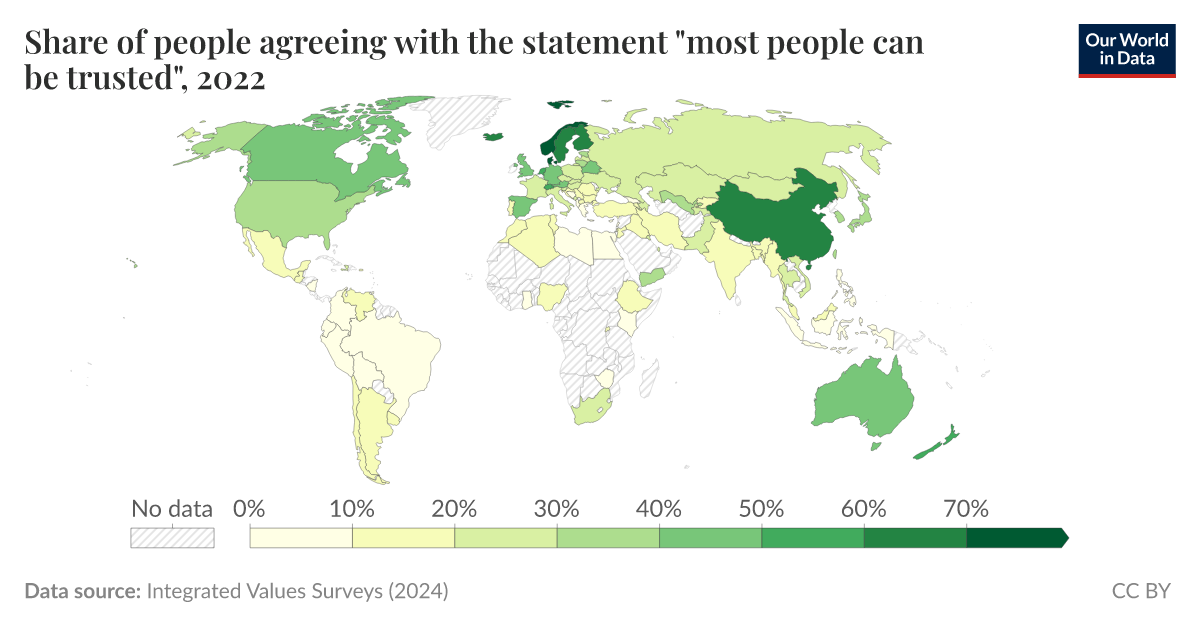
| ▲ | mf_tomb 20 hours ago | parent | next [-] | | https://ourworldindata.org/grapher/thumbnail/self-reported-t... Pretty clear trend: low-trust societies have low gdp and high-trust societies have high gdp, regardless of resource distribution. Africa/South America are resource rich, japan/iceland are resource poor. | | |
| ▲ | sokoloff 20 hours ago | parent | next [-] | | Which direction does the causation within that correlation (if any) flow? I can easily conjure a scenario where high per-capita GDP makes trusting easier (either because there’s enough to go around and/or because there are reliable police/judicial sanctions for violating trust) than in a hardscrabble low per-capita GDP society with lower (insufficient?) lawfulness. | |
| ▲ | aprilthird2021 16 hours ago | parent | prev [-] | | That's terrible proof. Anything better? Yemen and the US are equal shades on that trust polling map. That alone should show you it's not really a factor. India has a higher GDP and GDP per capita than it's neighbor Pakistan, but Pakistan has quite a higher trust score on your map than India. There are many more examples, just these jumped out at me. |
| |
| ▲ | oersted 20 hours ago | parent | prev | next [-] | | I didn't mean it so literally. Having robust taxation and well supported institutions is what I mean by "broad collaboration" and an effective "culture", as in a social operating-system a set of values and habits, that continually support and self-heal such constructions. I don't meant that everybody should be nice, and that poor countries are somehow culturally nasty, absolutely not. Real collaboration cannot be just founded on morals and good faith, it's not sustainable, it's more about incentives engineering. In terms of references, the main one that comes to mind is the economics Nobel price from 2024: "for studies of how institutions are formed and affect prosperity". | |
| ▲ | clrflfclrf 18 hours ago | parent | prev [-] | | > the number one way to avoid corruption is to pay public servants handsomely such that the job rivals the private sphere if this is true, then the public servant would earn only till he becomes rich equivalent to private sphere job. but nope, they go all the way in. |
| |
| ▲ | cryptica 21 hours ago | parent | prev | next [-] | | > the best play tends to be "to be unjust while seeming just" Yep this is a huge problem now. I think wealth inequality is also making this worse because people often turn a blind eye to the bad behaviors of people who have power over them. This is an extremely powerful effect; it's everywhere. For example, Christians turning a blind eye to certain negative character traits of God as he appears in the old testament. Employees turning a blind eye to the immoral actions of their boss and coming up with justifications to keep them on a pedestal... The social structure is not determined by morality; it's the other way round; morality is determined by the social structure. It reminds me of an old French fable in which a lamb tries to reason with a wolf why he should let him live... The wolf listens to the lamb's logic but then he eats it anyway and the story ends with a sentence like "The reason of the strongest is always the best one." | | |
| ▲ | oersted 21 hours ago | parent | next [-] | | My point (and Plato's) was rather that some people will definitely cheat, because it's locally rational, and it's actually better for everyone if they are "classy" about it and don't flaunt it too much. A minority will get away with terrible things, but somewhat bounded by conspicuousness, and at least the majority remains blissfully (willfully?) unaware and propping up the civilized system which is so much better for all of us. It is quite a cynical point of view of course. It's a hard balance, when it gets bad sometimes it's better to air the dirty laundry and go through the pain of purging those cheaters. But the worse thing is to have people be loud and proud cheaters, which is happening more and more. That's a deadly virus to a civilized society, everyone starts thinking they are dumb for not cheating, and we quickly go back to the dark ages. It's a bit like calling out the bank for being a fraud because they don't have all the money in a vault, and rushing to get your cash out. If people start taking the red pill and shouting that society is just a game of pretend, which it kind of is, then our very real prosperity can vanish overnight. | | |
| ▲ | cryptica 20 hours ago | parent [-] | | >> then our very real prosperity can vanish overnight. This sentence assumes a certain degree of shared prosperity. I think this is increasingly an illusion. IMO, Social media tends to create filter bubbles which create illusions of shared prosperity. Most of the social bubbles I participate in, the view is much more like 'monopolized prosperity' than 'shared prosperity'. I've been in a unique position to have mingled with billionaires/millionaires and also normal people and the contrast is significant. In some circles; it's like even the company cook, janitor, receptionist and wall-painter is getting rich... In others, it's like there are some really talented people who keep failing over and over and can't make any money at all from their work; like they're suppressed by algorithms. I think most people wouldn't mind seeing the whole system collapse as they don't feel they have any stake in it; their experience is that of being oppressed while simultaneously being gaslit about being privileged! It's actually deeply disturbing. I don't think most people on the other side have any idea how bad it is because their reality looks really wonderful. My view is that the oppression which used to be carried out at a distance in Africa is now being carried out to large groups of people within the same country; and filter bubbles are used to create artificial distance. My experience of the system is that it works by oppressing people whilst keeping them out of view so that those who benefit from that system can enjoy both physical as well as psychological comfort. The physical comfort is real but the psychological comfort is built on the illusion of meritocracy; which can be maintained by creating distance from the oppressed. It's why the media keeps spreading narratives about homeless people being 'crazy' and 'on drugs' IMO. Labeling people as crazy is a great way to ensure that nobody talks to them to actually learn about their experience. It's the ultimate way to dehumanize someone. Because their experiences would shock most people and create deep discomfort; it would sow distrust in the system. | | |
| ▲ | svara 19 hours ago | parent [-] | | > This sentence assumes a certain degree of shared prosperity. I think this is increasingly an illusion. IMO, Social media tends to create filter bubbles which create illusions of shared prosperity I think it's exactly the other way around? Wealth inequality (in the US, as an example) has actually not drastically changed in the past few decades, but I do agree the perception of unfairness has increased a lot. My hunch is that everyone is now being fed wealth porn on social media and comparing themselves to influencers or actual billionaires who actually do live or pretend to live a .01%er lifestyle. Life's never been fair; but feeling shortchanged for living a solid middle class lifestyle because Bezos has a big yacht seems new. Ultimately it all feels depressingly materialistic to me. Go work on something actually meaningful! |
|
| |
| ▲ | clrflfclrf 18 hours ago | parent | prev [-] | | > For example, Christians turning a blind eye to certain negative character traits of God as he appears in the old testament. If I were to extend your analogy, the problem in modern world has become aggresive. E.g. you have committed a crime or fraud. Everyone else has proved decisively and beyond doubt that you have committed fraud such that it has become common knowledge. yet the justice system isn't acting. In a sense, you are taunting and teasing me, "what you gonna do about it?" This is inviting violence. The guy killing insurance company CEO has exactly this line of thinking. |
| |
| ▲ | Der_Einzige 17 hours ago | parent | prev [-] | | Re: Plato/Socrates "Therefore Socrates said that it wasn’t enough to use the intellect in all things, but it was important to know for which cause one was exerting it. We would now say: One must serve the “good cause.” But to serve the good cause is—to be moral. Thus, Socrates is the founder of ethics. "Socrates opened this war, and its peaceful end does not occur until the dying day of the old world." Plato/Socrates are the original ghost story tellers. I spit on their grave. Republic is easily one of the worst books written in human history in terms of its impact. Right up there with Das Kapital. |
|
|
| ▲ | svara 21 hours ago | parent | prev | next [-] |
| Cooperation has been "invented" in evolution many times independently and is long term stable in many species. If your comment was true that fact wouldn't exist. We may consider the world we live in today competitive, but at the end of the day, humanity is a globe spanning machine that exists due to cooperative behavior at all scales. Comments such as yours are really missing the forest for the trees. I suspect that it's really the fact that cooperation is so powerful and pervasive that makes it normal to the point where any deviation from it feels outrageous. So you focus on the outrageous due to availability bias (seeing the trees rather than the forest). |
| |
| ▲ | marcosdumay 20 hours ago | parent [-] | | You seem to be misunderstanding the GP. Evolution does not work maximizing individual success. | | |
| ▲ | MarkusQ 19 hours ago | parent | next [-] | | > Evolution does not work maximizing individual success. Yes it does. In fact, unless you want to get nit-picky about intra-gene, inter-allele selection, that is _exactly_ what it does. | |
| ▲ | svara 20 hours ago | parent | prev [-] | | But it does? What do you think it optimizes other than individual fitness? I think I understand the GP pretty well. Cheating, or defection in the language of evolutionary theory, is subject to frequency based selection, meaning it is strongly selected against if its frequency is too high in the population. It's not a stable strategy. It can be a winning strategy for a few individuals in a cooperative environment, yes, but it breaks down at a point because the system collapses if too many do it. And yet, cooperative systems are common and stable, which is my point. | | |
| ▲ | integralid 16 hours ago | parent | next [-] | | >What do you think it optimizes other than individual fitness? Chance to pass genes forward. This is only equivalent to individual fitness for very solitary species and humans aren't. As an extreme example, take soldier termites - their chance to pass their genes is zero, but the chance for the colony to survive grows. Also gay people exist (they also - usually - don't reproduce, but help others instead). Humans naturally care about their family and tribe because this increases the chance of their bloodline to survive. | | |
| ▲ | svara 16 hours ago | parent [-] | | That's a distinction without a difference. Worker ants have high individual fitness if their colony successfully reproduces because they pass their genes forward. In evolutionary theory this is made clear by using the term "inclusive fitness" - worker ants actually pass their genes on to future generations more effectively by taking the detour, if you will, through the queen. If you want to be nitpicky and argue we should consider the individual gene the unit of selection, as Dawkins famously argued, I'm not going to disagree, you can see it that way too. That specific distinction very rarely leads to different predictions though. |
| |
| ▲ | clrflfclrf 18 hours ago | parent | prev [-] | | A world where everyone is a Giver is not a stable world. Ask Gemini or Claude to explain. Cheating by definition works only in minority. If everyone is in line to buy tickets, only few cheaters can get early tickets and it is a stable strategy. But everyone is a cheater, everyone is worse off. |
|
|
|
|
| ▲ | ajjahs 21 hours ago | parent | prev [-] |
| [dead] |