| ▲ | aprilthird2021 20 hours ago | |||||||||||||
> Poor countries tend to stay poor not due to fundamental resource constraints but due to self-reinforcing loops of desperate crab-bucket like behavior, where everyone is cheating one another out of necessity (or culture) This doesn't seem true and I'd be interested in any stats that back this up. It reminds me of a very interesting result (that most never internalize) which is that the number one way to avoid corruption is to pay public servants handsomely such that the job rivals the private sphere. Most developing countries can't do that, and that's why most of them have issues with corruption. Rich countries also have crab-bucket like behavior. You don't have to look twice at the current US administration to see lots of corruption and cheating and fraud, for example. | ||||||||||||||
| ▲ | mf_tomb 20 hours ago | parent | next [-] | |||||||||||||
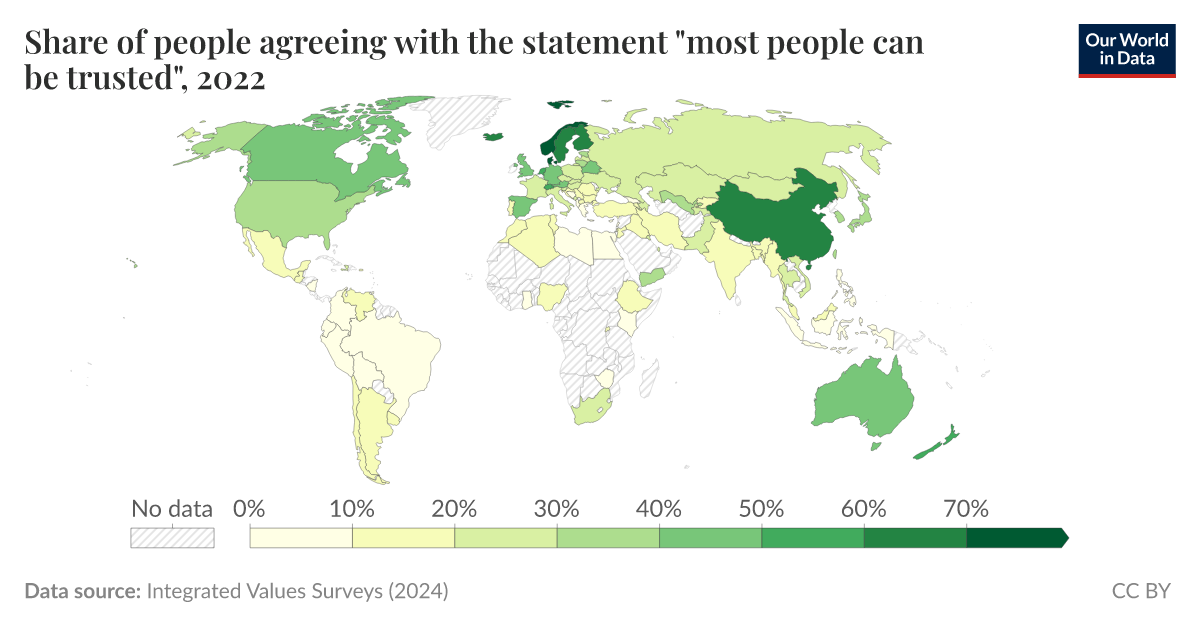
https://ourworldindata.org/grapher/thumbnail/self-reported-t... Pretty clear trend: low-trust societies have low gdp and high-trust societies have high gdp, regardless of resource distribution. Africa/South America are resource rich, japan/iceland are resource poor. | ||||||||||||||
| ||||||||||||||
| ▲ | oersted 20 hours ago | parent | prev | next [-] | |||||||||||||
I didn't mean it so literally. Having robust taxation and well supported institutions is what I mean by "broad collaboration" and an effective "culture", as in a social operating-system a set of values and habits, that continually support and self-heal such constructions. I don't meant that everybody should be nice, and that poor countries are somehow culturally nasty, absolutely not. Real collaboration cannot be just founded on morals and good faith, it's not sustainable, it's more about incentives engineering. In terms of references, the main one that comes to mind is the economics Nobel price from 2024: "for studies of how institutions are formed and affect prosperity". | ||||||||||||||
| ▲ | clrflfclrf 18 hours ago | parent | prev [-] | |||||||||||||
> the number one way to avoid corruption is to pay public servants handsomely such that the job rivals the private sphere if this is true, then the public servant would earn only till he becomes rich equivalent to private sphere job. but nope, they go all the way in. | ||||||||||||||