| ▲ | Geonode 4 days ago |
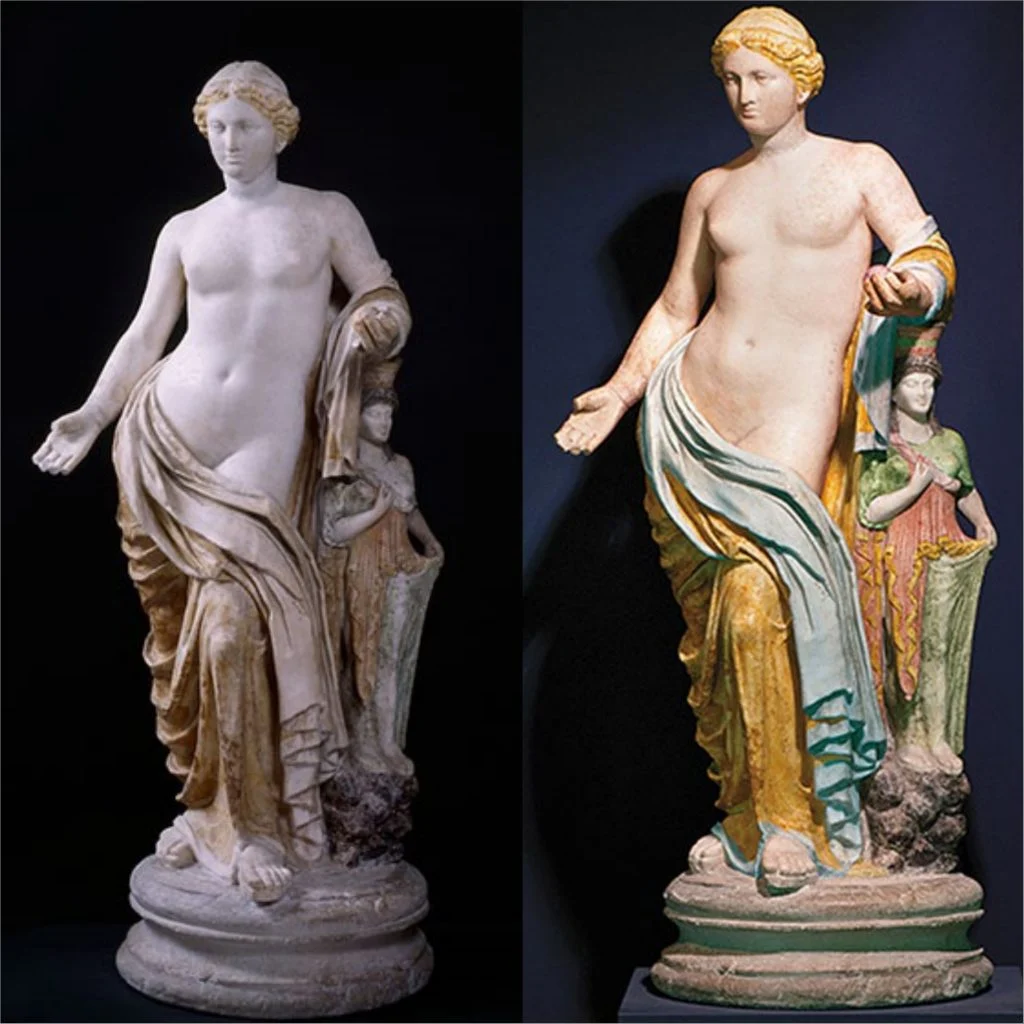
| I will die on this hill, because I'm right. Painters put on the first layer in saturated colors like this, then add detail, highlight and shadow. The base layer stuck to the statues, and the rest was washed away. This whole thing just won't go away because many people are operating outside their area of expertise on this subject. Painters layer paint, starting with a saturated base color. These archaeologists are simply looking at the paint that was left in the crevices. |
|
| ▲ | griffzhowl 4 days ago | parent | next [-] |
| Yes, this is what tfa says, and it's a good point. But tfa also points out that the archaeologists/reconstructionists know that what they're producing differs from the original. The thing is the discipline of reconstruction means that they only use pigments that they have direct evidence of, and this is just the saturated underlayers. The problem is this is seldom explained when the reconstructions are presented to the public |
| |
| ▲ | wisty 4 days ago | parent | next [-] | | Reconstructioniats say that they only show th colours they can prove existed. The article suggests they obstinately do this because they know it creates a spectacle. I think there's another explanation - if they use their own judgement to fill in the gaps (making the statues more classically beautiful) then everyone will accuse them of making it all up, even if they were to base it on fairly rigorous study of e.g. the colour pallets used in preserved Roman paintings etc. | | |
| ▲ | griffzhowl 4 days ago | parent | next [-] | | Yes, the suggestion that they're trolling goes too far. However, I did a tiny bit of investigating, and according to this write-up it does seem like Brinkmann presents his work as resembling the originals https://www.smithsonianmag.com/arts-culture/true-colors-1788... But they still don't add anything without direct evidence - where there's evidence in later statues for more subtle colouring, they include that. | | |
| ▲ | naravara 4 days ago | parent | next [-] | | I’m reminded of a Reddit thread long ago about a reconstruction of Roman garum by some American scientists. In their paper they conclusively declared that it tasted foul and a Filipino Redditor replied saying “This actually sounds a lot like the fish sauce we use in SE Asia. I wonder if people from a different culinary tradition would find it less off putting or even tasty?” Cue a bunch of Redditors downvoting the poor sap to hell for daring to disagree with the scientists’ assessment of the flavor. | | |
| ▲ | griffzhowl 4 days ago | parent | next [-] | | There might even be a directish connection, one way or the other, between garum and SE Asian fish sauce, since Roman coins have been found in Vietnam. Can't find the better source on that specifically now but this is a nice article about the Roman trade with India and mentions the coins found in Vietnam and even Korea about half way down https://www.thecollector.com/why-was-the-roman-indian-ocean-... On the other hand, it's not implausible that maritime societies come up with their own fish sauce independently | | |
| ▲ | eru 3 days ago | parent | next [-] | | I read that what's now 'soy sauce' also started off as a kind of fish sauce originally. | |
| ▲ | rrrrrrrrrrrryan 3 days ago | parent | prev [-] | | Worcestershire sauce is also considered a descendent of the fish sauces from ancient Rome. | | |
| ▲ | griffzhowl 3 days ago | parent [-] | | That's funny, I thought Worcestershire sauce was based on some Asian fish sauce because it has the colonial ingredients like tamarind etc. I had a look on wiki and seems it's not known where the recipe comes from but it dates from the 19th century |
|
| |
| ▲ | electroglyph 4 days ago | parent | prev [-] | | love me some red boat fish sauce! |
| |
| ▲ | IAmBroom 3 days ago | parent | prev [-] | | It is possible for Brinkmann to be guilty of showboating, while other researchers are simply being fastidiously proper in what they communicate. |
| |
| ▲ | xg15 4 days ago | parent | prev | next [-] | | The problem is that there is no "missing data" color, so that discipline would default to marble white, which is just as made up as the rest. I think the Augustus statue is a good example of that: Part of the garish effect comes from the contrast between the painted and nonpainted areas. The marble of his face and harness work well if everything is marble - but in contrast to the strong colors of the rest, the face suddenly seems sickly pale and the harness becomes "skin-colored". The result is a "plastic" or "uncanny valley" effect. If the entire statue were painted, the effect would be weaker. | | |
| ▲ | fsckboy 4 days ago | parent | next [-] | | >The problem is that there is no "missing data" color they should use "green screen green" and give you viewing glasses that fill in the colors to your own historical preference (e.g. rose colored? blood-soaked?). then if you point a finger with your "anhistorical" complaints, there will be 3 fingers pointing back at you! | | | |
| ▲ | IAmBroom 3 days ago | parent | prev [-] | | Architectural restoration often solves this by using an inoffense, but still visibly detectable, "new material color". Some British castles have been rebuilt this way. |
| |
| ▲ | dddgghhbbfblk 4 days ago | parent | prev | next [-] | | They're making it up no matter what they do, since we don't know how these things were originally painted and have no way of knowing. They should just present the reconstructions as interpretations and actually try to do a good job painting them. I agree with the article that what they're doing now is harmful to the public understanding. | | |
| ▲ | 20k 4 days ago | parent [-] | | I mean, we kind of do though? We could assume that the surviving images of statues showing how they were painted are accurate. If you know the colour of the underlayer, this actually lets you determine exactly what the colouration of the paint on top of that is despite it not being present whatsoever This gives you a general trend of how brightly underlayed statues tended to be painted afterwards to finish them, and lets you infer how other statues without surviving coloured pictures of them would have appeared based on the likely prevailing style at the time |
| |
| ▲ | resize2996 4 days ago | parent | prev | next [-] | | That is how scholarship works. It’s like a math proof: they’re interested in proving the base case. If someone else wants to do more speculative work to theorize what a well-painted version would look like, that would be super cool, but it wouldn’t be scholarship. | | |
| ▲ | bjt 4 days ago | parent | next [-] | | And that's a fine standard to maintain when you're writing an academic paper. When you are instead putting together a museum exhibition intended for the general public, and you observe over and over again that they will interpret your work as representing what the statues actually looked like, it is irresponsible to keep giving them that impression. It's not an either/or question. They could do some of the statues with just the pure archaeological approach of only using the paints they found in the crevices, and do others in a layered approach that is more speculative but probably closer to how they actually looked. If they did that, this article would not be necessary. | | |
| ▲ | throwthrowuknow 4 days ago | parent [-] | | Imagine if we refused to publish any material or exhibit recreations of dinosaurs because the only evidence we have are fossilized skeletons and a few skin texture impressions. | | |
| ▲ | philistine 4 days ago | parent [-] | | You've highlighted a very cogent comparison! Dinosaurs in the first Jurassic Park were fairly well represented considering what we knew in the late 80s. But our knowledge of dinosaurs has grown, with feathers being the most emblematic change. Yet the Jurassic Park movies steadfastly refuse to put feathers on their 3D monsters in the current movies, because viewers do not expect feathers on the T-Rex. We might be at that point with repainted statues. Museum visitors are now starting to expect the ugly garish colours. | | |
| ▲ | pbhjpbhj 4 days ago | parent [-] | | I've not seen the latest Jurassic Park movie, but I've seen a clip with velociraptor's with feathers, and maybe quetzlcoatalus too? Along with colourful skin on eg compsagnathus. They seem to have moved on a bit, they're balancing audience expectations with latest research, I expect. | | |
| ▲ | autoexec 4 days ago | parent [-] | | This guy had feathers and they made him the right size https://jurassicpark.fandom.com/wiki/Oviraptor | | |
| ▲ | philistine 3 days ago | parent [-] | | They didn't revisit any of the previously featured dinosaurs. The T-Rex in the latest film looks like the best science can ascertain ... in 1990. | | |
| ▲ | pbhjpbhj 21 hours ago | parent [-] | | My knowledge of dinosaurs is a few decades old really - any good sources for a summary of T-rex developments in particular or dinosaurs more generally? I could imagine there's some great videos out there? I'd be keen to have scientific basis given rather than speculative artwork. |
|
|
|
|
|
| |
| ▲ | shermantanktop 4 days ago | parent | prev | next [-] | | “The reason I’m totally misleading you with a speculative example is because of scholarship.” No way. When they engage the public, they are not longer exclusively scholars. They responsible for conveying the best truth they can to non-experts. A journal paper can be misunderstood when the reader lacks the context to interpret it. Out in the public square, that is not the reader’s fault anymore. | | |
| ▲ | vkou 4 days ago | parent [-] | | Give the scholars full editorial control of the newspaper the public is getting their news from, and you might get better public understanding of their scholarship. You generally can't hold someone responsible for what someone else says about them. |
| |
| ▲ | WorldMaker 4 days ago | parent | prev | next [-] | | "Dance your PhD" exists for several reasons, but one of them is to point out that the divorce between scholarship and art in some academic fields isn't "required" but an accident of how we separated colleges and how hard it can be to do multi-disciplinary work. You can do both: prove the base case and reach across the aisle to the art college next door to see if someone is interested in the follow up "creative exercise". You can present both "here's what we can prove" and "here's an extrapolation by a skilled artist of what additional layering/contouring might have done". | |
| ▲ | marcus_holmes 3 days ago | parent | prev [-] | | I would agree with you, but archeologists often classify finds as "for ritual purposes" without any proof or evidence that it was used in a ritual, without specifying what ritual is involved, or how the find would be used in the ritual. Likewise archeologists will classify finds as tools when they don't have nearly enough knowledge about the craft in question to be able to do this properly (see the extensive mis-classification of weaving swords/beaters as weapons [0], but there are many other cases). So I'm a little reluctant to cut them some slack and say "this is how scholarship" works when they get all petulant about including colours that we know the ancients had, in ways we know they used them, for this kind of reconstruction. [0] https://www.academia.edu/67863215/Weapon_or_Weaving_Swords_a... |
| |
| ▲ | underlipton 3 days ago | parent | prev | next [-] | | This is crucial. From the article: >As a result, we internalized a deep-seated attachment to an unblemished white image of Greek and Roman art. We became, to use David Bachelor’s term, chromophobes. It is this accidental association between Greek and Roman art and pristine white marble, we are told, that accounts for the displeasure we feel when we see the statues restored to color. And there's indeed been quite a bit of push-back since the story first broke. Unspoken is the reason. Primacy bias is probably a part of it, but what really accounts for the intensity of the attachment to the idea of white marble finishes? I'm sure you can imagine. >Bond told me that she’d been moved to write her essays when a racist group, Identity Evropa, started putting up posters on college campuses, including Iowa’s, that presented classical white marble statues as emblems of white nationalism. After the publication of her essays, she received a stream of hate messages online. She is not the only classicist who has been targeted by the so-called alt-right. Some white supremacists have been drawn to classical studies out of a desire to affirm what they imagine to be an unblemished lineage of white Western culture extending back to ancient Greece. When they are told that their understanding of classical history is flawed, they often get testy. https://archive.is/qTreQ#selection-1695.0-1695.693 So, yes, it was important to categorically falsify the notion that the statues, frescoes, etc., were unpainted. Anything that left it open would have been something for the worst sorts of people to latch onto. Now that that's out of the way, possibly even more accurate explanations can be given the time of day, instead of being stuck having to hash out, "Oh, but were they even colored at all?" | | |
| ▲ | sdiupIGPWEfh 2 days ago | parent [-] | | Maybe it's just me, but this "We have to fudge the truth because nuance would support the alt-right" business just seems to drive a bigger wedge into the political divide than would just being reasonable. Folks closer to center see it as controlling the narrative, lies, and conspiracy when the full truth comes out. I'd prefer not driving more people into the fringes. | | |
| ▲ | underlipton 2 days ago | parent [-] | | They didn't fudge the truth. They reported exactly what the scientifically-supportable findings at the time were. Even if they had a notion that they were only looking at underpainting that was covered by more intricate work, they couldn't prove it. And, at the point, when they were trying to draw a distinction between objective fact and subjective sentiment, it was paramount that they come down solidly on the side of objective fact. Which they did. They proved that there was originally a weathered-away chroma layer above the base marble on these statues. >Folks closer to center see it as controlling the narrative, lies, and conspiracy when the full truth comes out. And this, I reject. The people who think this way aren't in the center, and they were never interested in the truth. Their aim has always been promoting the primacy of Western classical art (often as part of larger notions of white supremacy). They fought hard for the debunked no-chroma interpretation until another angle presented itself: that the chroma scientists were trying to purposely make the statues seem ugly, in order to devalue Western classical art, or to dictate its value outside of their control and terms. It's the same tack as right-wing gamers claiming that female characters are being made purposely "ugly" in order to alienate male heterosexual gamers. And while the reason for changes in female representation in games are less objective and more complicated than the scientific inquiry that produced the knowledge of painted statues, most of the people driven to the fringes by the evolution of these topics, as knowledge and circumstances develop, are people who share their fringe (and incorrect) ideas. Implicit there is that there's no "full truth coming out", just a developing collective understanding. If you want narrative control, lies, and conspiracy, look at Wall Street. |
|
| |
| ▲ | nobodywillobsrv 3 days ago | parent | prev [-] | | I would be curious to know if the treatment of statues in terms of "making them ugly and ridiculous to the point of being insulting" is roughly uniform across the different historical cultures being treated to this "reconstruction" procedure. i.e. is there evidence that there is comfort in trolling using Roman or Greek vs Assyrian, Nubian etc. Or do they just like to make everything bright and blocky. |
| |
| ▲ | xp84 4 days ago | parent | prev | next [-] | | This practice of defining a reconstruction so pedantically as to be wholly unlike real life is just so dumb to me, as a layperson. This would be like “recreating” the experience of using a Commodore 64 but we can’t find any intact copies of the software at all so we provide a fake “OS” that requires the user to write code in ASM only, and say “Ladies and gentlemen, behold our reconstruction! This is what it was like!” | | |
| ▲ | wang_li 4 days ago | parent | next [-] | | All of those CRT simulators? Largely bullshit, and we still have them around to look at! | |
| ▲ | nextaccountic 4 days ago | parent | prev [-] | | The alternative is no reconstruction at all on one hand, and adding fake detail on another hand And if one wants to add fake detail, why should archeologists be involved? Just have AI generate them | | |
| ▲ | mistercheph 4 days ago | parent [-] | | The archeologists are already adding fake detail, just at a different level of abstraction. Did they constrain themselves to only painting in the places where they find remnants of pigment? No, otherwise there would be gaps, cracks, and random interruptions of other colors in the painted figures. And there's the guesswork involved in going from spectral analysis (+ other tools) of a pigment sample to an actual paint that could have been plausibly available to the artist. Reconstruction, (similar to translation) is an art that combines carefuly study of evidence and craftfully filling in gaps and adding in detail where necessary (or leaving details unfilled and ambiguous to communicate the impossibility of total translation or reconstruction!) to present some communicable form of the original that gives the viewer some closer but imperfect access to it. |
|
| |
| ▲ | mkehrt 4 days ago | parent | prev | next [-] | | A while back the Met in New York had an exhibit of painted reconstructed statues where they let artists make reasonable guesses about what the statues would have looked like. It was pretty fantastic. Here's an article with one picture I could find, along with a few of the more saturated ones (NSFW artistic nudity): https://www.euronews.com/culture/2022/07/14/visit-the-exhibi... | |
| ▲ | pqtyw 4 days ago | parent | prev | next [-] | | > have direct evidence of, and this is just the saturated underlayers Why do they even bother with the "reconstructions" if they know that they are inherently inaccurate, though | | |
| ▲ | bee_rider 4 days ago | parent | next [-] | | Bare marble and garish underlayer reconstructions could be seen as two extreme ends. The article points out that the garish underlayer reconstructions have (maybe accidentally) been successful at correcting the widely held misperception of bare marble. There’s also something in… the bare marble reconstruction maps somehow to our idea of sophisticated. Garish underplayed reconstruction, our idea of silly, frivolous, or childish. There were a lot of Greeks, they didn’t all live on one end of that spectrum. | | |
| ▲ | lo_zamoyski 4 days ago | parent [-] | | Borderline deception is a bad way to correct inaccurate knowledge. And frankly, if I wanted to ridicule the ancients and flatter my own age, I could think of no better way than to make the old stuff look bad. I would much rather have an exhibit that showed the bare marble, then a conservative reconstruction based on what direct evidence merits (to the degree possible, noting that it is not a complete reconstruction), then more liberal but reasonable reconstructions based on indirect evidence. | | |
| ▲ | bee_rider 4 days ago | parent [-] | | I think it is hard to say to what extent there actually is even borderline deception. The internet amplifies random and funny things. In this article (which, we should note, is even-handed but leaning skeptical toward the garish reconstructions), it is noted that the images that have spread are the ugliest of the exhibit. If the exhibit tells the full story, and the internet just amplified the silt bits, that’s not deception on the part of the exhibit. | | |
| ▲ | lo_zamoyski 3 days ago | parent [-] | | That's true, but IIRC, the official "marketing" material is guilty of the same thing. I may be misremembering, though. |
|
|
| |
| ▲ | Sharlin 4 days ago | parent | prev [-] | | Because exhibitions make money, apparently. |
| |
| ▲ | michaelbuckbee 4 days ago | parent | prev | next [-] | | The "garish" statues are more akin to a false color image of mars that shows topography or something. That they're a visual representation of a particular portion of the pigments found and are not supposed to be an accurate recreation of how the statue looked at the time it was created. | | |
| ▲ | lokar 4 days ago | parent [-] | | AIUI, false color images of the cosmos are hand tuned to look pretty / interesting / impressive. |
| |
| ▲ | kijin 4 days ago | parent | prev | next [-] | | The people who produce dinosaur illustrations don't seem to have as much of a problem with adding all sorts of details (extravagant plumage, wacky colors/patterns, starry eyes and acrobatic postures) that are neither directly supported nor contradicted by available evidence. | | |
| ▲ | griffzhowl 4 days ago | parent | next [-] | | They only started adding feathers after they found evidence of them being feathered, though. Plus there's zero direct evidence for their colours so there's no option but to use guesswork in these cases. And a lot of dinosaur reconstructions may be more for edutainment value rather than reflecting a scholarly best-guess. There's no uniform methodology across all these disciplines. | | |
| ▲ | bdr 4 days ago | parent [-] | | > Plus there's zero direct evidence for their colours This is no longer true! Starting with Sinosauropteryx in 2010, paleontologists have identified what they believe to be fossilized melanin-containing organelles. These organelles, called melanosomes, have different shapes depending on which color they produce, and those shapes are preserved well enough to be visible under an electron microscope. | | |
| ▲ | griffzhowl 3 days ago | parent | next [-] | | Amazing, thanks for pointing it out. In the meantime, there's been some rejigging of the classification so it's this related genus where they've found the melanosomes https://en.wikipedia.org/wiki/Huadanosaurus | |
| ▲ | sdiupIGPWEfh 2 days ago | parent | prev [-] | | Isn't a rather good deal of color from feathers a result of "structural color", rather than pigmentation? I'd be curious if fossilized feathers could ever, in theory, preserve enough microscopic detail to guess at that. |
|
| |
| ▲ | RajT88 4 days ago | parent | prev [-] | | We are not dinosaurs, so have rather less skin in the game when it comes to accuracy. |
| |
| ▲ | amarant 4 days ago | parent | prev [-] | | Is there someone who tries to achieve beauty similar to what the original might've looked like? Would be interesting to see a painted statue that's actually pleasant to look at, rather than these "let's smear this one pigment we found in the armpit all over the face"-style "reconstructions" | | |
|
|
| ▲ | justinator 3 days ago | parent | prev | next [-] |
| I have a degree in fine art painting and drawing and that's not correct for oil painting. We would first put on a layer of earth tones, and work from the shadows to the mid tones. Once you got the form correct, you would work on things like adding color, details, and highlights. In no way would you start with saturated colors. One, they're very expensive, so why would you apply them, just for most to be painted over? Secondly, the more saturated (strong) a color is, the harder it is to paint over. Try painting over a wall painted bright red with literally anything. Paint it over in blue and your blue turns brown. Paint it in yellow and you'll just get red again. That's why we (still) employ a very opaque, white paint to the canvas. Oil paint also becomes more transparent over time, so getting the form right with the earth tone underpainting is crucial for the painting to last hundreds of years. Perhaps you're thinking of fresco painting? Then, the pigments are added to the medium (plaster) initially, and only very subtle highlights are added afterwards (if at all). This is a very, very difficult technique, and illusions like highlight and shadow are hard to pull off. But the painting over was frowned upon, because it doesn't last nearly as long as the embedded pigment in the plaster (and certainly not after cleaning/restoration). But adding highlight/shadow to a sculpture seems like not the play, as the 3D-ness of a sculpture would imply it brings its own to the table. Makes more sense just to paint the sculptures the color you wanted them painted, like the (in comparison very contemporary) bust of Nefertiti in the article, which looks excellent. No need for highlight/shadow. I could only see that needed in the face, which would look and act much like makeup. |
| |
| ▲ | Geonode 3 days ago | parent | next [-] | | friendly knuckle cracking I wouldn't normally do this, but I did say I'd die on this hill. I'm a tenured professor of art at a major research university. Firstly, maybe I shouldn't have said "saturated," but then again, you wouldn't argue that your earth tones, for example Yellow Ochre or Burnt Sienna aren't saturated in color? I have a particular expertise in historical scenic painting, (granted, largely for theatrical and ceremonial practice, but that's where we have the oldest examples of painting a fake thing to look real, see trompe l'oeil https://www.britannica.com/art/trompe-loeil ) In these examples, it's clear that the painters started with relatively saturated midtones, and used washes to take the shadows down and clay filled light colors (think gouache) for the highlights: https://masonicheritagecenter.org/backdrops-gallery/ As to the expense of saturated colors, it's the scholars claiming saturated colors, so the expense was made, obviously. But was yellow the final color, when it is the perfect base coat for a two part skin tone using first yellow, and then pink? In the first image in the article, you can see that half of the face is yellow, but that the other half is light colored skin. This exact theatrical layering practice has been used, first yellow, and then pink. The fourth and eighth images in the article looks extremely similar to the scenic backdrops I've linked above, but one is from the same time period as these statues, and the other is from hundreds of years later. There is a clear similarity in the final work. I believe it's obvious that both painters used dry pigment mixed down to a thin consistency, and used a series of 5 to 7 quick layers to achieve fast, one session results. This practice doesn't have anything to do with what we call oil painting today, which can be quite laborious and is normally achieved over multiple sessions. These artists would have wanted to knock out a work and get down off the ladder. Happy to discuss further, all the best. | | |
| ▲ | IAmBroom 3 days ago | parent | next [-] | | > Firstly, maybe I shouldn't have said "saturated," but then again, you wouldn't argue that your earth tones, for example Yellow Ochre or Burnt Sienna aren't saturated in color? I think you are confusing a definition of saturation meaning "unable to absorb more" with the visual perception definition. Optical Engineer here, but AFAIK artists use the term the same way: "saturation" refers to how the color is free of both white- and black-shading, "degree of non-grayness" if you will. The outer ring of this image is fully saturated; you'll see that "muddy" colors like ochre and sienna don't occur there. https://blogger.googleusercontent.com/img/b/R29vZ2xl/AVvXsEi... | | | |
| ▲ | wileydragonfly 3 days ago | parent | prev [-] | | How much of that major research is related to art? | | |
| ▲ | Geonode 3 days ago | parent [-] | | Well my team brought in several million dollars this year, but your point is still valid. :) |
|
| |
| ▲ | felipeerias 3 days ago | parent | prev | next [-] | | As the article points out, the more of the original color scheme that has survived, the better the reconstructions look. Example: https://www.dailyartmagazine.com/wp-content/uploads/2022/09/... The author suggests that this minimizes the opportunity for mischief, but tbqh it's likely that the ancients were simply much better artists than the people carrying out these reconstructions today. I'd love to see a modern artist attempt one of these reconstructions using original materials but with greater artistic freedom. | |
| ▲ | bethekidyouwant 3 days ago | parent | prev [-] | | Romans didn’t have oil paints | | |
|
|
| ▲ | aylons 4 days ago | parent | prev | next [-] |
| The archaeologists know that and say as much in TFA: "The paints used in the reconstructions are chemically similar to the trace pigments found on parts of the surface of the originals. However, those pigments formed the underlayer of a finished work to which they bear a very conjectural relationship. Imagine a modern historian trying to reconstruct the Mona Lisa on the basis of a few residual pigments here and there on a largely featureless canvas. How confident could we be that the result accurately reproduces the original? This point is not actually disputed by supporters of the reconstructions. For example, Cecilie Brøns, who leads a project on ancient polychromy at the Ny Carlsberg Glyptotek in Copenhagen, praises the reconstructions but notes that ‘reconstructions can be difficult to explain to the public – that these are not exact copies, that we can never know exactly how they looked’." |
| |
| ▲ | Jakob 4 days ago | parent | next [-] | | Contemporary historic preservation sees itself as the guardian of historical substance. The content of a monument is bound to the preservation of the inherited material. Georg Dehio’s principle of "conserving, not restoring" is often invoked as a synonym for this self-conception. Old and new need to be clearly separated. It is a counter-movement to the 18th century historicism which ”destroyed” a lot of old monuments beyond repair. Personally, I think we went too far on the conservation angle (at least in Germany, not sure about other countries), and should restore a bit more again with the knowledge we have. But much more intelligent people have debated that for centuries, so I guess their answer would be the same like https://askastaffengineer.com/. | | |
| ▲ | golemotron 4 days ago | parent [-] | | I'm in the conserving camp. It's more truthful than the narrativization that accompanies attempts to restore. We should remember that we all had a reptilian vision of dinosaurs for decades (centuries?) before the latest feathered view. We would have been better with neither. Just display the bones: what we have. Everything else burdens the public with guesses. |
| |
| ▲ | pqtyw 4 days ago | parent | prev [-] | | > that these are not exact copies, that we can never know exactly how they looked Meaning that these "reconstructions" are a pretty pointless and have no real purpose. | | |
| ▲ | alistairSH 4 days ago | parent | next [-] | | Idealy, for me as a layperson who is only going to see these in a museum, I'd love to see a series of pieces... First, the original, untouched (preserved but not restored?) sculpture. Second, the reproductions highlighted in the article. With appropriate notations about "these are the base layers, not complete, etc" And third, a best-guess at what the original could have looked like, based on the first two. Yes, this might be wrong and need to change over time. | |
| ▲ | JoeAltmaier 4 days ago | parent | prev | next [-] | | They show us what the base layers were, and what pigments of the day looked like. It may be an academic point. But they are academics. | | |
| ▲ | pqtyw 4 days ago | parent [-] | | Well they might as well show the texture of unprocessed marble as well. This is not particularly different. | | |
| ▲ | notahacker 4 days ago | parent [-] | | I mean, showing the texture of the underlying stone is how the vast majority of statues from classical antiquity are displayed, and indeed how most pastiches are created. (and half the objection to the paint jobs comes from the fact we've come to incorrectly associate decorative elements from the classical period with the colours of bare stone) | | |
| ▲ | pqtyw 2 days ago | parent [-] | | Associating them with garishly and almost certainly inaccurately (based on pretty much all the indirect evidence we have) painted sculptures doesn't seem like much of an improvement, though? |
|
|
| |
| ▲ | indoordin0saur 4 days ago | parent | prev [-] | | I totally agree with. This is not a reconstruction because the shading, detail and subtler colors are completely left off. It's just a reconstruction of the statue as it would have been in an incomplete state! |
|
|
|
| ▲ | marginalia_nu 4 days ago | parent | prev | next [-] |
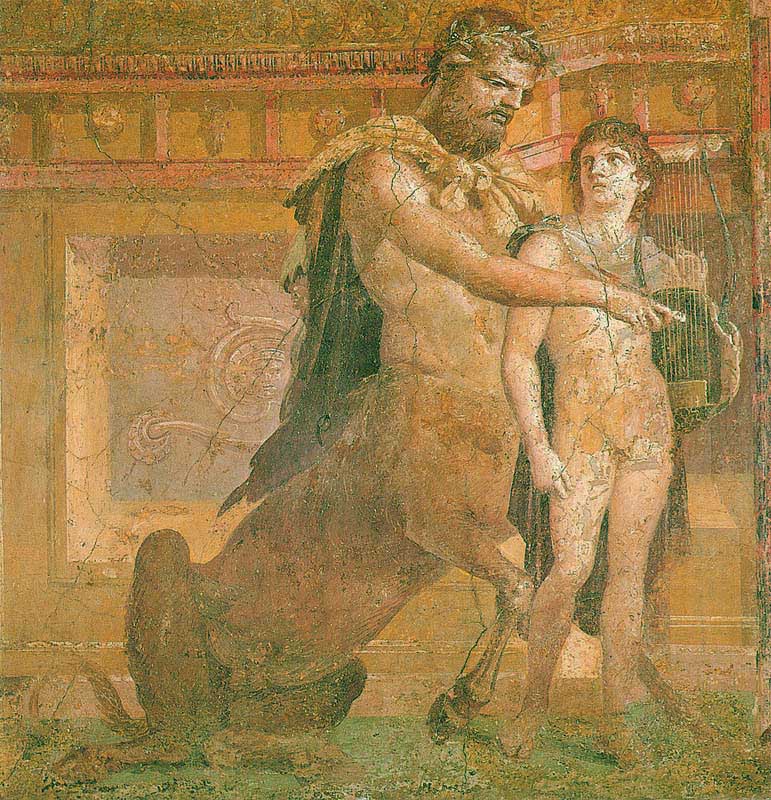
| Yeah, I've likewise always figured the reason these reconstructions ended up looking so awful is because paint is generally applied in layers (even to this day), so what they're likely reconstructing is the primer layer. Like we know from Roman frescoes[1] and mosaics[2] that they were pretty skilled painters and solving the problem of how to paint something to have more hues than a King's Quest 3 sprite is unlikely to be an unsolvable aesthetic problem. [edit] Changed from Secret of Monkey Island since that game has too many versions and remakes. [1] https://upload.wikimedia.org/wikipedia/commons/6/6e/Chiron_i... [2] https://en.wikipedia.org/wiki/Plato%27s_Academy_mosaic#/medi... |
|
| ▲ | fsloth 4 days ago | parent | prev | next [-] |
| "many people are operating outside their area of expertise on this subject." Exactly. I takes years of really hard work to get good at this stuff. Decades. I do realize research budgets are not that awesome, but when claims are of aesthetic in nature (explicitly and implicitly) and deal with human craftmanship there should definetly be collaboration with also craftsmen subject experts. A good example where this was executed really well was the Notre Dame reconstruction (I _guess_). Craftsmen and academic diligence hand in hand. Not everyones archeological reproduction has such a budget unfortunately. |
| |
| ▲ | the_af 4 days ago | parent [-] | | > I do realize research budgets are not that awesome, but when claims are of aesthetic in nature (explicitly and implicitly) and deal with human craftmanship there should definetly be collaboration with also craftsmen subject experts. Do we know for a fact this didn't happen in this case? | | |
| ▲ | fsloth 4 days ago | parent | next [-] | | With the horrible version of the statues? They just look ... bad. While photography destroyed academic art almost to extinction, thank heavens it's still trained and you can find practicing artists. Finding good ones might be a bit hard though. So you could find a _bad_ artist to help you in your reconstruction project. But finding an incompetent accomplice probably is not in anyones best interest. So while hiring _anyone who claims to be an artist_ might be procedurally and managerially an approved method, it really is not the outcome anyone actually woudl want to have. So whatever happened here ... it does not count as professional reconstruction. You don't need to be an art historian or an artist to recognize this. You just need to compare them to other art from the period and the frescoes, and consider which one you find more appealing. And once you do this, there is a fair chance you will recognize the "good" art feels like an order of magnitude more appealing to you, even if you don't have the training to recognize the exact features that cause this appeal. | | |
| ▲ | jfengel 4 days ago | parent | next [-] | | An awful lot of the things hanging in museums look "bad" to me. I'm not just talking about the easily-mocked contemporary art. I mean things like Medieval paintings with Jesus painted as a baby-sized adult man. Everything before the development of perspective looks like a grade-school cartoon. I'm sure you're right that reconstructions of painted statues are inaccurate. But I'm not sure that a good-looking reconstruction would be any more authentic. Cultural tastes vary a lot. I suspect that if we ever do get enough data for a valid reconstruction, I won't like it any better. | | |
| ▲ | bsder 4 days ago | parent | next [-] | | > An awful lot of the things hanging in museums look "bad" to me. I'm not just talking about the easily-mocked contemporary art. I mean things like Medieval paintings with Jesus painted as a baby-sized adult man. Everything before the development of perspective looks like a grade-school cartoon. Perspective wasn't developed! The Greeks and Romans used it just fine, for example. What was lost was artistic training because there wasn't sufficient economic market for it. As soon as you got sufficient economic incentive, art magically improves again. This is stunningly obvious if you look at Athens and then Pompeii and then Rome and then the Vatican (with the attendant backslide until the Renaissance as you note). Interesting parallel to modern--will AI cause a huge backslip in art since the economic market for artists is being destroyed? | | |
| ▲ | fsloth 3 days ago | parent [-] | | "since the economic market for artists is being destroyed" I don't see it being destroyed. I mean the market for art. That's a market for tangible things made by specific humans, pieces that are unique. Very hard to see how AI will affect that since the market is dominated to large extent by the need by the art salespeople, art institutions, and art collectors to sustain prestige and investment value. If it just about volume, China would have destroyed it decades ago. Clearly adding even more volume will hardly put a dent to it. |
| |
| ▲ | JumpCrisscross 3 days ago | parent | prev | next [-] | | > An awful lot of the things hanging in museums look "bad" to me Sure. But if have a chance to visit Pompeii, the author’s argument will land. The Romans made beautiful art. It seems odd that they made beauty everywhere we can find except in the statues we’ve reconstructed. | |
| ▲ | fsloth 4 days ago | parent | prev | next [-] | | As a reference point to paintings in antique - these portraits from Roman Egypt are quite nice - from around 0 AD. https://en.wikipedia.org/wiki/Fayum_mummy_portraits | |
| ▲ | 4 days ago | parent | prev [-] | | [deleted] |
| |
| ▲ | the_af 4 days ago | parent | prev [-] | | I'm not sure whether they look "bad" is enough justification. The author dismisses the possible explanation "maybe they didn't consider this bad style back then" without any real argument other than "there are other works of art with different styles". I agree that I, personally, do not consider them painted in a way that is pleasing to me. But is that what the reconstruction project is meant to achieve, i.e. a painting style that is pleasing to current audiences? Or is it about reconstructing the bare minimum that can be asserted with some degree of reliability that is actually supported by the physical evidence? Again I must ask: do we know decent artists weren't involved in the reconstruction project? Remember, the goal is to use their artistry to achieve scientific results, not just do whatever they find pleasing. > You just need to compare them to other art from the period and the frescoes, and consider which one you find more appealing I get this is the most compelling part of the argument TFA is making, but to be honest I don't find it all that compelling. Surely the people involved in the reconstruction considered this, and there's a reason why they still produced these reconstructions, and I don't believe that reason is "they are incompetent or trolling". | | |
| ▲ | eudamoniac 4 days ago | parent [-] | | I believe it is basically irresponsible to present the statues with their base layers only. Either extrapolate the aesthetic top layers that might have been there, or just report that the statues were painted without a visual example. Presenting them as poorly as they do contributes to demoralization and a sense of alienation from one's own cultural roots. | | |
| ▲ | the_af 4 days ago | parent [-] | | I believe researchers are under pressure not to extrapolate too wildly, unless they can find strong evidence for their extrapolations. In TFA itself they are quoted (very briefly) saying this is not a representation of what the statues actually looked like, it's just the pigments they guaranteed were there. > Cecilie Brøns, who leads a project on ancient polychromy at the Ny Carlsberg Glyptotek in Copenhagen, praises the reconstructions but notes that ‘reconstructions can be difficult to explain to the public – that these are not exact copies, that we can never know exactly how they looked’. Consider that had they gone wild with creativity, they would have been criticized for it. Apparently the current overcautious trend is an (over)reaction to previous careless attitudes in archeology. This is my uninformed take, anyway. I think TFA's author should have engaged more directly with researchers instead of speculating about their motives; the article -- while making some interesting points -- reads a bit snarky/condescending to me. Why not go straight to the source and ask them? | | |
| ▲ | eudamoniac 4 days ago | parent [-] | | "This is almost certainly not what it looked like at all, and it's hideous, but I am going to make sure this image is disseminated across the literature and the news (which will make everyone think it was actually hideous but oh well)" is just more irresponsible in my mind than any alternative. |
|
|
|
| |
| ▲ | IAmBroom 3 days ago | parent | prev | next [-] | | The article makes very explicit proofs, in showing paintings of painted sculptures, where the sculptures are painted with very appealing, naturalistic hues. | |
| ▲ | cxvrfr 4 days ago | parent | prev [-] | | Perhaps... it's just that they collaborated with experts on publishing coloring books for five year olds due to some reason. |
|
|
|
| ▲ | hibikir 4 days ago | parent | prev | next [-] |
| Not all painters, and not in all cases: See, for instance, grisalle painting. One can then sketch the highlights and shadows first, and then come in with pretty translucent pigments. When the pigment is what is expensive, it can be more economical. We know for sure many a renaissance painting and fresco was done this way, and some of us do it today. Now, was it possible that, given the pigments available, they were better off just going with the most saturated thing they could possibly have, and then work from there? Absolutely. But the right argument here isn't that "Painters layer paint this way", but that, as the article indicates, they are unlikely to be unsophisticated artists that don't believe shadows and highlights. So the highlighting and the shading must be in the place where we can't see, because we assume they must exist. |
|
| ▲ | IAmBroom 3 days ago | parent | prev | next [-] |
| Agreed. Armor historians from the 1960s, all the way back to Victorian age, sat in their offices smoking pipes and imagining what purpose the armor served, and and what constraints molded it. Then the SCA and Renaissance Faires sprang up, and it was no longer purely theoretical. Recreationist research became a thing. And historical analysis became practical. The most glaring example are the rectangular epaulets on funereal brasses and sarcophagi. Historian used to claim they were used to deflect blows from the shoulder. Nothing is flat after a blow. All real armor is built on pressure-spreading arches, often first two-dimensionally, but ultimately in three dimensions (the armor over a 16th-century knight's legs are never conic sections, but more fluid curves). So, those rectangles? Not defensive metal, but purely decorative, and probably leather or paper-mache. (None survive, and in fact there's some argument they exist only in art.) Any historian who tried to make one and use it would learn this in a short exercise. But the fallacy survived for decades, because the people were operating outside of their area of expertise, while falsely claiming otherwise with no criticism. Another example is the still-pervasive myth that medieval people used spice to mask the flavor of spoiled meat; I've heard it used by academics a couple decades ago at a conference presentation. Ever eaten spoiled meat? Ever think to yourself, this bellyache wouldn't be so bad if I didn't taste the source of my poisoning? That myth was tracked back to a singular author in the 1950s, IIRC, and copied without any rational criticism ever since. |
|
| ▲ | pantalaimon 4 days ago | parent | prev | next [-] |
| That's what TFA is saying > Another may be that they are hampered by conservation doctrines that forbid including any feature in a reconstruction for which there is no direct archaeological evidence. Since underlayers are generally the only element of which traces survive, such doctrines lead to all-underlayer reconstructions, with the overlayers that were obviously originally present excluded for lack of evidence. |
|
| ▲ | metalman 4 days ago | parent | prev | next [-] |
| looking at it from the absolute simplest of perspectives, money/time/effort, then the notion of a base, or primer layer that seals a surface and provides a non absorbant layer for the much more expensive coulor coat.
primer bieng applied by aprentices and the finnish coat applied by specialists who would be very likely be useing ALL of the tricks of the trade to bring a statue to life, but then wejump forward to Bernini and the total lack of paint, which makes it even more likely that there were competing philosophies around statuary, with everything from vegas type full primary coulors put on with a mop, and others that were master paintings done on 3d canvases, and still others who believd in.the purity of the "raw" sculpture |
| |
| ▲ | kijin 4 days ago | parent [-] | | > then we jump forward to Bernini and the total lack of paint, which makes it even more likely that there were competing philosophies around statuary Most Greek and Roman statues had lost their paint long before the Renaissance. Early modern artists held up those paintless statues as the ideal form, which is why nobody from Michaelangelo to Bernini even tried to paint their sculptures. Instead, Bernini learned how to make marble itself interact with light to look alive. For centuries afterward, the purity of raw marble became the one true ideology. Diversity in this area collapsed, and took a long time to recover. Even today, most people who are used to Western classical art will probably agree that marble statues look better without paint. We've been conditioned for generations to believe so. The ugly reproductions of painted statues aren't helping, either. |
|
|
| ▲ | johndhi 4 days ago | parent | prev | next [-] |
| Makes sense. This is basically how skilled painters of miniatures (Warhammer) do it. |
| |
|
| ▲ | philistine 4 days ago | parent | prev | next [-] |
| I will die on an adjacent hill: when the details had washed away with time leaving behind merely the sturdier and ugly base, people removed the garish base coat cause that thing is uuugggo! Our ancestors were thinking what we're thinking: It looks better white than with only a base. |
| |
| ▲ | IAmBroom 3 days ago | parent [-] | | Like spraypainting over graffitti with a drab color that doesn't match the original stone perfectly. |
|
|
| ▲ | alterom 4 days ago | parent | prev | next [-] |
| >This whole thing just won't go away because many people are operating outside their area of expertise on this subject. The point the author made in the article is that the reconstructors are well aware of this, and are, in a way, trolling the masses to raise awareness and attract attention to the classical art and museums. Keeping history alive generally isn't a profitable enterprise. |
|
| ▲ | rayiner 4 days ago | parent | prev | next [-] |
| Thank you. I know nothing about painting, but I bought the original story about the statutes being painted these garish colors. |
|
| ▲ | ActivePattern 4 days ago | parent | prev | next [-] |
| I assume you didn't read the article, since that's their exact point... "Since underlayers are generally the only element of which traces survive, such doctrines lead to all-underlayer reconstructions, with the overlayers that were obviously originally present excluded for lack of evidence." |
| |
|
| ▲ | empath75 4 days ago | parent | prev | next [-] |
| Even a middling warhammer miniatures painter would have done a better job of painting these statues than the reconstructions. |
| |
| ▲ | mikkupikku 4 days ago | parent [-] | | Makes me wonder if they ever used the same sort of gimmicky paint, like paint with mica flakes to make something look metallic. | | |
| ▲ | hibikir 4 days ago | parent | next [-] | | They couldn't use the same paint, if just because for miniature painting we are almost always running acrylics, so it's all plastic binding the pigments. Even a modern oil paint is quite a bit more advanced than what they could do then. They also had a significant disadvantage in pigment availability. Chances are that there's a whole lot of modern, synthetic pigments among the colors you use regularly. Pyrrole Red is from 1974, for example. We know that painters were well aware of things like how many good, natural pigments get different outcomes when diluted (go see what happens as you thin ultramarine), so it's not as if they had no technoology. But something like mica vs aluminum vs just gold leaf is a budgetary issue, both today and back then. You will find that good metallics are more expensive and avoid mica. But for an important statue, I suspect they'd take fewer cost cutting shortcuts, just like we can tell in renaissance and medieval art that got to us in relatively good shape. This is the kind of thing some people spend their lives studying. | |
| ▲ | kijin 4 days ago | parent | prev [-] | | They probably used whatever paint was closest in chemical composition to the residue they found on the statue. | | |
|
|
|
| ▲ | Daub 3 days ago | parent | prev | next [-] |
| That is certainly how oil painters paint. But painting on absorbent stone is likely very different - more akin to fresco, and would probably not support a very layered approach. |
|
| ▲ | twelvechairs 4 days ago | parent | prev | next [-] |
| The other side is lack of colourfast pigments back then. Underlayers would be cheap and colourfast. Top layers would usually be more expensive and deteriorate much more quickly. |
| |
| ▲ | IAmBroom 3 days ago | parent [-] | | Most colourfast pigments are minerals, and many of them are found in the natural world (purple hues being notoriously absent). Ultramarine, cadmium red, and lead white have been known since ancient times. |
|
|
| ▲ | jerf 4 days ago | parent | prev | next [-] |
| This would be a great time to use AI, because it is very good at style transfer. Feed it a lot of contemporary painted art, feed it the base-coat version of the sculpture, and ask it to style-transfer the paintings on to the sculpture. You'd likely get something very close, and for once we can use "The computer said it, I'm not responsible for it!" for the power of good, by making it so no human is responsible for the heinous crime of assuming something without historical evidence (no matter how sensible the assumption is). (And lest someone be inclined to downvote because I'm suggesting an AI, the real sarcastic core of my message is about our faith in computers still being alive and well even after we all have decades of personal experience of them not being omniscient infalliable machines.) |
|
| ▲ | BurningFrog 4 days ago | parent | prev | next [-] |
| Are there really no statues with surviving full paint remnants? |
| |
| ▲ | bsder 4 days ago | parent | next [-] | | There aren't even that many of the original statues remaining. A lot of what survived are copies of the originals. So, we are extrapolating from a very, very, very spotty data set. | |
| ▲ | adgjlsfhk1 4 days ago | parent | prev [-] | | No. 2000 years is a long time. | | |
|
|
| ▲ | 4 days ago | parent | prev [-] |
| [deleted] |