| ▲ | UI_at_80x24 2 days ago |
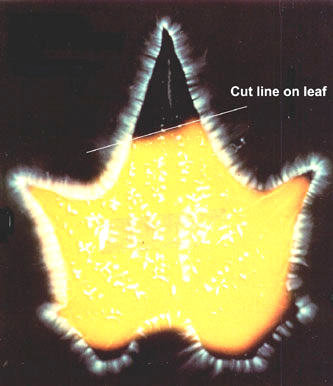
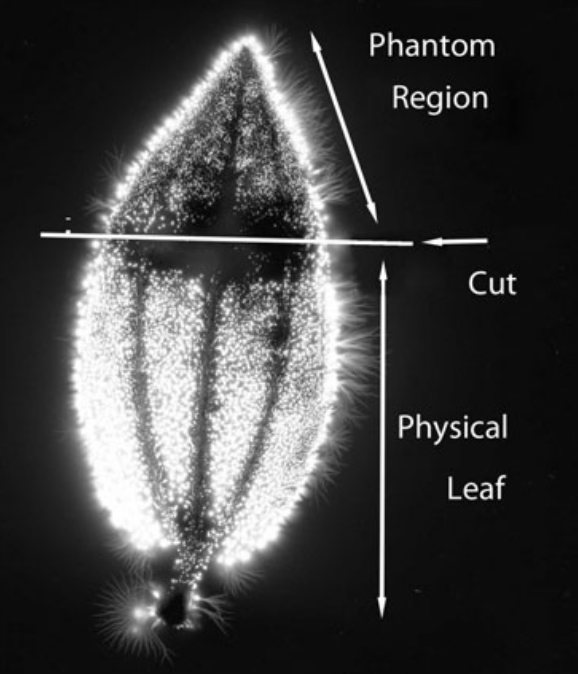
| IIRC this was debunked as ...The plate/glass was not thoroughly cleaned between photos... I.E. the leaf left residue on the glass. |
|
| ▲ | Eridanus2 a day ago | parent | next [-] |
| It appears to be a form of DBD (dielectric breakdown discharge). Setting aside the para-physical claims, that aspect of it seems reproducible, as a fun science demo, at least. |
| |
| ▲ | gus_massa a day ago | parent [-] | | I agree, the Kirian photography is real, but the GP is taking about the paranormal claims, in particular the torn leaf https://en.wikipedia.org/wiki/Kirlian_photography#Torn_leaf_... (Are the original photographs available somewhere? I found only bad modern photoshoped versions, and even a guy that made a debunking video and then his photos were repeated as confirmation evidence.) | | |
|
|
| ▲ | 47282847 a day ago | parent | prev | next [-] |
| I consider it a given that any living organism radiates (heat) energy: there is constant energy and matter exchange with its surroundings; a foundational aspect of life. I consider it at least a possibility that by looking at this radiation, you can find correlations between balanced “health” (new age speak: intact Aura), and potential imbalances, and thus that it may work as a diagnostic tool. |
| |
| ▲ | jstanley a day ago | parent [-] | | You can measure someone's temperature to find out if they have a fever, is that the kind of thing you're suggesting? | | |
| ▲ | 47282847 a day ago | parent [-] | | Did you ever touch a human body and noticed that its temperature feels different in different regions? Even, say, down one arm? That’s what I was referring to; not core temperature. | | |
| ▲ | _Microft a day ago | parent | next [-] | | They do that for professional athletes but they use thermal cameras for that and look for asymmetries in the left and right side of the body. That seems to give a clue about inflammations. They look for differences as low as 0.1°C iirc. Take all that with a grain of salt because I heard very little about it. | |
| ▲ | buildsjets a day ago | parent | prev [-] | | As a sufferer of psoriatic arthritis, I am painfully aware of this phenomenon. | | |
| ▲ | 47282847 a day ago | parent [-] | | Out of curiosity: did you ever try a craniosacral biodynamics treatment session, and if yes, how was it for you? | | |
| ▲ | rightnutwingjob a day ago | parent [-] | | Biodynamics is a method of organic farming. Craniosacral therapy (CST) is a gentle, noninvasive hands-on treatment that uses light touch to help release tension around your body’s connective tissue (fascia). Craniosacral Biodynamics Treatment is what then? I’m all for hands-on treatment, but there’s better modalities than whatever this is presented to be. | | |
| ▲ | 47282847 21 hours ago | parent [-] | | I didn’t pick the name. It was used by an embryology researcher, Erich Blechschmidt, and was picked up from him by craniosacral osteopath James Jealous, for a 10-year training in gentle touch and presence to assist relaxation as you say. It is a branch of craniosacral therapy. It has nothing to do with the farming method that goes by the same name. It has actually been coined way earlier: ” In September 1866, a seminal monograph authored by the German zoologist and evolutionary biologist Ernst Haeckel was published under the title Generelle Morphologie der Organismen (or the General Morphology of Organisms). In this 2-Volume-monograph, Haeckel not only introduced novel terms and concepts, such as Protista, Monera, ontogeny, phylogeny, ecology and the ‘biogenetic law’, but also coined the word “Biodynamik” (biodynamics) as a synonym for ‘general physiology’. Haeckel (1866) separated the natural sciences into the major branches I (Abiology or anorganology) and II (Biology or life sciences). In Haeckel's scheme, biology (zoology, protistology and botany) consisted of biostatics (morphology) and biodynamics (physiology).” https://www.tandfonline.com/doi/full/10.1080/15592324.2016.1... |
|
|
|
|
|
|
|
| ▲ | dvfjsdhgfv a day ago | parent | prev [-] |
| This is specifically addressed in the article, at length. |