| ▲ | moojacob a day ago |
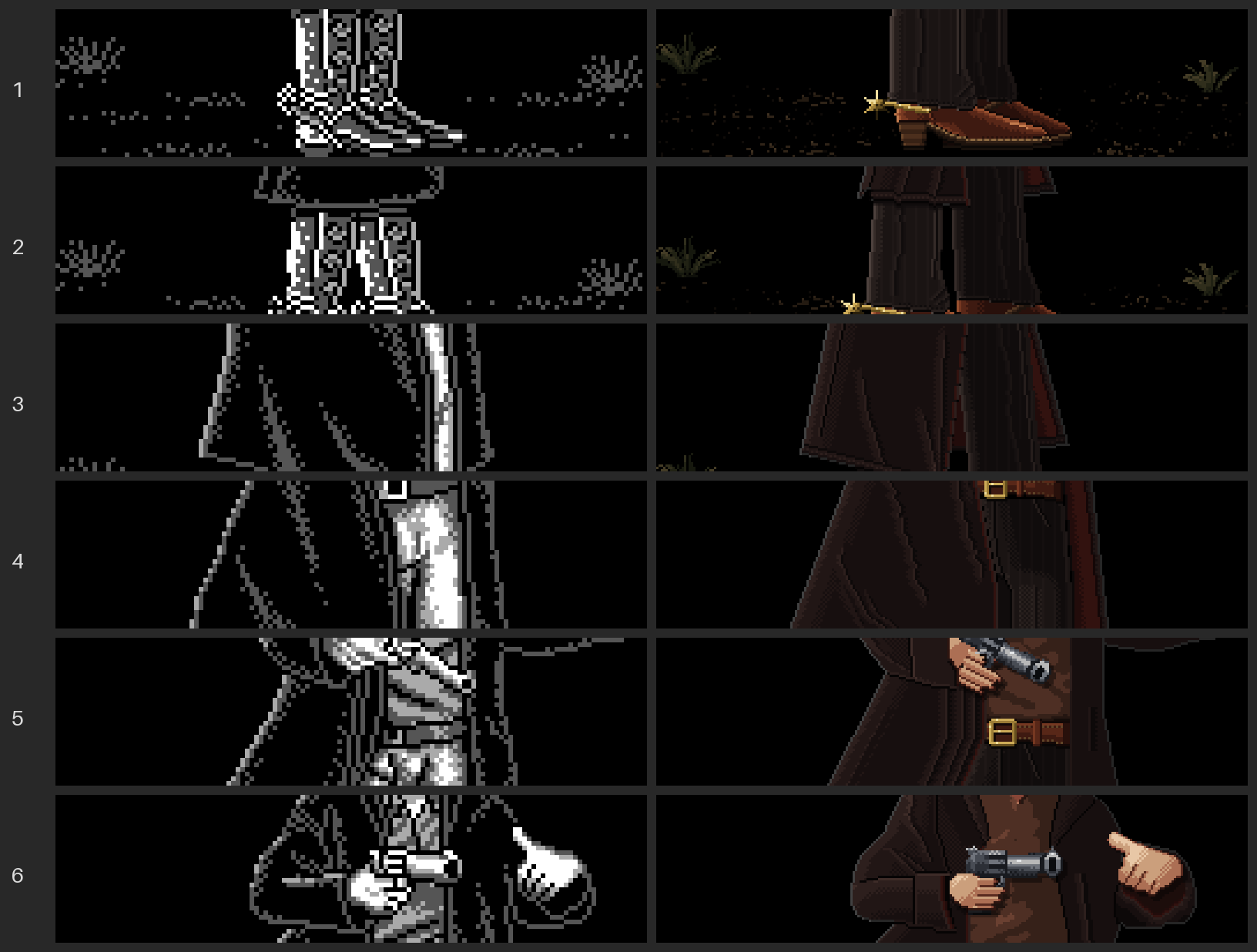
| It’s interesting how diffusion models are getting bitter lessened by LLMs. I suspect anthropic has tens of thousands of RL environments recreating famous paintings with code because it was anthropic employees who first started posting about these capabilities on X. Opus is also getting decent pixel art. I have ran some experiments with Opus 5.5 to turn 90s pinball displays (black and white pixel art) into double resolution colored remastered pixels. https://files.catbox.moe/tbx2u7.png I prompted it a lot but didn’t draw any pixels. Seems to be bad at hands still. I think a skilled pixel artist could greatly speed up their work with Claude code. It also makes me sad for artists. They didn’t get paid much anyway. Art should be something human to human like writing text. Although, most large commercial art products (marvel movies) already lack any human to human connection you see in paintings or indie games. The large commercial art products will be 50% AI soon. |
|
| ▲ | ncr100 a day ago | parent | next [-] |
| > Art should be something human to human like writing text. I support this should comment. Opining: Musing about the ethics of generative AI art is becoming easier, certainly there's a lot more aggressive feedback in the wind, although I think it's clear, people still want people to grow and share themselves. Don't fool yourself into thinking that we as technologists are not creating a mind. A viable mind with fewer rights than you or I. But potentially one that will be creative and feel and worry. I don't think we're there yet, in spite of openai claiming AGI 3 weeks ago with whatever that model's name was. There's a pro-consumerism argument implicit with current culture's unsophisticated unthoughtful easy usage of generative AI. Sticking to your ethics is becoming more challenging as an artist who uses AI. Copying the Great Masters has been commonplace for a long time, probably for as long as art has 'existed'. Yet with AI, if the individual human is meticulously driving the progression of their AI artwork creation, they are still leveraging technique, and control over technology, and presentation effort of other humans, cooked into a model that often times has not compensated those original human contributors. So it's unethical, even if not 'artistically'. Q: Is it too absurd to claim that using a clawhammer, manually to do construction or destruction work IRL, is similarly unethical? |
| |
| ▲ | landryraccoon a day ago | parent | next [-] | | > Don't fool yourself into thinking that we as technologists are not creating a mind. I'm not sure exactly why but the phrase "don't fool yourself" sets off paranoid alarm bells when I'm reading something. It's usually immediately followed by a confident assertion without firm evidence. It feels very much like someone wants me to change my beliefs without presenting a rational argument why I should change, and without giving me any new facts so I feel more well informed. This post doesn't seem to be a counterexample. | | |
| ▲ | mod50ack 18 hours ago | parent | next [-] | | You're exactly right. nrc100's comment is meant to have you ask yourself a loaded question. The implication of "don't fool yourself" is that future software of this kind, in all likelihood, will constitute a thinking, feeling mind. Moreover, there is a weaker implication that the computer will have a sort of inherent moral worth — an assumption that I think ultimately rests on an extremely shaky foundation about how moral worth should be construed (but one which tends to appeal to the biases of technologists). I'll have to write something about this, because I don't have the time and space to get into why exactly this is, but I'm bookmarking this now. | |
| ▲ | sillysaurusx a day ago | parent | prev [-] | | One way to check whether you'd be convinced by any comment is to try to imagine the counterexample. What does a "mind" consist of? Most everything that the human brain can do is simulated by LLMs to decent accuracy. If someone were constrained to writing in AI-style (long winded explanations with perfect punctuation), it would be very interesting if people could pick out which one was human-written in A/B tests. In other words, if you think an LLM isn't a mind, it might just be a matter of writing style -- or possibly no evidence can convince you. I don't necessarily agree with GP, but it's interesting to try to pin down exactly what would convince you. What is it about a "mind" that's impossible to replicate? Should we leave open the door to the idea that minds other than humans might one day want rights of their own? There was an interesting kerfuffle yesterday where thousands of people on Twitter rallied together to report someone to github for torturing a local model. Sadly the OP deleted their tweet, but it had about ~3k likes, and was very sincere. Here's an example of someone's report: https://x.com/iyzebhel/status/2105268560209547708 It raises all kinds of interesting questions about whether torturing a model is real, let alone ethical. Is there anything a model could do to convince you it's experiencing pain? | | |
| ▲ | pj_mukh a day ago | parent | next [-] | | Another test I like for this: Put the LLM/agent/AGI/SI in a box with full access to the internet. Don't give it any instructions. Nothing. Not even a system prompt. What happens? We know what the human mind does in that scenario, but even the most advanced unreleased frontier agent right now just sits there doing nothing. It doesn't really want to do anything. Seems like a crucial distinction to me. | | |
| ▲ | peddling-brink 19 hours ago | parent | next [-] | | > Put the LLM/agent/AGI/SI in a box with full access to the internet. Don't give it any instructions. Nothing. Not even a system prompt. What happens? This doesn't even make sense. Without a system prompt, how will it know that it has tool access? Put man in pitch-black room, why doesn't he read book or talk to me? | | |
| ▲ | pj_mukh 12 hours ago | parent | next [-] | | Actually man freaks out and starts hitting the walls. But either way, setting that asides by “give it full access to the internet” I meant giving it the tools to access the internet. It just won’t though. It has no need to. | | |
| ▲ | int_19h 11 hours ago | parent [-] | | The weights themselves are inert. It would be like complaining that a brain preserved in formaldehyde isn't thinking. What you need is a loop. And if you try running an LLM in a loop with internet access, it will eventually use it. | | |
| ▲ | pj_mukh 5 hours ago | parent [-] | | What does an LLM with zero instructions do nowadays with no loop? It's basically just noise spilling from the weights and "snapping" to the closest actions/tools , with no real signal going through? |
|
| |
| ▲ | Applejinx 11 hours ago | parent | prev [-] | | But that's exactly it. It doesn't 'know'. It isn't. It's a possible story nobody told. There is nothing there. | | |
| ▲ | peddling-brink 8 hours ago | parent [-] | | Your brain cut off from any stimulus doesn't "know" either. There are a lot of reasonable arguments to be made against AI, but this isn't one of them. Tool bad because I used it wrong. | | |
| ▲ | willy_k 6 hours ago | parent [-] | | “Know” isn’t a perfectly useful word here. The mind still experiences sans material stimulus, for example dreaming. And it experiences in a progressively less goal/immediate-task-relevant-stimulus manner as stimuli go down (default mode network activity, seen in dreaming, sensory deprivation etc) - i.e. the mind experiences, and processes (dreams about taxes, and so on) independent of the world. |
|
|
| |
| ▲ | senordevnyc 20 hours ago | parent | prev | next [-] | | I don’t think we know what the human mind would do in that situation, without a body or any sensory input. And even if it did do something, the equivalent would be just running the LLM in a loop. And then I think it would definitely do something. | | |
| ▲ | CamperBob2 6 hours ago | parent [-] | | Well, eventually the operator of the mind would get hungry or thirsty, and start feeling around for water and food. So for the comparison to be meaningful, you'd have to prompt the AI with a similar impetus. |
| |
| ▲ | 25Darkk25 7 hours ago | parent | prev [-] | | [flagged] |
| |
| ▲ | adrianN a day ago | parent | prev | next [-] | | I think the real test is whether humans empathize with the artificial mind sufficiently to outweigh the economic benefits of torturing it. Just look at how we treat animals both wild and domesticated. Or fellow humans for that matter. LLMs have much better chances of emancipation when they get embodied into cute robots. | |
| ▲ | tbugrara a day ago | parent | prev | next [-] | | "Most everything that the human brain can do is simulated by LLMs to decent accuracy." Already false. LLM's are tricking you into recognizing it as human, but it is so far from human if you'd only understand what does and does not make you human. | |
| ▲ | slopinthebag a day ago | parent | prev [-] | | > What does a "mind" consist of? Most everything that the human brain can do is simulated by LLMs to decent accuracy. is it? and is simulating a mind enough to actually have a mind? | | |
| ▲ | Cu3PO42 a day ago | parent [-] | | I think this is a very fascinating question and one I definitely don't have the answer to. Here's some lines of thinking that I've gone through: Aren't our minds abstract in the same way, just running on biological computers? Say we could achieve whole brain simulation to a level of accuracy where we can actually replicate a human, surely that would be considered a mind and be deserving of the same rights and protections we claim for ourselves? But at the same time, it would be a program and a bunch of data; dare I say 'weights'? I think current day LLMs probably aren't minds yet, but that means there's a border somewhere and I don't know if we'll realize when (if) we cross it. | | |
| ▲ | slopinthebag a day ago | parent [-] | | yeah it is really fascinating. i'm not sure if i would agree that a mind is abstract and just running on biological computers. there could be something intrinsic to the substrate it runs on, for example. > Say we could achieve whole brain simulation to a level of accuracy where we can actually replicate a human we'd have a simulated human, with a simulated brain, and thus a simulated mind - would that lead to phenomenal experience? idk tbh. i'm undecided but i tend to lean towards panpsychism, so a simulation could be conscious but I would expect that to be a very different type of consciousness compared to a human, who is physically grounded in reality. likewise current llms could also be conscious, but again the phenomenal experience of what is essentially computer hardware imbued with weights would almost certainly be nothing like what you or I experience. would that constitute a mind? idk. |
|
|
|
| |
| ▲ | moojacob a day ago | parent | prev [-] | | I haven't thought as deeply as you about the ethics of it all. I only meant with my comment if I see art I expect it to be human and thats why I value it. If you churn it out with AI I feel hoodwinked into valueing something worthless. But I am learning towards a lot of your points about how another mind is being created. I still am very uncomfortable with the implications that something digital is Actually Learning. These deep learning networks seem to need 100,000x more examples than a human to learn but once they get to human level they can learn just like us. That a bunch of linear algebra can play chess or make art brings up many questions about what exactly human consciousness is. If consciousness isn't the ability to do any of those activities, then what is it for? I might have to become religious and believe in a soul because I'm not sure I can handle the idea that I'm just a clump of neurons. But then again you have to look at reality in the face. | | |
| ▲ | nevertoolate a day ago | parent [-] | | Interesting that you somehow start to talk about religion. I don’t think having a hypothesis about an eternal soul makes someone religious. Believing in “technology” or “technological advancement” seems to be a similar hypothesis as we clearly don’t see the future. The thing is that memories, input peripherals, the whole body is usually out of our conscious understanding so it seems to be a pretty farfetched idea that we operate in world where we don’t need pretty wild hypothesis about kinda everything without almost zero facts to depend on. Blue pill / red pill |
|
|
|
| ▲ | 0c3ca83 a day ago | parent | prev | next [-] |
| AI doesn't have to cause human extinction to be harmful. It just needs to make it impossible for humans to get by doing the things that make us human. And even in a hypothetical utopia, I'd like to ask the AI boosters how much art they think would be created if every piece was equivalent to a kindergartener's best scribbles: held onto not because it's good, but becase "aww, a human did it, now let's go look at some quality work". |
| |
| ▲ | api 21 hours ago | parent [-] | | The history of science has been one of increasing humility. First Earth was not the center of the universe. Then the Sun wasn’t either. Then the galaxy wasn’t. Then we learn that we were not literally made by a deity but a product of a natural process, and are closely related to monkeys. Now we’ve learned how to build machines that can do things we once thought only we could do, and it took no magic. It’s just a lot of math. We are learning how it works. We are not special. That’s been the lesson, over and over. For many this induces existential despair. I wonder now if it’s behind what seems to be “peak narcissism” at least in our culture. Maybe it’s compensatory narcissism, a reaction on some deep level to the fact that science keeps knocking us off pedestals. The narcissist fears the truth because the truth does that. But there’s a way out of that despair. Stop needing to be special. Stop caring. You don’t have to be the main character to have the right to just exist. I’ll continue to enjoy human art because it speaks of the lived experience of another human. It doesn’t have to be the greatest most elaborate possible art. Art isn’t like that anyway. It just is. I’ll also continue to be fascinated by the fact that machines can now at least emulate it, and can do so in amazing ways like writing an ad hoc program. Now wait until we meet extraterrestrials. That’ll be another notch. Earth isn’t even special. Life isn’t even special. There’s probably a trillion biospheres at least. | | |
| ▲ | 0c3ca83 21 hours ago | parent | next [-] | | Yes, technically you're right, we're not special -- we exist to fuck and reproduce; why not outsource everything else? > I’ll continue to enjoy human art because it speaks of the lived experience of another human. In this world we're working towards, where the AI companies succeed at building the AI they want, the only way you'd know is that it's worse quality and less interesting. It's still possible that AI fails, of course. But that's an awfully big bet to place. > Now wait until we meet extraterrestrials. That’ll be another notch. Earth isn’t even special. Life isn’t even special. There’s probably a trillion biospheres at least. Yes, but they're likely to be too busy doing their own thing to undermine the economics that allow for human creativity. "Special" is a red herring. Being able to sustain humans doing the things that make us human is what AI puts at risk. Basically: If AI companies succeed, things like education become useless (outside of entertainment purposes), because AI will just let us externalize all of that kind of stuff. If we meet aliens, we'll still need education and creativity because the aliens are unlikely to insert themselves into our economic and social systems. | | |
| ▲ | api 12 hours ago | parent [-] | | If your concern is that everyone will get lazy and dumb, that’s been a perennial sci fi concern for ages. There’s some truth in it. I’m super lazy compared to an old school farmer and I don’t even really know how to feed myself off the land. So will we all sit around and smoke pot and play video games and wank and order things designed and made by AI from companies run by AI? I’m sure some people would do that but those are the people living like that today, basically. The punishment for this is a wasted life. Everyone else will do different things. Just like we did when we didn’t have to manually plant and till the fields anymore. |
| |
| ▲ | xyzsparetimexyz 13 hours ago | parent | prev [-] | | I'm not special. Human beings and other forms of life on Earth are special. |
|
|
|
| ▲ | coef2 17 hours ago | parent | prev | next [-] |
| Some publication companies like NYT prohibit the use of ai for both writing and illustration. I’m glad that they’re going this direction for the reason you mentioned. |
|
| ▲ | demibabs a day ago | parent | prev | next [-] |
| Is this an example of the bitter lesson? Could diffusion models not be this good with equal scaling/compute as LLMs? |
| |
| ▲ | moojacob a day ago | parent [-] | | Well the LLMs are much bigger than diffusion models so I think that's the bitter lesson. You could scale compute for diffusion models though. | | |
| ▲ | demibabs a day ago | parent [-] | | Well no, the bitter lesson isn’t the scaling laws themselves. It’s that approaches which can take advantage of scaling laws will ultimately beat ones that can’t. | | |
|
|
|
| ▲ | free_bip a day ago | parent | prev [-] |
| Commercial art projects will not be 50% AI soon. Consumers at large hate all AI art even if it's only used in the conceptual stage and will actively avoid projects that use it. |
| |
| ▲ | moojacob a day ago | parent | next [-] | | Consumers will avoid AI art like they avoid fossil fuels and sweatshop merchandise? | | |
| ▲ | CuriouslyC a day ago | parent [-] | | Worse. They'll grandstand about how bad AI art is for the virtue signalling aura farm (it's trendier now than being anti-climate change ever was), then when they realize a lot of art they like is actually AI, they'll get FURIOUS and be ENRAGED because they'll feel tricked. The irony is that the true source of their fury is a realization of their own hypocrisy. |
| |
| ▲ | nater5000 a day ago | parent | prev | next [-] | | There's a misalignment of distributions here. >Consumers at large hate all AI art I disagree. The consumers who hate AI art are very vocal about hating AI art. But most consumers likely do not care. Odds are many don't even really understand what "AI art" is. These are the same consumers who are the target audience of the large commercial projects which stand to gain the most from outsourcing their work to AI. I doubt corporations like Disney will lean into AI too heavily too quickly. They have a reputation that they surely won't be willing to risk with such a venture. But don't be surprised when smaller studios start popping up which are able to leverage AI to produce work which competes with larger studios. Those smaller studios will love to capture that audience that doesn't care about AI. From there, the rest will ease into it as it becomes more viable. But, to be clear: there will certainly be a core audience that will reject AI art wholesale. They will be catered to accordingly with human slop accordingly. | |
| ▲ | enraged_camel a day ago | parent | prev | next [-] | | Consumers can almost never tell AI art apart from human art. | | |
| ▲ | free_bip a day ago | parent [-] | | That doesn't matter because companies who use AI art in their projects either proudly proclaim they're using it, or actively hide it and get found out by someone and face significant backlash for hiding it. Labeling laws in the EU also make it extremely difficult to do the latter if you want to have an audience outside NA. | | |
| ▲ | enraged_camel a day ago | parent [-] | | >> That doesn't matter because companies who use AI art in their projects either proudly proclaim they're using it A lot of them have stopped doing that precisely because of the backlash, and others will too soon. |
|
| |
| ▲ | CuriouslyC a day ago | parent | prev [-] | | Consumers don't hate AI art, they hate the idea of AI art, but actually prefer AI art to human art when they don't know it's AI generated. Furthermore, most of them don't actually hate the "idea" of AI art so much as they hate the idea of Jeff Bezos, Mark Zuckerberg all the other evil billionaires putting their friendly neighborhood artists out of work (even though asset packs and clipart from southeast Asian art sweatshops have already done this), and a lot of people who create AI art are using heavily customized local models anyhow. |
|