| ▲ | thelastgallon an hour ago | |||||||
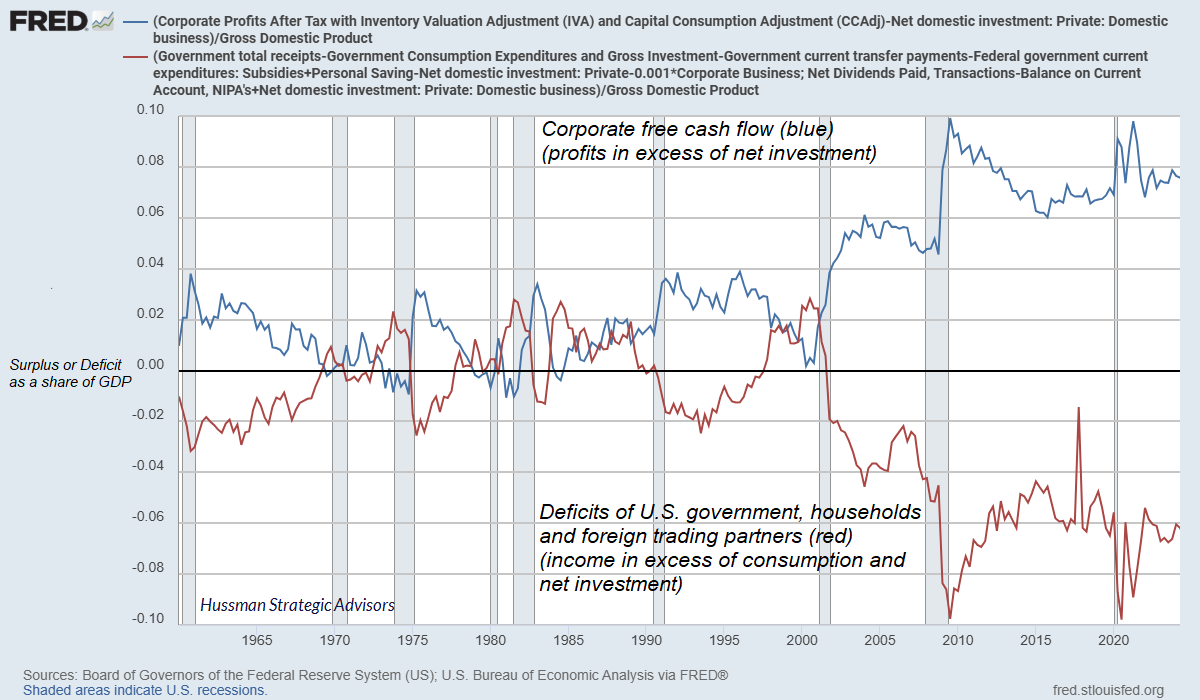
A few public servants in Australia, Norway and the kingdom of saud doesn't translate to all the people are benefiting. Nice try to shift the blame to 8.5 billion people instead of oil billionaires and corporations. Old people have set up systems to transfer wealth from future generations. The corporate profits are mirror images of debt: https://www.hussmanfunds.com/wp-content/uploads/comment/mc25... US has $40T federal debt (+state, +municipal, +household) and probably 100T+ debt worldwide which the future generations have to pay. Fossil fuel is unsustainable without substantial subsidies from Govts. Global Fossil Fuel Subsidies Reached $7 Trillion in 2022, an All-Time High: https://e360.yale.edu/digest/fossil-fuel-subsidies-2022 More than a century of subsidies and yet not profitable on its own. | ||||||||
| ▲ | roenxi 15 minutes ago | parent | next [-] | |||||||
> US has $40T federal debt (+state, +municipal, +household) and probably 100T+ debt worldwide which the future generations have to pay. Future US citizens are clearly not going to repay the debt, simply because they can't feasibly pay that much back in real terms. They cannot achieve the impossible. The magnitude of the debt is far beyond what it makes sense for the US to make good on. Future generations of the US won't be able to borrow on such favourable terms (ie, people will stop donating to the US cause) and all the capital investment that would have happened in the US to power their consumption happened in China instead - but the effects of the debt won't look like repaying anything. | ||||||||
| ||||||||
| ▲ | AndrewDavis 14 minutes ago | parent | prev [-] | |||||||
> A few public servants in Australia A few public servants in Australia? I'm not sure what you mean? Superannuation may have been limited to a public servants and employees of large corporations in the 1970s, but was expanded to blue collar workers in the 1980s (see industry super funds), and mandatory for all employers in the 1990s. Almost every worker in Australia has a superannuation fund. Whether a given person's fund is invested in fossil fuels is another questio (mine has a radio button to choose green only investments or not). | ||||||||