| |
| ▲ | bwindels 3 hours ago | parent | next [-] | | In Europe, we're already degrowing since 2008, even more so if you only look at the real, physical economy because we have to import our fossil energy. We won't be able to power the same lifestyle with nuclear and renewables either, the math doesn't add up. Jean-Marc Jancovici is a french engineer explaining this in great detail, see for example https://www.thegreatsimplification.com/episode/84-jean-marc-... if you don't speak french. | | |
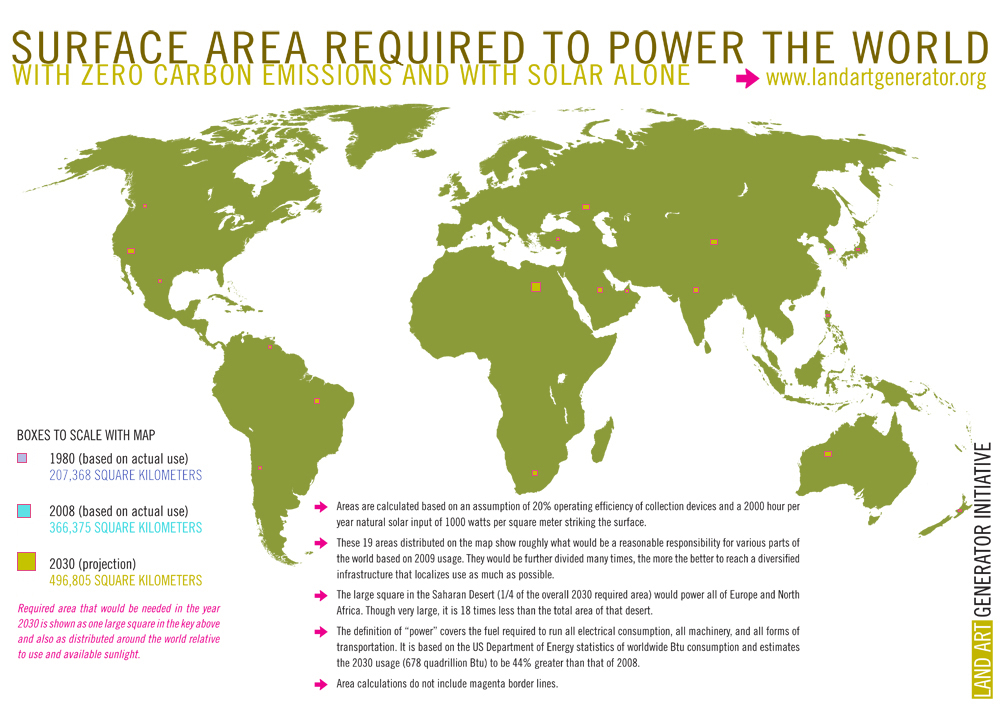
| ▲ | api 2 hours ago | parent [-] | | Yes, I've read tons of stuff like this. It won't work. You can absolutely trim a lot of fat from the modern lifestyle, but then you'll be left with a residual. Meanwhile the developing world will keep developing and we have no right to order them to stop. The idea that it's not possible is bullshit too, and it's still bullshit even if you ignore nuclear power. https://landartgenerator.org/blagi/wp-content/uploads/2009/0... Back in the 2000s there was a ton of discourse around peak oil. As part of that, I recall reading very detailed breakdowns written by actual engineers and scientists arguing why you would never have a mass-market EV with the range of a gasoline car and you would never be able to power more than 10-20% of a modern economy with solar power. I own two EVs, one with gas-comparable range, and California currently gets almost 40% of its total electricity (averaged across day and night) from solar, and climbing. There were whole books on this. I think one was called Power Down. It was all 100% wrong. I also recall reading detailed analyses by aerospace engineers about how you would never have a reusable rocket, that it was simply impossible or would cost so much it wouldn't be practical. First stage reusability is now routine, and second stage reusability is coming. Detailed breakdowns of why X is impossible have an incredibly poor track record unless they reduce directly to the laws of physics. Will faster than light travel ever be possible? No, and I believe that, because if it was it would mean a huge part of modern physics (not just relativity) is wrong in very bonkers ways. There is no first principles physics argument for the limits this guy is arguing. Of course if you imagine infinite growth on a finite planet, that fails. That's a trivial argument. But that's not happening, probably due to birth rates declining. The question I'm addressing is: can this civilization and its near-future extrapolation be powered without fossil fuels? The answer is yes, and again even without nukes. Throw nukes in there and it just gets easier. IMO this is 100% ideology and is an example of what I call "problemism." A "problemist" is someone who uses a problem as a stalking horse for one and only one solution that turns out to smuggle in some kind of ideological or social agenda. I see problemism as a dishonest propaganda technique. It's a way to sell the idea without directly selling the idea, instead using concern over some other thing to smuggle it in. So you know I'm not just picking on the left: right now there's a big freak-out on the right about birth rates. The problemists there argue that it's why we need to get back to ultra-traditional family structures and take rights away from women. They're not interested in any solution that doesn't do that, because they don't actually care about the problem. They only care about taking rights from women. This guy and those like him only care about degrowth as part of what is probably some kind of anti-industrial political ideology. If the problem could be solved without it, that would be bad as far as they're concerned, just like how the far right doesn't care about solutions to birth rate decline issues that don't involve reactionary social agendas. Most of these people are anti-capitalists. Thing is, I don't mind that. I don't think capitalism is the ordained perfect system. But if you want to sell me on an alternative to capitalism, argue for it directly on its merits. The test is: if climate change and fossil fuel depletion did not exist, could you still make your argument for abandoning capitalism in favor of your system? If not, then you're engaging in "problemism" to sell bullshit. Because there is no physical reason that you could not drastically cut CO2 emissions without abandoning capitalism. A simple progressive carbon tax combined with cheap renewables could do it. We just lack the political will. | | |
| |
| ▲ | uv-depression 2 hours ago | parent | prev | next [-] | | This is a gross misunderstanding of what degrowth means. The fantasy is that an economic system predicated on infinite growth can be made compatible with finite resources. Take, for example, the fact that renewable energy keeps growing as a percentage of total energy generation, yet total GHG emissions keep rising. That's a result of the system of incentives set up by capital. Yes, the economy can become less coupled to resources (as it has), but there is a limit, unless you seriously want to argue that iron (for example) can be an arbitrarily small portion of the economy. An economy is a method of allocating resources. This economic system is extremely terrible at meeting base human needs (consider that we produce many times the amount of food that's needed to feed everyone's needs, but massive amounts of it used for industrial meat production and biofuels). > we are never returning to pre industrial times This is an absurd strawman. > everyone needs to become poorer This is, in fact, the industry propaganda. What degrowth advocates for is taking as our first priority meeting human needs and living sustainably (which can be made compatible with most of the technology we have today in some form), rather than the ideology of growth for growth's sake, which mainly results in massive amounts of wasted resources and funnelling wealth into the hands of a few. > “Hey Africa, we know we colonized you and all but can you do us a favor and stay poor to help fix the problem we mostly caused?” There is not enough “fuck you” in the universe for that one. This is misdirection. Getting water, food, shelter, and medicine for everyone on the planet is well within our means as a species. It is the ideology of free movement for goods but not people and infinite growth that makes it impossible to meet those needs, because it requires and underclass who can be used for cheap labour and contained in states built for that purpose. It's not poor people who stand to lose from degrowth, it's the ultra rich. | | |
| ▲ | api 2 hours ago | parent [-] | | > It's not poor people who stand to lose from degrowth, it's the ultra rich. Trivially false, and I think this is the root of it. I'm lazy so I asked Claude Fable, but what it gave me is in the same ballpark as a blog post on this I saw a while back that I now can't find. Question: "Lets say a billionaire spends 100% of their time on boards a medium sized private jet. They also own three 10,000 square foot homes, all of which are heated and cooled 24/7. How much energy do they use? What is that energy use in terms of average European households?" I used European because Americans are notable energy pigs and can cut a lot without losing much. Europeans are closer to the reasonable baseline. The total it comes up with for our gas-guzzling fat cat is 96-97 GWh per year. That's including three homes and a continuously operating jet aircraft. This is a totally ridiculous footprint, of course. Claude Fable says the average European household uses about 15,000 kWh/year in electricity, heating, etc. That means our fat cat corresponds to about 6,400 average European households. The population of Europe is around 750 million people. There's about 3000 billionaires worldwide, and if they all lived as absurdly as my caricature they'd use 288 TWh per year. That corresponds to around 19.2 million European households, or about 2.5% of the energy use of a middle class Europe. The vast bulk of energy and resource use supports the middle class, and raising people out of poverty. Inequality probably reduces energy use. If we improved equality it would mean more people with a basic middle class standard of living. A society in which almost everyone has a European middle class standard of living would consume far more energy than one in which a few fat cats live it up and everyone else is poor. Personally I agree with the left at least a bit on this. I think we have too much inequality. If we reduce inequality, that will increase energy consumption, so we'd better build solar panels and batteries and reactors at the same time. | | |
| ▲ | vitro an hour ago | parent | next [-] | | Their money comes from somewhere, and that somewhere is many times a source of great suffering. If they had to make that somewhere adhere to rules or abide by law or stop exploiting others - humans or nature - it would cost them a great amount of money. | | |
| ▲ | api an hour ago | parent [-] | | If that's true it would mean fixing this injustice would just even out who gets to have what. It would not meaningfully reduce consumption, certainly not enough to make a huge difference in CO2 emissions. (There might be one exception to that: reducing warfare. War is a gigantic waste twice over: tons of energy to fight, tons of energy to rebuild all the stuff we break. But I doubt eliminating warfare would be enough alone to cut emissions enough to matter.) There's only two ways to reduce CO2 emissions by a large amount in a durable lasting way: 1. Replace CO2 emitting sources of power with those that don't emit CO2. 2. Destroy the middle class. Actually I guess there's a third: kill a lot of people. Anything less is a rounding error that won't make much of a difference. I'll take option 1. Luckily the laws of physics say we can do it. We just need the political will. There's also precedent. Many developed countries' emissions per capita has been falling while growth has actually continued (in most cases) and standard of living hasn't moved much. We just need to do a lot more of what works. |
| |
| ▲ | uv-depression an hour ago | parent | prev [-] | | Perhaps instead of using one of the hallucination machines that's aggravating the climate crisis, you could have done some research: https://www.iea.org/commentaries/the-worlds-top-1-of-emitter... > Globally, the top 10% of emitters were responsible for almost half of global energy-related CO2 emissions in 2021, compared with a mere 0.2% for the bottom 10%. The top 10% is quite a bit more than billionaires, it's true. But you are also assuming that reducing emissions must come with a reduction in lifestyle, which is untrue. Think about the way that our computers are designed to be disposable and unrepairable, or how clothing is made worse and worse (because it's more profitable, which is only necessary because of the need for infinite growth). Or, as you pointed out, North Americans use a ton of energy for terrible reasons, and fixing that problem would improve their quality of life: walkability, bikability, and public transit so people can drive less (or even stop owning a car) while also getting improved health; replacing flights with more comfortable high speed trains; removing the need to maintain a lawn for every house (shockingly terrible for the environment); etc. Or how we ship things all around the world to be assembled in different phases in different countries because it's cheaper (and suppresses labour). What so many of the things we need to do to solve this problem have in common isn't a reduction in lifestyle (some will do the opposite!), but rather that they impact profits and therefore threaten infinite growth. Yes, there are some things that people won't like doing, like significantly reducing the amount of meat they eat (>15% of global emissions are from meat production, and it is the primary driver of deforestation in the Amazon). But pretending nothing will ever change doesn't solve the problem (and we'll be catastrophically forced to change later if we don't voluntarily do it sooner). | | |
| ▲ | api an hour ago | parent [-] | | I'm not saying nothing will ever change. That's a misreading. I'm saying asking people to sacrifice will both be rejected and will not do enough, and that the only answer is changing where we get energy. Environmentalists have been making the "abstinence first" guilt trip argument for decades and it's done absolutely nothing and it will never do anything. That approach is a total failure. I use the abstinence framing because it's like abstinence-based sex ed. Instead of having sex, teenagers have guilty sex. Let's say Claude's wrong. The argument still stands if it's off by 10X. Soaking the rich won't help by more than a rounding error, and redistribution might actually increase resource use. It's also a one-time thing. Speaking of AI: turning off all the AI data centers won't help either. They're a few percent of electricity use. A few percent won't matter and it's another one-time thing. It's not an ongoing solution to anything if the economy is still powered by burning stuff. Then you have the developing world. Let's say we can cut energy requirements to live a middle class life style to 1/4 the current level, which might be possible. There are about 1.4 billion people in Africa who mostly live below that level. We have no right to tell them they can't have what we have. There's also probably a billion more in Asia who are still climbing to middle class. If Africa modernizes on coal like China did, that'll add another China worth of emissions, which would be catastrophic. The only way out is for Africa to industrialize and modernize on sources of power that don't emit CO2. Luckily that's possible, but telling them to stay poor isn't how you make that happen. It's how you get them to say "fuck you" and ignore you. |
|
|
| |
| ▲ | throwaway5752 an hour ago | parent | prev [-] | | "we are never returning to pre industrial times" We are, one way or the other. It is just a question of the choices we make on the way and how pre-industrial we end up. There is no a position of leverage, the climate is behaving as modeled and expected. We know what will happen next. | | |
| ▲ | api an hour ago | parent [-] | | Last post in this thread for me... We won't go back. That's the thing, the false option. I think you underestimate how much being poor sucks. I personally call this the "it's better to reign in hell" principle. So if we are dumb and don't cut emissions, we will "reign in hell," and it'll look like a dark cyberpunk dystopia. There might also be some pretty nasty wars and genocides in there. I think that's the real choice we have. If we reduce carbon emissions enough, we can blunt the effects of climate change and adapt without too much pain. If we don't, we get to LARP Bladerunner with billions taking shelter in air conditioned mega-blocks when the deadly heat waves hit. Nature isn't happy life in harmony. Nature is suffering and death. It's an amoral Darwinian meat grinder. Let me make it concrete. I have kids. Let's say you give me a choice. Option 1: I go to the future where we live closer to nature, more primitively, but my daughter died of a childhood disease. Option 2: I go to the future that looks like Bladerunner or Kowloon Walled City with killer heat waves requiring air conditioning to survive, but my child is alive because of modern medicine. I'd pick two and so would most people, which is why we'll never go back. The infant and child mortality rates alone in "wild nature" are enough to turn people away. It's better to reign in hell. But I don't think we have to do that. We could do things like carbon taxes, provided we stop spending the social and political capital on guilt trip tactics and back to the land bullshit that will just be ignored, which is why I'm wasting my time ranting about this. | | |
| ▲ | throwaway5752 30 minutes ago | parent [-] | | It's popular right now because the impacts are visibly getting worse. This weather event in Europe is far from normal, and the trend is accelerating. If we fail to control it, what will happen is that we'll be reduced in population by an order of magnitude or two. We won't be able to sustain the technology we've created, we'll have mined easily accessible minerals and energy, and there is a real chance we will not return to being an advanced species in the same way we are today. A simple reduction to greens vs not-greens is not helping anything. We can use more solar and wind. We can be more efficient with energy. We can stop burning hydrocarbons immediately and reserve the for material science and we can replace most car energy sources with electric. None of this is even difficult, it just hurts some established interests who are fighting it with everything they have. They would rather that the planet get destroyed than to lose their wealth and power. I'd prefer my kids not live in Bladerunner, also, and right now that's the path we're on. |
|
|
|
| |
| ▲ | otherme123 2 hours ago | parent | next [-] | | Antinuclear have and always had zero power to stop nuclear plants. Except for Germany, if nuclear stopped growing was because of its economics. The same economics that stopped solar photovoltaics until it made sense. Even France, that is heavily pro-nuclear, can't find the economics to build new nuclear energy at decent pace. Also, nuclear was not replaced by more carbon, except again a for a couple of years in a small country (by global standards) called Germany. Everyone else is planting more clean energy. What we did: growing China and all Asia at high rates based on coal, for decades. Offsetting by a lot internal combustion engine efficiency by buying bigger and more cars. Buying stupid and useless stuff on the other side of the planet. Everyone first hobby today is "travelling the world", preferably by plane. Being 10 billion people, and richer (more capita and more consumption per capita). None of those thing would be solvable with more nuclear plants. | | |
| ▲ | kakacik 2 hours ago | parent [-] | | Dude, Germany sets the tone for whole EU and then some more (aka Switzerland, they are extremely pushy also in matters which should be completely upon given country, like citizen gun laws). They are the biggest economic force bar none (at least for now, lets see in few years when their car industry will be mostly a thing of the past). They steer 500+ million continent like a fiddle. I have to crap on Merkel here yet again - she was horrible, utterly despicable leader. Much of the backlash in popularity of extreme right across Europe is her doing. She killed nuclear which wasn't in greatest shape, but it was well before we had actual replacements. She studied as nuclear physicist. Europe as a continent would be in much better shape politically, economically, militarily and socially if she didn't get so much power for so long. German ADF is completely her doing. Of course when she met real power dealers like putin she caved immediately so he played her like those proverbial fiddles. |
| |
| ▲ | Krssst 3 hours ago | parent | prev | next [-] | | Successful massive nuclear and renewable deployment at world scale, would it have happened, would have only solved one third of the problem. Agriculture, construction and all carbon-emitting industry processses (steel production) require their own solution too. | | |
| ▲ | EA-3167 3 hours ago | parent [-] | | One third of global emissions is a staggering quantity we presently can't even dream of, and it would buy us a lot of time. I'd take it. |
| |
| ▲ | consumer451 3 hours ago | parent | prev | next [-] | | Many of the "luddite" groups were funded, and in some cases entirely formed, by fossil fuel interests. | |
| ▲ | originalvichy 4 hours ago | parent | prev | next [-] | | I think it is extremely simplistic to blame the nuclear transition's failed potential solely on them. 1. The fact that nuclear power has been quite safe so far does not mean that it would have been just as safe if its deployment would have rapidly spread. 2. Nuclear energy is unfortunately tightly coupled with nuclear weapons, as well as the treaties and geopolitics that were designed to keep them only in the hands of the few. Quite many late 1900s crises in Europe could have looked different if nuclear material was even more widespread than it was. I don't even wanna think about nations outside Europe that have been extremely unstable in the past and in recent history. 3. Seeing how intensely fossil fuel companies spread misinformation and disinformation about green technology and climate science, it's hardly a far-fetched idea that that same industry had a hand in helping policymakers steer away from an energy source that would unseat it from the throne. | |
| ▲ | well_ackshually 2 hours ago | parent | prev | next [-] | | No. You can shit all you want over the antinuclear boys but: * Building nuclear plants is a 5-10 year plan. More if you haven't built them in a while. * The first economy in the world has quite literally started wars over oil because it wants to keep using it. * The countries that would be the biggest emitters right now are also the ones doing the most in electrification. Building more nuclear wouldn't have changed shit: there is an ongoing work to maintain the world dependent on fossil fuels. We can't even get electric cars to properly pick up. | | |
| ▲ | fpoling an hour ago | parent [-] | | EV only this year became comparable in prices to gasoline cars thanks to massive efforts by Chinese companies to reduce battery prices and improve drivetrain. With that further changes can be very quick as forcing EV no longer requires reallocating money from other things. |
| |
| ▲ | epolanski 4 hours ago | parent | prev [-] | | I don't buy it. Climate change is related to our consumptions, period, focusing only on energy or transport doesn't tackle the whole problem: we consume too much, eat too much (cattle and fish in particular) and destroy too much in our quest for more and more. Inefficient transport or energy is just one aspect of the whole problem. But I'm tired of hearing how it is just a matter of energy or transport, it's literally missing the forest for a tree, even if it might be a particularly big one. | | |
| ▲ | Gud 3 hours ago | parent [-] | | "A third of the problem" is fucking huge | | |
| ▲ | epolanski 22 minutes ago | parent [-] | | Sure, which is why I used the image of "missing the forest for the tree, even if the tree is huge". But it's our consumption and expectations that feed into it. |
|
|
|