| ▲ | TulliusCicero a day ago |
| > A new pick-up truck that once cost $40,000 now runs to $100,000. A wooden fence post has gone from about $6 to as much as $19. A quarter-mile roll of barbed wire has doubled, from $60 to $130. Everything he uses day to day, he says, has jumped in price since the Covid pandemic. I know why pick-ups have gone up in cost (though I don't think it's quite to 2.5x levels like suggested here since the pandemic), but wooden posts and barbed wire, it's less clear why those are so much more expensive now. |
|
| ▲ | jermaustin1 a day ago | parent | next [-] |
| > it's less clear why those are so much more expensive now. It's basically, because everything else has gotten more expensive. Labor + fuel + wear and tear on equipment + raw materials. Inflation of a single thing, will have effects on anything down stream of that thing. And then there is the "greed" aspect, though overstated, where a company will see that costs have gone up in other sectors, so they raise their accordingly. This has been claimed, but I'm not sure how much it actually happens. |
| |
| ▲ | kevin_nisbet a day ago | parent | next [-] | | >It's basically, because everything else has gotten more expensive. Labor + fuel + wear and tear on equipment + raw materials. Don't forget taxes (tariffs) have also increased substantially. Even if a supplier isn't paying tariff's, if their competitors are they can often just raise their prices, or their prices go up due to the supply/demand shift. | | |
| ▲ | goalieca a day ago | parent [-] | | Inflation from Covid spending is what got us. It was horrible before tarrifs. | | |
| ▲ | kevin_nisbet a day ago | parent [-] | | Sorry, I didn't mean to imply tariff's were the exclusive cause, just a reminder that an additional factor is large tax increases. |
|
| |
| ▲ | hn_throwaway_99 a day ago | parent | prev [-] | | The "greed" aspect is always bullshit unless there is a specific instance of market failure like monopoly power or collusion. This has definitely happened, so I'm not discounting it, but in those cases folks should just say the issue is monopoly concentration or collusion. Saying "greed" comes from people who fundamentally believe economics doesn't exist, or don't understand it. Everyone in the economy is "greedy". Consumers want to pay the lowest possible prices, and producers want to generate the most profit. Nobody starts a business to be a charity, and businesses will always set their prices to maximize profits. If prices have gone up, the question to ask is why. Is there not enough competition? Have input prices risen? Why are consumers willing to pay more? Saying greed is just a bullshit boogeymanization that politicians like to spout. | | |
| ▲ | falsemyrmidon a day ago | parent | next [-] | | Because markets are neither rational nor perfectly elastic. | | |
| ▲ | bryanlarsen a day ago | parent | next [-] | | Which was also true before COVID. So what has changed? | | |
| ▲ | Ekaros a day ago | parent [-] | | Shock moved the price equilibrium to new higher price point. And big enough share of demand accepted that new price point. | | |
| ▲ | hn_throwaway_99 a day ago | parent [-] | | > And big enough share of demand accepted that new price point. Exactly - this is literally econ 101, no appeals to "greed" needed. As they say, the cure for high prices is high prices. You already saw this in a number of different areas. Fast food prices outpaced what people were willing to pay, so people stopped eating out and businesses needed to adjust accordingly. | | |
| ▲ | math_loser a day ago | parent [-] | | > As they say, the cure for high prices is high prices. Your line of reasoning is downplaying the fact that we don't exist in a world with perfect markets or rational consumption habits. There are multiple clear cut examples of producer collusion and oligopoly formation in the past few years - including in the food industries (see eggs and pork in the past 5 years). Food being essential for life means consumers can't interact with the market rationally, just like they can't for insulin, transportation that enables income, and so on. |
|
|
| |
| ▲ | hn_throwaway_99 a day ago | parent | prev [-] | | Fine, but blaming price increases on "greed" is still just as idiotic. Yes, market participants are "greedy" - sellers want to make the most money and buyers want to spend the least. | | |
| ▲ | BobbyTables2 a day ago | parent [-] | | If only McDonalds charges $20 for a burger instead of $10, people will go elsewhere. If everyone charges $20 for a burger, people will still go to McDonalds. In such a state, no individual place would dare charge $10 again. Why cut revenue to nearly half? It’s not like they have the capacity to sell 20x the usual volume… I’m not convinced that basic economics works when output capacity isn’t fully scalable. Same reason no lawn care team tries to deeply undercut competitors - they can only mow so many! (Barring that they hire more helpers) | | |
| ▲ | rstuart4133 17 hours ago | parent | next [-] | | > Why cut revenue to nearly half? Because, to quote Jeff Bezos, your margin is my opportunity. And did he ever squeeze every drop from that opportunity. Just ask the brick and mortar stores in your street. > I’m not convinced that basic economics works when output capacity isn’t fully scalable. Economics works for land, which isn't scalable. > Same reason no lawn care team tries to deeply undercut competitors That works right up until Fred down the road loses his job, and then it dawns he could be making more money with his mower because of those sweet fat margins those other lawn care people thought they could keep all to themselves. | |
| ▲ | Rury a day ago | parent | prev [-] | | That’s an uncompetitive market. No one can outcompete on service, so they can only compete on price, but why would you in such a circumstance, it would only hurt you, so nobody does. This is what people seem to forget... you don’t need monopolies or collusion for markets to be uncompetitive. Collusion works fundamentally because participants aren't competing with each other... not for the fact people made a secret agreement. It is entirely possible for markets to be completely uncompetitive even without a monopoly or any collusion going on. Your examples here are better known amongst economists as the Bertrand–Edgeworth model (https://en.wikipedia.org/wiki/Bertrand%E2%80%93Edgeworth_mod...) |
|
|
| |
| ▲ | BobbyTables2 a day ago | parent | prev | next [-] | | Name one thing cheaper than it was 6 years ago… | | | |
| ▲ | ab5tract 21 hours ago | parent | prev | next [-] | | This is absolutely untrue. The rational actor model is no longer supported by evidence. In fact, it’s supported by no evidence. | |
| ▲ | IAmGraydon a day ago | parent | prev [-] | | It's a shame you're getting downvoted (and I probably will too), but I have to say this is one of the few rational and correct posts in this thread. Most people can't look at markets objectively because they're actively participating in them and are therefore emotionally involved. As you said, the bid side seeks the lowest price and the ask side seeks the highest price. You don't get to judge the motivation of market participants on either side. The price is what it is because two parties decided to make a deal at a certain price level. The seller is no more to blame for rising prices than the buyer is because they were willing to pay it. |
|
|
|
| ▲ | dhx a day ago | parent | prev | next [-] |
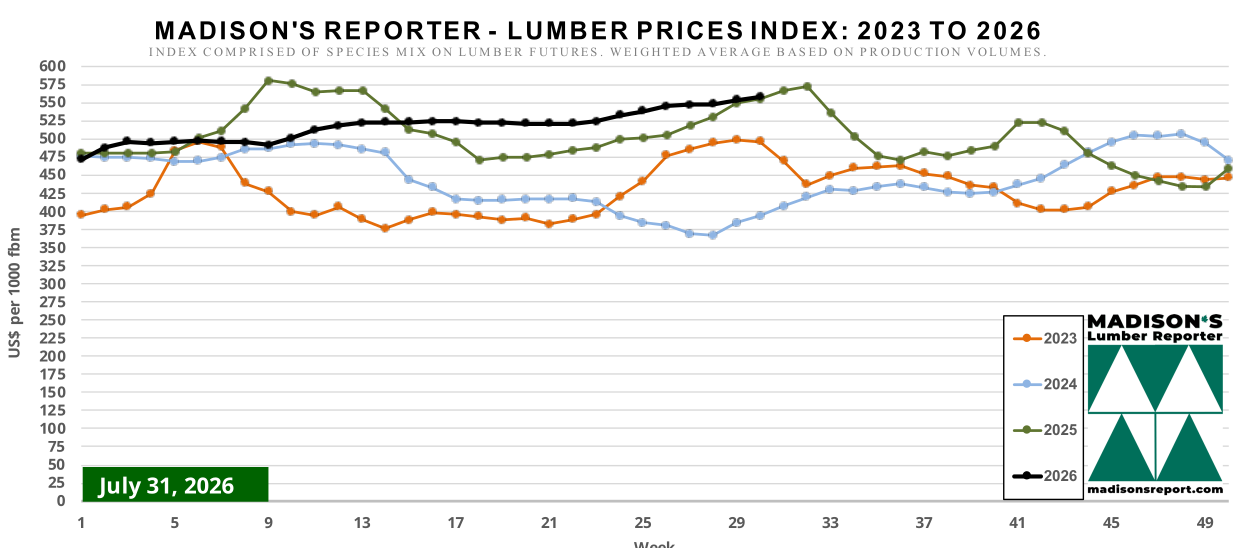
| For lumber, data at [1] indicates much volatility in North American lumber prices from January 2023 to February 2026. Trough-to-peak prices for 2023, 2024 and 2025 have been over 30% across a given year. The main difference for 2026 so far is the stability of prices which have remain peaked for half a year. Now is the perfect time for someone being overly dramatic to say "In the 2 years since July 2024, lumber prices have increased 47%, significantly higher than inflation". But someone else could also say "Lumber prices are the same as July 2025 even though inflation has risen" or "Lumber prices are up just 10% in the 3 years since July 2023, lower than the rate of inflation across these 3 years". [1] https://madisonsreport.com/wp-content/uploads/2026/07/IndexG... |
| |
| ▲ | antisthenes a day ago | parent [-] | | Do you have a graph that extends to 2020? https://tradingeconomics.com/commodity/lumber Roughly ~400 index pre-Covid. Roughly ~580 index the past year.
45% inflation, compared to 30% reported inflation by BLS from October 2019 to June 2026. So yes, lumber prices are definitely beating inflation. Not sure what you were trying to say by playing around with the numbers in the last 4 years. |
|
|
| ▲ | dannyw a day ago | parent | prev | next [-] |
| Logistics and labor. People under-estimate the cost of logistics and transport. Every inch of travel for any input, component, or the final product has to be paid; and even a wooden fencepost typically moves between at least 5 different locations before reaching retail. Let's use wooden posts as an example: 1. Forest. Trees are cut down into logs, and then transported to...
2. Lumbermill. Logs are cut to size, and then transported to...
3. Treatment plant. Without it, your fencepost won't last for every long, and then transported to...
4. Distributor location. And then transported to...
5. Store (e.g. Home Depot or whatever). And then you pick it up, or get it delivered to you.
Every inch, every mile, you're paying for the energy, inefficiencies, and labor involved. |
| |
| ▲ | Tadpole9181 a day ago | parent [-] | | Its a good thing that we didn't start a war for no reason that caused the price of fuel to skyrocket. | | |
| ▲ | JKCalhoun a day ago | parent [-] | | And good thing we didn't shitcan alternative (essentially free) energy projects that were in the works. |
|
|
|
| ▲ | yojo a day ago | parent | prev | next [-] |
| At the beginning of the pandemic all the mills cut production anticipating economic collapse that didn’t come. Prices spiked on high demand and low production. Mills did ramp back up, but it’s unclear to me if they used it as a chance to do so slowly/preserve margins. Lumber never got close to pre-pandemic levels. Tariffs probably also play a role here. About a quarter of US lumber comes from Canada, and barbed wire is just steel with a little bit of processing. For products with little value add there’s not anywhere for the tax to be absorbed, and no real way for domestic producers to quickly scale up, even if they wanted to. |
|
| ▲ | ricardonunez a day ago | parent | prev | next [-] |
| I work with contractors and my family own a GC company. After Covid, construction material prices increased a lot due to multiple reasons like supply chain issues, and high demand from the housing boom. Lumber, fencing materials, and steel products were all affected. Although some prices have go down from their peaks, many never returned to pre-2020 levels, so products like fence posts and barbed wire are still expensive. |
|
| ▲ | hn_throwaway_99 a day ago | parent | prev | next [-] |
| Generalized inflation affects everything. Energy prices have gone up, labor prices have gone up. The people who sell the barbed wire and wooden posts presumably like to be able to eat, so they need to raise their prices to be able to afford groceries, etc. |
|
| ▲ | Ekaros a day ago | parent | prev | next [-] |
| I am starting to think that there might be lot less competition on free markets than we think. And many markets tend to be established with big enough players. So they have stopped competing. If new entrants try to come well they might be undercut or simply bought out. |
| |
| ▲ | win311fwg a day ago | parent [-] | | It is highly unlikely that big players are even able to emerge in a free market. All big businesses we know are big because they found a so-called moat. But I suppose we'll never know for sure as you have a greater chance of winning the lottery while simultaneously being struck by lightning than ever seeing a free market. |
|
|
| ▲ | ikidd a day ago | parent | prev | next [-] |
| Tariffs I'm guessing. A fencepost in Canada is CAD$8 so $6. A roll of barbwire is US$70. See UFA.com for Canadian prices. Keep in mind, there's a lot of variance in what people prefer to use, I'm just giving what I've always used and while prices have gone up, it sure hasn't gone up 2.5X here. |
|
| ▲ | bryanlarsen a day ago | parent | prev | next [-] |
| I assume the posts come from Canada, so are heavily tariffed. And the barbed wire might be produced in the US, but steel producers have raised their prices to match the level of tariffed imported goods. |
|
| ▲ | sssilver a day ago | parent | prev | next [-] |
| Because people who sell wooden posts and barbed wire use pickup trucks, among other things that have gone up in price. |
|
| ▲ | stronglikedan a day ago | parent | prev | next [-] |
| The pick-up thing is definitely true, and is also affecting the used market just as significantly |
|
| ▲ | creaturemachine a day ago | parent | prev | next [-] |
| > but wooden posts and barbed wire Less clear? Check your tariffs. |
|
| ▲ | win311fwg a day ago | parent | prev [-] |
| > but wooden posts and barbed wire, it's less clear why those are so much more expensive now. I am seeing way more active paddocks of grazing cattle now as compared to a couple of years ago. The world is complex and there is never an expiation that can be given in a short soundbite, but the primary driver is no doubt that higher beef prices compelled more people to try and raise cattle, which resulted in them needing supplies required to raise cattle, and fences are one of those things you need to establish a secure paddock. The increase in demand for fencing supplies, without a corresponding increase in supply, necessities an increase in price. |