| ▲ | mazurnification 5 hours ago | |
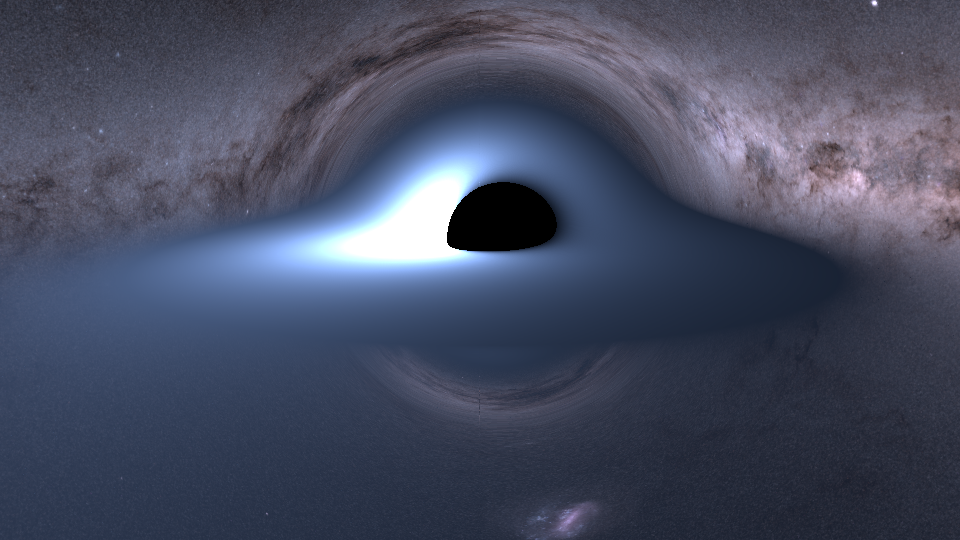
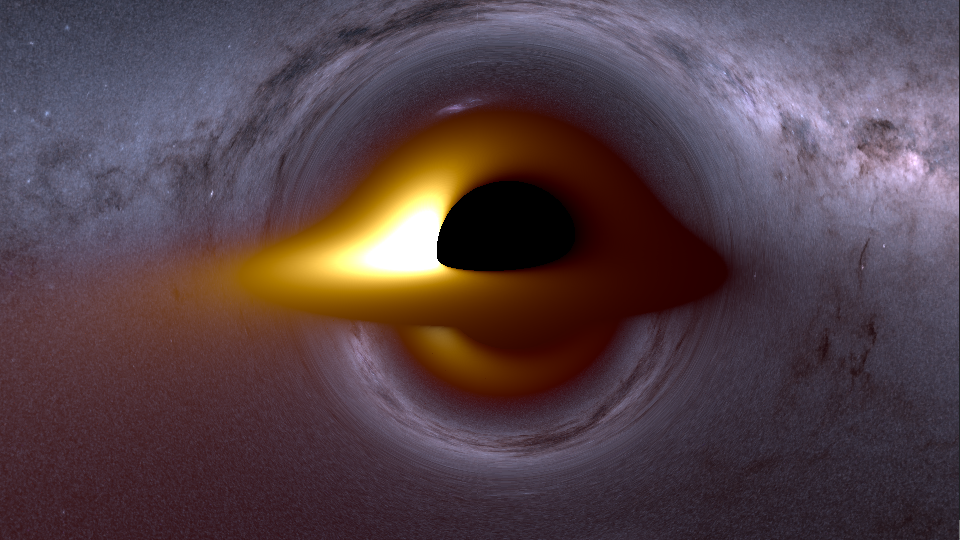
at 1 - is it red due to red shifting due to gravity? | ||
| ▲ | 20k 19 minutes ago | parent | next [-] | |
They're blue, in general black hole accretion disks are very hot, and anything past a certain temperature looks pale blue as follows: https://20k.github.io/assets/kerraccrete.PNG This is a colour and relative brightness accurate example of a hot accretion disk. The size, emissivity and absorption are set to arbitrary parameters, but this is human-eye-colour accurate with correct doppler and radiative transfer for a spinning black hole. Its as correct as I can make a specific model, for what a human would see standing next to a black hole taking into account the limitations of the human visual system You can get a red accretion disk like this: https://i.postimg.cc/pV8VWKhw/verycold.png But it requires the disk to be extremely cold, which is physically pretty suspect One interesting feature is that the temperature and brightness scale differently, so that its actually hard to observe the colour shift, as the brightness changes much faster than the colour. So its not something you ever really see to the human eye That said these don't do accretion disk within the ISCO, which is a major limitation | ||
| ▲ | aplavin an hour ago | parent | prev [-] | |
It's purely my color map choice – the underlying simulated image is simply a number at each pixel. Transforming that number to the actual displayed color is generally an arbitrary choice, as common for the vast majority of images in astronomy/astrophysics papers. The only difference is that I don't show a numeric colorbar here, for the sake of simplicity. | ||