| ▲ | Why don't we get more daylight faster after the winter solstice?(rnz.co.nz) | |
| 5 points by billybuckwheat 10 hours ago | 1 comments | ||
| ▲ | k310 9 hours ago | parent [-] | |
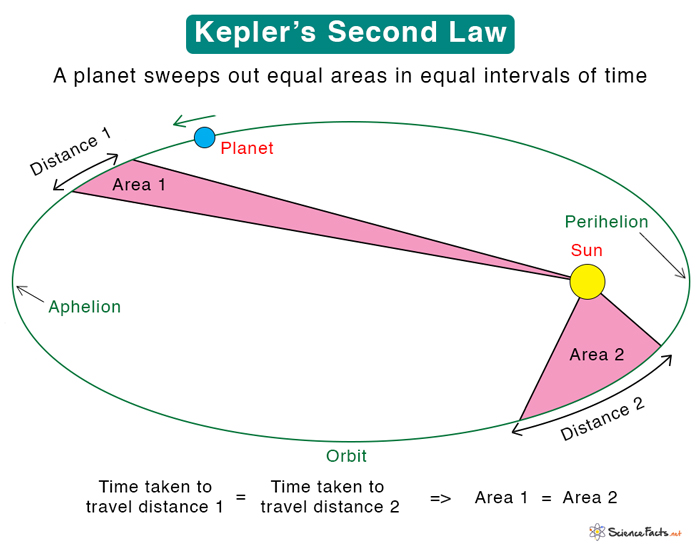
It's all hand-waving. What an insult. It doesn't seem to have any logic. Kepler's second law. It's easy to visualize. [0] > Kepler’s second law states “An imaginary line joining a planet and the Sun sweeps out equal areas in equal time intervals“. > Kepler’s second law describes the speed of a planet traveling in an elliptical orbit around the Sun. According to this law, the planet’s orbital radius and angular velocity will vary, but the angular momentum will be conserved. The planet’s speed increases as it approaches the Sun and decreases as it recedes. It is for this reason that Kepler’s second law is important. This law is also known as the Law of Equal Areas. Cool graphic: [1] Seasons are due to the Earth's tilt, and if the above text and graphic seem "wrong", do remember that NZ is south of the equator and their winter is NA summer. In both cases, the sun is farther (aphelion) Do Perihelion or Aphelion Coincide With Solstices or Equinoxes? [2] > Currently, perihelion occurs shortly after the December solstice, and aphelion occurs after the June solstice. The proximity of perihelion to the Northern Hemisphere’s winter solstice slightly shortens winter and lengthens summer. And the June solstice is winter in NZ. [0] https://www.sciencefacts.net/keplers-second-law.html [1] https://www.sciencefacts.net/wp-content/uploads/2022/04/Kepl... [2] https://sciencenotes.org/perihelion-and-aphelion-closest-and... | ||