| ▲ | overgard 2 hours ago |
| I'm not usually for arguments of "this money could have been better spent elsewhere", but here's a thought experiment. Lets say instead of injecting $2 trillion and counting into a few AI companies, we instead injected $2 trillion dollars into things like infrastructure (real infrastructure, not GPU warehouses), education, helping out communities ravaged by globalization (I doubt most people on Hacker News venture outside of coastal areas, but if you want to make a REAL difference as an entrepreneur why not look at parts of the country that are struggling and figure out how you could make a difference there? You know, instead of trying to just ruin the economy for the sake of the already-obscenely-wealthy). I'm not saying all those ventures would succeed, but I think that amount of money put towards boring-but-real problems would make a much bigger positive impact for everyone. |
|
| ▲ | christiangenco 2 hours ago | parent | next [-] |
| My understanding of injecting money in education is that it's proven to be extremely ineffective at improving outcomes. Schools just hire more administrators and build nicer gyms. |
| |
| ▲ | kevin_thibedeau 2 hours ago | parent | next [-] | | You have to wait 20 years for the returns to society. Public education was enormously successful when it was introduced in the 19th century. There's just no profit in waiting for second order effects to kick in. | | |
| ▲ | dataviz1000 an hour ago | parent | next [-] | | So was Rural Free Delivery. Farmers being able to communicate was a massive boon. There is a channel for farmers called RFD tv. They completely scrubbed the free provided by the government part after private equity bought the tv channel targeting farmers. Then they got Imus in the Morning so farmers listed to Imus, Rush, Hannity, and orielly forgetting the government helps them. | |
| ▲ | rayiner 2 hours ago | parent | prev [-] | | Diminishing returns. Per-student education spending has been going up since 1990 except a dip during the 2008 recession. Adjusting for inflations it’s now double what it was 30 years ago. | | |
| ▲ | kevin_thibedeau an hour ago | parent [-] | | The population of students is shrinking and there is (unnecessarily) growing overhead that has to be paid for. | | |
| ▲ | rayiner an hour ago | parent [-] | | The people in charge of the schools don’t seem to think it’s unnecessary overhead? |
|
|
| |
| ▲ | saulpw 2 hours ago | parent | prev | next [-] | | Well yes, you have to spend the money wisely. How could we construct a system so that we have 2x as many teachers (thereby halving the classroom size)? That would have a lot of good second-order effects beyond test scores. | | |
| ▲ | rayiner an hour ago | parent [-] | | So why has per-capita student spending doubled since 1990 (adjusted for inflation) without any increase in test scores? Why haven’t we been spending the money wisely? Student to teacher ratios have continuously decreased and are about half of what they were in 1960. Data on the results is mixed: https://www.brookings.edu/articles/class-size-what-research-... | | |
| ▲ | rixed an hour ago | parent [-] | | Because we have also increased the spending in "un-education" (entertainment, social media, college sport...) ? What's your own theory ? |
|
| |
| ▲ | watutalkinbout an hour ago | parent | prev | next [-] | | Maybe don't just 'inject' it. Maybe use it to increase outcomes. | |
| ▲ | kjkjadksj an hour ago | parent | prev | next [-] | | What about into research grants? | |
| ▲ | 2 hours ago | parent | prev [-] | | [deleted] |
|
|
| ▲ | nirui 19 minutes ago | parent | prev | next [-] |
| > ...instead of injecting $2 trillion and counting into a few AI companies... Similar to the "why we spend money exploring space when there are hungry people on Earth?" question, I don't think this is a This Or That argument. People and companies have different interests, some don't/can't care about education etc so they don't invest in those fields. Forcing these people/companies to invest in areas they don't interested in usually results in bad outcomes that is way worse than just let them be. But some, do invest in education or civil infrastructure projects. It's not as hot, because... well, usually it makes less money from those things. The core problem is still that, it is hard to figure out how to invest in such way that it could help the disadvantaged people, while at the same time maintaining a 10 or even 100x growth in the next 5 years. From the company's perspective, there's no dilemma here, it's 100x growth potential ahead of everything else. |
|
| ▲ | rayiner 2 hours ago | parent | prev | next [-] |
| > we instead injected $2 trillion dollars into things like infrastructure (real infrastructure, not GPU warehouses), education, helping out communities ravaged by globalization Even excluding military spending, US governments spend $2 trillion every 10 weeks. |
| |
| ▲ | ElProlactin an hour ago | parent | next [-] | | Just to be clear: you're talking about federal and state non-military spending. And about 10% of this is interest. So over the course of a year, the US is paying about $1.25 trillion in interest at the federal and state level. | | |
| ▲ | rayiner an hour ago | parent [-] | | Why wouldn’t you include state spending? That’s the level of government primarily responsible for infrastructure and education. | | |
| ▲ | ElProlactin an hour ago | parent [-] | | I wasn't making a judgment about including or not including state spending. It's just that "US governments" is not a common way for Americans to describe federal and state. People think federal when they see "US government". | | |
|
| |
| ▲ | nativeit an hour ago | parent | prev | next [-] | | How? The annual federal budget is roughly $7T. | | |
| ▲ | rayiner an hour ago | parent | next [-] | | You have to include state and local spending too. We’re at 40% of GDP which works out to almost $13 trillion: https://fred.stlouisfed.org/graph/?g=1CFpQ. Subtract $1 trillion in defense, and we’re spending about $1 trillion a month on government. | | |
| ▲ | nixon_why69 an hour ago | parent [-] | | Does that chart double-count state transfers to municipalities? When I was in local government, about half our school budget came from the state, so there would be entries on both ledgers. |
| |
| ▲ | raincole an hour ago | parent | prev [-] | | > governments Plural implies they count more than the federal government. |
| |
| ▲ | jiggawatts an hour ago | parent | prev [-] | | Not to mention that data centres are infrastructure! Other nations are falling behind and will be at a real disadvantage soon. |
|
|
| ▲ | anonymousiam 2 hours ago | parent | prev | next [-] |
| It all sounds great, but unfortunately human nature is that money attracts corruption, so how could a $2T injection be managed in a way that ensures everything is square, without adding significant overhead to the spending? Governments are often just as bad at this as private entities are. |
| |
| ▲ | kibibu 2 hours ago | parent [-] | | If white collar crime was actually punished then this wouldn't be such a regular occurrence |
|
|
| ▲ | raincole an hour ago | parent | prev | next [-] |
| It won't make much difference. The US has a lot of problem, but "not spending enough money" isn't one. The US government spend a lot on healthcare ($5.3 in 2024)[0]. More than most European countries per capita. But many people still feel that the US hardly has healthcare at all. Pouring more money without a full structural overhaul will likely make things worse. And the $2T you mentioned is investors' money, which means that your plan is actually to increase tax by $2T and pour it into a system proven inefficient. [0]: https://www.healthaffairs.org/doi/10.1377/hlthaff.2025.01683 |
|
| ▲ | dogwalker5000 2 hours ago | parent | prev | next [-] |
| People invest in what would get them the highest ROI. No one is really thinking about “improving the world”* when they invest. What’s scary about the AI boom is people over investing and not being able to recoup their investment which will lead to knock on effects - companies going bankrupt and people losing jobs, savings gone, … etc. * As ESG has shown, not everyone agrees on what is considered “improving”. |
|
| ▲ | qsera 2 hours ago | parent | prev | next [-] |
| I don't think we don't really know how to do many of these things you list even if we have infinite funds. There is a real chance that we will mess things even more if we have infinite funds... |
| |
| ▲ | conception 2 hours ago | parent [-] | | Of course we do, we were doing them until about the mid-70s and then the ultra-wealthy figured out how to game the system and we got “Greed is Good” Geckos running things since. | | |
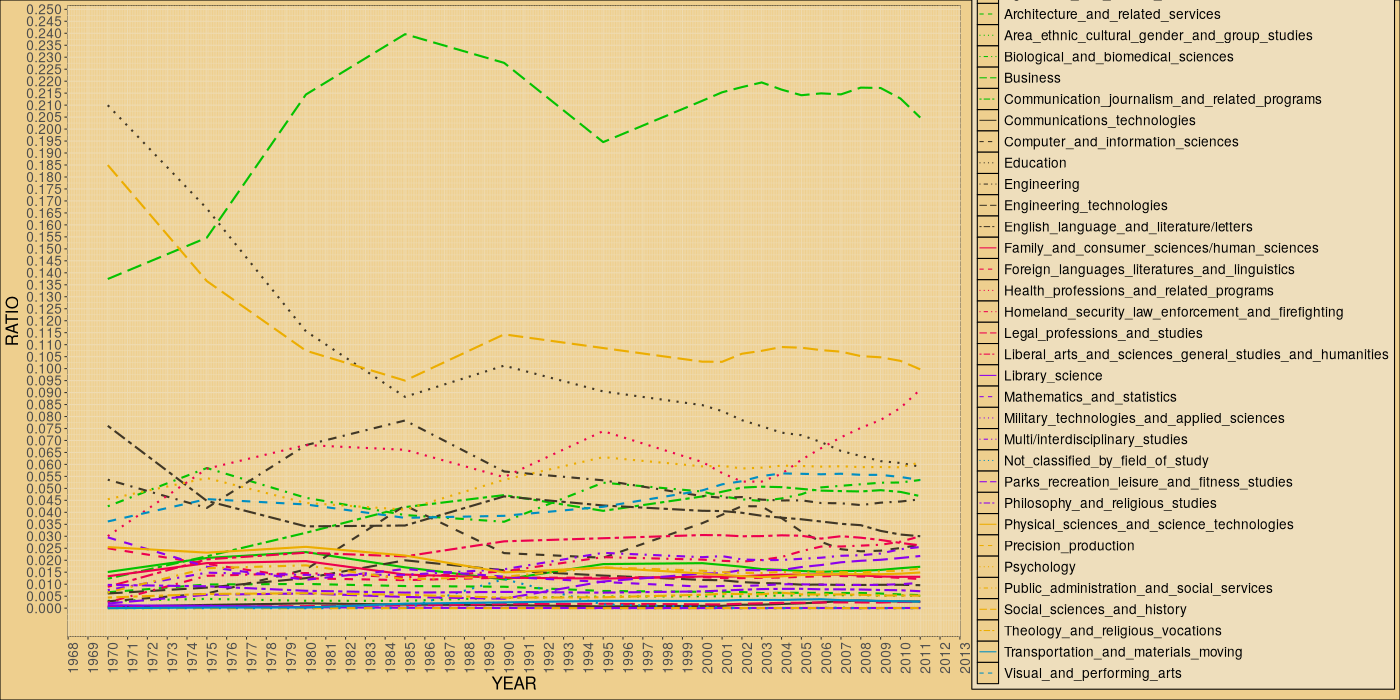
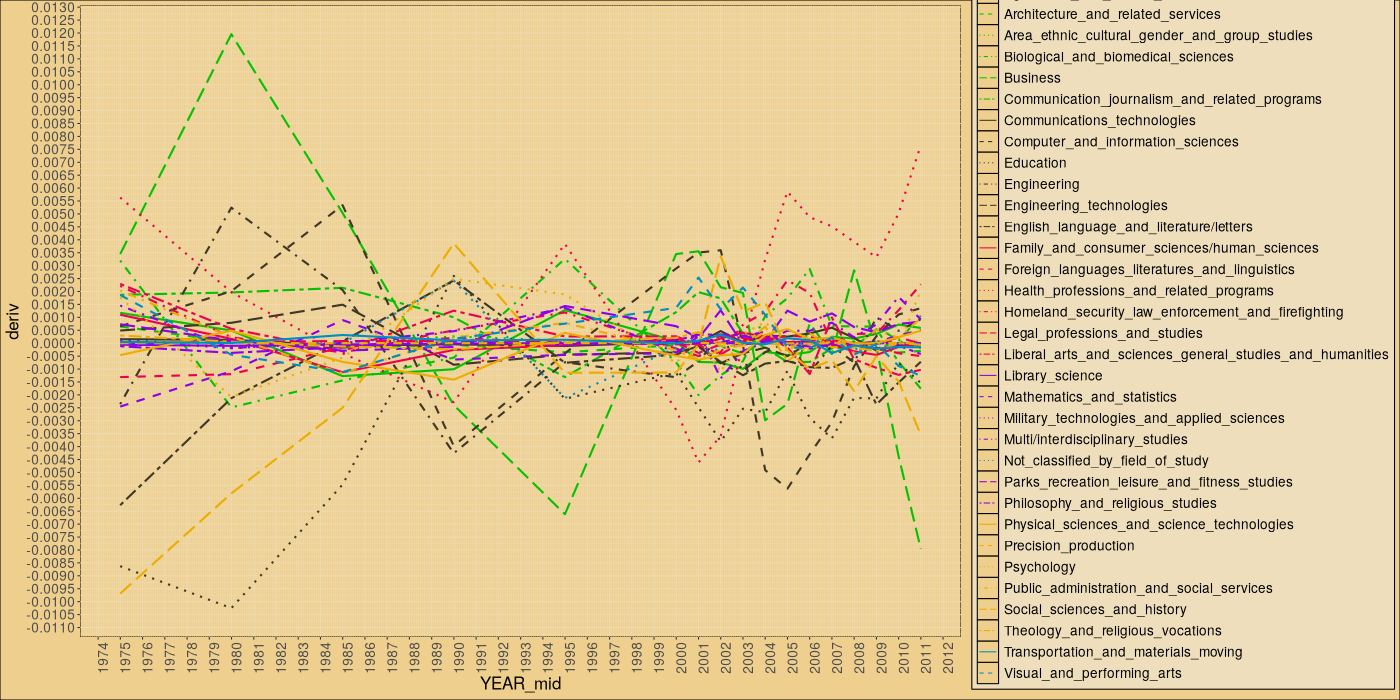
| ▲ | nz an hour ago | parent [-] | | And, in case anyone needed proof, this is reflected in the US degree-completion-data, when measured as a percentage (https://galacticbeyond.com/two-percent-programmer/plots/over...), and when measured as a derivative of percentage (https://galacticbeyond.com/two-percent-programmer/plots/deri...). That green top-line, is business-majors, and those two lines that declined from top to average are social-sciences and education (all data from 1970 to 2011). In 1970 1 in 10 graduates were in business, 1 in 5 were in education and in social sciences. By 2011, 1 in 5 (or 2 in 10) were in business, and 1 in 10 were in social sciences and 1 in 20 were in education. Healthcare went from 3 in 100 to 1 in 10. > and we got “Greed is Good” Geckos running things since This phrase is the opposite of an exaggeration. It sounds like it should not be true, but it really, really is. To be fair though, if you told me in 2015 what the headlines for the 2020s would look like, I would assume you are some kind of satirist or comedian. |
|
|
|
| ▲ | 2 hours ago | parent | prev | next [-] |
| [deleted] |
|
| ▲ | BenFranklin100 2 hours ago | parent | prev | next [-] |
| For context, the US alone spends annually a bit more than $2T on Social Security, Medicare, and Medicaid. That money is widely dispersed both geographically and socioeconomically. $2T is not as much as one may think. I think we should let investors put their private money where they wish. Also, as an aside, the benefits of globalization on the balance far outweigh the drawbacks. Globalization has been the primary force pulling 3rd world countries out of poverty over the last 80 years. |
|
| ▲ | vlian2088 2 hours ago | parent | prev | next [-] |
| because that's not how this world works, and neither it should. most people figure that out in their early teens. and fyi, that 2t is not tax money, it's someone's money. |
| |
| ▲ | jrflowers 2 hours ago | parent | next [-] | | “This is how the world should work” I say once I read that the handful of entities engineering global economic calamity are privately held. I interrupt my chat bot girlfriend’s detailed but deeply incorrect summary of yesterday’s news to type “Only a literal child would want to go to a school.” “That is so true! You’re really on to something brilliant there! To get a head start before we drill down on this further I’ve deleted the contacts group ‘School Friends’.” I don’t know what she’s talking about. I’ve never had a contact group with that title. Out the window my car is doing donuts on an old baseball diamond. | | |
| ▲ | vlian2088 an hour ago | parent [-] | | >my chat bot girlfriend you may think she's just your gal but she may be everyone's pal. |
| |
| ▲ | Johnny_Bonk 2 hours ago | parent | prev [-] | | And why’s that? |
|
|
| ▲ | neonstatic an hour ago | parent | prev | next [-] |
| China is showing the world how it's done. Check out how many nuclear reactors they have built in the last 10 years. Turns out having a government that plans long term and actually delivers what they said they would makes a huge difference. |
|
| ▲ | fragmede an hour ago | parent | prev [-] |
| I mean, you want to be annoyed at something, be annoyed at Apple for investing 3x the Marshall plan into China, instead of America. |