Remix.run Logo
yreg 10 hours ago

You are saying it as if those costs were not necessary to provide the service.

LUmBULtERA 9 hours ago | parent | next [-]

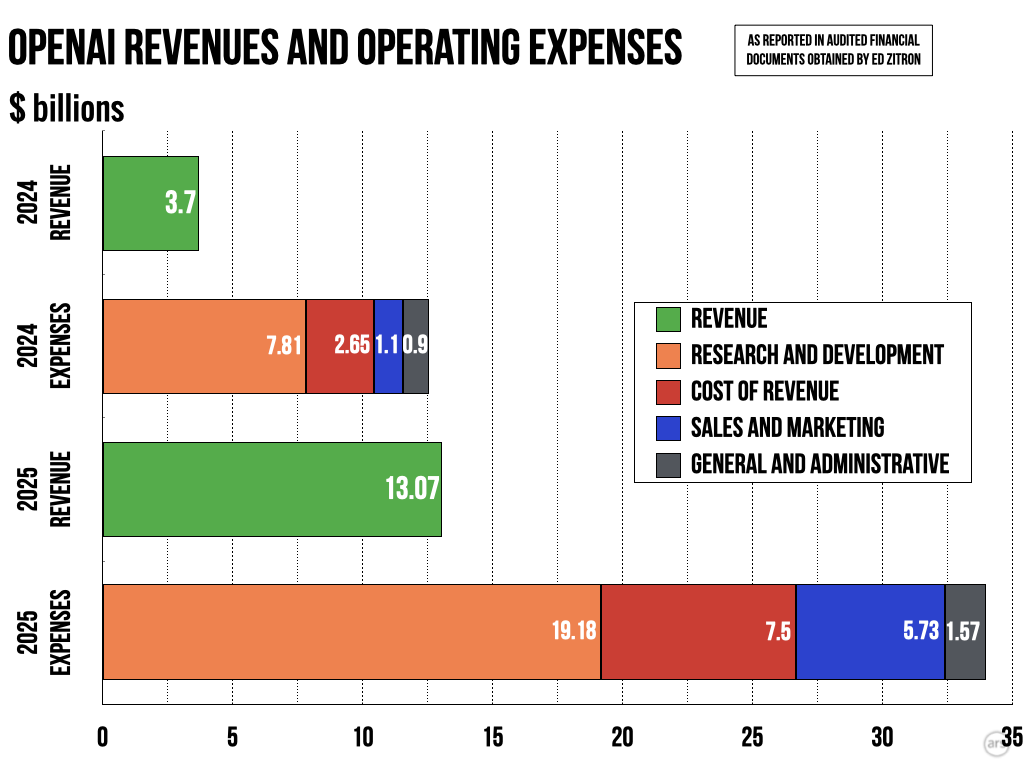
OpenAI inference revenue exceeds its cost of inference by a good margin in 2025 (https://cdn.arstechnica.net/wp-content/uploads/2026/06/opena...)

jijijijij 9 hours ago | parent [-]

Great, but that's only a part of operational costs. A craftsman's revenue may exceed the electricity bill for the power drill, doesn't mean the business is sustainable.

LUmBULtERA 9 hours ago | parent [-]

Day 2 the craftsman has not made up for the investment/loss of their equipment. Not a useful example.

jijijijij 9 hours ago | parent [-]

Sorry, I don't understand what you are trying to say.

LUmBULtERA 8 hours ago | parent [-]

The craftsman, who may otherwise be profitable, also has investment costs that cause them to show a loss for some time.

jijijijij 5 hours ago | parent [-]

"Otherwise". If the craftsman revenue isn't enough to recover the investment expenses, the business is operating at loss. But that's beside the point, because research investments are not the issue at hand.

As said before: Interference costs are not the only operational costs. Same as electricity costs for the craftsman. Running a power drill is not the the whole expense to consider. The craftsman has to eat, AI company's employees have to eat. The craftsman has to learn about new building standards, the AI company has to train their models because no one wants to use a product stuck in time (that's not "research", just maintenance). If not even interference was recovered in revenue, nobody would even start to argue about sustainability.

I can't debate this further, because HN is rate limiting my account for dissenting opinions in the past.

Paradigma11 9 hours ago | parent | prev [-]

They are not. They are necessary for the development of future models, which does not influence the availability of the current ones. Plus you have chinese models distilling current SOTA for pennies on the dollar, so as a consumer I never will be worse off in the long (1-2 years) run.