| ▲ | wavemode 3 hours ago | |||||||
Your logic is flawed because, a thing can improve for an infinite amount of time while never surpassing a certain limit. It's called an asymptote. That being said, I don't even think that arguing about this from a mathematical perspective is a worthwhile use of time. Calling something an asymptote in the first place requires defining a quantifiable "X" and "Y", which we don't even have. What we have are a bunch of synthetic benchmarks. Even ignoring the fact that the answers to the questions are known to regularly leak into the training data (in other words, it's possible for scores to increase while capabilities remain the same), there's also the fundamental fact that performance on benchmarks is not the same thing as performance in the real world. And being able to answer some arbitrary set of arbitrary questions on a benchmark which the previous model couldn't, does not have a quantifiable correlation to some specific amount of real-world improvement. The OP article focuses on research papers which assess real-world impact of LLMs within software organizations, which I think are more representative. I wouldn't call myself an "AI doubter" - I use LLMs every day. When you say "doubter" you're not referring to "AI" in general, or the fact that AI is helpful or boosts productivity (which I believe it does). You're rather referring to the very specific, very extraordinary claim, that LLMs will surpass humans in coding. If that's the case then yeah I'm a doubter, at least on any foreseeable timescale. | ||||||||
| ▲ | handoflixue an hour ago | parent [-] | |||||||
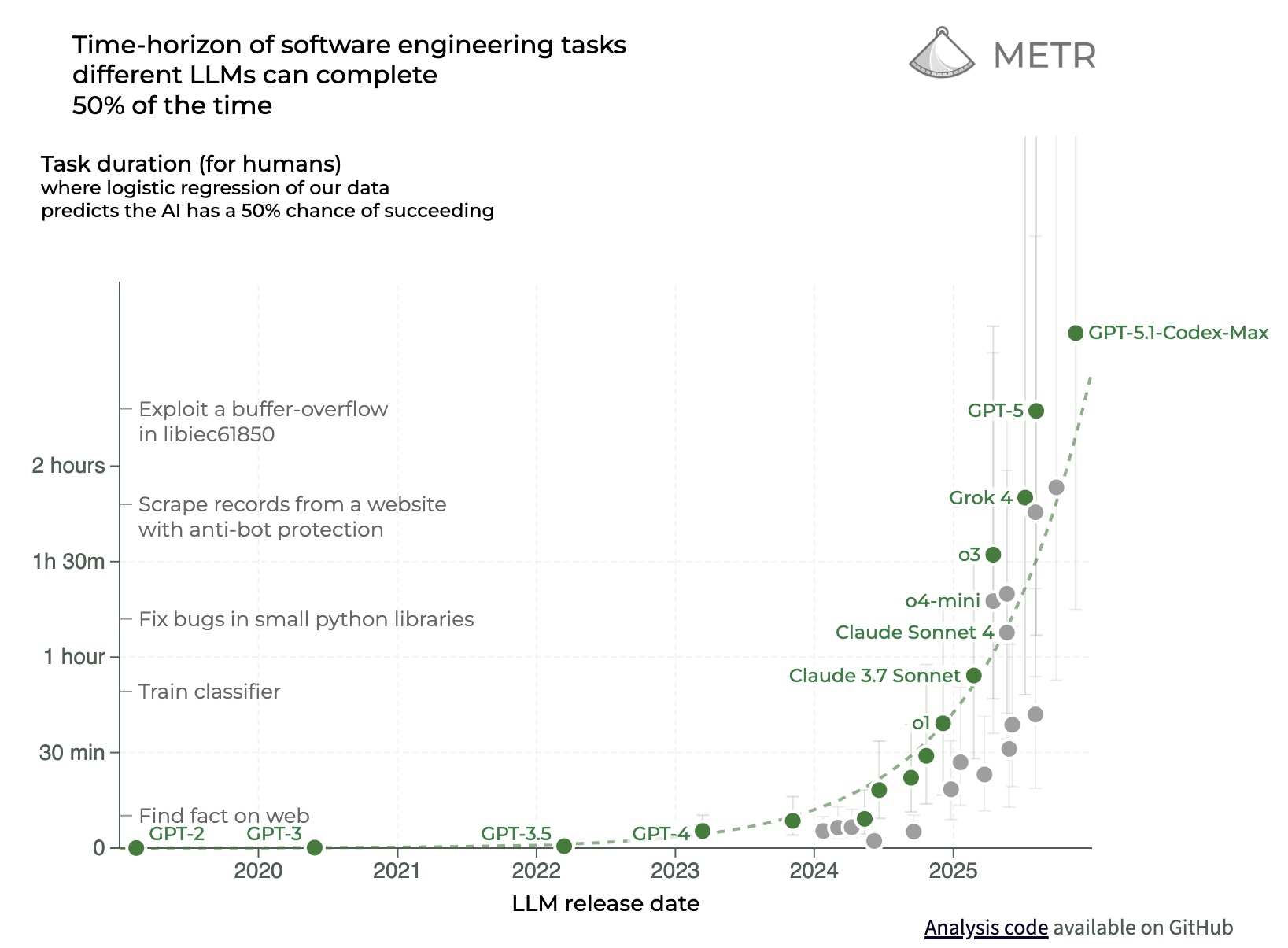
> Your logic is flawed because, a thing can improve for an infinite amount of time while never surpassing a certain limit. It's called an asymptote. Have you ever once looked at a METR chart? https://files.civai.org/assets/METR_Chart.jpg That's not an asymptote. > there's also the fundamental fact that performance on benchmarks is not the same thing as performance in the real world Again, yes, you're correct in the general case but it has very little to do with the specific case. Would you find it convincing if I simply said "some internet arguments are wrong"? It's certainly a true statement, and you've made an internet argument here, so clearly you should accept that you're wrong, right? | ||||||||
| ||||||||