| ▲ | dylan604 11 hours ago | |||||||
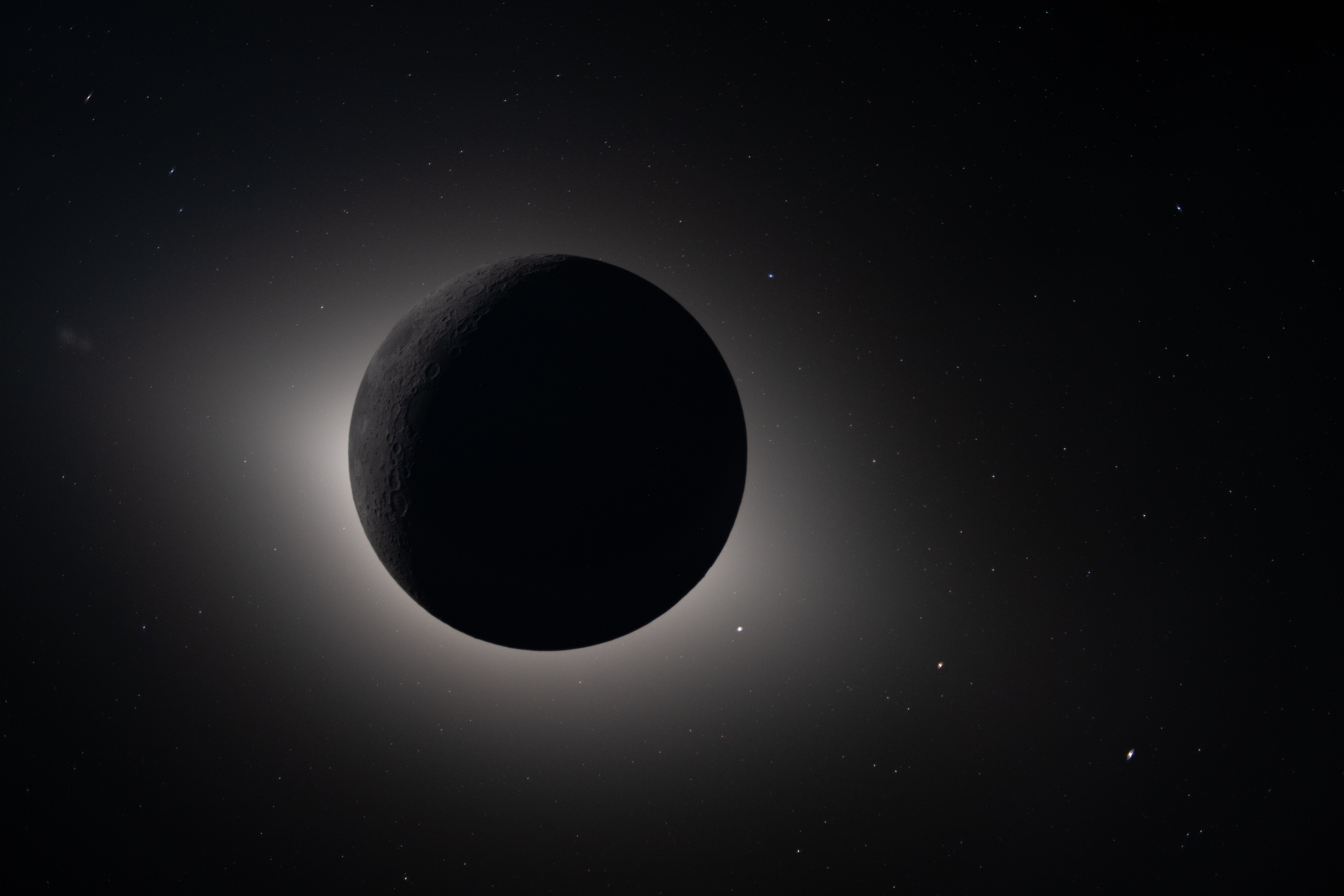
They said they were able to see a few planets during the eclipse. I know they definitely saw Mars as they were discussing the red color. They saw Venus which was visible in the live feed from the GoPro on the solar panel. IIRC, they were thinking Saturn would have been visible. My guess is the really bright dots are planets. It looks like some horrendous compression artifacts along with some possible lens distortion. My exif app says no exif data in the jpg you linked. Did you come to that image from their website that provides the EXIF to see what lens it was? Nothing looks like a galaxy in the image to me. Edit: After further looking and some zooming into it, I'd say the bright dot closest to the moon is Venus, the next one has a red tint making it Mars, and then the last one would be Saturn with the rings. There might be a couple of galaxies in the upper left corner. I was quick to dismiss and blame on compression. The benefits of not having to shoot through atmosphere. I wouldn't have expected that detail in what I'm assuming to be a fairly fast exposure | ||||||||
| ▲ | Deebster 6 hours ago | parent | next [-] | |||||||
There is EXIF available in the original version: https://images-assets.nasa.gov/image/art002e009301/art002e00... It's taken with an AF Nikkor 35mm f/2D on a NIKON Z 9. | ||||||||
| ▲ | cogogo 11 hours ago | parent | prev [-] | |||||||
Appreciate the detailed response. I think it would be a borderline miraculous photo if they are planets aligned in that way. Zooming they look more like artifacts or galaxies to me. I spend a good amount of time looking at planets from earth through binoculars and even with an atmosphere they resolve better than that. | ||||||||
| ||||||||