Remix.run Logo
milkytron 6 days ago

For a long time, the US had the money to build things, use them, let them slowly deteriorate, and then abandon them.

It was cheaper to simply let things fall into disrepair, and build shiny new buildings and developments further away from the city center. Rinse and repeat. This is why a lot of inner ring suburbs are filled with strip malls that can't maintain their parking lots, don't have the residential density to support nearby businesses, etc.

It's kind of an interesting development pattern that's been pervasive since the 1950s, and some towns and cities are trying to reverse it with infill.

cucumber3732842 5 days ago | parent | next [-]

It wasn't cheaper for any physical reason. It was cheaper because we regulated it that way on purpose.

We've intentionally made it unconscionably expensive to bring anything not built to current standard back into service even in a limited capacity (e.g. sublet a factory into smaller space) because we have because this stuff is mostly the purview of local governments who seem to optimize for some middle-ish ground path of "what makes Karen screech least" and "what makes the professional developers who know everyone in government happiest". There's various exemptions for small residential stuff, but at scale it's all just crap that tends toward "don't allow anything that isn't a new build or a high dollar revitalization project"

Seriously, go to your local zoning board, planning board, etc public facing meetings sometime. The shit they put people who just want to spend huge sums of money to develop stuff, run businesses etc, in your city/town through is beyond the pale. And then some "professional" shows up with a BigCo packet about "here's why our toxic waste dump on the ground floor with a strip club on the top floor can go beside the school" and they can't approve it fast enough. You'll be looking for bulldozers on facebook marketplace before the meeting is half over.

mothballed 5 days ago | parent [-]

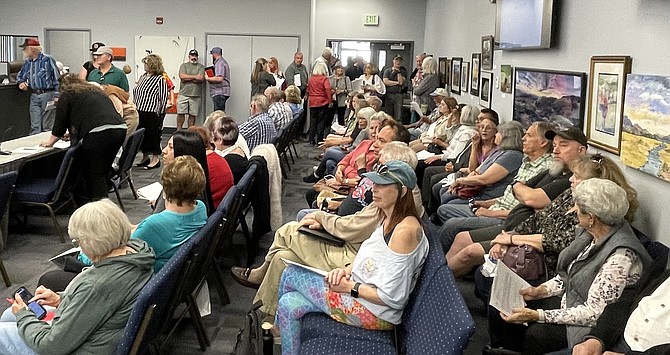
You don't even have to listen to the meeting, just take a look around. Here's one at Carson City[]. Notice something about the demographics? None of those people look like young family in need of their first home or condo. It's people old enough that already have a place, bought during the days while the getting was still good, and are looking to secure their property values. Maybe a few of them had bad luck or had a nasty divorce and lost their house and have no real estate now, but that's unlikely to be the majority of them.

There's almost no overlap between people on and with the means and time to go to planning and zoning meanings and the people who have the greatest marginal utility lowering the bar to owning a business or a home.

[] https://nevadanewsgroup.media.clients.ellingtoncms.com/img/p...

cucumber3732842 5 days ago | parent [-]

Depends on the meeting type. If you go to whichever one involves the relevant committee or board extracting expensive concessions from mundane businesses you're gonna see more younger people because first time business owners tend to be the ones who get screwed the most because they blunder right into all the traps the system has prepositioned for such people.

I watched two brothers in their 30s who'd bought a 12-unit (they lived in it) go rounds with the city over all manner of petty bullshit that can be construed as a legitimate concern on paper but really isn't if you look at the totality of the situation. Ultimately they hired the law firm which was owned by a lifelong developer who was the head of the equivalent board in the next town over (i.e. someone who knew people) and suddenly none of those things were problems anymore.

DroneBetter 6 days ago | parent | prev | next [-]

no way, https://en.wikipedia.org/wiki/Fairy_rings on a macroscopic scale

toomuchtodo 6 days ago | parent | prev [-]

Debt funded sprawl.

https://www.strongtowns.org/journal/2020-8-28-the-growth-pon...

https://www.strongtowns.org/journal/2020-5-14-americas-growt...

https://archive.strongtowns.org/journal/2025/4/14/cities-are...

cucumber3732842 5 days ago | parent [-]

Why did it fund sprawl? Why didn't anyone choose to develop density on existing sites? We built that stuff just fine from 1870 through the 1940s. What changed? Surely it wasn't the proliferation of government regulation of the development process (and the financials thereof) that caused developers to optimize for greenfield sprawl crap that could most cheaply check the boxes, get the cheap money, get the approvals, be compliant, etc, etc.

toomuchtodo 5 days ago | parent | next [-]

> Surely it wasn't the proliferation of government regulation of the development process (and the financials thereof) that caused developers to optimize for greenfield sprawl crap that could most cheaply check the boxes, get the cheap money, get the approvals, be compliant, etc, etc.

I'm sure white flight was a component, as well as subsidizing the auto manufacturing industry and a car centric planning model with federally funded highways.

https://en.wikipedia.org/wiki/White_flight

https://nlihc.org/resource/myth-white-suburb-and-suburban-in...

https://www.governance.fyi/i/191825260/the-money-problem-is-...

https://www.brookings.edu/articles/the-end-of-suburban-white...

milkytron 4 days ago | parent | prev [-]

> Why did it fund sprawl?

Road funding is a big reason. Federal, state, and local taxes are used for roads, and more driving. Parking minimums required land to be dedicated to parking, further encouraging car usage for transportation and spreading out development with parking lots in between developments.

> Why didn't anyone choose to develop density on existing sites?

Existing sites would have had to not be developed enough to trigger a rezoning. If a different use was being proposed for land, then a zoning hearing would be needed, and parking minimums would have to be enforced. Thus requiring adjacent lots to be bought and redeveloped into parking unless exceptions were made. You can see remnants of this in some cities where amongst historic buildings and skyscrapers there are large surface parking lots.

> We built that stuff just fine from 1870 through the 1940s. What changed?

Quite a few things. Parking minimums as mentioned, euclidian/single use zoning, etc. I think one of the core things that changed is something that Strong Towns mentioned. Up until the early 1900s, municipal planners would try to project how much tax revenue per acre of land was being generated and how much tax expenditures were made for those areas. Over time, tax per acre or per parcel was deprioritized, and level of service for roads was used as an economic metric. More vehicles in an area means more economic activity (in theory), so municipalities started optimizing for more vehicular movement.

In the end, it was a lot of government regulation that resulted in this. From the federal level, to states, counties, and municipalities. It worked for a large portion of the voting populace, so it was generally favored.