| ▲ | layer8 4 hours ago |
| Before Lightroom it might have looked closer to this: https://images-assets.nasa.gov/image/art002e000193/art002e00... |
|
| ▲ | hannesfur 4 hours ago | parent | next [-] |
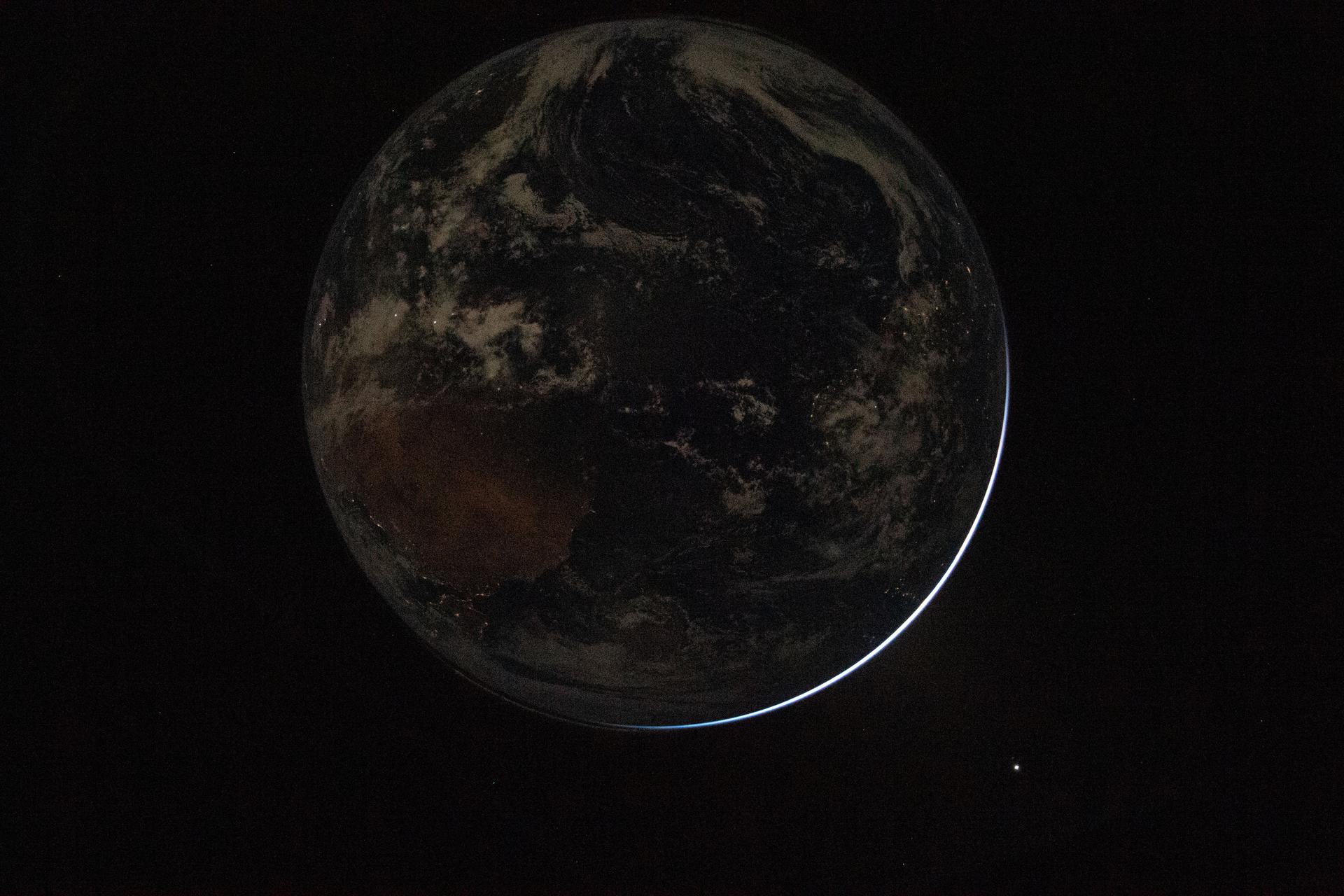
| From the EXIF we can infer that every setting was left at the default. No exposure comp, no contrast, no HSL, no lens correction and a linear tone curve. Just the default Adobe Color profile at 5400K. |
|
| ▲ | dotancohen an hour ago | parent | prev | next [-] |
| On which NASA website are these raw images posted? |
|
| ▲ | divbzero 3 hours ago | parent | prev | next [-] |
| The photograph appears to show nightime on Earth with just a sliver of daytime. Beyond cities in Iberia and along the coast of Africa, most of what we can see would be reflected light from the Moon? We are just past full moon on April 1. |
| |
| ▲ | hparadiz 3 hours ago | parent | next [-] | | 1/4 exposure time so 250 ms of light. the light is coming from all the light sources in the universe, plus the moon, plus the sun's rays refracting through the atmosphere which happens even at night. The natural blue light is coming from the oxygen in the atmosphere but it's so overwhelming in that spot that it turns the light pure white. The red/orangish is coming from particulates and the green/red from aurora. My favorite part I think is the very bottom where you can see the blue light taper off and not overwhelm the camera sensor and you can see the aurora with it. I love this photo so much. Probably my favorite photo ever now. | | |
| ▲ | pdonis 4 minutes ago | parent [-] | | > the light is coming from all the light sources in the universe, plus the moon And all the others are negligible by many orders of magnitude compared to the moon. So it's really just the moon as far as this photo is concerned (except for the small sliver that's still illuminated by sunlight, including refracted sunlight). |
| |
| ▲ | pdonis 5 minutes ago | parent | prev | next [-] | | > Beyond cities in Iberia and along the coast of Africa, most of what we can see would be reflected light from the Moon? Yes, exactly. | |
| ▲ | tayo42 3 hours ago | parent | prev [-] | | That's what the caption the article above says |
|
|
| ▲ | deepsun 3 hours ago | parent | prev | next [-] |
| But that one (art002e000193~large.jpg) is only 287kB. The Lightroom-processed one is 6.2MB. I would expect original to be heavier. |
| |
| ▲ | porphyra 3 hours ago | parent | next [-] | | The Lightroom one was processed from raw. Also, by brightening it a lot, the noisy high-ISO grain becomes more apparent. Noise is famously incompressible, so it leads to a much larger file size. | | |
| ▲ | thfuran 2 hours ago | parent [-] | | Brightening the image may make the iso noise easier to see, but it doesn't create it. | | |
| ▲ | godelski 10 minutes ago | parent | next [-] | | It's not lossless | |
| ▲ | miduil 2 hours ago | parent | prev | next [-] | | But lossy-codecs job is to utilize psychovisual tricks to discard as much high-frequency information as possible, whilst remaining similar visual effects. If you increase the brightness in RAW and then re-encode the JPEG - more noise is being pulled up in the visual spectrum, therefor less of that information (filesize) is discarded. For example, if you render Gaussian noise in photopea and export as JPEG 100% quality, it has 9.2MB. If you reduce the exposure by -2 it goes down to 7.8MB. That's partially because more parts of the noise are effectively black pixels, but also I believe because of the earlier mentioned effect. | |
| ▲ | porphyra 2 hours ago | parent | prev [-] | | Noise that's easier to see will not be compressed away by the JPEG compression. JPEG is basically just DCT + thresholding. Any higher amplitude noise is going to stay and increase the final file size. Also, pulling more data from your 14 bit or 16 bit raws results in more noise in the end compared to the straight-out-of-camera 8 bit JPEGs. |
|
| |
| ▲ | saint_yossarian 2 hours ago | parent | prev [-] | | The resolutions are different, 1920x1280 vs. 5568x3712. Also possibly different JPEG quality settings. | | |
|
|
| ▲ | consumer451 4 hours ago | parent | prev | next [-] |
| Might I ask, what was your path to finding this image? |
| |
|
| ▲ | ranie93 3 hours ago | parent | prev [-] |
| Maybe it’s because I (like many) have experienced taking pictures at night and seeing the grainy result that _this_ image struck me as incredibly realistic. Almost like I ran the grainy-to-real conversion in my mind and I felt like I was imagining seeing this in person. Beautiful image! |