| ▲ | troad a day ago | |||||||
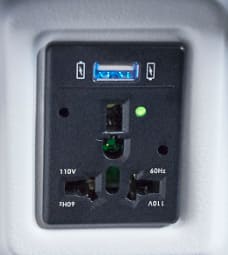
Because it's completely impossible to prevent people from being able to touch a live contact in a socket that must accept many different types of plug. Safe sockets firmly grip the plug they are designed for. This socket cannot, since it must be willing to accept anything you stick in. Without being able to grip any individual plug's prongs, any actual plug plugged into the socket will always hang from it. This exposes the top of the live contacts, now flowing with mains (!!) power. > https://www.ana.co.jp/cont-image/common/etc/0059-lang-multi.... Look at the image above. Note the sheer size of those bottom holes, and remember that the socket can't firmly grip anything (compare the narrow US/Japanese holes, the diagonal Australian/Chinese holes, the circular European holes, the outer British holes - all overlapping but in different places). You are basically guaranteed to get exposed contacts. This is just bizarrely dangerous on a transcontinental flight where you might be asleep, covered in blankets, etc. Given that this kind of socket would be illegal to install in your own home under most electrical codes, I have no idea why it's fine on a plane. (And that's without getting into how this provides a completely incorrect voltage to most of the plugs, or how it encourages folks to try to shove non-compliant plugs into all that spare room, or the existence of plugs like Argentina's, that will fit but will be electrified on the wrong prong, etc etc) | ||||||||
| ▲ | sidewndr46 a day ago | parent [-] | |||||||
I don't have need to look at this image, I've used this outlet safely plenty of times. I've helped other passengers use them as well. I've never seen a plug "hang" from it. In fact they usually are so firmly attached I have difficulty removing them. You're argument about "exposed contacts" is absurd. The entire design of the US plug is exposed contacts. Anyone can and will find a way to use them in an unsafe manner. We allow people to eat with steak knives, despite them being able to cut their own jugular vein with them. This socket does not provide "half" the power. It provides around 110 VAC to most outlets. Almost all devices you are going to be using are rated for 90 VAC-240 VAC. The frequency range is wide too, 47-63 Hz. Some of them work all the way up to 277 VAC as a rated voltage. The actual socket is incredibly complex and monitors for the presence of a load & the total current. Have you ever noticed the flight attendants know exactly who is using the plugs at what time? If you actually plugged a 240 VAC angle grinder into this plug, it would just turn off immediately. This socket would be explicitly legal to install in almost any jurisdiction in the US so long as it has the right engineering documents. Equipping your home with these outlets would be so many orders of magnitude safer than normal wiring, although you could not run devices like a vacuum cleaner or a large appliance. | ||||||||
| ||||||||