| ▲ | keeda 20 hours ago | ||||||||||||||||
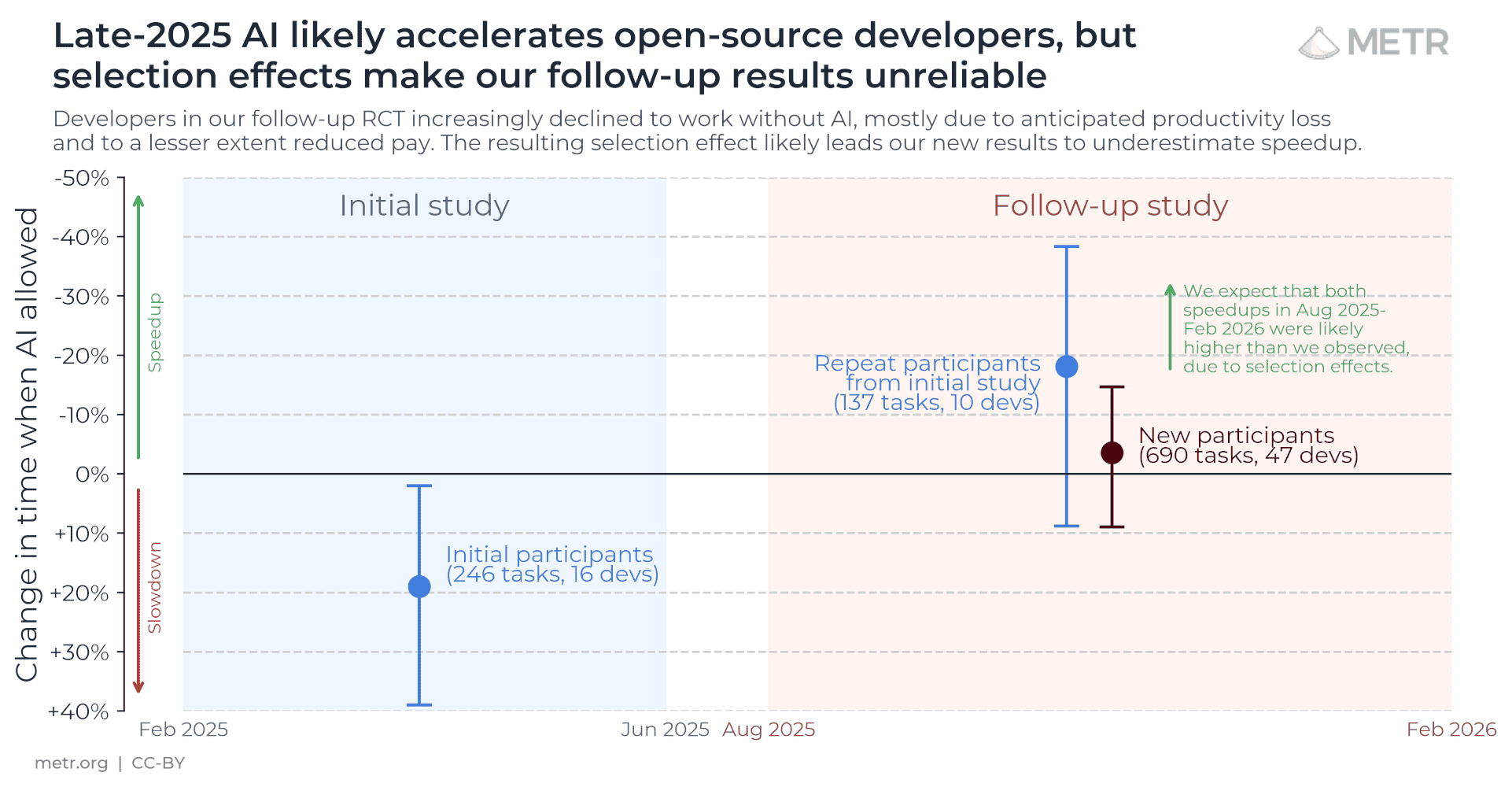
> No productivity studies of individual developers tackling tasks show a 10x speedup; results tend to be anywhere from +20% to minus 20%. The only study showing a -20% came back and said, "we now think it's +9% - +38%, but we can't prove rigorously because developers don't want to work without AI anymore": https://news.ycombinator.com/item?id=47142078 Even at the time of the original study, most other rigorous studies showed -5% (for legacy projects, obsolete languages) to 30% (more typical greenfield AND brownfield projects) way back in 2024. Today I hear numbers up to 60% from reports like DX. But this is exactly missing the point. Most of them are still doing things the old way, including the very process of writing code. Which brings me to this point: > There have been absolutely zero indicators that this is true. I could tell you my personal experience, or link various comments on HN, or point you to blogs like https://ghuntley.com/real/ (which also talks about the origanizational impedance mismatch for AI), but actual code would be a better data point. So there are some open-source projects worth looking at, but they are typically dismissed because they look so weird to us. Here's two mostly vibe-coded (as in, minimal code review, apparently) projects that people shredded for having weird code, but is already used by 10s of 1000s of people, up to 11 - 18K stars now. Look at the commit volume and patterns for O(300K) LoC in a couple of months, mostly from one guy and his agent: https://github.com/steveyegge/beads/graphs/commit-activity https://github.com/steveyegge/gastown/graphs/commit-activity It's like nothing we've seen before, almost equal number of LoC additions and deletions, in the 100s of Ks! It's still not clear how this will pan out long term, but the volume of code and apparent utility (based purely on popularity) is undeniable. | |||||||||||||||||
| ▲ | laserlight 13 hours ago | parent | next [-] | ||||||||||||||||
> we now think it's +9% - +38% If you are referring to the following quote [0], you are off by a sign: > we now estimate a speedup of -18% with a confidence interval between -38% and +9%. | |||||||||||||||||
| |||||||||||||||||
| ▲ | applfanboysbgon 19 hours ago | parent | prev [-] | ||||||||||||||||
> they are typically dismissed because they look so weird to us. I dismiss them because Yegge's work (if it can even be called his work, given that he doesn't look at the code) is steaming garbage with zero real-world utility, not "because they look weird". You suggest the apparent utility is undeniable, while saying "based purely on popularity" -- but popularity is in no way a measure of utility. Yegge is a conman who profited hundreds of thousands of dollars shilling a memecoin rugpull tied to these projects. The actual thousands of users are people joining the hypetrain, looking to get in on the promised pyramid scheme of free money where AI will build the next million dollar software for you, if only you have the right combination of .md files to make it work. None of these software are actually materialising, so all the people in this bubble can do is make more AI wrappers that promise to make other AI wrappers that will totally make them money. I am completely open to being proven wrong by a vibe-coded open source application that is actually useful, but I haven't seen a single one. Literally not even one. I would count literally anything where the end-product is not an AI wrapper itself, which has tens to hundreds of thousands of users, and which was written entirely by agents. One example of that would be great. Just one. There have been a couple of attempts at a web browser, and Claude's C compiler, but neither are actually useful or have any real users; they are just proofs of concept and I have seen nothing that convinces me they are a solid foundation from which you could actually build useful software from, or that models will ever be on a trajectory to make them actually useful. | |||||||||||||||||
| |||||||||||||||||