| ▲ | nosianu 5 hours ago | ||||||||||||||||
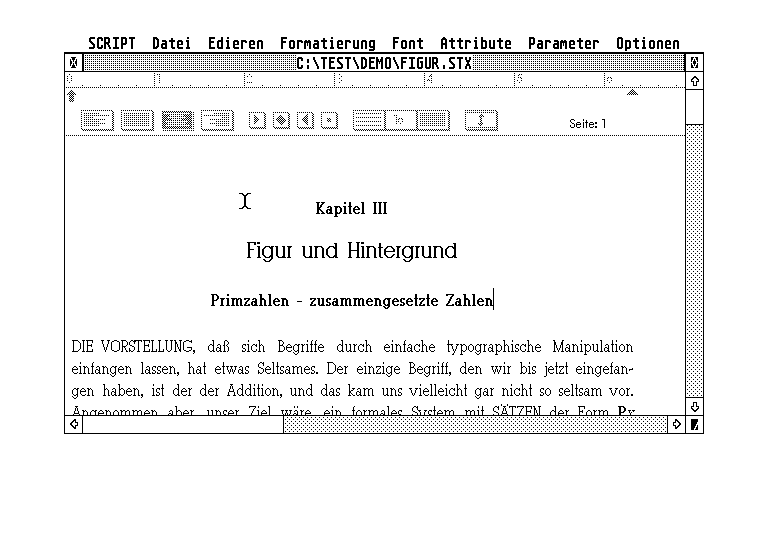
I used Application System Heidelberg's Script II on an Atari 1040STFM with 72 Hz SM 124 black/white monitor and an Epson LQ 550 24 pin printer. That was some superb publishing system for the time (1991), for a low budget. 1 MB RAM, 1.44 MB floppy drive SM 124: 640x400 pixels, monochrome https://en.wikipedia.org/wiki/Atari_ST https://www.atarimuseum.de/1040st.htm The software used a special driver to get better than standard quality from the then most common 24 pin printers (laser printers where much expensive) by kind of double-printing, I forgot the details. It looked really good though. https://www.planetemu.net/screenshots/Atari%20ST%20-%20Appli... https://stcarchiv.de/tos/1990/11/script-2 (German) "Script" was the cheap version of their better product "Signum". | |||||||||||||||||
| ▲ | m-i-l a minute ago | parent | next [-] | ||||||||||||||||
> "The software used a special driver to get better than standard quality from the then most common 24 pin printers (laser printers where much expensive) by kind of double-printing, I forgot the details. It looked really good though." In opening up a few ancient files to answer another question about formatting, I found some long forgotten notes on how to make my Epson LQ400 24 pin printer work at 360dpi rather 180dpi, which may have been the same for you: First you had to install it as a NEC 24-pin 360dpi printer rather than 180dpi printer. Then, because it used fonts of half the size, you needed to switch fonts. So I had two fonts disks, one with 180dpi installed fonts and one with 360dpi fonts, and used the ASSIGN.SYS file to switch between them. It also seems to have taken twice as long to print out at 360dpi, and used twice as much printer ribbon:-) | |||||||||||||||||
| ▲ | qsi an hour ago | parent | prev | next [-] | ||||||||||||||||
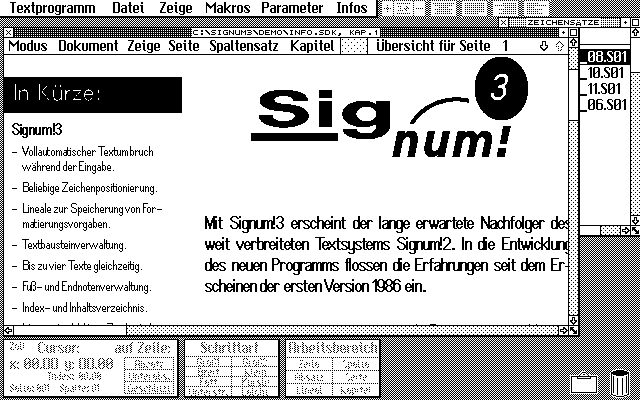
Signum! (don't forget the exclamation point!) was an amazing piece of software. The key to its incredible print quality: carefully hand-crafted pixel fonts with incredible attention to detail. With a 24-pin printer the output beat vector fonts on a 300dpi laser printer at the time. The actual resolution was higher than a single pass of printing with the 24 pins. Signum! would advance the print head in minute amounts and overprint to achieve its remarkable quality. Printing a single page at maximum quality took a while... Think minutes per page instead of pages per minute. But it was very impressive. Fond memories! | |||||||||||||||||
| ▲ | billygoat an hour ago | parent | prev [-] | ||||||||||||||||
I'm curious: the "Script" screenshot looks like it's using standard GEM Desktop, while the "Signum" is some other desktop. Are these both for ST? Was Signum written using some other full-screen graphic environment? | |||||||||||||||||
| |||||||||||||||||