Remix.run Logo
martinald a day ago

The problem is essentially memory bandiwdth afiak. Simplifying a lot in my reply, but most NPUs (all?) do not have faster memory bandwidth than the GPU. They were originally designed when ML models were megabytes not gigabytes. They have a small amount of very fast SRAM (4MB I want to say?). LLM models _do not_ fit into 4MB of SRAM :).

And LLM inference is heavily memory bandwidth bound (reading input tokens isn't though - so it _could_ be useful for this in theory, but usually on device prompts are very short).

So if you are memory bandwidth bound anyway and the NPU doesn't provide any speedup on that front, it's going to be no faster. But has loads of other gotchas so no real "SDK" format for them.

Note the idea isn't bad per se, it has real efficiencies when you do start getting compute bound (eg doing multiple parallel batches of inference at once), this is basically what TPUs do (but with far higher memory bandwidth).

zozbot234 a day ago | parent [-]

NPUs are still useful for LLM pre-processing and other compute-bound tasks. They will waste memory bandwidth during LLM generation phase (even in the best-case scenario where they aren't physically bottlenecked on bandwidth to begin with, compared to the iGPU) since they generally have to read padded/dequantized data from main memory as they compute directly on that, as opposed to being able to unpack it in local registers like iGPUs can.

> usually on device prompts are very short

Sure, but that might change with better NPU support, making time-to-first-token quicker with larger prompts.

martinald a day ago | parent | next [-]

Yes I said that in my comment. Yes they might be useful for that - but when you start getting to prompts that are long enough to have any significant compute time you are going to need far more RAM than these devices have.

Obviously in the future this might change. But as we stand now dedicated silicon for _just_ LLM prefill doesn't make a lot of sense imo.

zozbot234 a day ago | parent [-]

You don't need much on-device RAM for compute-bound tasks, though. You just shuffle the data in and out, trading a bit of latency for an overall gain on power efficiency which will help whenever your computation is ultimately limited by power and/or thermals.

observationist a day ago | parent | prev [-]

The idea that tokenization is what they're for is absurd - you're talking a tenth of a thousandth of a millionth of a percent of efficiency gain in real world usage, if that, and only if someone bothers to implement it in software that actually gets used.

NPUs are racing stripes, nothing more. No killer features or utility, they probably just had stock and a good deal they could market and tap into the AI wave with.

adastra22 a day ago | parent | next [-]

NPUs aren't meant for LLMs. There are a lot more neural net tech out there than LLMs.

aleph_minus_one a day ago | parent [-]

> NPUs aren't meant for LLMs. There are a lot more neural net tech out there than LLMs.

OK, but where can I find demo applications of these that will blow my mind (and make me want to buy a PC with an NPU)?

adastra22 a day ago | parent | next [-]

Apple demonstrates this far better. I use their Photos app to manage my family pictures. I can search my images by visible text, by facial recognition, or by description (vector search). It automatically composes "memories" which are little thematic video slideshows. The FaceTime camera automatically keeps my head in frame, and does software panning and zooming as necessary. Automatic caption generation.

This is normal, standard, expected behavior, not blow your midn stuff. Everyone is used to having it. But where do you think the computation is happening? There's a reason that a few years back Apple pushed to deprecate older systems that didn't have the NPU.

adgjlsfhk1 a day ago | parent [-]

I've yet to see any convincing benchmarks showing that NPUs are more efficient than normal GPUs (that don't ignore the possibility of downclocking the GPU to make it run slower but more efficient)

adastra22 a day ago | parent | next [-]

NPUs are more energy efficient. There is no doubt that a systolic array uses less watts per computation than a tensor operation on a GPU, for these kinds of natural fit applications.

Are they more performant? Hell no. But if you're going to do the calculation, and if you don't care about latency or throughput (e.g. batched processing of vector encodings), why not use the NPU?

Especially on mobile/edge consumer devices -- laptops or phones.

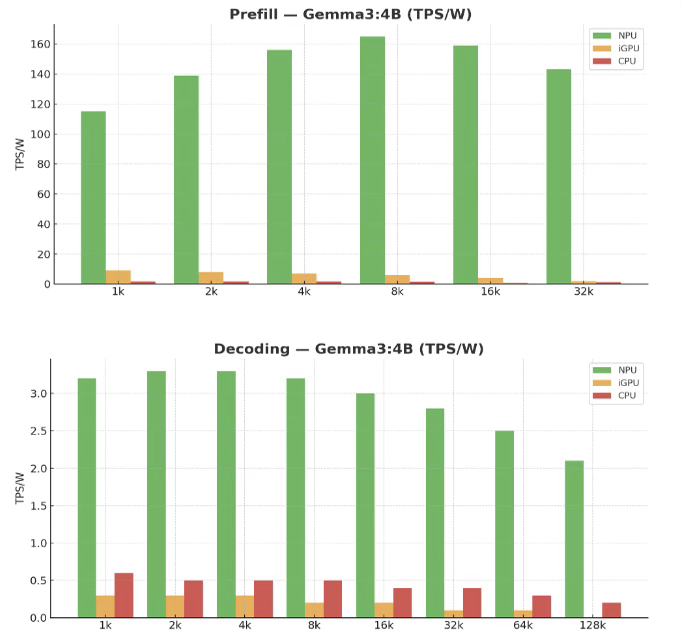
imtringued 17 hours ago | parent | prev [-]

https://fastflowlm.com/benchmarks/

https://fastflowlm.com/assets/bench/gemma3-4b.png

jychang a day ago | parent | prev [-]

Best NPU app so far is Trex for Mac.

microtonal a day ago | parent | prev [-]

I think they were talking about prefill, which is typically compute-bound.