| ▲ | nyeah 4 days ago |
| Sure, but medieval European art generally sucked. (Call this a hypothesis if that helps.) Compare the damn cave paintings of buffalo to most medieval European art. Some of the 10k-year-old stuff is much better observed. Europeans between about 500 and 1300 mostly couldn't paint. I'm sorry about that. It's just not always taste. Sometimes it's taste. Sometimes people are bad at making art. |
|
| ▲ | sudobash1 4 days ago | parent | next [-] |
| I think that the medieval art article is making a different point. The art there had a style that was dictated by its purpose and the beliefs of the artists. For example, most of the examples given in that article are illustrations from manuscripts. This was something (as far as I know) that was new in the western world. The idea that books should be illustrated. And being before the printing press was introduced, each illustration (of which there were often many per page) was hand made. This added a substantial amount of time to an already labor-intensive process. And each image was not intended to be a standalone work of art. Also, some of the other examples are of iconography. That style remains, largely unchanged to this day. If you do an image search for "religious iconography", you will see plenty of examples of sacred art that are not visually realistic but are meant to be metaphorically or spiritually realistic. |
| |
| ▲ | nyeah 4 days ago | parent | next [-] | | Sure, but for me the standard isn't whether it's visually realistic. Plenty of good stuff isn't particularly realistic. Traditional Chinese landscapes aren't realistic, but a lot of them are great. David Hockney has a lot of good work that isn't realistic and uses primitive-looking technique. The standard is not realism or which style was used. The standard, for me, is whether the artist was any good at art. Hockney is. (Usually.) I'm not particularly basing my opinion on the examples in this article. It's easy to see that a lot of surviving European medieval art sucks. Maybe "surviving" is the problem. Maybe the good stuff got all smokey from being displayed and only the leftovers and student paintings, in storage, have survived. On illustrations, everybody can see the difference between Durer and most medieval stuff. It's not simply style or taste. | | |
| ▲ | ianstormtaylor 3 days ago | parent [-] | | So, just to make it clear… you define good art by “whether the artist is any good at art”. Illuminating… —— For anyone who’s interested in a slightly more nuanced take on how people in the Middle Ages perceived of “art” — and how different that notion was to how we perceive it today — Forgery, Replica, Fiction by Christopher Wood [1] is a really interesting read. Here’s the last sentence of the Goodreads summary, which describes the major transition in thinking: “… Ultimately, as forged replicas lost their value as historical evidence, they found a new identity as the intentionally fictional image-making we have come to understand as art.” [1]: https://www.goodreads.com/book/show/3921524-forgery-replica-... |
| |
| ▲ | red75prime 3 days ago | parent | prev [-] | | It's all good and spiritual, but it seems that they lost some artistic tools like point-projection perspective during non-that-well-documented ages. |
|
|
| ▲ | YeGoblynQueenne 4 days ago | parent | prev | next [-] |
| Well, I mean you find lots of wonky sculptures and reliefs in medieval art but people in Europe still made some really stunning pieces of art, e.g. see The Lady and the Unicorn (https://en.wikipedia.org/wiki/The_Lady_and_the_Unicorn), or the Choir Screen at the Amiens Cathedral (https://en.wikipedia.org/wiki/Amiens_Cathedral#The_Choir_scr....)) and so on. So it's kind of a sweeping generalisation to say that "medieval art generally sucked". |
| |
| ▲ | mcmoor 3 days ago | parent [-] | | Mmm both of those are from 1400s and OP do limit it to 1300. And that 1300 limit is for good reason. Renaissance is usually dated after 1453 and that's when European art quality exploded. So yeah, those examples instead prove OP's statement. | | |
| ▲ | 3 days ago | parent | next [-] | | [deleted] | |
| ▲ | YeGoblynQueenne 3 days ago | parent | prev [-] | | If you want to nitpick, I can point out that the full quote is "Europeans between about 500 and 1300 mostly couldn't paint"; stress on "about", and those aren't paintings. Besides the comment started by saying that "medieval European art generally sucked", so it covers the work I mention. That's if you want to nitpick. If you don't, both those works are hallmarks of medieval art and while they're not necessarily exemplars, it is important to remember that there were still artists who knew their stuff in and out in medieval times and the Renaissance didn't come out of nowhere. Edit: I travel through Europe by train a lot (mainly France and Italy but also Switzerland and Germany occasionally) and I visit museums, cathedrals, and art galleries in every city I stay. I have seen a lot of medieval art because those places just seem to have it lying around by the bucketload. There is a broad range in quality, but I have seen some very high quality woodcuts and, indeed, paintings, although those tend to be religious icons. Sculptures also, but mainly in statues of saints on the outside of cathedrals (see e.g. the Rouen cathedral). I'm trying to say that I'm not some kind of art authority or expert on medieval art, but I have seen my fair share of it, and no, Europeans didn't just suck at art in the medieval. I think what happened is there was a lot of mostly religious art that was lower quality, sort of like you can find plenty of slop on the internet today, but there were still skilled artists that created shockingly good art. You'd be more likely to find it in the palaces of the rich and powerful, I reckon, because they were the ones who could afford/support talented artists, as opposed to more ordinary craftsmen, who would be paid less. For the same reason you might find less of the good art lying around than the rougher, cruder kind, because the former was more expensive and thus harder to obtain. This also goes for religious art, which tended to include a smorgasboard of art forms, from painted icons and sculptures to reliquaries and liturgical equipment like communion chalices. But good medieval art existed, I've seen it, and it wasn't that rare. | | |
| ▲ | nyeah 3 days ago | parent [-] | | It's not nitpicking. 1450 is not between 500 and 1300. You may stress "about" but I certainly didn't. I put the cut-off at 1300 very intentionally. As soon as you go much past 1300, you start to see stuff like this
https://en.wikipedia.org/wiki/Andrei_Rublev#/media/File:Rubl... That's some good shit. I see this in Wikipedia dated 1338:
https://en.wikipedia.org/wiki/File:Lorenzetti_amb.effect2.jp...
Not bad at all. They're already creeping up on or El Greco or Da Vinci or something. And if we move the cut-off all the way to 1450, fuhgeddaboudit. You have freaking Albrecht D\:urer by that time. No fair. I'm sorry. The challenge concerned a particular 800-year period, which I chose carefully. Yes I hear you about the range of quality. You're right. Many of the best pieces may have been "exhibited to death." There was presumably lots of student art and whatnot, probably not considered very good at the time, but it happened to survive. I accept that. But I'm only asking for a single counterexample in an 800-year block of time. I think that's fair. If you like, though, I'm happy to amend my claim to this: "No, medieval European art did not suck. European art between 500 and 1300 sucked. But from 1300 until whenever the Renaissance starts, watch out. Those folks did some really nice work." |
|
|
|
|
| ▲ | Bayart 4 days ago | parent | prev | next [-] |
| I won't bother getting into trying to demonstrate Medieval art doesn't "suck", it's not worth dignifying. But you should be aware you might be placing too much emphasis on painting and drawing specifically as opposed to other art forms. |
| |
| ▲ | nyeah 4 days ago | parent | next [-] | | Fine, good point. Medieval paintings and drawings suck, but the pottery may have been incredible. Yeah, why sacrifice dignity by providing a counterexample? Dignity is important. | |
| ▲ | IAmBroom 3 days ago | parent | prev [-] | | Isn't the actual topic of this thread specific to painting? On sculptures, but the skillset is painting; you can't paint a marble bust with a chisel. |
|
|
| ▲ | Ekaros 4 days ago | parent | prev | next [-] |
| I have my own take that painting as art peaked long ago. And now we are mostly at similar level to that in middle-ages... Paintings used to be better, and before that they were worse. |
| |
|
| ▲ | joefourier 4 days ago | parent | prev | next [-] |
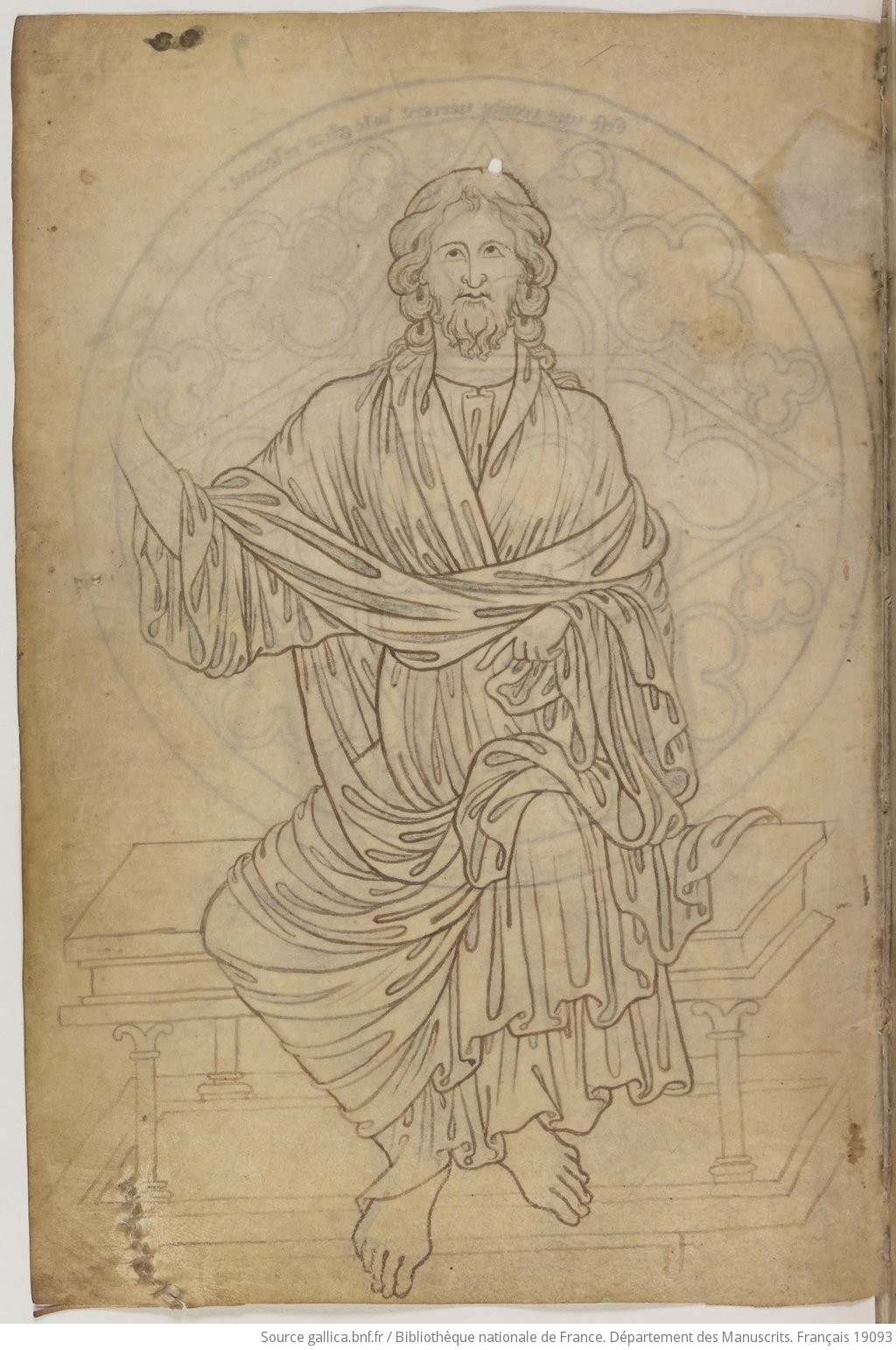
| If you think medieval artists lacked skill, check out Villard Honnecourt’s sketchbook, especially the insects on folio 7 and Christ in Majesty on 16: https://www.medievalists.net/2024/12/sketchbook-villard-honn... Medieval art is very stylised, but the quality of the lines, the details in the clothes, the crispness of the composition, all that requires a lot of skill. Check out Jean Bondol’s work for instance https://artsandculture.google.com/asset/tapisserie-de-l-apoc... You may not like the style, but being able to produce works like that requires you to be good at art on some level. |
| |
| ▲ | nyeah 4 days ago | parent | next [-] | | Ok, but the Honnecourt sketches are kind of strong. Not professional by today's standards, but decent. I'd be happy to have done them--but I'm not an artist. The tapestry can be appreciated, like Klimt's 2-D-ish stuff can be appreciated. The style is fine. It's not fantastic work, I wouldn't hang it up, but it's reasonably accomplished. In general, though, yes, I think medieval European artists were short on skill compared to artists from Europe in pre-medieval and post-medieval times, and art from other places between ~500 and ~1300. They had some skill, but not as much. Artists with limited technique are a real thing. Not everything is taste or style. | |
| ▲ | thaumasiotes 4 days ago | parent | prev [-] | | You convinced me that they lack skill. The clothing does often look good. In folio 16v ( https://www.medievalists.net/wp-content/uploads/2024/12/Vill... ), it's been overdone and appears to be far wrinklier than fabric could support, suggesting that Jesus is embedded in some kind of strange plant. The faces are terrible in all cases. In general, perspective is off, anatomy is off, and you get shown things that aren't physically possible. | | |
| ▲ | regentbowerbird 3 days ago | parent [-] | | Are you aware there are artistic styles beyond photorealism? | | |
| ▲ | thaumasiotes 3 days ago | parent [-] | | Yes, but in that case, as this article argues, you'd expect something that looked good. https://static.wikia.nocookie.net/teentitans/images/e/e3/TTO... The Honnecourt illustrations strongly suggest that (a) photorealism is the goal, but (b) Honnecourt doesn't know how to draw it. He does things like place a person's right eye at a different angle to the rest of the face than the left eye has. But hey, how likely is it that viewers will notice a malformed human face? | | |
|
|
|
|
| ▲ | Der_Einzige 4 days ago | parent | prev | next [-] |
| So were the Japanese better at painting circa the 1700s and 1800s? Because you got a whole lot of paints of, uhhh, octopi… |
| |
| ▲ | nyeah 4 days ago | parent | next [-] | | That's hard to call. Both Europe and Japan seemed fine in that time period. Octopi or no octopi. | |
| ▲ | MyOutfitIsVague 4 days ago | parent | prev [-] | | Octopuses or octopodes. Octopi is incorrect. | | |
|
|
| ▲ | watwut 3 days ago | parent | prev | next [-] |
| The medieval art was better then those cave paintings. Like, common. > Europeans between about 500 and 1300 mostly couldn't paint. They could. And they had wide variety of what they painted and how. |
| |
| ▲ | nyeah 3 days ago | parent [-] | | I've given up asking for an example to support that. |
|
|
| ▲ | archagon 4 days ago | parent | prev | next [-] |
| Utterly bizarre to claim that a diverse group of people within an 800-year period were simply “bad at art.” |
| |
| ▲ | nyeah 4 days ago | parent [-] | | No need to generalize. Post some clear exceptions. Or if the statement turns out to be "utterly bizarre but correct" I'm fine with that. | | |
| ▲ | archagon 4 days ago | parent [-] | | What do you mean by “exceptions”? Who are we, in our own infinitesimal slice of human history, to judge historic taste in art? And is naturalism the be-all, end-all of good taste? If so, we need to throw out the majority of art in the 20th century. This is a question for an art historian, not some anon on a tech forum. (For what it’s worth, I find Medieval and Renaissance art to be about equally tepid despite the difference in execution. And plenty of people non-ironically enjoy Medieval art despite its supposed deficiencies.) | | |
| ▲ | nyeah 4 days ago | parent [-] | | "some anon on a tech forum" Don't sell yourself short. Post some art from those 800 years that doesn't suck, and I'll change my views. Sure, there's plenty of crap in 20th century art. I've seen examples of that. But that's a different subject. | | |
| ▲ | archagon 4 days ago | parent [-] | | Like I said, I find the majority of European art before 1800 or so to be fairly dull, so I can't really answer this question. The prevailing technique improved remarkably post-Renaissance, and that's enjoyable to an extent, but the same themes get repeated over and over and over again. If you're looking for art with an impact, the iconography of Andrei Rublev (and other icon painters during this period) is still massively influential in the Russian Orthodox Church today. 600+ years of direct use and inspiration! The lack of naturalism is not a deficiency. | | |
| ▲ | simiones 3 days ago | parent | next [-] | | The problem is not a lack of naturalism, it's obvious mistakes in the way the naturalistic poses are attempted. Many of Rublev's icons have obvious mistakes in the way joints are painted, for example - but not all of them or the exact same thing; it's not a style, it's simply a limitation of his skills. Many later painters who were inspired by him have corrected this mistake, not sought to reproduce it. Not to mention, Rublev lived at the end of the Medieval period, and well into the Renaissance - the period where painterly skill in Europe was revitalized. | | |
| ▲ | archagon 3 days ago | parent [-] | | Again, I’m not sure why it matters. Henri Rousseau couldn’t draw for shit and yet people adore his art. The represented idea and its aesthetic execution are what people mostly respond to, not how realistic a figure’s joints happen to be. (And FWIW, a large number of Renaissance painters clearly have no idea what a female body looks like.) |
| |
| ▲ | nyeah 3 days ago | parent | prev [-] | | Oh. My. God. Andrei Rublev, 1360-1430? This dude?
https://en.wikipedia.org/wiki/Andrei_Rublev#/media/File:Rubl... Yeah he's good, that's obvious. Klimt cribbed from Rublev I bet. Naturalism was never the topic. But note that Rublev didn't do much work between AD500 and AD1300. Because not born yet. This is precisely why I wrote down dates, and why I am insisting on counterexamples instead of vague generalities. |
|
|
|
|
|
|
| ▲ | lo_zamoyski 4 days ago | parent | prev [-] |
| Your exposure to medieval art must be very limited. I have seen some very magnificent pieces of medieval art personally. And paintings are a small part of what falls under "medieval art". Include those in the category, please. And there is another element to consider, which is the purpose of the art. Medieval art was not concerned so much with realism, but with the symbolic. I wonder: do you think Byzantine icons "suck"? I suspect you do. |
| |
| ▲ | nyeah 4 days ago | parent [-] | | Do you just want to generalize, or do you want to provide a counterexample? Fine either way. | | |
| ▲ | lo_zamoyski 3 days ago | parent [-] | | Stop being an obnoxious pest. What would be the point? Any example given will be met with some snarky and ignorant remark. Veit Stoss's Krakow triptych? Gentile da Fabriano's "Adoration of the Magi"? Byzantine art, like Monreale Cathedral? The Christ Pantocrator icon from St. Catherine's Monastery? Romanesque and gothic cathedrals? Ornate illuminated manuscripts? Shall I continue? You don't have to like medieval art, but claiming it "sucks" is not only generalizing (your very accusation in this thread), but it is boorish and ignorant. You've already gotten more "discussion" out of this topic than you deserve. So, go troll somewhere else. | | |
|
|