| ▲ | isoprophlex 5 hours ago |
| > I’ve seen generations grow up. Some grandparents come in with their grandkids and say, “Anna, remember the jukebox?”
> Today, however, young people no longer come to the bar. They came when we had the dance floor and the music. Today, they like to spend time with the smartphone; they even take it to bed when they go to sleep.
What are we losing, what are we taking away from life, now that we ourselves have become a resource to extract. Probably, a lot. |
|
| ▲ | lqet 4 hours ago | parent | next [-] |
| > Today, [young people] like to spend time with the smartphone; they even take it to bed when they go to sleep. Recently my parents (in their mid-60ies) were visiting us. At some point I realized that both of them had been quietly sitting at our dinner table for over on hour, eyes glued on their smartphones. They are massively addicted. I have noticed that they get nervous as soon as the smartphone is out of reach, or even in silent mode. They mostly talk to friends via Whatsapp and are in constant fear that they miss out on something or that these friends (which also seem to spend most of their days on Whatsapp) will be offended if they don't reply within 5 minutes to the latest Whatsapp trivia. It is quite a struggle to even get them to turn off their phones when we are having dinner. The Whatsapp messages just keep coming in. My wife recently learned that her mother mostly spends her evenings with posting photos of her life on social media, and broke off contact with her brothers for a few days because they failed to quickly and enthusiastically react to some photos she posted on a family Whatsapp group. But I guess for Anna Possi, our parents are "young people" and could be her grandchildren... |
| |
| ▲ | inglor_cz 3 hours ago | parent [-] | | I agree with you, the infection hit quite a lot of older people very hard as well. I have problem getting some 40somethings to meet in person, even in professional contexts, they are just so soaked in a WhatsApp maelström of utterly irrelevant messages that they are conditioned to answer NOW! That said, the core of the message should not be judgments between the young and the old, but the problem that we have introduced digital fentanyl into our pockets. | | |
| ▲ | isoprophlex 3 hours ago | parent | next [-] | | You're right, as is your parent comment, in saying that this isn't something only the young suffer from. In fact it's everywhere; the people with the worst smartphone addictions near me personally are an 11 year old and a 70 year old... That said the message, when taken as a general progression between how life was then and how it is now, stands. | | |
| ▲ | darkwater 2 hours ago | parent | next [-] | | The same thing happened with TV in the 80s/90s. It will eventually fix itself, Gen Alfa will grow tired of smartphones when they will be in their thirties, I'm pretty sure.
(that doesn't mean that there should not be active campaigning to point out the risks of smartphone addiction) | | |
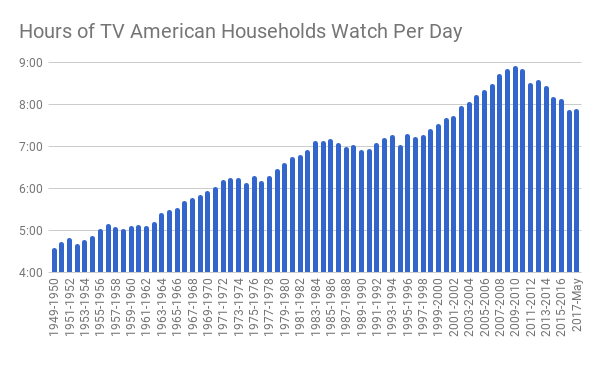
| ▲ | bigmealbigmeal 14 minutes ago | parent | next [-] | | I'm not so confident. TV use was higher in the 2000s than it was in the 1980s/1990s. TV viewing hours steadily rose from 1949 until finally peaking in 2010.[1] But when TV finally peaked in 2010, did overall screen time go down? No. It kept going up.[2] Obviously, this is when the masses went all-in on smartphones, social media, and the internet. Screen usage basically never went down. It has only gone up. So I only see anyone getting tired of smartphones and actually using them less if they've found something more addictive to replace them. [1] https://cdn.theatlantic.com/thumbor/3FzEghXwS-KkIYu1KwG-YyHh... (from https://www.theatlantic.com/technology/archive/2018/05/when-...)
[2] https://www.brookings.edu/articles/how-free-time-became-scre... | |
| ▲ | AdamN an hour ago | parent | prev [-] | | A friend of mine's kid (maybe 10 years ago) started crying when he watched regular TV for the first time. He literally thought the TV was broken when the commercials came on with the volume cranked up. It's the same now with fb and these other old format social media sites. People just stop doing it. With that said I literally think fb will be with us for another 50 years as the people who are still on there are great marks and they won't be leaving until they 'age out'. |
| |
| ▲ | hopelite 2 hours ago | parent | prev [-] | | It seems we (America) are in some kind of “middle”, or at least a phase change in a larger wave of the addiction cycle, with different stages affecting different generations and countries based on arrival of what can be described as the addiction dealers, “Big American social media”. It reminds me of the effects of the crack epidemic rippling through different generations differently from the late 70s to this very day still. I don’t have hard data to substantiate it and my theory is based on anecdotal conversations but it seems, e.g., where there is some recovery going on amidst something like American millennials, who have both dealt with their own addiction and were the first generation that is also dealing with the neglect of addicted parents, they are also to some degree recovering (“reparenting” themselves), to some degree probably also spurred on by realizations shot the deleterious effects of phones and SM that come from exhaustion and different life stages. On the other hand, other generations of Americans, like those now elderly parents of millennials, not only are still, but increasing number of them are entering the earlier stages of “phone addiction” (which encompasses many different things), with the most tragic part being that they are in the latter quarter of their life and are unlikely to even realize, let alone recover from the addiction. I also see this cycle and these stages emerging in other western societies in particular. My theory is that it is a particular effect or amplifier of the underlying culture to some degree, i.e., adoption, degree, impacts. It seems particularly pernicious in America because the underlying culture (if you can call it that, after decades of it being poisoned and corrupted by corporations and the government) was and is fertile ground for the societal rot caused by social media and its amplifier, smart phones, to have taken hold and spread like the virus it is. It was even all described as “viral”, and yet we still engaged in it as if unfamiliar and investigated viruses spreading in an uncontrolled manner are a perfectly acceptable thing that should not even give anyone pause, especially if money can be made, regardless of whether it is something like HIV, with a very long lead-time, a delayed ETA for the reaper. What happens now that we are in some kind of middle stage of the “smartphone“/Social Media civilization wildfire, with the first to have been affected looking over the devastation it has left in their wake, Shell shocked by the neglect and destruction, as the inferno is still raging on off in the distance as it consumes their parents and new generations, and even toppling whole countries through the “Color Revolution” playbook? |
| |
| ▲ | pastage 2 hours ago | parent | prev [-] | | > maelström Good use of that word. English has ae in Maelstrom but the contemporary word in Danish, Swedish and Norwegian is Malstrøm/Malström. I wonder when it lost it's ae, I see Mahlströmn from 1698, reading the etymology it says dutch but I wonder if they just wrote it down first. Everything about the sea is always filled with mythology. I think social media needs a less poetic word though. |
|
|
|
| ▲ | sph 3 hours ago | parent | prev | next [-] |
| I have recently moved into a new accomodation, and my neighbour is an elderly Italian lady in her mid 80s. Our first conversation was about how estranged she feels nowadays that everyone around her, young people but also middle-aged adults, are unable to connect not only with strangers but also among each other, filling every minute of their lives with a smartphone. Even the doctor's waiting room or Sunday mass doesn't feel the same, and she has to force people to snap out of it and just put the bloody phone down. She asked me how did I cope. I said I didn't, really. We had a beautiful conversation about that as it is a topic that I think about a lot, yet whenever I breach it with any "adult" (millennial or older) the response I get is either a shrug, or denial. Weirdly enough, it is an easier topic to discuss with the younger generations, those that have grown up in the YouTube era, yet deep inside feel there is something crucial that's gone lost in our society and we haven't even started trying to recapture it. I have always believed the millennial generation to be the only one to do something about it, as it sits right between the major societal upheaval the internet has brought. The older generations are lost to Facebook and inertia, the younger have never even seen the world of before. |
|
| ▲ | Cthulhu_ 38 minutes ago | parent | prev | next [-] |
| To expand, I wonder whether people will wistfully look back on their days browsing tiktok and shitposting on HN compared to whatever they and their kids / parents will be doing in 20 years. |
|
| ▲ | mytailorisrich 8 minutes ago | parent | prev | next [-] |
| > now that we ourselves have become a resource to extract. This has nothing to do with what you quoted. Smartphones and their effects are orthogonal to your point. Before smartphones if you were at home you were alone, isolated, and bored, so you went out and meet your friends. With smartphones you are always connected to your friends or others and it seems that it reduces the psychological need to meet in person (it's no longer the only option). |
|
| ▲ | 3 hours ago | parent | prev | next [-] |
| [deleted] |
|
| ▲ | simonebrunozzi 4 hours ago | parent | prev | next [-] |
| > What are we losing, what are we taking away from life, now that we ourselves have become a resource to extract. Probably, a lot. Beautifully said. And sad. |
|
| ▲ | trymas 4 hours ago | parent | prev | next [-] |
| Socrates would have drawn the line at writing and reading texts. |
| |
| ▲ | sph 3 hours ago | parent [-] | | And he would've been right. Any new advancement in technology brings societal change, and it is possible to reach a point of diminishing return, where the bad sides outweigh the positives. I wish we could, as a society, have a serious conversation about this effect without resorting to name calling ("Luddist nonsense") and straw men ("but what about penicillin?") | | |
| ▲ | phorkyas82 2 hours ago | parent [-] | | Second that. I see that as a failure of society or democracy as a whole - that we are no longer able to have that broad, public conversation and act accordingly. Why should every "innovation" be shoved down our throats, if we don't want to? |
|
|
|
| ▲ | vasco 4 hours ago | parent | prev | next [-] |
| When ever in the history of the world were humans not exploited by other humans, in much worse ways than now? I'd rather be google's data source for ads than be someones actual slave for example. Also I don't really like these luddite sentiments, usually shared between the two extremes, old ladies that never used the internet so they don't understand what they are missing, and IT guys that are too jaded to see the benefits and are at the stage of "wanna become goat farmer". Outside addiction the internet is great. |
| |
| ▲ | inglor_cz 3 hours ago | parent [-] | | "Outside addiction the internet is great." So are painkillers, or alcohol. Still we shouldn't simply shrug our shoulders over their abuse. We need to find a rational way to treat smartphones. As of now, we are fully in the Gin Craze [0] phase of their use and moderation is badly needed. [0] https://en.wikipedia.org/wiki/Gin_Craze |
|
|
| ▲ | carabiner 4 hours ago | parent | prev [-] |
| Are we the bad guys? |
| |