| ▲ | Tides are weirder than you think(signoregalilei.com) | |||||||||||||
| 55 points by surprisetalk 4 days ago | 11 comments | ||||||||||||||
| ▲ | antognini an hour ago | parent | next [-] | |||||||||||||
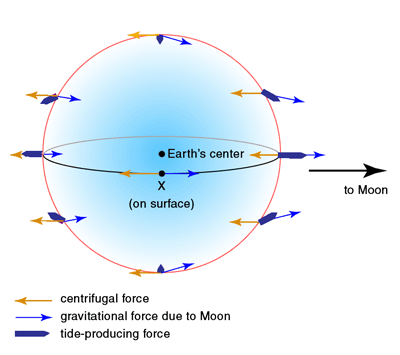
You may have seen diagrams of the tidal force of the Moon on the earth (like this one: https://www.oc.nps.edu/nom/day1/tide_force_diagram.gif). Intuitively you would think that the tide is being formed because the Moon is "lifting up" the water at the point closest to the Moon. But this contribution is actually very miniscule to the tidal effect. Instead the bulk of the tides are produced about 45 degrees away where the tidal force is parallel to the Earth's surface. This has the effect of dragging the water closer to the tidal bulge. | ||||||||||||||
| ▲ | cortesoft 23 minutes ago | parent | prev | next [-] | |||||||||||||
I know this is unrelated to the actual content, but I have such a visceral reaction to any headline in the "x is different than you think"... how do you know what I think? I am sure many people who read this will be experts on tides, and the title is completely wrong. For me, the worst are posts about scale and things I won't need, like "You don't need kafka" or "your data isn't actually big data" or "don't horizontally scale, just get a bigger server" I get that I am not the target audience and there are people for whom those statements are true, but I am running Kafka clusters with data from 10s of thousands of servers, I absolutely can't move that to a single machine. I wish they would phrase it as "Tides are weirder than most people think", although that probably doesn't drive as much engagement. | ||||||||||||||
| ||||||||||||||
| ▲ | xg15 2 hours ago | parent | prev | next [-] | |||||||||||||
> Kelvin’s machine automates the second half of that task. As the pulleys spin, they pull on a common chain by the correct amount for each of the calculated components. A year’s worth of tidal tables can be put together in half an hour, if you know the components. Even better, you can “guess and check” the components by comparing your machine’s output to past records, and adjusting the pulleys until you get something that works correctly. I didn't know they already had machine learning and model fitting algorithms in the 1800s, but here we are... | ||||||||||||||
| ||||||||||||||
| ▲ | esafak 25 minutes ago | parent | prev | next [-] | |||||||||||||
https://en.wikipedia.org/wiki/Tide-predicting_machine Basically, a summation of sinusoids. | ||||||||||||||
| ▲ | fhdkweig 2 hours ago | parent | prev | next [-] | |||||||||||||
https://www.youtube.com/watch?v=AxC770lpSLw shows one of the old tide prediction mechanical computers briefly mentioned in this article. It is effectively doing an inverse Fourier Transform, summing all the various 30+ sinusoids that affect the tides. | ||||||||||||||
| ▲ | wasting_time 2 hours ago | parent | prev | next [-] | |||||||||||||
Relevant xkcd: https://xkcd.com/3135 | ||||||||||||||
| ||||||||||||||
| ▲ | metalman 2 hours ago | parent | prev [-] | |||||||||||||
out the back door of my house, down through the field and woods to the water is a 12 min walk at high tide, and another 12 min + walk to the water at low tide, 53 vertical feet between the two. I know ,not the slightest thing about tides, other than what my senses tell me when walking the shore, and I suppose the practicalities of beach walking along cliffs are similar to planning and predicting arival times for ships loaded to the maximum draft, the money to be made there bieng the motivation behind the push to understand tides. | ||||||||||||||