| ▲ | oompydoompy74 3 hours ago |
| Speaking as an American, I don’t give a shit if it increases productivity or not. Productivity has gone up exponentially with technological advancement since the advent of the 5 day work week. We, as a species, should be minimizing work to 3 or 4 days a week with equal overall pay. Corporations should be fined heavily for contacting an employee after working hours. On call should require corporations to pay hefty overtime. This is a compromise because really and truly corporations should be illegal. Employee owned co-ops are more humane. |
|
| ▲ | schappim 41 minutes ago | parent | next [-] |
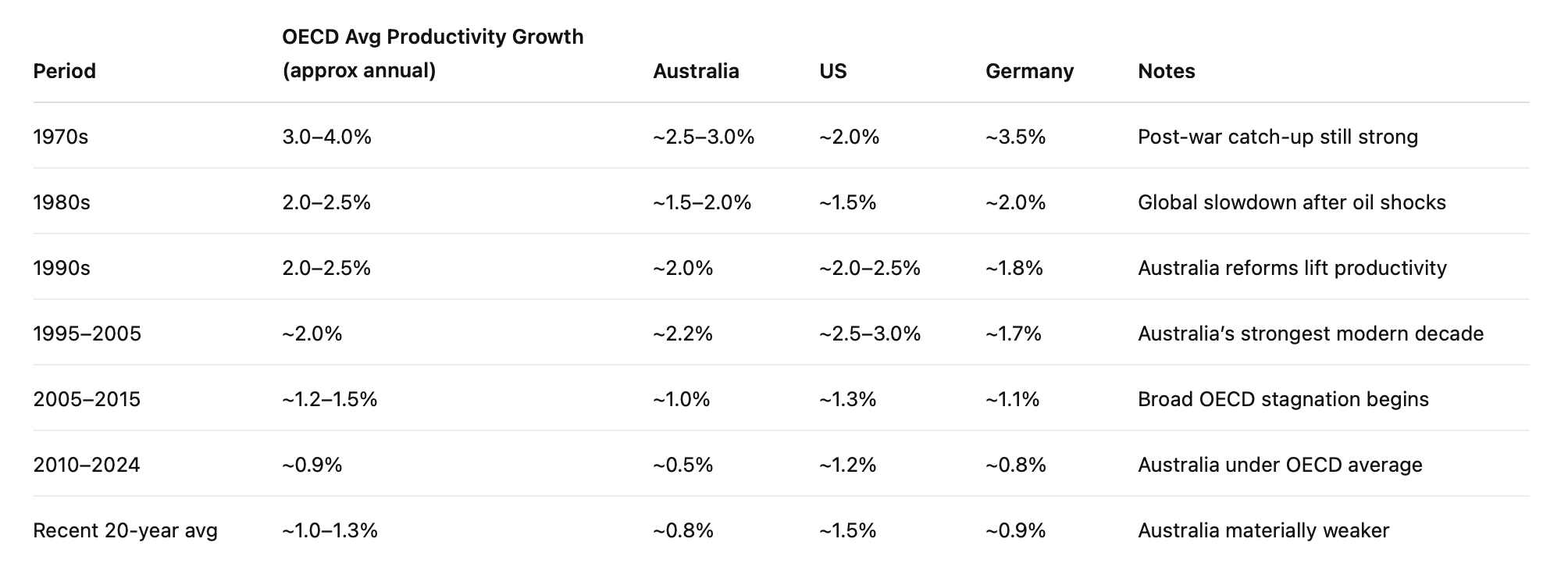
| Speaking as an Australian, our productivity has been lagging[1] compared to the US, largely due to the availability of cheap labour (attributed by economists to foreign students)[2]. I heard one economist on the ABC give the example of carwashes[2]. From the 1990s to the early 2000s, car washes in Australia were largely automated and hand-wash car washes were relatively uncommon. However, the abundance of cheap labour has since led to a proliferation of hand-wash car washes. 1. https://files.littlebird.com.au/SCR-20260525-ietj.png 2. https://www.abc.net.au/listen/programs/abc-news-daily/the-pr... |
| |
| ▲ | gsinclair 13 minutes ago | parent [-] | | The car wash example is interesting, as something I’ve seen and experienced but never thought about in that way. I wonder how it truly factors into productivity, though. How is productivity measured, and does that measurement capture what is true? You mention automated car washes as a baseline. I never used those in the past because I figured they’d be rubbish or would scratch the car or whatever. So I’d occasionally wash the car myself, and that’s it. Now that we have manual car washes available, I use them from time to time. They clearly (I assert) do a better job than anything automated. And they do it inside and out. So I find the comparison interesting, but in need of elaboration. | | |
| ▲ | card_zero 10 minutes ago | parent [-] | | It's a tautology, if productivity is measured as GDP per worker. Productivity, so defined, is down because each worker is moving money around less, although there may be more workers. Which is the same thing as them being paid less. Question is, if they accept that, and cars still get washed, does it matter? |
|
|
|
| ▲ | christophilus 3 hours ago | parent | prev | next [-] |
| That would be ok in a non-globalized world. In our world, any country that implements those laws will see a lot more offshoring. |
| |
| ▲ | xg15 40 minutes ago | parent | next [-] | | So then all the productivity improvements are nothing more than boosting the hashrate of your crypto miner? You have to do it to not fall behind, but once everyone has done it, we all end up back in the same spot where we started? | | |
| ▲ | amazingamazing 37 minutes ago | parent [-] | | Unironically, yes. One saving grace is in some ways, such as medicine and technology, more will be available to you, but not for less effort. | | |
| ▲ | xg15 34 minutes ago | parent [-] | | It's kind of understandable then that parts of the younger generations aren't motivated to continue that system? (Not just in the West, also in China, see "lying flat") |
|
| |
| ▲ | 2 hours ago | parent | prev | next [-] | | [deleted] | |
| ▲ | danaris 2 hours ago | parent | prev | next [-] | | Not if that country also legislates heavy penalties for companies that produce their goods in countries with worse labor laws. | | |
| ▲ | nickff 2 hours ago | parent | next [-] | | The economic motive for offshoring would remain (though slightly mitigated), unless that country’s demand (in each regulated sector) was much more than rest of the world’s. I personally doubt that most places are even willing to implement such legislation, given that they’re not even willing to protest PRoC’s use of slave labor and prison camps. | |
| ▲ | anomaly_ an hour ago | parent | prev | next [-] | | You're just going to Galapagos your economy. Consumers won't put up with high prices and inferior goods. Unless you want to restrict internet/information access so your consumers don't know what they are missing out on. | | |
| ▲ | amanaplanacanal an hour ago | parent | next [-] | | I dunno. Consumers put up with a lot. Why can't I buy a cheap Chinese EV again? | | |
| ▲ | Avicebron 36 minutes ago | parent [-] | | Well the short version is that Robert Rubin and company sold our industries for parts years and years ago. And now we have to rebuild the industrial base from scratch |
| |
| ▲ | youngNed an hour ago | parent | prev [-] | | Nah, I live in the UK, prices are higher than eu, public service is much worse, but public are voting for the party with members that brought this about. Humans are weird. |
| |
| ▲ | xg15 25 minutes ago | parent | prev [-] | | Almost like we needed some international worker's organization to put pressure on all relevant countries at the same time... | | |
| |
| ▲ | idle_zealot 2 hours ago | parent | prev | next [-] | | Hey, if fuel gets expensive enough this will be much less of a problem! Let's all thank Trump and Iran for their great work on bringing the four day work week closer to fruition. This isn't how I would've imagined bringing industry back to the States, but it's a promise made, promise kept. | |
| ▲ | jmyeet 38 minutes ago | parent | prev [-] | | This has the same energy as "if we tax the billionaires, they'll leave". That statement and yours are wrong. Why? Because if it was profitable, they would've done it already. Pretty much any employer would use you as fertilizer if there was an uptick in the stock price. But let's say it's true. Great. Punish them with tariffs. They also have diminished political power because they're no longer a local employer. We are colletively at a breaking point as a society where people legitimately can't afford to exist in a society that will soon mint its first trillionaire. This is beyond even French revolution levels of wealth inequality. | | |
| ▲ | FridgeSeal a few seconds ago | parent [-] | | Fully agreed. “Oh but businesses will leave” Yeah so what, if they do, we either didn’t want them, or they _actually won’t_ despite the squealing, or they will go, and if their segment of the market is useful, will get snapped up by new/local versions which do respect local constraints from the get-go. All of these are better outcomes than not doing anything because “what if”. |
|
|
|
| ▲ | stanac 2 hours ago | parent | prev | next [-] |
| > Employee owned co-ops are more humane Speaking as someone born in Yugoslavia. That's almost how it was in Yugoslavia. Companies where "owned by society", but workers had voting rights. Whenever there was a vote to decide whether extra profit should be used for capital investments and/or operational improvements or assigned to salaries budget, everyone voted to increase their salaries. Not every employ should be a co-owner, or at least not everyone should have voting rights. |
| |
| ▲ | mohamedkoubaa an hour ago | parent | next [-] | | Did you know that public market shareholders almost always vote for stock buybacks | |
| ▲ | teaearlgraycold 28 minutes ago | parent | prev [-] | | You still need free market economics. If consumers have enough choices then the company with comfortable employees that refuse to invest profits into their operation will lose to the better organized competitor prioritizing a balance between the two. |
|
|
| ▲ | amazingamazing 2 hours ago | parent | prev | next [-] |
| This will never happen for the simple reason that there are some countries whose members are poor and so they are rightfully ready to work harder and longer for opportunities. A more important point is why is it that Americans objectively are richer yet feel poorer? |
| |
| ▲ | HDBaseT an hour ago | parent | next [-] | | Trillions of dollars spend on wars which don't need to exist doesn't help. | |
| ▲ | pixelatedindex 2 hours ago | parent | prev | next [-] | | > A more important point is why is it that Americans objectively are richer yet feel poorer? I thought about this a lot. Some of it is expectation wrapped up in the American Dream. You work hard, and get those rewards. But that isn’t true because life isn’t fair and capitalism isn’t particularly humane or ethical. Some of it is perceived. The people who strike gold without hard work expect to keep striking more gold, and when the yield shrinks you’re appalled because that’s not how things should be. US is a deeply individualistic society, now more so than ever. We don’t always sacrifice for the common good, because they’re supposed to work hard just like me. Anyway if you read all that, thank you. | | |
| ▲ | FpUser 23 minutes ago | parent [-] | | >"You work hard, and get those rewards." For a relatively short period it was true. Now majority works hard, lives from paycheck to paycheck and can not even own a house. Most results of what they produce goes to feed ever growing appetites of Musks |
| |
| ▲ | xg15 36 minutes ago | parent | prev | next [-] | | Depends what your comparison is. Are you comparing with the EU, China or Ethiopia? Seems to me, the question is more why all that supposed prosperity doesn't translate to the living quality improvements one would expect. | |
| ▲ | an hour ago | parent | prev | next [-] | | [deleted] | |
| ▲ | micromacrofoot 2 hours ago | parent | prev | next [-] | | on the whole, most americans are not being compensated for the amount of value their work produces | |
| ▲ | stavros an hour ago | parent | prev [-] | | But, if there exist poorer countries, why is there a five-day work week instead of a seven-day one? Why aren't we all just working 24/7? | | |
| ▲ | phyzix5761 an hour ago | parent | next [-] | | In most poor countries workers are doing 10 hours per day 6 days a week. With a significant number of them doing 7 days a week. | | |
| ▲ | stavros 42 minutes ago | parent [-] | | The argument (maybe in a sibling comment) was that, if the US switched to a 4-day workweek, companies would simply offshore their work to poorer countries who work 5 days, so my question is, then why isn't the current workweek 7 days? |
| |
| ▲ | amazingamazing an hour ago | parent | prev [-] | | There are Americans working 24/7, though. Surely you have heard of people working multiple menial full time jobs? Jobs are being offshored and cheaper immigrants are being imported who can be paid less. What more evidence do you need? |
|
|
|
| ▲ | azan_ 2 hours ago | parent | prev | next [-] |
| People should realise that they will be the ones paying for it. Prices will increase a lot. People need to be aware of that. Personally I'm okay with that trade-off. Also corporations - when checks and balances work properly, which is frequently not the case unfortunately - are great and net benefit for humanity. |
| |
| ▲ | runtime_terror an hour ago | parent | next [-] | | I wonder what would happen to costs if we had a 90%+ tax rate on the ultra wealthy... maybe if all these record profits were instead funneled back into society everyone would be better off AND prices would drop... a system like this would be good for society it seems... we should come up with a good name for that system, tho... | | |
| ▲ | azan_ 28 minutes ago | parent [-] | | I think its pretty naive to thing that it'd work this way. It's really bad idea. If someone has company that debuts on stock market, and stock price increases let's say 100x times, who is he funneling the funds from? I'd say it's not funneling but creation of wealth, economy is not zero-sum game. | | |
| ▲ | thfuran 11 minutes ago | parent [-] | | If someone has a company doing an IPO, it’s extremely unlikely that the company was so small that one person did all the work. Why is it a given that one person should retain nearly all of the proceeds of the sale? To answer your question, that person is funneling funds from investors who are expecting returns derived from the labor provided by the undercompensated employees. |
|
| |
| ▲ | nonfamous an hour ago | parent | prev [-] | | >> Prices will increase a lot. Citation needed. Very little of what we buy today as a consumer are commodities whose price is determined primarily by the cost of production — and even then labor costs are rarely the most significant cost. Most things we buy are priced according to what the consumer is willing to pay for it, and the balance sheet of the companies that sell most of the things we buy show there’s a lot of wiggle room there. | | |
| ▲ | azan_ 30 minutes ago | parent [-] | | > Citation needed. Very little of what we buy today as a consumer are commodities whose price is determined primarily by the cost of production — and even then labor costs are rarely the most significant cost. Services and goods where lots of human labor is required get much more expensive with larger cost of labor. E.g. fast-food, food delivery. And there's nothing wrong with that of course - I'd rather pay 2x more for delivery than have people working on wages that are not enough to even feed them. |
|
|
|
| ▲ | losvedir an hour ago | parent | prev | next [-] |
| Lot of shoulds, oughts, etc. How about this: do whatever you want. Nothing is stopping you from setting up a 3 day workweek co-op. More power to any group that wants to. There are a number out there already. But it's worth considering why it hasn't totally taken over "naturally". |
| |
| ▲ | tsimionescu an hour ago | parent | next [-] | | This is absurdly ahistorical. Corporations take as much as they can. If there were no law limiting work to 40 hours / week, they would demand far more - as they had before massive workers' protests forced the current limits. | | |
| ▲ | losvedir 26 minutes ago | parent [-] | | All the more reason people would prefer to work for a co-op, no? I really don't know why there aren't more co-ops, and am inferring they just don't work all that well. But if there are any regulations or something preventing them from succeeding, I'd love to know about it. Also, I guess it's worth noting I've been "exempt" all my life (not subject to 40 hours a week), so that particular labor win I guess didn't really cross my mind. | | |
| ▲ | squibonpig 13 minutes ago | parent [-] | | If everyone has 40 hours a week + overtime and you have a coop that pays competitively for 24 hours a week and no overtime you won't get as much market share, can be outcompeted. It has to be done on a large scale, historically as a matter of policy. This was true for tons of different reductions in the workday and other labor rights improvements in the past. |
|
| |
| ▲ | anonymars an hour ago | parent | prev | next [-] | | How did the 40-hour workweek come about? (Certainly not "naturally") | | |
| ▲ | farnell an hour ago | parent | next [-] | | Labor unions and henry ford | |
| ▲ | bigiain an hour ago | parent | prev [-] | | Unions. | | |
| ▲ | baylisscg an hour ago | parent [-] | | More completely the 8 hour work day movement. Loosely, 8hrs each for work, sleep, and everything else with everything else often being called recreation. Add in a 5 day work week and 40hrs. There's monument in Melbourne commemorating stonemasons winning an 8 hour work day in 1856 but they were working 6 days a week. |
|
| |
| ▲ | xg15 15 minutes ago | parent | prev | next [-] | | You can ask that question in the opposite way too: Why does the weekend still exist? Why aren't people working 24/7? | |
| ▲ | throwaway-11-1 an hour ago | parent | prev [-] | | Labor has been completely defeated in the US. Capital sets the terms and has captured the political class. You know this but are using deflection to put blame on individuals who don’t actually hold power. Management can offshore anytime workers present a challenge. |
|
|
| ▲ | han1 2 hours ago | parent | prev | next [-] |
| Do workers really care about productivity? As long as I get paid that's what matters. |
| |
| ▲ | idle_zealot 2 hours ago | parent | next [-] | | I like to feel that I'm spending my time productively, yeah. Not all of my time, mind you. People generally like to feel their work impacting their environment. Many consider it the most fulfilling part of their lives. Working purely for compensation is a great way to kill most positive energy for a solid half of your waking hours most days. People react differently, of course. For some the knowledge that they're making money alone provides the psychological reward, others find enjoyment in the moment-to-moment of things, even if they're not part of a meaningful goal, and yet others offset the meaninglessness of their work with a fulfilling home life or hobbies. On the whole though, I'd say yes, people do care about productivity so long as they feel it's connected to their world and oriented in the right-ish direction. | | |
| ▲ | han1 2 hours ago | parent [-] | | I work remotely at companies until they fire me for doing the minimum. I still get paid for the two to three weeks, so I couldn't care less because the money goes towards my hobbies. | | |
| ▲ | idle_zealot an hour ago | parent | next [-] | | Do you feel like maybe we could do a better job of constructing a world where people don't feel they need to do this objectively worthless activity? | |
| ▲ | losvedir an hour ago | parent | prev [-] | | This is why we can't have nice things. |
|
| |
| ▲ | FpUser 18 minutes ago | parent | prev | next [-] | | As long as they feel growth of productivity results to increase in their standard of living then why not? | |
| ▲ | micromacrofoot an hour ago | parent | prev [-] | | a good number do, I've been surprised by how many low level fast food managers actually care about how well the store's performing due to owner pressure despite seeing little to no wage improvement regardless |
|
|
| ▲ | MattDamonSpace 23 minutes ago | parent | prev | next [-] |
| Someone doesn’t understand why we have nice things. “Increased productivity”, the thing you don’t give a shit about, is the only reason you’re not living in the dirt and dying of a tooth infection before 35. If you wanted to live with a QoL of the 1940s you could do so today working 2 days a week. Of course you’d have no air conditioning, shitty food, no running water, etc etc. You don’t have to LIKE corps but you should at least understand your world before calling for the guys with guns to get involved. |
|
| ▲ | abcde666777 2 hours ago | parent | prev | next [-] |
| This all sounds great until you've actually had your own small business and experienced things from the other side. Employees are expensive, good employees are hard to find, and sometimes things need to be fixed outside 9-5 to avoid having an angry client on your hands. |
| |
| ▲ | sensanaty an hour ago | parent [-] | | You should hire people to cover those hours outside of the 9-5 then. Or do you expect your employees to slave away for your benefit without getting anything but the bare minimum from you? |
|
|
| ▲ | dabluecaboose 2 hours ago | parent | prev [-] |
| [flagged] |